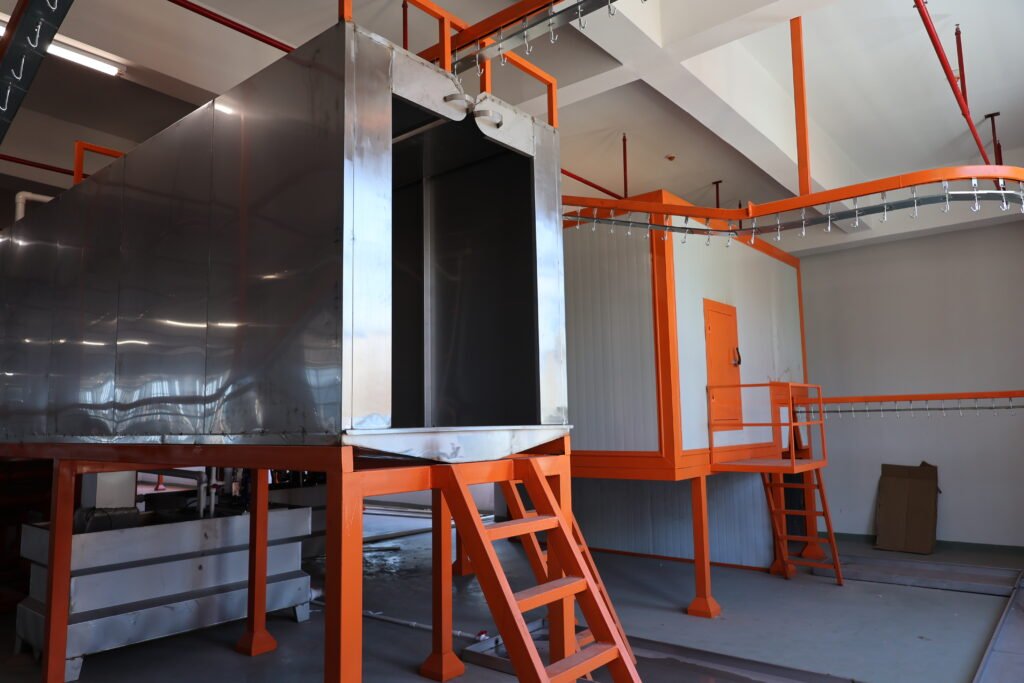
I often see small shops copy a “big factory layout” and then struggle with dust, traffic jams, and long changeovers. I also see teams buy decent equipment but lose money because the layout forces extra handling and extra waiting.
A small powder coating line layout should be designed around your order reality: part size range, color-change frequency, pretreatment requirement, and how you move parts. If the layout reduces rework, powder loss, energy waste, and handling time, a small shop can run like a much bigger one.
Below are 10 proven small-layout patterns from a factory implementation view. I use the same logic when we help customers plan space: define dirty vs clean zones, lock the flow, and avoid layout decisions that make the booth dusty or the oven idle.
How Much Can a Small Powder Coating Business Make?
Many new owners ask this first, but they often look at revenue and ignore rework and downtime. In powder coating, profit is made in stability. If your layout makes changeovers slow and defects frequent, your profit disappears even if your quotes look good.
A small powder coating business can make good money when it keeps utilization high and rework low, because most profit comes from controlling four leaks: rework, powder waste, energy waste, and labor/changeover time.
The profit drivers I watch in small shops
I look at the same five numbers every week:
- rework hours
- powder usage per m²
- oven energy per shift
- changeover minutes per color
- true coated area per day (not “parts touched”)
If a shop improves these numbers, profit grows even without raising price.
A simple profitability model (for real decision making)
| Variable | What “good” looks like | What kills profit |
|---|---|---|
| Utilization | booth and oven are fed most of the day | long waiting between batches |
| Rework | defects are rare and traced | “we fix it later” culture |
| Changeover | predictable and timed | changeover longer than production |
| Energy | oven not heating empty air | empty-oven time every day |
| Handling | smooth traffic and no damage | scratches during unloading/packing |
This is why layout matters. Layout is not decoration. Layout is a profit system.
What Is the 9 Tank Process for Powder Coating?
Small lines do not always need a full 9-tank system. But some small shops still need strong pretreatment because they do outdoor work, or they coat oily welded steel, or they serve customers with strict corrosion targets.
A 9-tank pretreatment process is an extended surface-prep route that adds more staged cleaning, rinsing, conditioning, conversion coating, and sealing steps to improve consistency and corrosion resistance before powder coating.
A common 9-tank flow example
| Tank # | Stage | Purpose |
|---|---|---|
| 1 | Pre-degrease | remove heavy oil/soil |
| 2 | Main degrease | remove film oils |
| 3 | Rinse 1 | reduce carryover |
| 4 | Rinse 2 / DI rinse | stabilize water quality |
| 5 | Etch / desmut (as needed) | stabilize metal surface |
| 6 | Condition | improve conversion uniformity |
| 7 | Conversion coat | build adhesion/corrosion layer |
| 8 | Rinse / DI rinse | remove residue |
| 9 | Seal / passivation | improve corrosion performance |
Then dry-off, then spray, then cure.
How it affects small-layout planning
If you run multi-tank pretreatment, your layout must handle:
- drainage and floor slope
- mist exhaust and ventilation
- chemical storage and safety zone
- maintenance access
These utilities often decide where the “dirty zone” must be placed.
What Is the ISO Standard for Powder Coating?
People often say “ISO standard for powder coating” when they mean different things: quality management systems, coating test methods, surface prep grades, or product performance standards. In projects, I treat “ISO” as a compliance conversation, not as one single number.
There is no single ISO standard that defines “powder coating” as a whole; instead, ISO standards often cover quality management systems and test methods for coating performance, while many coating requirements are defined by customer specs and recognized test procedures.
The practical way I handle “ISO” in a small shop
When a customer asks for “ISO,” I ask:
- Do you mean a quality system (how you manage processes)?
- Do you mean test methods (how you measure adhesion, thickness, corrosion)?
- Do you mean product performance targets (what pass/fail values you need)?
Then I build a simple quality plan:
- incoming surface condition rules
- pretreatment control routine
- thickness check routine
- cure verification habit
- defect photo log and cause-action table
This is how a small shop looks professional without drowning in paperwork.
What Is the Most Common Problem With Powder Coating?
Small shops usually struggle with the same problem: inconsistency. One batch looks good, the next batch has fisheyes or thin edges. Most of the time, the root cause is not the gun. It is prep, grounding, airflow, or cure verification.
The most common problem with powder coating is inconsistent results, usually caused by unstable surface preparation, weak grounding and racking, unstable booth airflow/recovery, or curing based on oven setpoint instead of part temperature.
Why layout influences this problem
Bad layout creates:
- dust contamination (dirty air moving into clean areas)
- longer handling time (more touch points and more damage)
- longer changeovers (no cleaning space and poor flow)
- poor discipline (tools and powder management spread everywhere)
A good layout makes stability easier.
10 Small Powder Coating Line Layout Patterns (With Use Case + Benefits + Sketch)
1) Straight Line Layout (Most common, easiest to install)
I use this when the building is long and flow is one-direction. It is simple to manage.
Best for: long narrow workshop, stable flow, simple logistics
Core benefits: clean movement, easy supervision, fewer crossings
Sketch:
Load → Prep/Clean → Dry-off → Booth → Oven → Cool → Unload/Pack
2) L-Shape Layout (Use the corner to separate zones)
I use this when I want to push the booth and oven into a corner to reduce dust travel into packing.
Best for: corner-shaped buildings, zoning dust area vs clean area
Core benefits: easier dirty/clean separation, flexible placement
Sketch:
Load → Prep → Dry-off ↘
Booth → Oven → Cool → Unload
3) U-Shape Return Layout (Save steps, same-side load/unload)
I use this when the team is small and I want loading and unloading close.
Best for: compact space, small team, limited forklifts
Core benefits: one-side operations, shorter walking, shared staff
Sketch:
Load → Prep → Dry-off → Booth → Oven
↑ ↓
Unload ← Cool ←──────────────────
4) Parallel Two-Row Layout (Heat zone on one side)
I use this when the building is wide and utilities can be grouped.
Best for: wide buildings, easier ducting and energy routing
Core benefits: simpler piping/ducting, heat maintenance in one zone
Sketch:
Row A: Load → Prep → Dry-off
Row B: Booth → Oven → Cool → Unload
5) Compact Core Cell (Booth + Oven core for a quick start)
I use this when a shop wants to start fast with low capex. It is common for manual spraying and batch curing.
Best for: very small startup, manual coating, tight budget
Core benefits: fewer modules, fast setup, short travel distance
Sketch:
Load → Simple clean → Manual booth → Batch/small oven → Cool/Unload
6) Pass-Through Oven Layout (Let the oven create the return)
I use this when the shop wants a U-flow without complex conveyor turning.
Best for: U-flow plan, simple return path
Core benefits: natural loop, less traffic conflict
Sketch:
Load → Prep → Dry-off → Booth → Oven (pass-through) → Cool → Unload (near load area)
7) Batch Rack / Cart Layout (Maximum flexibility for high-mix)
I use this for fabricators with many SKUs and frequent inserts. The “cycle time” becomes rack turnover.
Best for: high-mix, small batches, big size variation
Core benefits: easiest scheduling, simplest inserts, low fixed flow risk
Sketch:
Clean zone → Cart/Rack → Manual booth → Cart/Rack → Batch oven → Cool/Unload
8) Overhead Monorail Small Loop (Small but stable)
I use this when the shop wants cleaner floors and more stable takt without a full automatic line.
Best for: frames and long parts, cleaner floor, more stable rhythm
Core benefits: stable flow, less floor clutter, better part handling
Sketch:
Load → Prep/Dry-off → Booth → Oven → Cool → Unload
(overhead monorail loop)
9) Quick Color Change Layout (Built for frequent color changes)
I use this when changeover time is a top cost driver. The key is space planning next to the booth.
Best for: many colors, daily changeovers, contamination risk
Core benefits: shorter changeover, lower scrap, cleaner workflow
Sketch:
Load → Prep → Dry-off → Booth (easy clean) → Oven → Cool → Unload
↘ Changeover/Cleaning/Powder staging area
10) Dirty/Clean Zoning Layout (Best for quality image and packing)
I use this when customers visit, or when appearance quality is critical. It protects finished parts from dust.
Best for: high appearance demand, customer audits, stable packaging quality
Core benefits: fewer dust defects, lower final-step damage, clearer management
Sketch:
Dirty zone: Prep/Dry-off/Booth/Recovery
Heat zone: Oven/Cool buffer
Clean zone: Unload/Inspect/Pack/Finished goods
Conclusion
A small powder coating line becomes profitable when the layout reduces rework, powder loss, energy waste, and handling time, and when dirty and clean zones stay separated to protect finished parts.
 English
  German
  Vietnamese
  French