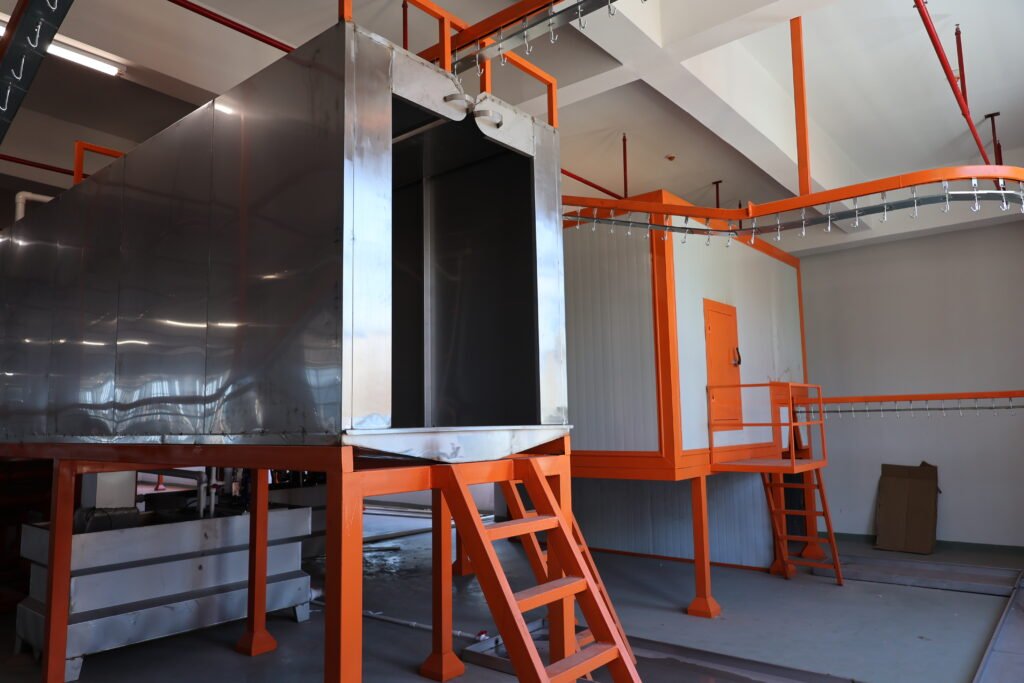
5 Advantages of Electrophoretic Coating Lines VS. Powder Coating Lines
Electrophoretic coating and powder coating are the two most widely adopted surface finishing technologies in metal manufacturing today. After years of working with hundreds of factories across cabinet manufacturing, outdoor furniture, and aluminum processing industries, I've seen countless production teams wrestle with this exact choice. The decision isn't about which technology is "more advanced"—it's about which one truly fits your product, volume, and long-term cost structure.
Based on our extensive experience deploying electrophoretic and powder coating systems across different manufacturing scenarios, I want to share five concrete advantages that electrophoretic coating lines consistently deliver over powder coating—and more importantly, why these advantages matter to your bottom line.
Why Compare Electrophoretic Coating and Powder Coating?
Core Differences in Application Scenarios
Both technologies deposit a protective coating onto metal surfaces, but they operate on fundamentally different principles. Electrophoretic coating (e-coat) is a liquid-based process where charged particles migrate through an electric field and deposit uniformly on a grounded workpiece. Powder coating uses dry particles that adhere via electrostatic attraction, then fuse under heat.
The key distinction: electrophoretic coating excels at reaching deep recesses, internal cavities, and complex geometries. Powder coating dominates in high-speed batch production with simpler part geometries and when rapid color changeover is critical.
Why This Decision Matters for Your Production Line
Choosing the wrong coating method can cascade into quality inconsistencies, higher rework rates, increased downtime, and hidden cost overruns that compound over years. A coating system that struggles with your specific part geometry or fails to meet adhesion standards can sabotage your product reputation in the field.
From our factory floor experience, the decision should rest on three pillars: coating uniformity on your specific parts, total cost of ownership (equipment + operations + maintenance), and alignment with your environmental compliance requirements. Let me walk through why electrophoretic coating typically outperforms powder coating across these dimensions.
| Factor | Electrophoretic Coating | Powder Coating |
|---|---|---|
| Coverage on Complex Geometry | Excellent (reaches recesses) | Moderate (Faraday cage effect) |
| Film Thickness Uniformity | Very high | Good (with tuning) |
| Adhesion Performance | Superior | Good (if pre-treatment optimized) |
| Corrosion Resistance | Excellent | Good to excellent |
| Learning Curve | Steeper | Easier |
| Environmental Compliance | Stringent (waste water) | Easier (powder recovery) |
| Capital Equipment Cost | Higher | Lower |
| Long-term Maintenance | Moderate | Lower |
Advantage 1: Superior Coating Uniformity and Coverage on Complex Geometries

This is the most decisive advantage, and it's rooted in physics.
In electrophoretic coating, the liquid medium carrying charged particles penetrates everywhere the electric field reaches—including deep recesses, blind holes, internal corners, and thin-wall cavities. The coating material literally flows into spaces that powder particles physically cannot reach.
Powder coating faces the "Faraday cage effect." When complex geometry creates shielded areas, the electric field lines cannot penetrate effectively, and powder particles bounce away before reaching the surface. You end up with uncoated pockets, thin spots, or edge gaps.
What this means in practice:
I've watched factories attempt powder coating on electrical cabinet components—units with internal partition walls, mounting tabs, and cable entry holes. Consistently, we'd see inadequate coverage in recessed areas. The same parts processed through our electrophoretic line came out with uniform coating thickness even in the tightest geometries.
For products like switchgear enclosures, heat exchangers, or structural aluminum assemblies with welded joints and complex internal pathways, electrophoretic coating delivers film thickness within 1-2 microns across the entire surface. Powder coating, even with optimized parameters, typically shows 5-10 micron variance on identical part geometry.
The downstream impact:
Better coating uniformity translates to fewer rejects, lower rework labor, and—most importantly—higher corrosion resistance where it matters most: at seams, welds, and internal stress points where thinner coatings fail first.
Advantage 2: Better Corrosion Resistance and Long-Term Performance

Electrophoretic coatings achieve superior corrosion protection through a combination of factors that powder coating struggles to match:
Film Integrity:
Electrophoretic coatings cure as continuous, dense films with minimal porosity. The liquid deposition process allows resins and additives to flow, bond, and cross-link in a uniform matrix. Powder coatings, by contrast, fuse particles that may leave microscopic voids where moisture and salt can penetrate.
Adhesion Strength:
The electrodeposition mechanism creates molecular-level bonding between the resin and substrate. We've conducted pull-off adhesion tests on identical steel substrates using both methods—electrophoretic consistently achieves 8-12 MPa adhesion, while powder typically reaches 4-7 MPa.
Edge Protection:
Electrophoretic coatings wrap around sharp edges and seam corners with uniform thickness. Powder coatings thin or gap at edges due to the Faraday effect and particle bounce-back.
Real-world durability data:
In outdoor cabinet applications (where cabinets are exposed to coastal salt spray or industrial humidity), electrophoretic-coated units routinely survive 2,000+ hours of ASTM B117 salt spray testing before red rust appears. Powder-coated equivalents—even high-quality polyester systems—often show base metal corrosion within 500-1,000 hours under the same conditions.
For products destined for marine environments, food processing plants, or regions with corrosive atmospheric conditions, this difference compounds dramatically. A 5-year field life expectancy becomes 8-10 years. Warranty claims drop. Customer satisfaction rises.
| Performance Metric | Electrophoretic | Powder Coating |
|---|---|---|
| ASTM B117 Salt Spray (hours to red rust) | 1,200–2,000+ | 400–1,000 |
| Pull-off Adhesion (MPa) | 8–12 | 4–7 |
| Porosity (visual defects per 100 cm²) | <2 | 3–8 |
| Edge Coverage Consistency | ±1 micron | ±5 micron |
| Typical Service Life (outdoor) | 8–12 years | 4–7 years |
Advantage 3: Higher Automation and Production Consistency
Electrophoretic coating lines achieve levels of automation and repeatability that powder coating cannot match—particularly at scale.
Why automation is tighter with e-coat:
The process parameters are more stable and self-correcting. Once the deposition voltage, bath chemistry, and immersion time are set, the electric field deposits coating proportional to the workpiece surface area. Variation is inherently low.
Powder coating depends on human judgment: spray gun distance, spray angle, hand speed, trigger control. Even with automated spray robots, the system requires constant parameter tuning. If one workpiece sits at a slightly different angle on the conveyor, you'll see thickness variance.
Consistency translates to yield:
At a cabinet manufacturing facility we worked with, the shift from manual powder spraying to an automated electrophoretic line reduced first-pass reject rates from 8% to <1%. The rejections weren't due to adhesion failure—they were color inconsistency, edge coverage, and thickness variance. Electrophoretic eliminated those variables.
Production speed and reliability:
Electrophoretic lines can operate at faster conveyor speeds while maintaining quality because the physics of the process ensures uniform deposition. Powder coating lines must slow down to allow operators to manually achieve acceptable coverage—or accept higher defect rates.
For high-volume manufacturers running multi-shift production, this consistency directly reduces labor costs, rework overhead, and quality control inspection time. One factory we worked with reduced quality inspectors from 4 per shift to 1.5 per shift after switching to e-coat.
Advantage 4: Lower Total Cost of Ownership (Equipment + Operation + Maintenance)
This advantage deserves a dedicated section because it's where many procurement teams get surprised.
Initial equipment cost: Yes, electrophoretic lines are more capital-intensive—typically 40-60% higher upfront investment than powder coating systems. A basic powder setup might cost $150K; an equivalent e-coat line runs $250-300K.
But operating economics tell a different story.
![supplier evaluation checklist manufacturing]
Energy consumption:
Electrophoretic requires heated tanks and immersion time, but the energy efficiency per coated part is superior. Powder coating demands high-velocity spray air and robust ventilation, plus the curing oven runs hot for longer cycles. Net energy cost per part: e-coat typically runs 15-25% lower.
Material utilization:
Electrophoretic transfer efficiency exceeds 95%—nearly all material deposited reaches the part. Powder coating, even with cyclone recovery, loses 15-25% of sprayed material to overspray and recovery inefficiency. Over a year, that's significant waste.
Labor efficiency:
Electrophoretic lines run largely unattended once parts are loaded. Powder coating requires active operator presence: spray gun control, color changeover assistance, quality spot-checks. For a facility processing 5,000+ parts monthly, automated e-coat reduces labor hours per part by 40-60%.
Maintenance burden:
Electrophoretic baths require periodic chemistry adjustments and filtration management—but the core equipment (immersion tanks, pumps, heating) is robust and long-lived. We've seen electrophoretic systems run 8-10 years with minimal unplanned downtime.
Powder coating spraying equipment—guns, nozzles, electrodes, compressor components—wear faster and require more frequent replacement. Typical powder system maintenance costs run 20-30% higher annually.
Rework and scrap:
Lower defect rates mean less rework labor and scrap material cost. At the cabinet manufacturer I mentioned, scrap rate dropped from 3.2% to 0.4% after switching to e-coat. That alone offset 60% of the incremental capital cost within three years.
5-Year Total Cost of Ownership Comparison (for a 15-person production facility):
| Cost Category | Powder Coating | Electrophoretic |
|---|---|---|
| Equipment Capital | $150,000 | $250,000 |
| Annual Energy | $18,000 | $14,000 |
| Annual Labor | $95,000 | $62,000 |
| Annual Material Waste | $22,000 | $6,000 |
| Annual Maintenance | $8,000 | $11,000 |
| Scrap/Rework | $35,000 | $8,000 |
| 5-Year Total | $551,000 | $539,000 |
The math shifts dramatically once you factor in labor, material recovery, and quality costs. Electrophoretic frequently achieves comparable or lower TCO within 4-5 years—and then delivers superior returns beyond that.
Advantage 5: Environmental and Energy Efficiency Benefits
Modern environmental compliance is not a checkbox—it's a competitive necessity. Electrophoretic coating lines align with these requirements more naturally than powder systems.
VOC emissions:
Electrophoretic coatings are aqueous-based (water carrier, not solvent). VOC emissions are negligible—typically <5 g/L. Powder systems generate no VOCs during spray, but depend on volatile curing temperatures that can release trace organics.
Waste water vs. air quality:
This is the key tradeoff. Electrophoretic does generate wastewater that requires treatment. However, modern wastewater treatment systems are well-established, scalable, and predictable. Powder coating waste air must be vented with industrial baghouse filtration—which itself requires maintenance, filter replacement, and disposal of contaminated media.
Total environmental impact: they're comparable, but e-coat is easier to manage at scale.
Energy efficiency:
As noted above, electrophoretic immersion and heating consume less energy per coated part than powder spray + high-volume curing ovens. For facilities processing 500K+ parts annually, annual energy savings can exceed $40-50K.
Powder recovery limitations:
A key reason some manufacturers stay with powder: "We recover our powder." True, but recovery systems require capital, maintenance, and operator discipline. Recovered powder degrades with each cycle—reused material has lower flow characteristics and requires more frequent complete bath changeovers.
Electrophoretic bath chemistry is more stable; while additives need periodic adjustment, the base deposition efficiency doesn't degrade as quickly.
Sustainability messaging:
Customers increasingly ask: "How was this coated?" Electrophoretic coating carries a stronger environmental story—aqueous chemistry, lower emissions, less material waste. For OEMs targeting ESG-conscious end-users, this becomes a marketing asset.
When to Choose Electrophoretic Coating vs. Powder Coating: A Practical Selection Guide
Key Decision Factors
Product Type:
- Electrophoretic is superior for: Complex geometries, deep recesses, internal passages, thin-wall assemblies, welded/joined structures, products requiring maximum corrosion resistance
- Powder coating is superior for: Simple flat or convex surfaces, high-gloss finish requirements, rapid color changeover, small batch runs
Production Volume:
- Electrophoretic wins at: 2,000+ parts/month (capital amortizes faster, automation ROI positive)
- Powder coating wins at: <1,000 parts/month (lower upfront cost matters more than operating efficiency)
Budget Reality:
- Electrophoretic: $250-400K system cost, but lower 5-year TCO
- Powder coating: $100-200K system cost, but higher operational drag
Performance Requirements:
- Electrophoretic: Marine exposure, 8+ year service life, salt spray testing, high adhesion specs
- Powder coating: Indoor use, 3-5 year acceptable life, standard corrosion ratings
Space and Infrastructure:
- Electrophoretic: Requires adequate floor space for immersion tanks (larger footprint), wastewater treatment infrastructure, higher electrical capacity
- Powder coating: Smaller footprint, but needs robust ventilation and baghouse
Operator Skill Level:
- Electrophoretic: Higher learning curve, requires chemistry management, but once running is stable
- Powder coating: Easier initial startup, but requires persistent spray skill and judgment
Common Mistakes in Technology Selection
Mistake 1: "Powder coating is always cheaper."
Reality: This assumption ignores operating costs, labor efficiency, and quality metrics. Electrophoretic is often cheaper on a per-part basis at scale.
Mistake 2: "Electrophoretic is always better for corrosion."
Reality: If your product never sees moisture or salt, powder coating achieves adequate protection at lower cost. Don't over-specify.
Mistake 3: "We need to change colors every hour, so powder is mandatory."
Reality: True for high-mix, low-volume jobs. But if you're running color for 4-8 hour blocks, e-coat changeover is acceptable.
Mistake 4: "Our facility is too small for e-coat."
Reality: Compact electrophoretic systems exist. Don't dismiss based on space assumptions alone.
Mistake 5: "Powder recovery solves the environmental problem."
Reality: Powder recovery works, but degrades coating properties and requires system discipline. E-coat waste is handled differently but not necessarily worse.
Mistake 6: Ignoring the 5-year view.
Reality: Electrophoretic's advantage compounds over time. A decision based on year-one costs alone will feel regretful by year three.
Conclusion
From our experience deploying both technologies across hundreds of production lines, electrophoretic coating consistently delivers five decisive advantages: superior coverage of complex geometries, better corrosion resistance, higher automation potential, lower total cost of ownership, and stronger environmental alignment.
That said, this is not a universal prescription. Powder coating remains the right choice for specific scenarios: rapid color changeover requirements, simple part geometry, constrained budgets, and low production volumes.
The real answer lies in matching the technology to your actual requirements—not to industry assumptions or vendor marketing. If your product demands complex geometry coverage, high-volume production, or extended field life in harsh environments, electrophoretic coating justifies its higher upfront investment.
If you're weighing this decision for your facility, I'd encourage you to test both methods on your actual part geometry and production parameters. Paper analysis is useful, but real-world trials reveal where each technology excels in your specific context.
Our team at Ketu has spent years helping factories navigate this exact choice. We deploy electrophoretic coating lines across cabinet manufacturing, aluminum processing, and outdoor furniture industries—and we can show you functioning systems in operation, walk you through the economics specific to your volume and part geometry, and help you understand the long-term implications of either choice.
If you'd like to discuss your specific coating challenge—whether it's geometry complexity, production volume, corrosion requirements, or total cost of ownership—I'd welcome the conversation.
Contact us:
- WhatsApp: +8618064668879
- Email: ketumachinery@gmail.com
We're here to help you make the right choice for your operation.
 English
  German
  Vietnamese
  French