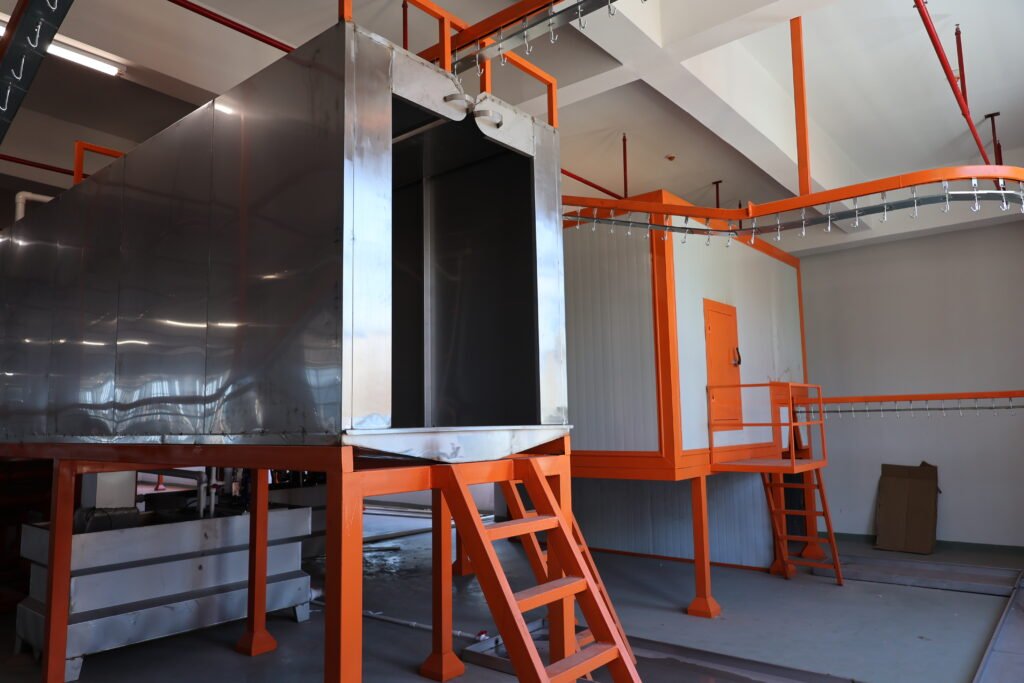
I often see fabricators treat powder coating like “spray it, bake it, ship it.” Then the same shop gets stuck with missed delivery, unstable finish, and a rework loop that never ends. I also see teams spend money on the wrong module because they did not define what they will run first.
For fabricators, a powder coating line is a production system that must keep takt time controlled, film thickness and appearance stable, and the process window repeatable—even when you run mixed sizes, mixed batches, and frequent inserts.
From our factory view at Ketu, we judge whether a line fits a fabricator by five things. We first lock what products you run, then we match equipment to that reality. We treat surface preparation as the base of quality, not an option. We design the booth and recovery for fast color change, not for “one color all day.” We size the oven by effective cure time and heat-up curve, not by length only. And we treat conveyor and hangers as the hidden master switch for throughput and finish.
I will break this down in four questions that buyers ask most. I will keep the logic simple and practical, so you can use it to review your current line or to plan a new one.
What Is a Powder Coat Line?
Many people think a powder coat line is “a booth plus an oven.” That is too narrow for a fabricator. A fabricator usually has wide size ranges, mixed batches, and frequent scheduling changes. So the line must behave like a stable system, not like a set of separate machines.
A powder coat line is a connected set of stations—surface preparation, drying, powder application, curing, cooling, and handling—designed to deliver repeatable finish quality at a predictable takt time.
When I design or evaluate a line for a fabricator, I do not start with brands or “automatic vs manual.” I start with what you run. Fabricators often have a “largest part” that sets clearances and hanger strength. They also have a “smallest part” that sets grounding stability and overspray control. And they have switching frequency that sets whether your booth and recovery will feel smooth or painful.
The first rule I use: define what you run before you define what you buy
If you skip this, the line will punish you later.
| Input you must lock | Why it matters for fabricators | What happens if you skip it |
|---|---|---|
| Largest part size + weight | sets conveyor clearance and hanger strength | parts hit walls, hanger redesign |
| Smallest part size | affects grounding and transfer efficiency | thin edges, unstable film build |
| Daily switching frequency | decides color change strategy | changeover time kills output |
| Part family mix | sets booth type and loading method | takt time becomes unstable |
| Quality spec (indoor/outdoor) | decides pretreatment depth | adhesion and corrosion failures |
The five checks we use to judge “fit for fabricators”
I use these five checks on every project:
1) Can the line hold takt time when you run mixed sizes and mixed hangers?
2) Can surface prep keep cleanliness consistent every day?
3) Can booth + recovery support frequent color changes without dust chaos?
4) Can the oven deliver correct cure for your thickest and thinnest parts?
5) Can conveyor + hangers keep grounding stable and loading fast?
If these five are right, you get stable delivery. If one fails, you will feel it as rework, delays, or finish complaints.
What Is the Powder Coating Process Step by Step?
Many guides list steps, but they do not tell you which steps decide rework rate and which steps decide takt time. Fabricators need the practical view, because a small drift can turn into a big cost.
Step by step, powder coating is: part receiving and prep, surface cleaning/pretreatment, drying, powder spraying, curing, cooling, and quality checks—with handling and grounding built into every step.
I always call out the three “make or break” points for fabricators: surface prep stability, color change efficiency, and cure completion on real parts. Spray guns matter, but they cannot rescue a dirty surface or an under-cured part.
Step-by-step, the way it runs in a real fabrication shop
1) Incoming sorting and surface condition check
I want parts grouped by size and by “surface risk.” Welded carbon steel parts with oil, rust, or slag are high risk. If you mix them blindly with clean parts, you lose control.
2) Surface preparation / pretreatment (not optional for stability)
This is where rework is decided. If your surface cleanliness is unstable, adhesion and corrosion results will be unstable. For outdoor carbon steel and welded parts, this step is the quality foundation.
3) Rinse and dry-off (when wet pretreatment is used)
Water trapped in seams, tubes, or corners will show up later as defects. Dry-off is a control step, not a “nice add-on.”
4) Powder application in the booth
This step sets film build and appearance. For fabricators, the booth also must support mixed sizes without creating dead zones and dust traps.
5) Recovery and color change
This is where many fabricators lose time. If the booth has too many corners and too much powder hold-up, changeover becomes the real bottleneck.
6) Curing in the oven (by effective cure time and heat-up curve)
I do not judge an oven by length only. I judge it by whether your thick parts and thin parts both reach the needed metal temperature for long enough time.
7) Cooling and handling
Cooling affects packaging, safety, and surface damage. Handling affects scratch rate and delivery speed.
8) QA checks and a rework loop that does not block the main flow
I define simple checks that catch drift early: film thickness, appearance, adhesion, and cure confirmation. I also design a rework area so rework does not choke the main line.
The control-point table I use with fabricators
| Process stage | What I control | The shop symptom when it fails |
|---|---|---|
| Pretreatment | cleanliness consistency | adhesion failures, corrosion claims |
| Dry-off | moisture removal | pinholes, bubbles, fisheyes |
| Booth spraying | film build stability | thin edges, orange peel drift |
| Recovery/change | clean-out speed and dust | changeover time eats capacity |
| Oven curing | part temperature curve | under-cure, soft finish, returns |
| Conveyor/hangers | grounding and handling | rejects, drops, slow loading |
This table matters because it shows where to invest. For fabricators, the best ROI often comes from prep, hangers, and changeover design.
What Are Powder Lines?
People use “powder lines” to mean different things. Some mean a batch booth + oven setup. Some mean a full conveyor line. For fabricators, the right line type depends on mix, throughput, and how often you change color.
Powder lines are the equipment systems used to apply and cure powder coating, and they can be batch lines, semi-automatic lines, or automatic conveyor lines based on your production mix and takt needs.
I keep the decision simple: do you need flow stability or maximum flexibility? Many fabricators need both. That is why hybrid lines are common.
The common powder line formats I see in fabrication shops
1) Batch line (booth + oven)
This fits very high mix and lower volume. It is flexible, but it relies on operators for consistency. Takt time can swing a lot.
2) Semi-automatic line (conveyor flow with manual loading)
This is a strong fit for many fabricators. You get better control and better repeatability. You also keep flexibility for mixed parts.
3) Automatic conveyor line (high throughput)
This fits higher volume and more stable part families. If color change is frequent, automation must be designed around fast clean-out and stable recovery, or it will still feel slow.
How I choose the line type for a fabricator
| Line type | Best fit condition | Main risk if misused |
|---|---|---|
| Batch | very high mix, low volume | labor cost and quality swings |
| Semi-auto | mixed batches + steady volume | hanger design and changeover bottleneck |
| Auto conveyor | high volume and stable families | color change and scheduling stress |
In real life, many fabricators start with semi-auto. Then they upgrade modules that remove their biggest bottleneck, like hangers, booth cleanability, and oven cure capacity.
What Are the Six Types of Powder Coatings?
Some buyers ask this early because they think powder type is the main quality lever. Powder choice matters, but the line’s stability often matters more. A great powder on a weak prep process still fails.
Six common powder coating types are epoxy, polyester, epoxy-polyester hybrid, polyurethane, acrylic, and fluoropolymer systems, and each fits different durability and appearance needs.
I pick powder type by use case first, not by buzzwords. I ask if the part is indoor or outdoor. I ask about UV exposure and corrosion needs. I ask about chemical exposure. I ask about appearance requirements. Then I check if the line can support the cure profile.
Simple comparison table (what most fabricators actually need)
| Powder type | Strength | Limit | Common fabricator use |
|---|---|---|---|
| Epoxy | strong adhesion, corrosion resistance | poor UV outdoors | indoor parts, undercoat |
| Polyester | good UV/weather | depends on chemistry need | outdoor frames and rails |
| Epoxy-polyester hybrid | balanced indoor finish | not for outdoor UV | indoor cabinets, brackets |
| Polyurethane | strong appearance and toughness | cost and control needs | premium metal products |
| Acrylic | special aesthetics in some cases | niche use | special finishes |
| Fluoropolymer | top weather resistance | higher cost, strict control | high durability outdoor |
The link between powder type and line design
If you run many colors and small batches, you need a booth and recovery that can change fast. If you target outdoor durability, you need prep stability and cure stability. If you coat thick and thin parts, you need an oven sized by heat-up curve, not just by length.
This is why I keep repeating the same message: for fabricators, the system design decides whether your powder choice can perform.
Conclusion
For fabricators, the best powder coating line is not the most automatic. It is the line that keeps prep stable, color changes fast, curing correct, and hangers and conveyor from killing takt time.
 English
  German
  Vietnamese
  French