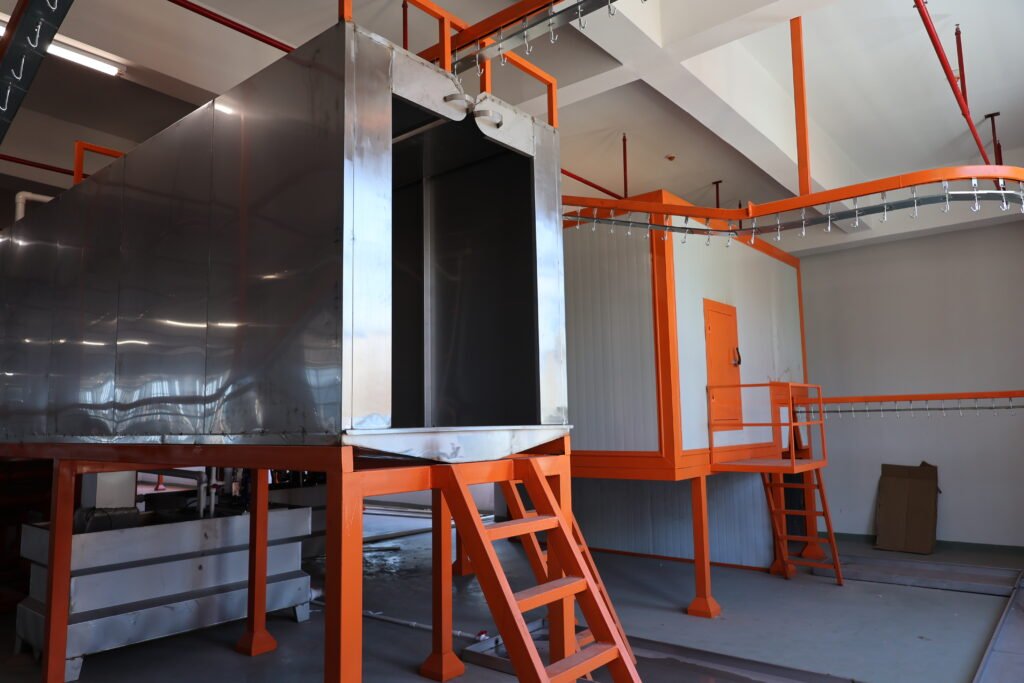
Many factories think a powder coating line is just “spray and bake,” and they keep losing time to defects and rework. I see this problem all the time in real production.
A powder coating line works by turning “clean → deposit powder → cure” into a repeatable flow, so every batch keeps stable appearance, film thickness, and adhesion.
I explain powder coating lines in factory language. I focus on what the line controls, not only what equipment you can see. When I lock the key variables, I can keep quality stable and keep takt time predictable.
What Is a Powder Coat Line?
Many people call a booth and an oven a “line,” then they feel confused when quality still drifts. I see shops spend money, but they still fight powder dust and unstable adhesion.
A powder coat line is a production system that moves parts through surface prep, powder application, and curing with controlled time, temperature, airflow, and grounding, so results repeat every day.
What the line really does in a factory
I treat a powder coat line as a “variation control machine.” The goal is simple. I want the same output even when people change shifts and the workshop temperature changes. The line does this by fixing a few key variables in each zone.
H3: The three jobs every powder coat line must complete
1) I make the surface consistent.
I remove oil, rust, and random contamination. I also build a stable surface condition for adhesion.
2) I make powder deposition stable.
I use electrostatic charging and a grounded part. I also control airflow and recovery so the booth stays clean.
3) I make curing complete and repeatable.
I bring the part to the correct metal temperature for the correct time. I do not rely only on oven setpoint.
H3: The “invisible controls” that decide if a line works
Many buyers watch the spray gun. I watch what the line controls behind the scenes:
- time in each step
- temperature stability
- airflow balance and negative pressure
- grounding path through hangers and hooks
- film thickness window
- part temperature curve in the oven
H3: The core modules I expect to see
A line can be manual, semi-auto, or automatic. The function is the same.
| Module | What it does | The key variable I lock | What fails if it drifts |
|---|---|---|---|
| Loading + racking | holds parts and sets flow | contact and hang points | thin corners, bare spots |
| Pretreatment/cleaning | builds the base | consistency, not “looks” | adhesion and corrosion drift |
| Dry-off | removes hidden water risk | dry in seams and holes | pinholes and bubbles |
| Booth + spray | deposits powder | ground + airflow + recipe | texture, dust, rework |
| Recovery + dust control | manages overspray | stable suction and filtration | powder loss, contamination |
| Oven curing | completes reaction | part temp + effective time | under/over cure |
| Cooling + packing | protects finish | handling timing and protection | scratches, dents |
When I explain “what is a line,” I always end with one rule: a line is not a list of machines. A line is a control system that makes output repeatable.
What Are Powder Lines?
People use the phrase “powder lines” in many ways, and this causes confusion. I often see a buyer compare a batch setup to a conveyor line as if they are the same thing.
Powder lines are the different system layouts used to run powder coating, such as batch lines, semi-automatic conveyor lines, and fully automatic lines, and each one fits a different order mix.
Why “best” depends on your order structure
I do not call one powder line “best.” I match the line to the daily order reality. If the shop changes color often and runs many SKUs, I value flexibility and fast changeover. If the shop runs high volume with stable parts, I value repeatable automation and low unit cost.
H3: The three common powder line types I see in real factories
1) Batch line (rack/cart + booth + batch oven)
I use it for high-mix, small batch, frequent inserts. It is flexible. It needs strong SOP discipline.
2) Semi-automatic line (conveyor flow + manual loading/spray or assisted spray)
I use it for mixed production where the shop wants more stable takt time and cleaner flow.
3) Automatic line (conveyor + reciprocators/robots + controlled recovery)
I use it for stable product families and high volume where the line can stay fed.
H3: The trade-offs in one table
| Line type | Best fit | Main advantage | Main risk I watch |
|---|---|---|---|
| Batch | high-mix small lots | maximum flexibility | operator variation and handling damage |
| Semi-auto | mixed but steady flow | stable takt and clean layout | changeover and racking bottlenecks |
| Auto | few SKUs high volume | consistency and low unit cost | idle time and slow color change |
H3: What makes a “manual line” still work well
I see many shops label a line “manual” and assume quality must be weak. I disagree. I can make a manual or semi-auto line stable if I lock:
- hanger and grounding design
- pretreatment consistency
- cure verification by part temperature
- booth airflow and recovery stability
When these are stable, manual spraying becomes predictable. When these are unstable, even robots will produce unstable parts.
What Is the Powder Coating Process Step by Step?
Many guides list steps, but they skip the real question: what does each step control. I see beginners chase spray settings because they do not control the earlier steps.
The powder coating process is: incoming check → cleaning/pretreatment → rinsing → dry-off → racking and grounding → spraying and recovery → curing by part temperature → cooling → inspection and packing.
Step A: Incoming parts and surface risk sorting
I start with surface reality. I look for oil, silicone, rust, weld slag, and sharp edges. I sort parts by risk. If I mix “easy parts” and “dirty parts” without a plan, the whole day becomes unstable.
H3: Step B: Pretreatment and rinsing
I control chemistry and consistency. I do not accept “it looks clean.” I want the same surface condition every batch.
- Degreasing must remove oil film, not only visible dirt.
- Rinsing must reduce carryover, or chemicals will contaminate later steps.
- Conversion coating must be stable if corrosion resistance matters.
H3: Step C: Dry-off
I remove water risk. Seams and tubes hold water. If water stays, defects show up later as pinholes or bubbles. I tune dry-off for “dry through,” not “hot air.”
H3: Step D: Racking and grounding
I treat grounding as a production control item. If ground is weak, edges go thin and recesses stay light. If hang points are wrong, I get shadowing and bare spots. If hangers are dirty, I get particles and contamination.
H3: Step E: Spraying, recovery, and dust control
I control:
- gun distance
- powder flow
- kV/current settings
- airflow and negative pressure in the booth
- recovered powder ratio and cleanliness
I do not want the shop floor full of powder dust. A stable booth and recovery system keeps powder where it belongs.
H3: Step F: Curing, cooling, and packing
I cure by part temperature curve, not only by setpoint. Thick parts heat slowly. Heavy hangers steal heat. I confirm effective cure time for the real part.
After cure, I protect the finish. Many appearance complaints come from scratches during unloading or packing.
H3: The process control checklist table I use
| Step | What I measure | What it prevents |
|---|---|---|
| Pretreatment | concentration/temp/time records | adhesion drift and corrosion claims |
| Dry-off | dryness in corners and seams | pinholes and bubbles |
| Grounding | stable contact points | thin edges and rough texture |
| Booth airflow | negative pressure and dust | contamination and powder loss |
| Curing | part temperature curve | under/over cure failures |
| Handling | packing protection | last-step damage |
This step-by-step view is simple, but it works because it focuses on control. When I lock these controls, the process becomes repeatable.
What Is a Coating Line?
People often ask this when they want a big-picture definition. I answer it in the simplest way. A coating line is a manufacturing line that applies a coating with controlled steps and controlled variables.
A coating line is a production system that prepares the surface, applies a coating material, and then sets that coating by drying or curing, with controlled movement, timing, and quality checks.
How powder coating lines compare to other coating lines
I explain differences by “how the coating becomes a film.”
- Liquid painting lines rely on wet film control and solvent or water evaporation.
- Powder coating lines rely on electrostatic deposition and heat curing to form the film.
Powder has some advantages. It can reduce solvent emissions. It can also produce strong and durable finishes when pretreatment and cure are correct. Still, powder is not “easy by default.” Powder needs stable grounding and stable curing.
H3: The four things I check to judge if a coating line is “good”
This works for powder lines, and it also works for most coating lines:
1) Surface preparation consistency
2) Material application stability
3) Cure or dry completion
4) Handling and traceability
If one of these is weak, the line becomes expensive. Rework rises. Delivery slips.
H3: The “factory four” that decide if a powder line is truly usable
I use these four items as a quick audit:
- pretreatment consistency (rework rate base)
- racking and grounding system (coverage and takt)
- booth recovery and changeover efficiency (powder cost and downtime)
- cure verification by part temperature (performance pass/fail)
| Audit item | What I look for | What it improves first |
|---|---|---|
| Pretreatment | stable routine and records | rework and corrosion stability |
| Grounding/racking | clean contact and fast loading | edge coverage and throughput |
| Booth/recovery | low dead zones and stable suction | powder waste and contamination |
| Cure verification | real part curve data | adhesion, hardness, durability |
When I define a coating line, I always bring it back to stability. If the line helps the team repeat good results, it is a good line.
Conclusion
Powder coating lines work by turning cleaning, electrostatic powder deposition, and part-temperature curing into a controlled flow, so quality and takt time stay stable across batches, shifts, and seasons.
 English
  German
  Vietnamese
  French