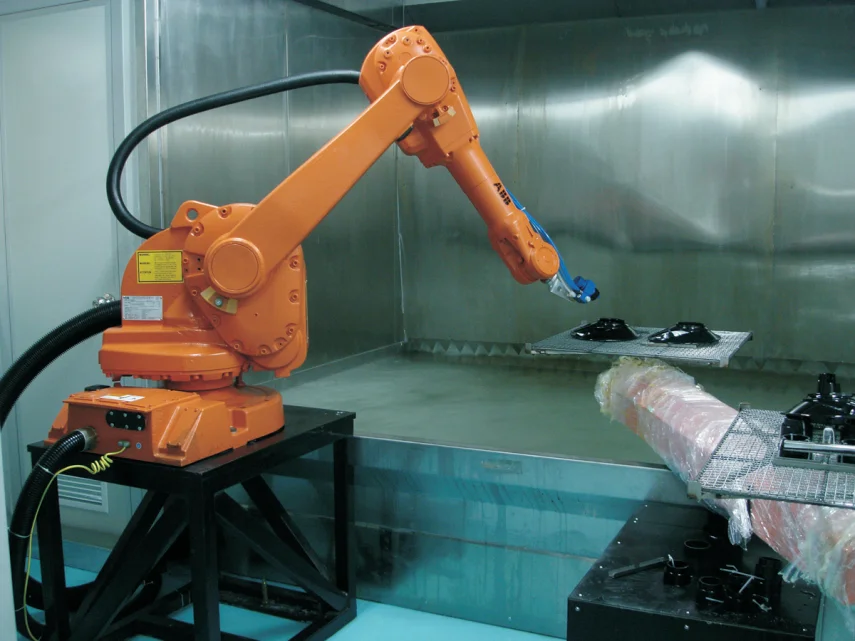
I often see buyers assume an automatic powder coating line is a “faster version” of a manual setup. Then they invest a lot, but they still get the same issues: drifting film thickness, unstable cure, dusty workshops, and slow changeovers. I also see the opposite: a shop stays manual for years, and labor and rework quietly eat the profit.
An automatic powder coating line is not “fancy equipment.” It is a controlled production system that uses continuous conveying, fixed process timing, and stable parameters to reduce variation in quality and cost. When your orders are stable enough to feed the line, automation becomes the lowest unit cost over time.
From our factory view at Ketu, I do not sell “full automatic” as a label. I match automation to order structure. If you choose the wrong level, the most common result is painful: you pay for automation but you run it like manual, or you save capex and then lose money on labor, downtime, and rework. This guide is written to help you avoid both.
What Is an Automatic Powder Coating Line?
People often picture only the automatic spray booth. In real production, the “automatic line” starts with conveying and ends with stable shipment. The automatic spraying part is only one module.
An automatic powder coating line is a continuous system where parts move through pretreatment, dry-off, automatic powder application (reciprocators/automatic guns/robots), curing, cooling, and unloading, with performance controlled by takt time and fixed process parameters.
What automation really gives you (factory meaning)
I see two real values:
1) Lower variation: film thickness and appearance become more consistent across shifts.
2) Lower unit cost over time: rework drops, labor per m² drops, and the line becomes easier to manage.
Automation is not only about “less labor.” It is about making output repeatable.
Who Should Use an Automatic Line?
I decide this with order structure, not with ambition. If orders can feed the line and keep changeovers low, automatic lines win. If orders are high-mix with constant inserts and frequent color changes, full automation can slow you down unless you design for changeover.
Automatic powder coating lines fit best when you have relatively few part families, stable volume, and strong demand for consistency, while high-mix frequent color-change shops often perform better with semi-automatic flow plus manual or upgrade-ready spraying.
Fast fit rules I use
- Few SKUs + large volume + stable takt → automatic spraying is usually worth it
- Many SKUs + small lots + frequent color change → semi-auto flow + changeover-friendly booth is often safer
- You have both → I often recommend a hybrid: automatic main line + manual bypass for sampling and urgent inserts
The common “wrong match” I see
- High-mix shops buy full automatic, then changeover dominates the day.
- Shops buy manual to save, then labor and rework become permanent taxes.
What You Are Really Buying: Core Modules of an Automatic Line
When buyers compare quotes, they often compare only the booth and oven. In real cost and stability, conveying, pretreatment, and recovery are equally important.
A complete automatic powder coating line includes conveying, pretreatment with rinses, dry-off, automatic application, booth and recovery/dust collection, curing oven, controls and safety interlocks, plus handling and inspection zones.
The module checklist (with what each one controls)
| Module | What it controls | Why it affects long-term cost |
|---|---|---|
| Conveyor system | takt, buffering, loading rhythm | defines real throughput |
| Pretreatment + rinsing | adhesion and corrosion base | rework rate driver |
| Dry-off oven | water risk removal | pinholes and bubbles prevention |
| Automatic application | thickness consistency | powder usage and appearance stability |
| Booth + recovery | dust, powder loss, contamination | powder cost and changeover |
| Curing oven | coating performance | pass/fail and returns |
| PLC + safety interlocks | stable operation | uptime and compliance |
| Cooling + unloading + packing | finish protection | “last-step damage” prevention |
If any one is weak, the line will “run” but not “run profitably.”
The 6 Parameters That Decide Selection (And Quote Price)
When we quote projects, we do not start with “one fixed price.” We start with six parameters. These parameters decide equipment sizing and line risk.
The key parameters are: target throughput, max/min part size and weight, substrate condition, color count and changeover frequency, quality requirement, and building/utility boundaries.
The 6 parameters in a practical table
| Parameter | What I need to know | What it decides |
|---|---|---|
| Throughput | parts/hour, shift output, line speed | conveyor + booth + oven size |
| Part size/weight range | max, min, hang points | rail height, oven dwell, fixtures |
| Material + surface state | steel/aluminum/galv, oil/rust level | pretreatment route strength |
| Colors + changeovers | colors/day, minutes/change | booth structure and recovery type |
| Quality targets | indoor/outdoor, corrosion expectation | pretreatment + cure verification |
| Building + utilities | L×W×H, door, power/gas, exhaust | layout feasibility and cost |
The biggest risk is ordering before these are locked. Then the line arrives, and you find that takt cannot be reached or changeover kills the schedule.
How Automatic Lines Stay Consistent (And Why They Still Fail)
People think automatic guns guarantee stable film thickness. They do not. Consistency is a system result. I rely on three pillars: racking and grounding, stable spray window, and stable powder management.
Automatic line consistency comes from a stable racking/grounding system, fixed spray recipes within a verified process window, and controlled recovery and powder management that prevents contamination and drift.
Pillar 1: Racking and grounding
If grounding is unstable, edges go thin and recesses stay light. Automatic guns cannot fix physics. I always design:
- clean contact points
- fast loading without drops
- stable hang points to avoid shadowing
- hanger maintenance routine to prevent build-up
Pillar 2: The spray process window
Automation helps because motion becomes repeatable. Still, I must lock:
- gun-to-part distance
- gun angles and stroke patterns
- powder flow and air settings
- kV/current settings appropriate for geometry
If you run many part shapes without a plan, you can still drift even with automation.
Pillar 3: Recovery and powder management
Recovery instability creates three problems:
- powder loss (money)
- contamination (rework)
- color drift (customer complaints)
For multi-color production, I treat booth design and clean-out workflow as core engineering, not as “operator skill.”
The 5 Most Common Failure Points (Where Projects “Flip Over”)
I have seen these five problems repeat across many sites. If you control them, your automatic line becomes stable.
The most common failure points are: ignoring changeover needs, curing by setpoint instead of part temperature, weak racking and grounding design, weak pretreatment control routines, and unbalanced booth airflow that causes dust leakage and poor recovery.
1) Full automation without changeover design
High-mix shops get trapped in cleaning and waiting.
2) Oven sized by length, not by part-temperature curve
You can “pass through” parts and still be under-cured.
3) Racking not engineered
Slow loading, poor ground, and drops reduce throughput and quality.
4) Pretreatment water quality and maintenance not standardized
Adhesion and corrosion drift becomes a permanent problem.
5) Airflow not tuned
Dust escapes, filters load fast, recovery becomes unstable, and the workshop gets dirty.
These are not small details. They are the difference between “it runs” and “it makes money.”
How I Accept an Automatic Line (A Factory-Style Acceptance Method)
Many customers accept a line because it moves parts. That is not enough. I accept a line because it runs stable and can be repeated.
A proper acceptance should include thickness mapping, cure verification by part temperature, continuous run stability, color-change drills with time and powder loss, and a defect sample library linked to root causes.
The acceptance checklist I use
| Acceptance item | What I do | What it proves |
|---|---|---|
| Thickness mapping | measure edges/backs/recesses | coverage and consistency |
| Cure verification | log part temperature vs time | real performance window |
| Continuous run | run at least one full shift | drift and uptime risk |
| Changeover drill | measure minutes + contamination | real high-mix capability |
| Defect library | photo + cause-action sheet | fast troubleshooting later |
If a supplier cannot support these tests, the handover is risky.
My Factory Recommendation (Fast Decision Logic)
I keep it simple:
- If your orders can feed the line and changeovers are low, an automatic line becomes your lowest unit cost over time.
- If you are a typical fabricator with frequent inserts and many colors, I often recommend a stable semi-automatic backbone first, then upgrade spraying when orders stabilize.
If your volume is stable and color changes are limited, automatic lines are usually the best long-term unit cost. If you are high-mix with frequent changeovers, a semi-automatic line with an upgrade-ready automatic spray position is often the most stable path.
Conclusion
Automatic powder coating lines win when they reduce variation: stable pretreatment, stable racking and grounding, stable recovery, and cure verification by part temperature, all matched to your real order structure.
 English
  German
  Vietnamese
  French