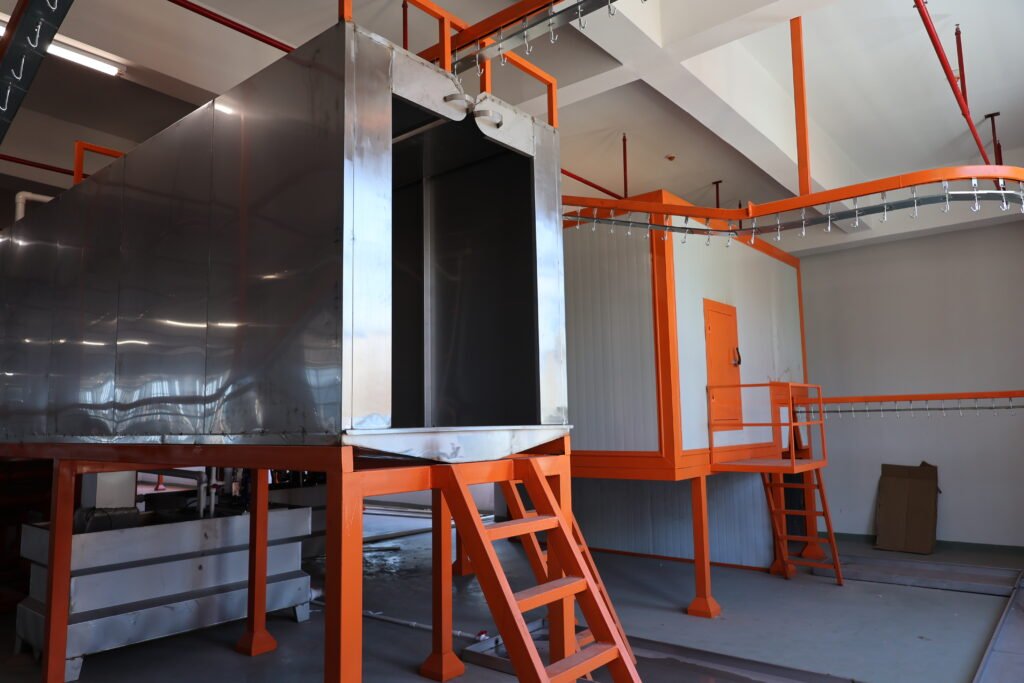
Many fabricators try to run powder coating like a simple “spray + bake” task. Then reality hits. Parts change every day. Sizes jump from small brackets to big frames. Colors switch all the time. Urgent inserts break the schedule. If the line is not designed for this, you will see the same pattern: changeover time eats the day, film thickness drifts, rework grows, and delivery becomes stressful.
For a fabricator, a powder coating line is not built to chase maximum speed. It is built to handle mixed batches with stable quality: fast color change, low rework, and controllable takt time even when orders are messy.
From our factory view at Ketu, I judge a fabricator line by one question: can you keep shipping consistent parts when the mix changes? If the answer is yes, the line is doing its job.
What Is a Powder Coat Line?
A fabricator often starts with a booth and an oven. That can work for a while. But once orders diversify, the missing pieces show up fast: unstable prep, unstable grounding, slow changeovers, and cure inconsistency across different part thicknesses.
A powder coat line is a connected production system that takes parts through surface preparation, dry-off, powder application with controlled airflow and recovery, curing by part temperature and time, and then cooling and handling—so output stays repeatable across batches.
A typical line flow looks like this:
- Loading and racking
- Surface preparation (cleaning, rust removal, conversion coating when needed)
- Rinses
- Dry-off
- Powder spray booth (manual or automatic) + recovery/filtration
- Curing oven
- Cooling
- Unload, inspection, packaging
For fabricators, the same flow exists everywhere. The difference is how well it is engineered for mixed production.
What Are Powder Lines?
Fabricators often ask “which powder line should I buy?” I do not answer with “manual vs automatic” only. I answer with “what line type will survive your changeovers and inserts.”
Powder lines are the different system types used for powder coating production, such as batch/cart systems, semi-automatic conveyor lines, and fully automatic lines, and the right one depends on your part mix, color-change frequency, and takt targets.
Here are the line types I see fabricators use most often:
- Batch/cart systems: maximum flexibility for big size range and frequent inserts
- Semi-automatic conveyor lines: stable flow with controlled ovens and booth, while keeping flexibility
- Automatic spray lines: best for stable part families, but can disappoint in high-mix unless changeover is engineered hard
A fabricator line wins when it keeps uptime high even with frequent changeovers.
What Is a Coating Line?
When someone says “coating line,” they mean the broader category: a system that prepares a surface, applies coating, and then sets it by drying or curing. Powder coating is one version of that.
A coating line is a production system that prepares a surface, applies a coating material, and sets it by drying or curing, using controlled movement, utilities, and inspection to repeat results.
The reason this matters is simple: once you think in “line” terms, you stop blaming operators for every defect. You start controlling the process.
What Is the Powder Coating Process Step by Step?
Fabricators do not fail because they do not know the steps. They fail because the steps are not controlled for variation: different materials, different thicknesses, and constant color changes.
Step by step, a powder coating line runs: load and rack → surface preparation → rinsing → dry-off → powder spray with recovery → curing → cooling → unload, inspect, and pack, and the fabricator success is decided by changeover design, grounding, and cure verification.
Below is the same process, but explained in the way I run it for high-mix production.
1) Loading, racking, and grounding
For fabricators, racking is the hidden master switch. If the fixture system is messy, takt time collapses.
- If hooks are not standardized, loading time becomes unpredictable.
- If grounding contact is weak, edges go thin and recesses stay light.
- If hang points change every job, film build and appearance drift.
What I do in practice is build racking standards by part family. I do not want a new fixture idea for every order. I want repeatable hanging and repeatable electrical contact.
2) Surface preparation (pretreatment)
This is where fabricators often lose money without noticing. Mixed work means mixed contamination.
- welded steel parts bring scale, slag, and heat marks
- oily parts bring fisheye risk and craters
- rust level changes between batches
If pretreatment is not consistent, you will chase defects downstream forever. For many shops, the fastest cost reduction is not a new gun. It is stable cleaning and stable rinse control. This single change can drop rework more than most people expect.
3) Dry-off
Dry-off is not about “hot air.” It is about removing hidden water risk.
If water stays in seams, tube ends, or complex pockets, you can see pinholes or bubbles after cure. In mixed production, this is common because part geometry changes every hour.
4) Powder spraying in the booth (and why color change matters)
For fabricators, the booth is a productivity battlefield.
If your booth has too many dead corners, you lose time in cleaning.
If your powder path is hard to purge, you lose time in changeover.
If airflow is not balanced, you get dust contamination and unstable recovery.
This is why fabricators often benefit from:
- changeover-friendly booth design (low dead zones, easy access)
- quick-disconnect powder hoses and feed components
- a simple, timed cleaning routine that every shift follows
A poor changeover setup can make a “high-capacity line” behave like a low-capacity line, because uptime disappears.
5) Curing: do not judge by oven length
Fabricators run parts with different thickness and different thermal mass. A “10 minutes at 200°C” label is not enough.
- thick parts heat slowly and may under-cure
- thin parts can over-cure and lose gloss or yellow
- heavy racks steal heat and change the curve
I verify cure by part metal temperature and effective time in the cure window. This is not academic. It is a practical tool to stop the “some parts pass, some parts fail” problem.
6) Cooling, unloading, inspection, packaging
Fabricators often ship visible parts. The last step can ruin a perfect finish.
- unloading too hot causes marks and dents
- stacking without protection causes scratches
- rushing to pack causes edge damage
I standardize the handling and packing routine, because this is the cheapest way to protect good work.
A fabricator-focused control map
| Fabricator pain | What usually causes it | What I lock first |
|---|---|---|
| rework is high | prep drift, contamination, under-cure | pretreatment routine + cure verification |
| color change kills the day | dead corners, slow purge, messy SOP | changeover-friendly booth + timed SOP |
| thin edges and poor coverage | weak grounding, dirty hooks | racking and grounding standards |
| takt time is unstable | loading bottlenecks, inserts | part-family fixtures + buffer planning |
Conclusion
For fabricators, a powder coating line matters because it keeps mixed-batch production stable: consistent prep, fast changeover, reliable cure, and repeatable racking, so you ship on time with less rework and lower unit cost.
 English
  German
  Vietnamese
  French