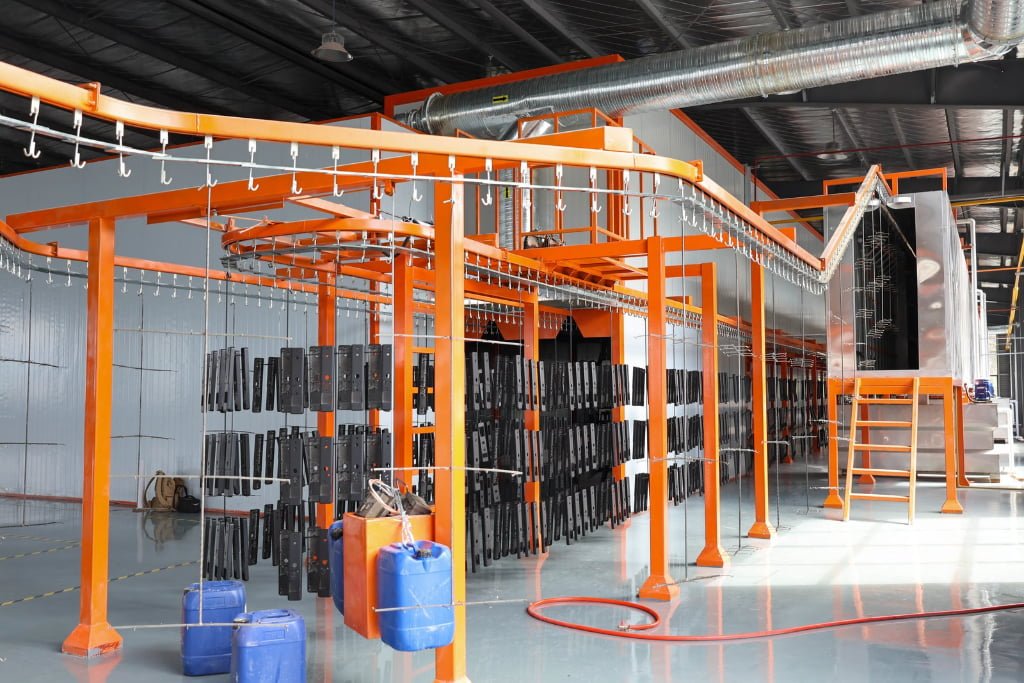
What Is the Principle of Powder Coating Process? A Complete Guide to Electrostatic Adhesion and Curing
Opening Section
At its core, powder coating works through a simple but elegant principle: charged powder particles are electrostatically attracted to a grounded workpiece, then fused and hardened through heat to create a durable coating.
This three-stage process—electrostatic charging, surface adhesion, and thermal curing—is fundamentally different from traditional liquid spray painting. And once you understand how it works, you'll see why it has become the preferred surface treatment method for manufacturers worldwide.
Let me walk you through exactly how this process unfolds, why grounding matters so much, and why powder coating delivers results that liquid paint simply cannot match.
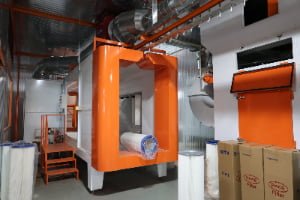
What is Powder Coating? — Basic Definition and Core Principle
Powder coating is a dry finishing process in which finely ground particles of pigment and resin are electrostatically charged and sprayed onto a grounded metal workpiece. Once the powder adheres to the surface, the workpiece is heated in a curing oven where the powder melts, flows, and chemically cross-links to form a continuous, durable protective and decorative coating.
Think of it this way: instead of spraying liquid paint that must evaporate and cure over hours or days, powder coating uses electrostatic force to deposit dry powder, then heat to transform it into a solid layer in minutes. The result is a coating that is thicker, more uniform, more durable, and far more environmentally friendly than traditional spray painting.
From a manufacturing standpoint, this matters enormously. Whether you're coating sheet metal cabinets, aluminum extrusions, outdoor furniture, or industrial equipment, powder coating offers superior corrosion resistance, impact durability, and surface consistency—all while generating zero volatile organic compounds (VOCs) during application.
The Three-Stage Working Principle of Powder Coating
Stage 1: Electrostatic Charging in the Spray Gun
The powder coating journey begins inside the spray gun, where an electric charge is applied to the powder particles.
Here's how it works: The spray gun contains a high-voltage electrostatic generator (typically operating at 60–90 kilovolts). As powder flows through the gun nozzle, it passes through this electrical field. Every individual powder particle receives a negative charge from the electrode inside the gun. This happens almost instantaneously and consistently.
The result: you now have millions of negatively charged powder particles exiting the spray gun in a fine mist, all seeking to migrate toward something positively charged (or more accurately, toward a grounded surface where electrons can flow away).
This charging process is crucial because it enables the next stage—adhesion. Without this electrostatic force, powder would simply fall to the ground like talc powder falling from a hand.
Stage 2: Electrostatic Adhesion to the Grounded Workpiece
Here is where the magic happens—and where grounding becomes absolutely critical.
The workpiece (your metal cabinet, aluminum extrusion, or steel component) must be electrically connected to ground. This grounding connection is not optional; it is the foundation of the entire process.
When a negatively charged powder particle approaches a grounded metal surface, an irresistible electrostatic force pulls it toward the surface. Opposite charges attract. The powder wraps around the workpiece—coating front surfaces, reaching into corners, adhering to edges—all without any direct contact between the gun and the part.
Why is this so powerful? Because the electrostatic field does the work for you. The operator doesn't need to manually rotate the part or angle the gun perfectly. The charged powder naturally seeks the grounded metal and clings to it. This is why powder coating achieves such uniform coverage on complex shapes, deep cavities, and internal surfaces where liquid paint would be difficult to access.
In our factory experience, we've seen parts with intricate internal structures—electrical enclosures, aluminum channels, multi-cavity tooling—coated beautifully on the first pass because the electrostatic field carries the powder everywhere the grounding connection reaches.
This is also why grounding quality directly impacts your coating results. A poor ground connection means reduced electrostatic force, lower powder transfer efficiency, and visible areas where the coating is thin or missing entirely.
Stage 3: Heat Curing and Cross-linking
Once the powder has adhered to the workpiece surface, the part moves into a curing oven where heat triggers two critical transformations.
First: Melting and Flow
At elevated temperatures (typically 170–200°C / 340–390°F, depending on the powder formulation), the powder particles soften, melt, and flow together. Individual grains fuse into a continuous liquid film. This "flow" is essential because it fills tiny gaps, levels surface irregularities, and creates a smooth, seamless coating rather than a grainy, particulate finish.
Second: Chemical Cross-linking
While the powder is molten, a second chemical reaction occurs. The thermosetting resin in the powder contains reactive groups that cross-link (form chemical bonds) when heated. This is not a simple evaporation or drying; it is a permanent molecular change. The linear resin molecules restructure into a three-dimensional network, creating a coating that is hard, chemically resistant, and durable.
This cross-linking is why powder-coated parts are so resistant to corrosion, impact, chemicals, and environmental degradation. The coating doesn't just sit on the surface; it becomes chemically bonded to itself and (with proper surface preparation) to the base metal.
The entire curing process—from cold part entering the oven to fully cured coating exiting the far end—typically takes 10–30 minutes depending on part thickness, oven temperature, and conveyor speed.
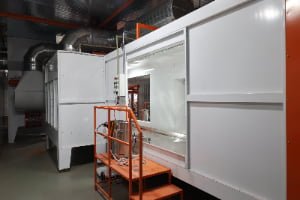
Why Grounding Matters: The Critical Role of Electrical Connection
I cannot overstate this: grounding is not a detail. It is the foundation of the entire process.
In our factory, we've seen firsthand how grounding problems cascade into coating failures. When an operator tells me "we're getting patchy coverage" or "the coating isn't sticking well," the first question I ask is always, "How's the ground connection?"
Here's what happens when grounding fails:
-
Reduced Electrostatic Force — Without a good ground path, the electrical potential difference between the charged powder and the workpiece drops. The powder loses its strong attraction to the surface.
-
Lower Transfer Efficiency — More powder misses the target and ends up in the collection system instead of on the part. This wastes material and increases costs.
-
Uneven Coverage — Some areas of the part may maintain a decent ground connection while others don't. You get coating thickness that varies wildly—thin in some spots, heavy in others, possibly missing in corners or recesses.
-
Poor Adhesion — Powder that manages to land on a poorly grounded surface adheres weakly. It's prone to flaking or peeling during shipping, handling, or in-service use.
How to ensure good grounding:
- Verify the contact point — The workpiece must make clean, direct contact with the grounding fixture or hanger. No paint, oil, or oxidation between the part and the contact point.
- Check the fixture/hanger conductivity — The entire path from the workpiece contact point back to the electrical ground must have low resistance (typically <1 megohm for powder coating applications).
- Inspect the conveyance system — Hangers and fixtures wear over time. Replace them if they show significant oxidation or corrosion at contact surfaces.
- Measure resistance regularly — Make it part of your quality routine. Use a multimeter to verify ground resistance at the start of each shift.
In my experience, 80% of on-site powder coating problems trace back to grounding issues, not to equipment malfunction.
How Powder Coating Differs from Liquid Paint Spraying
Understanding powder coating's advantages becomes much clearer when you compare it directly to traditional liquid spray painting.
In liquid spray painting:
- Solvent-based or water-based paint is sprayed as a liquid onto the workpiece.
- The liquid must evaporate or cure over hours or days.
- Large amounts of volatile organic compounds (VOCs) are released into the atmosphere.
- Overspray (powder that misses the part) is typically wasted and creates environmental and disposal problems.
- Application speed is limited by cure time; you cannot stack parts immediately after coating.
- Coating thickness is harder to control uniformly, especially on complex shapes.
In powder coating:
- Powder is sprayed as a dry mist and adheres electrostatically.
- Curing happens in minutes via heat, not hours via evaporation.
- Zero VOCs are emitted during application (powder coating is solvent-free).
- Overspray is collected and can be recycled directly back into the system.
- Parts exit the oven fully cured and can be handled, stacked, or shipped immediately.
- Electrostatic adhesion naturally favors uniform, complete coverage.
The practical impact for manufacturers:
If you operate a cabinet production line, powder coating gives you faster throughput, lower labor costs, superior durability, and minimal environmental liability compared to liquid spray. If you manufacture aluminum extrusions or outdoor furniture, powder coating delivers the weather resistance and aesthetic consistency that customers expect. If you're concerned about meeting environmental regulations (ISO 14001, local VOC limits), powder coating is simply the cleaner choice.
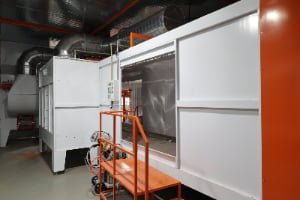
Key Advantages That Come from This Principle
The physical and chemical mechanisms of powder coating directly enable a series of real-world benefits that matter to manufacturing operations:
1. Superior Coating Uniformity
Because the electrostatic field carries powder to all grounded surfaces equally, you get consistent coating thickness even on complex geometries. Internal cavities, recesses, and sharp edges all receive the same coverage as flat surfaces. Liquid spray cannot do this reliably.
2. Exceptional Durability and Corrosion Resistance
The cross-linked resin network creates a coating that resists salt spray, humidity, UV exposure, and chemical attack. Properly formulated powder coatings regularly pass 1000+ hour salt fog tests. Liquid coatings, by comparison, typically achieve 500–800 hours under the same conditions.
3. Higher Transfer Efficiency
Modern powder coating lines achieve 85–95% transfer efficiency, meaning 85–95% of the powder sprayed actually lands on the workpiece. The remaining 5–15% is collected by the recovery system and reused. In liquid spray, overspray recovery is far more difficult, and waste rates are typically 20–40%.
4. Zero VOC Emissions
Powder coating releases no solvents into the air. This simplifies regulatory compliance, improves workplace air quality, and eliminates many health and safety concerns associated with solvent vapors.
5. Rapid Production Cycles
A part exits the curing oven fully hard and ready for handling in minutes. You can immediately stack, package, or ship. Liquid paint requires hours of air dry or low-temperature cure, creating bottlenecks and inventory buildup.
6. Cost Efficiency Over Time
Yes, powder coating equipment requires higher initial capital. But material waste is lower, labor is reduced (less operator skill required), and scrap rates drop because adhesion and coverage are so consistent. Over a 5–10 year horizon, powder coating typically delivers better total cost of ownership than liquid spray for high-volume operations.
7. Aesthetic Flexibility
Powder coatings are available in hundreds of colors, finishes (gloss, matte, textured), and special effects. The rigid, smooth coating surface provides a premium appearance that many customers prefer over liquid paint finishes.
What Materials and Products Are Suitable for Powder Coating?
Powder coating is ideally suited to metal substrates and works exceptionally well across dozens of industries and product categories.
Metal Types: Steel, aluminum, stainless steel, zinc-plated steel, and galvanized steel all powder coat reliably. The key requirement is that the substrate must be conductive (so it can be grounded) and capable of withstanding the curing temperature.
Ideal Application Categories:
- Electrical enclosures and control cabinets — Sheet metal boxes, switchgear housings, and UPS cabinets benefit enormously from powder coating's uniform coverage and corrosion resistance.
- Structural metal components — Beams, brackets, frames, and hardware for construction and infrastructure.
- Outdoor furniture and fixtures — Metal patio chairs, garden benches, railings, and light posts. Powder coating's UV and weather resistance makes it the standard choice.
- Industrial aluminum extrusions — Window frames, door frames, and structural profiles benefit from powder coating's superior adhesion and aesthetic finish.
- Automotive and appliance parts — Brackets, frames, and enclosures that require lightweight, durable coating.
- HVAC and mechanical equipment — Ductwork, casings, and housings that must withstand temperature cycling and environmental exposure.
Not Suitable: Powder coating requires conductive substrates that can be grounded. Non-conductive materials (plastic, ceramic, wood) cannot be powder coated directly using standard electrostatic equipment. Some thermoplastic materials also cannot withstand the curing temperatures (typically 170–200°C).
In our factory, we've coated everything from small sheet metal brackets to large cabinet assemblies, aluminum frames, and structural steel components. The consistency is remarkable. A 2mm thick cabinet door achieves the same coating uniformity as a thicker structural member—something I've never seen liquid spray achieve reliably.
Common Issues and How the Principle Explains Them
Understanding the core principles of powder coating helps you diagnose and prevent the most common surface defects:
Orange Peel Texture
Cause: Powder particles land on the surface but do not flow completely during cure. This often happens if oven temperature is too low, cure time is too short, or the powder resin has poor flow characteristics.
Connection to principle: If the melt phase isn't complete, powder particles retain their individual boundaries instead of fusing into a smooth film.
Pinhole and Crater Defects
Cause: Moisture or gas trapped in the substrate escapes during curing, piercing through the coating film. Often caused by inadequate pre-treatment (oil, water, or rust remaining on the surface).
Connection to principle: The curing stage's heat activates these contaminants. Proper grounding and good surface preparation prevent this before the coating ever reaches the oven.
Poor Adhesion or Peeling
Cause: Weak ground connection, inadequate surface preparation, or substrate contamination.
Connection to principle: Adhesion depends on two things: (1) the powder must be transferred reliably to the surface (requires good grounding), and (2) the base metal must be clean and receptive to the coating (requires proper pre-treatment).
Patchy or Uneven Coverage
Cause: Grounding defects, operator technique issues, or incorrect spray gun settings.
Connection to principle: The electrostatic field can only carry powder to areas that are electrically connected to ground. Any break in the ground path creates a "dead zone" where powder won't adhere.
Coating Coming Off in Sheets
Cause: Severely inadequate surface preparation (heavy oil, rust, or mill scale not removed).
Connection to principle: No amount of electrostatic force can overcome poor substrate adhesion. The three-stage process works perfectly only if the base metal is clean and chemically receptive.
More Related Questions
Q: Can powder coating be applied in cold weather?
A: Yes, but powder application quality depends on environmental conditions (temperature and humidity affect powder charge and flow). Curing ovens must reach operating temperature regardless of outdoor weather. Best practice: climate-controlled spray booths.
Q: How thick is a typical powder coating?
A: Ideal thickness ranges from 2–3 mils (50–75 microns) for general industrial use. Thicker coatings (4–5 mils) provide enhanced corrosion protection but increase cost and can cause application defects if not carefully controlled.
Q: Why is powder coating more expensive upfront than liquid spray?
A: Equipment cost is higher. A complete powder coating system (spray booth, curing oven, powder supply system, collection system, electrical controls) requires substantial capital. However, over 3–5 years, total cost per part typically becomes competitive or superior due to higher transfer efficiency and faster cycle time.
Q: Can powder coating be repaired or touched up?
A: Full re-coating is straightforward. Small touch-ups are difficult because powder cannot be sprayed over a small area without affecting surrounding coating. This is a practical disadvantage compared to liquid paint.
Conclusion
Powder coating operates on elegantly simple physics: electrostatic force deposits charged powder onto a grounded workpiece, then heat fuses and chemically transforms that powder into a durable, protective coating. This three-stage principle—charging, adhesion, curing—is the reason powder coating outperforms liquid spray in uniform coverage, durability, transfer efficiency, and environmental impact. When you encounter coating defects, the principle itself points you to the root cause: usually grounding quality, surface preparation, or oven temperature. Master these fundamentals, and you control the process.
Ready to Optimize Your Coating Process?
If you're evaluating powder coating systems for your manufacturing operation—whether you're coating sheet metal cabinets, aluminum extrusions, structural components, or outdoor furniture—understanding the principle is just the first step. The real challenge is configuring a complete line that matches your specific products, production volume, and facility constraints.
This is where many manufacturers struggle. They buy equipment that looks good on the spec sheet but doesn't integrate well with their actual production flow, or they install a system that works beautifully for one product type but struggles with another.
At Ketu, we've built complete powder coating systems for cabinet manufacturers, aluminum extrusion shops, furniture producers, and industrial component makers across three continents. We don't sell standard equipment off a shelf. We design custom integrated lines—front treatment, spray booth, oven, recovery system, electrical controls, and conveyance—configured specifically around your workpiece geometry, production speed, and facility layout.
We also know that the best decision comes after seeing a real working line. We invite customers to visit our factory, observe our sample systems in operation, and tour actual customer production sites where our equipment runs daily. Seeing the consistency, the throughput, the coating finish—that's when the principle becomes concrete, and the decision becomes clear.
If you're ready to discuss your specific coating requirements, facility constraints, or production goals, reach out. We can help you translate the principles of powder coating into a system that delivers real results for your operation.
Contact us today for a consultation and facility visit.
Phone: +86-18064668879
Email: inquiry@coating-machinery.net
Address: A6 Smart Industrial Park, Shishan Town, Nanhai District, Foshan, Guangdong, China
 English
  German
  Vietnamese
  French