Is Powder Coating the Right Choice? A Decision Framework for Manufacturing Enterprises
Introduction
Many manufacturing enterprises face a critical strategic question when upgrading surface treatment processes: Should we invest in powder coating, or continue with traditional liquid spray painting?
This isn't simply a "good vs. bad" decision. It's a comprehensive evaluation involving production methods, cost structures, product characteristics, and long-term business strategy. Over our years operating electrostatic powder coating production lines, we've worked with hundreds of manufacturers making this exact choice. What we've learned is clear: success with powder coating depends less on the equipment itself, and more on whether your operation genuinely fits powder coating's requirements.
This guide draws from real factory experience to help you understand what powder coating truly offers—and what it doesn't. We'll walk through when it makes sense, when it doesn't, and how to calculate the real return on investment.
Table of Contents
- Why Manufacturers Are Switching to Powder Coating: Core Advantages Beyond the Hype
- The Real Downsides: When Powder Coating Isn't the Right Fit
- Powder Coating Types and Their Performance Trade-Offs
- From Pre-Treatment to Curing: Is Your Production Line Ready?
- How to Calculate True ROI: Equipment Cost vs. Lifecycle Savings
- Which Products and Industries Benefit Most from Powder Coating?
- Making the Final Decision: A Practical Checklist for Your Enterprise
Why Manufacturers Are Switching to Powder Coating: Core Advantages Beyond the Hype
Unmatched Surface Consistency and Quality Control
From the cabinet and furniture manufacturers we work with, surface consistency ranks as the #1 reason for switching to powder coating.
One electrical cabinet producer we served had been using manual liquid spray painting. Between batches, color variation was noticeable, flow marks appeared frequently, and uniform coverage was inconsistent. After implementing electrostatic powder coating, their film thickness variance dropped to ±20 micrometers, and color deviation became virtually imperceptible to the naked eye.
Why this matters: Electrostatic powder coating relies on physics, not operator skill. Once a workpiece is properly grounded, charged powder particles distribute uniformly under electrostatic attraction. Compare this to liquid spray painting, which depends entirely on operator technique. Even excellent technicians cannot guarantee 100% consistency across all pieces.
Our perspective: If your customers inspect products closely, or if your brand depends on visual uniformity, powder coating's investment typically pays for itself within 3-6 months through reduced rework and customer complaints.
Superior Corrosion Resistance and Long-Term Cost Economics
Outdoor furniture manufacturers, electrical equipment makers, and metal component suppliers all cite durability as critical. Powder coatings routinely outperform liquid paints in salt-fog testing by 3-5x.
One Turkish outdoor furniture client we worked with had experienced premature rust at coastal locations when using liquid paint—rusting appeared within 1-2 years. The same product with powder coating showed zero corrosion after 5 years in identical sea-air environments. While upfront equipment investment was substantial, their product lifecycle costs and warranty claims dropped dramatically.
This isn't just about aesthetics. For products carrying warranties or sold into harsh environments, powder coating fundamentally changes your cost structure:
- Fewer warranty claims
- Lower field failure rates
- Reduced replacement logistics
- Stronger brand reputation
Our perspective: Don't evaluate powder coating by equipment cost alone. Calculate the full product lifecycle cost: materials, rework, warranty expenses, and customer satisfaction impact. Many manufacturers discover their true ROI is actually 2-3x higher than they initially calculated.
Environmental and Regulatory Compliance Benefits
Powder coating uses zero solvents and produces zero VOC emissions during application—a massive regulatory advantage in markets with strict environmental controls.
Powder utilization rates reach 90-98%, compared to roughly 50-60% for liquid spray painting. That unused powder gets collected, screened, and recycled back into production. The environmental benefit is clear, but the economic benefit is equally important: you're buying material that actually ends up on workpieces, not waste streams.
Many regions now impose VOC taxes, require air treatment systems, or limit production based on emission levels. Powder coating eliminates these constraints entirely.
Our perspective: Compliance isn't optional—it's accelerating. Manufacturers in stringent markets (EU, California, parts of Asia) face rising pressure. Investing in powder coating now positions you ahead of regulatory tightening that will eventually affect liquid paint users.
Higher Material Efficiency and Lower Waste Costs
The economics of material efficiency often get overlooked in initial comparisons.
With liquid spray painting, overspray is lost. With powder coating, oversized atomization is recovered. On a typical cabinet or aluminum extrusion job, we see material cost reductions of 15-25% when switching from liquid to powder—even after accounting for reclamation system operating costs.
For high-volume production, this compounds quickly. A manufacturer producing 10,000 units monthly might save $8,000-12,000 per month in material alone. Over a 10-year equipment lifespan, that's $960,000-1,440,000 in material savings.
Our perspective: Material efficiency is real, measurable, and immediate. It begins paying dividends from month one, even before addressing quality improvements or rework reduction.
The Real Downsides: When Powder Coating Isn't the Right Fit
High Capital Investment and Setup Requirements
Electrostatic powder coating isn't cheap. A complete mid-range system—including pre-treatment, spray booth, recovery systems, curing oven, and controls—typically runs $150,000-400,000+. For specialized applications or high automation, costs exceed $500,000.
This is a hard reality: if your annual production is under 500-1,000 units, your payback period extends well beyond 5 years. For seasonal or project-based production, powder coating may never justify the investment.
Contract spraying (outsourcing to a third-party facility) is a legitimate alternative if your volume doesn't justify in-house equipment. The trade-off is reduced control and higher per-unit costs, but zero capital outlay.
Our perspective: Capital investment is the primary barrier for small-to-medium manufacturers. Be honest about your production volume before committing. We've seen manufacturers over-invest in automation they don't actually need, or under-invest and regret it within two years as volume grows.
Production Constraints and Throughput Limitations
Powder coating requires sequential steps that cannot be skipped: pre-treatment → drying → spraying → curing → cooling. Each step takes time.
Typical cycle times:
- Pre-treatment: 10-15 minutes
- Drying: 5-10 minutes
- Spray application: 5-10 minutes (varies by complexity)
- Curing: 10-20 minutes at 350-450°F (depends on powder type)
- Cooling: 10-15 minutes before handling
Total line time easily reaches 1-2 hours per batch. If your product requires hand-loading and unloading, add another 5-10 minutes per cycle.
Compare this to liquid spray painting, which can be faster for simple geometries and doesn't require a long curing cycle (many liquid finishes dry at room temperature in minutes).
Our perspective: If you need extreme speed and have simple products, powder coating creates bottlenecks. Conversely, if your product already requires multi-step handling or long curing, powder coating's additional time is less of a constraint.
Technical Challenges with Specific Materials and Geometries
Powder coating struggles with certain geometries and materials:
Complex internal cavities — Deep recesses, internal threads, and shielded areas experience the "Faraday cage effect." Electrostatic field lines don't penetrate effectively, leaving these zones under-coated. Solutions exist (angled spray guns, lower voltage, split-coating passes) but add complexity and time.
Heat-sensitive materials — Curing temperatures typically run 350-450°F. Plastics, certain adhesives, and temperature-sensitive components may not survive. You'd need lower-temperature powder systems, which are more expensive and have different performance characteristics.
Thin-walled or fragile components — Parts that warp or distort under curing heat become problematic. Liquid paint, drying at room temperature, avoids this entirely.
Non-conductive or poorly conductive substrates — Powder coating relies on electrostatic charge transfer through workpiece grounding. Highly insulating materials (certain composites, coatings) resist this. Special pre-treatment or conductive primers are needed, adding cost.
Our perspective: Don't assume powder coating works for everything. Early in evaluation, test a representative sample of your actual products. If more than 10-15% of your production has geometric or material incompatibilities, you're looking at a hybrid approach (powder for what works, liquid for exceptions)—which defeats much of the efficiency gain.
Common Pitfalls and Why They Happen
Neglecting pre-treatment: We see this repeatedly. Manufacturers skip or shortcut pre-treatment to save time, then suffer poor adhesion and corrosion. Pre-treatment isn't optional—it's the foundation of coating durability. Cut corners here, and everything downstream fails.
Poor compressed air quality: Powder spraying and recovery systems depend on clean, dry air. Air carrying moisture or oil causes defects (pinholes, orange peel, poor flow). Many facilities underestimate air system requirements and pay the price in scrap.
Inadequate grounding: If workpieces don't ground reliably, powder transfer efficiency collapses. Grounding failures cause uneven coverage, reduced material utilization, and visible defects. This often traces to dirty contact points or worn fixtures.
Underestimating automation complexity: Fully automated systems require precise coordination of conveyor speed, spray timing, powder flow, and curing parameters. Misalignment causes cascading problems. Semi-automated systems are often more reliable for lower volumes.
Our perspective: Powder coating failures are rarely equipment failures. They're usually process failures—inadequate pre-treatment, poor maintenance, or operator error. The investment isn't just in equipment; it's in process discipline.
Powder Coating Types and Their Performance Trade-Offs
Thermoset vs. Thermoplastic: Which Performs Better in Your Environment?
Thermoset powders (85-90% of the market):
- Undergo chemical cross-linking during curing
- Once cured, cannot be reheated without degrading
- Superior adhesion and hardness
- Better chemical and solvent resistance
- Best for outdoor, harsh-environment, and high-performance applications
- Higher cost
- Limited color/finish options compared to thermoplastics
Common thermoset resins: polyester, epoxy, polyurethane, acrylic.
Thermoplastic powders:
- Do not chemically cross-link; they simply melt and fuse
- Can technically be reheated and reformed (though not recommended)
- Slightly lower performance than thermosets in harsh environments
- Excellent chemical resistance (some formulations)
- More color and finish variety available
- Lower cost
- Slightly easier to reclaim and reuse
Most quality manufacturers default to thermoset formulations because long-term performance is more predictable. Thermoplastics excel when budget is tight and environment is moderate (indoor use, non-corrosive).
Our perspective: For corrosive environments or outdoor use, thermoset is non-negotiable. For protected indoor applications (mechanical components, furniture hardware), thermoplastics deliver good value. Don't over-specify—it wastes money.
Resin Selection: Polyester, Epoxy, and Hybrid Formulations
| Resin Type | Best For | Advantages | Limitations |
|---|---|---|---|
| Polyester | General-purpose, outdoor, architectural | Excellent UV stability, good cost, wide color range | Moderate chemical resistance, slower cure |
| Epoxy | Industrial, heavy equipment, chemical environments | Superior adhesion, hardness, corrosion resistance | Limited UV stability (yellows), narrower colors, higher cost |
| Epoxy-Polyester Hybrid | Balanced performance, outdoor + moderate chemicals | Good UV + chemical resistance, reasonable cost | Compromises slightly on both vs. pure resins |
| Polyurethane | High-end outdoor, specialty automotive | Exceptional flexibility, UV stability, appearance | High cost, processing complexity |
| Acrylic | Aesthetic finish, indoor, electronics | Fast cure, excellent gloss, color vibrancy | Lower chemical/corrosion resistance |
Real-world recommendation logic:
- Coastal/outdoor/corrosive: Polyester thermoset
- Industrial/chemical exposure: Epoxy thermoset
- Balanced needs (most manufacturing): Epoxy-polyester hybrid or polyester
- High appearance/indoor: Acrylic or polyester
- Automotive/specialty: Polyurethane (if budget allows)
Our perspective: Don't let suppliers up-sell you unnecessarily. Most cabinet makers, furniture producers, and structural steel shops work perfectly with polyester or hybrid formulations. Epoxy is excellent but costs 15-25% more. Choose based on your actual environment, not marketing claims.
Choosing the Right Powder for Durability, Cost, and Finish
The "right" powder balances three factors: durability (how long it lasts), cost (price per kg), and aesthetics (gloss, color, surface feel).
Most manufacturers operate under budget constraints, so the conversation becomes: "What's the minimum performance I need at the lowest cost?"
For cabinets in climate-controlled warehouses: polyester, 60-80 microns, standard gloss. Cost: ~$4-6/kg.
For outdoor furniture in salt-air: polyester with UV additives, 80-120 microns, semi-gloss. Cost: ~$7-10/kg.
For electronics/appliances: acrylic or polyester, 50-70 microns, high-gloss. Cost: ~$5-8/kg.
One often-overlooked factor: powder particle size distribution. Finer powders ($8-12/kg) produce better surface finish and penetrate complex geometries better. Coarser powders ($4-6/kg) spray faster but leave slightly rougher surfaces. Match particle size to your application.
Our perspective: Buy powder matched to your actual needs, not industry defaults. If you're spraying simple flat panels, coarse polyester saves money without visible compromise. If you're spraying complex brackets or fine details, invest in finer particle powder—the better coverage and finish reduce rework costs.
From Pre-Treatment to Curing: Is Your Production Line Ready?
Pre-Treatment Requirements and Hidden Operational Costs
Pre-treatment is where most manufacturers stumble.
Typical pre-treatment sequence:
- Degreasing — Remove oil, coolant, fingerprints (5-10 min, typically alkaline bath)
- Rinsing — Remove degreaser residue (2-3 min)
- Pickling/acid wash — Remove rust and mill scale (5-15 min, for steel)
- Rinsing again — Remove acid (2-3 min)
- Phosphating — Build conversion coating for adhesion (5-10 min, steel) or zirconium treatment (2-5 min, aluminum)
- Final rinse — Remove phosphate residue (2-3 min)
- DI water rinse — Remove dissolved salts (1-2 min)
- Drying — Remove moisture (5-15 min, often heated)
Total pre-treatment time: 25-60 minutes depending on contamination level and material.
Hidden costs:
- Constant chemical replenishment (degreaser, acid, phosphating agent)
- Wastewater treatment (acid/base neutralization, phosphate precipitation)
- Energy for heating tanks and drying
- Labor for loading/unloading and monitoring
- Equipment maintenance (pump replacement, seal leaks, tank corrosion)
A typical mid-size pre-treatment line runs $80,000-150,000. Monthly operating costs (chemicals, utilities, labor, maintenance): $3,000-8,000.
Our perspective: Pre-treatment is non-negotiable and expensive. Many manufacturers underestimate this when comparing total cost of ownership. Don't shortcut pre-treatment—it's where coating durability is built.
Three Spray Methods and Their Suitability for Your Product Mix
1. Manual spray guns (operator-held)
- Lowest capital cost ($5,000-15,000 for spray booth + basic equipment)
- Maximum flexibility for complex or varied geometries
- Slower (human-paced)
- Highly dependent on operator skill
- Best for: low-volume, high-variety, or complex parts
2. Automatic reciprocating arms (programmed motion)
- Medium capital cost ($30,000-80,000)
- Consistent spray patterns for defined geometries
- Moderate speed improvement over manual
- Less operator dependency
- Best for: medium-volume production of similar parts (cabinets, frames, housings)
3. Fully automated inline systems (conveyor + multi-gun arrays)
- Highest capital cost ($100,000-300,000+)
- Fastest throughput
- Lowest labor cost per unit
- Inflexible—requires stable product designs
- Best for: high-volume, standardized products (appliances, automotive parts)
Powder spray transfer efficiency (percentage of powder that adheres vs. oversized) varies:
- Manual: 65-75% (operator inconsistency, spray angles)
- Reciprocating: 75-85% (more consistent motion)
- Fully automated: 85-95% (optimized geometry, multiple passes if needed)
Lower transfer efficiency = higher powder consumption = higher material cost per unit. This compounds significantly at scale.
Our perspective: Automation is not always the right answer. If your product mix is diverse or volumes fluctuate, a reciprocating arm often delivers better ROI than full automation. You gain consistency without losing flexibility. Reserve full automation for stable, high-volume production.
Curing Processes and Equipment Space Planning
Curing is where chemistry happens. Powder doesn't just "dry"—it undergoes chemical cross-linking at elevated temperature.
Typical thermoset powder parameters:
- Temperature: 350-450°F (177-232°C), depending on resin
- Time at temperature: 10-20 minutes
- Ramp rate: 30-40 minutes to reach target temperature (varies by workpiece mass)
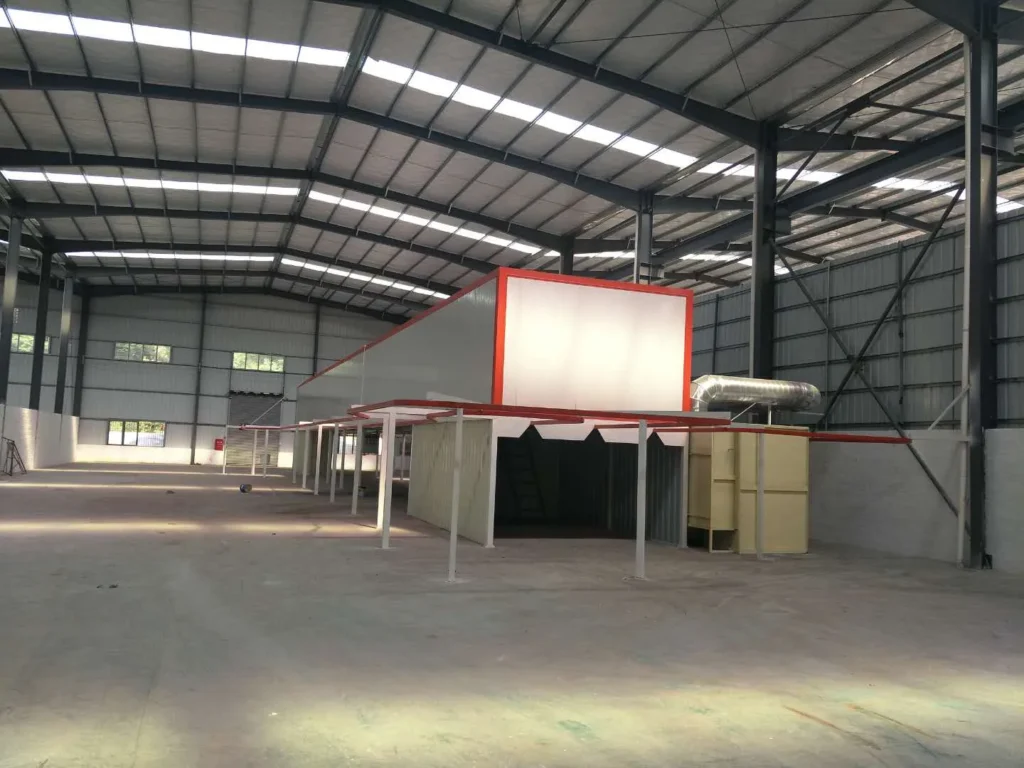
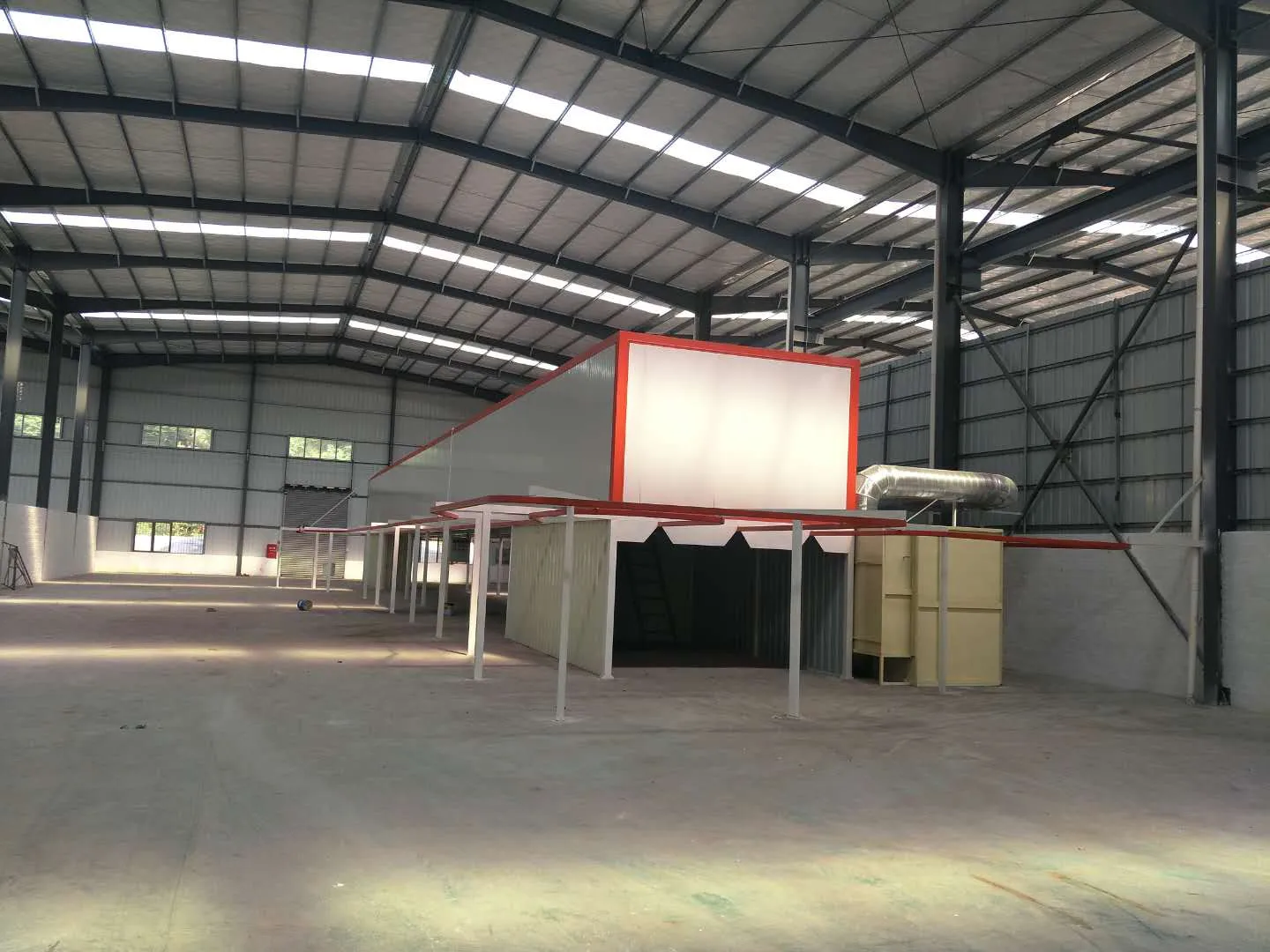
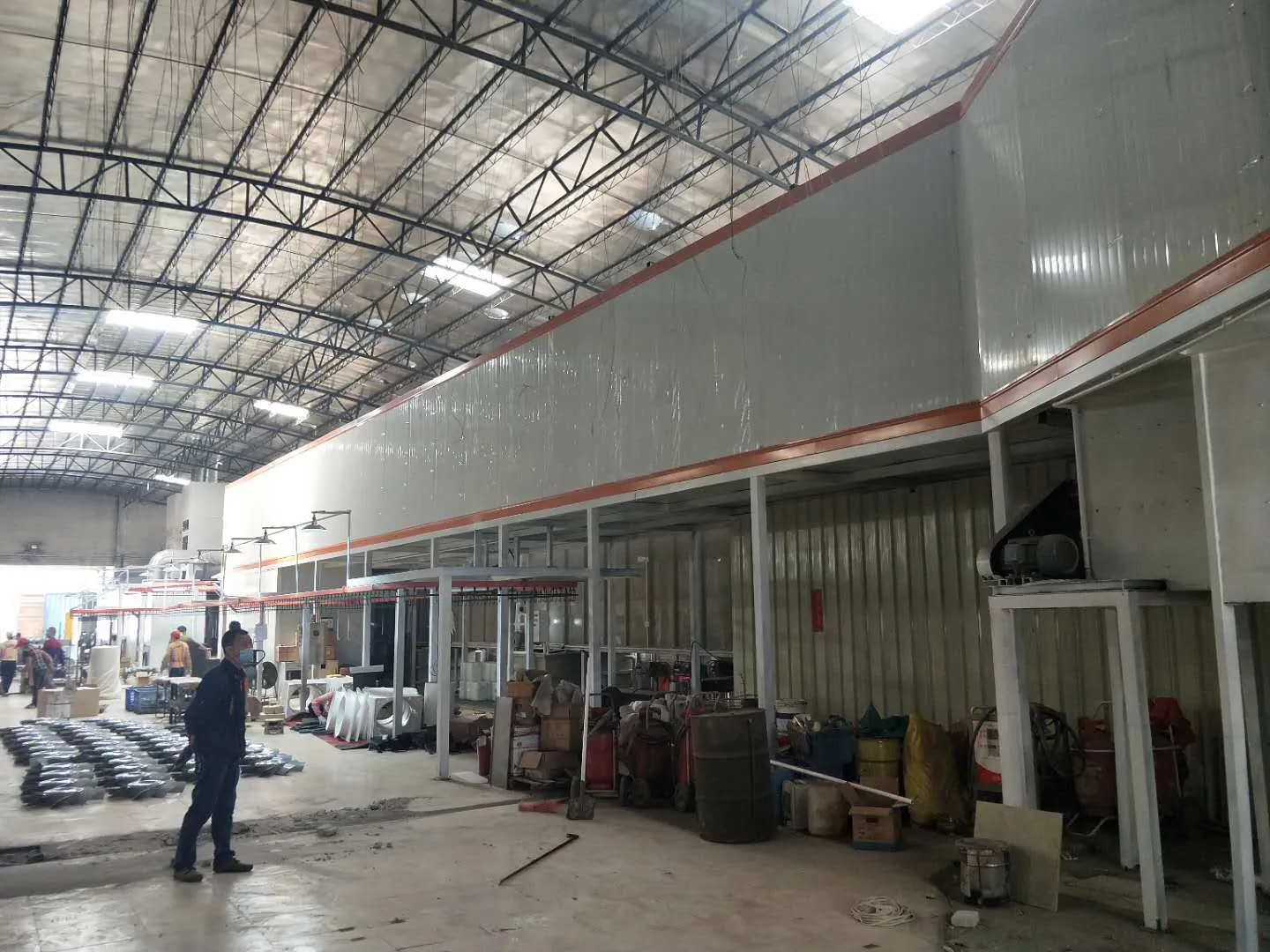
A 5100mm (17ft) long, 2100mm (7ft) high curing oven is standard for mid-range production. These operate continuously, so heating costs are constant. A typical electric curing oven pulls 40-80 kW; a gas-heated oven uses 100,000-200,000 BTU/hour.
Energy cost implications:
- Electricity: ~$0.12/kWh × 60kW × 8 hours = ~$58/day, or ~$14,000/year for a single-shift operation
- Natural gas: $3-4/MMBtu × 120,000 BTU/hour × 8 hours = ~$30-40/day, or ~$7,500-10,000/year
Add workpiece pre-heating time, and total energy cost can reach $15,000-25,000/year for a modest operation.
Curing defects to watch:
- Under-cure — Insufficient time or temperature leads to soft, easily scratched coating
- Over-cure — Excessive heat yellows coating, causes brittleness, and degrades some resin types
- Uneven cure — Cold spots in oven create quality variance
- Thermal shock — Rapid cooling after curing can cause crazing (fine surface cracks)
Proper oven maintenance (calibration, thermal uniformity verification, burner service) is critical but often neglected.
Our perspective: Curing oven selection significantly affects your energy footprint and quality consistency. Gas-heated ovens are typically cheaper to operate than electric for high-volume work, but require proper ventilation and safety systems. Electric ovens are cleaner and easier to maintain but higher operating cost. Match oven type to your expected volume and energy rates.
Infrastructure, Personnel, and Service Support Gaps
Powder coating systems are complex. They demand:
-
Electrical infrastructure — 380V/50Hz three-phase power for large systems, plus isolated ground for electrostatic systems. Many facilities need electrical upgrades ($10,000-30,000).
-
Compressed air — Clean, dry air at 4-8 bar pressure. Moisture or oil in air causes coating defects. Proper air preparation (dryer, multi-stage filters) is essential. Many facilities overlook this.
-
Water supply and wastewater handling — Pre-treatment consumes significant water and generates acidic/alkaline waste. Local regulations require neutralization and treatment before discharge. Budget $5,000-20,000 for wastewater systems.
-
Dust collection and environmental compliance — Powder overspray must be captured and filtered. Without proper dust collection, you face regulatory violations and worker health risks.
-
Trained personnel — Powder coating requires different skills than liquid spray painting. Operators need training on electrostatic principles, grounding, air quality, temperature control, and troubleshooting. Budget $2,000-5,000 for initial training.
-
Spare parts and service support — When equipment fails, downtime is expensive. Reliable suppliers with local service technicians reduce risk.
Our perspective: Many manufacturers underestimate infrastructure requirements. Don't assume your existing facility is ready. Budget 15-20% of equipment cost for supporting infrastructure. And factor in 2-3 months lead time to set up utilities and bring facilities into compliance.
How to Calculate True ROI: Equipment Cost vs. Lifecycle Savings
Breaking Down Initial Investment and Hidden Costs
Direct equipment costs (what suppliers quote):
- Pre-treatment system: $40,000-80,000
- Spray booth + guns: $20,000-50,000
- Powder recovery system: $30,000-60,000
- Curing oven: $50,000-120,000
- Conveyor/transport: $20,000-60,000
- Electrical controls: $10,000-30,000
- Subtotal: $170,000-400,000
Hidden/indirect costs (what surprises you later):
- Installation & commissioning: 10-15% of equipment cost
- Electrical/water/gas infrastructure upgrades: $15,000-50,000
- Initial tooling & fixtures: $10,000-30,000
- Operator training: $2,000-10,000
- First-run inefficiency (months 1-3): 20-30% scrap/rework
- Contingency (always needed): 10-15% of total
- Subtotal: $50,000-150,000
Total first-year cost: $220,000-550,000
This is why many manufacturers are shocked. They budget for equipment but get hit with infrastructure, training, and ramp-up costs.
Material Yield Comparison: Powder vs. Liquid Paint Economics
This is where powder shines economically.
Liquid spray painting:
- Material utilization: 50-65% (rest is overspray, waste)
- Coverage rate: ~80-120 square feet per gallon (varies by viscosity)
- Typical cost: $30-60/gallon
- Waste disposal: ~$2-5/gallon (hazardous waste)
- Net material cost for 1000 sq ft: ~$350-500
Powder coating:
- Material utilization: 90-98% (recovery systems capture most overspray)
- Coverage rate: ~100-150 square feet per kg (powder coats differently than liquid, often requires less material)
- Typical cost: $4-10/kg
- Waste disposal: Minimal (recovered powder recirculates)
- Net material cost for 1000 sq ft: ~$100-200
Annual savings for 10,000 units (avg. 5 sq ft each = 50,000 sq ft):
- Liquid paint cost: ~$1,750-2,500
- Powder coating cost: ~$500-1,000
- Annual material savings: ~$1,200-1,750
On 10,000 units/year, that's $0.12-0.18 per unit in material savings. For 50,000 units/year, it's $1.20-1.75 per unit. At scale, material cost advantage becomes substantial.
Rework, Defect Rates, and Customer Satisfaction Impact
Quality improvements directly affect profitability:
| Metric | Liquid Spray | Powder Coating |
|---|---|---|
| First-pass quality rate | 85-90% | 95-98% |
| Rework/scrap rate | 10-15% | 2-5% |
| Customer returns/warranty | 3-8% | 0.5-2% |
| Setup/color-change time | 15-30 min | 5-15 min |
| Coating consistency variance | ±30% | ±5-10% |
If you produce 10,000 units/year:
- Liquid spray with 12% scrap = 1,200 units reworked
- Powder coating with 3% scrap = 300 units reworked
- 900 units saved from rework = $9,000-18,000 savings (at $10-20 rework/unit labor + material)
Plus reduced customer returns, warranty claims, and field failures compound the benefit.
Our perspective: Quality improvements are the hidden ROI. Many manufacturers focus on material cost savings but overlook rework reduction. The combination often delivers 2-3x better ROI than equipment alone suggests.
When Does Payback Happen? Industry Benchmarks
Payback period depends on volume and application:
Low-volume scenario (2,000 units/year):
- Total investment: $250,000
- Annual savings (material + rework): $3,000-5,000
- Payback: 50-85 years ❌ Not viable
Medium-volume scenario (10,000 units/year):
- Total investment: $300,000
- Annual savings: $12,000-20,000
- Payback: 15-25 years ⚠️ Marginal (depends on financing)
High-volume scenario (30,000+ units/year):
- Total investment: $350,000
- Annual savings: $40,000-60,000 (material + rework + efficiency)
- Payback: 6-9 years ✓ Viable
Very high-volume scenario (50,000+ units/year):
- Total investment: $400,000
- Annual savings: $70,000-100,000+
- Payback: 4-6 years ✓ Strong ROI
Our perspective: Below 5,000 units/year, powder coating is difficult to justify on economics alone. At 10,000+ units/year, it makes sense. At 30,000+ units/year, it becomes strategically valuable. These thresholds vary by industry and application, but they're reliable reference points.
Which Products and Industries Benefit Most from Powder Coating?
Best-Fit Applications: Metal Cabinets, Furniture, Aluminum Extrusions, and Electronics
Metal cabinets & enclosures ✓ Excellent fit
- Simple geometry, flat panels
- High-volume production typical
- Durability and corrosion resistance required
- Color standardization critical
- ROI: Strong (typically 8-12 year payback at 15,000+ units/year)
Outdoor furniture ✓ Excellent fit
- Corrosion and UV exposure critical
- Powder's durability advantage very significant
- Quality consistency drives brand reputation
- Automotive-like aesthetic expectations
- ROI: Very strong (payback often 5-8 years because quality premium justifies cost)
Aluminum extrusions & profiles ✓ Excellent fit
- High-volume production
- Complex multi-stage coating needs (pre-treatment, coating, anodize alternative)
- Consistency requirements high
- Material cost efficiency dramatic
- ROI: Strong (material savings alone often cover equipment in 3-5 years)
Appliance/electronics housings ✓ Very good fit
- Aesthetic demands high
- Volume stable and predictable
- Color and finish consistency paramount
- Cosmetic defects unacceptable
- ROI: Good (5-10 year payback typical, justified by reduced returns)
Structural steel, architectural elements ✓ Good fit
- High corrosion resistance required
- Outdoor/industrial exposure typical
- Volume moderate-to-high
- ROI: Depends on volume; marginal if <5,000 units/year
Automotive components ⚠️ Specialized
- Some parts (brackets, fasteners, underbody components) perfect for powder
- Other parts (body panels) require specialized systems
- Only pursue if volume >50,000 units/year and you have dedicated equipment
- ROI: Variable, requires industry-specific calculation
Questionable Fits: Complex Geometries, Heat-Sensitive Materials, and Low-Volume Production
Complex internal geometries ❌ Poor fit
- Deep cavities, internal threads, shielded areas don't coat uniformly
- Faraday cage effect leaves zones under-coated
- Requires manual touch-up or liquid paint for details
- Better option: Hybrid approach (powder for simple areas, manual liquid for details) or pure liquid coating
Heat-sensitive materials ❌ Poor fit
- Plastics, rubber gaskets, certain adhesives degrade at 350-450°F
- Special low-temperature powders exist but cost 30-50% more
- Better option: Liquid painting (room-temperature cure), or redesign to separate heat-sensitive components
Low-volume, high-variety production ❌ Poor fit
- Constant color changes waste powder (reclamation challenges)
- Setup/tear-down time becomes larger portion of cycle
- Equipment utilization never optimizes
- Better option: Contract spraying to specialized vendor, or continue with manual liquid spray
Frequent design changes ❌ Poor fit
- Geometry variations require fixture redesign
- Automated spray programs need reprogramming
- Changeover time becomes prohibitive
- Better option: Liquid painting (more flexible) or outsource coating
Custom/bespoke products ❌ Poor fit
- One-off or very small batch production
- Equipment investment unjustifiable
- Better option: Always contract spray
Production <2,000 units/year ❌ Poor fit
- Payback period exceeds 10 years
- Equipment sits idle much of the time
- Capital tied up unproductively
- Better option: Contract spray or continue current method
Adaptation Strategies for Non-Traditional Substrates
Aluminum & non-ferrous metals:
- Standard powder works well if pre-treatment is proper (zirconium conversion coating instead of phosphate)
- Cost: 5-10% premium vs. steel pre-treatment
Stainless steel:
- Requires specialized pre-treatment (passivation compatible)
- Powder selection matters (some powders bond poorly to stainless)
- Cost: 10-20% premium
Plastic substrates (rare, but possible):
- Requires conductive base layer or specialized adhesion promoter
- Powder must have excellent adhesion to plastic
- Curing temperature limited (max 300°F typical)
- Cost: 30-50% premium
- Recommendation: Usually not worth it; liquid paint more practical
Composite materials:
- Non-conductive—requires conductive primer or spray base
- Curing heat can degrade matrix
- Recommendation: Liquid paint preferred
Wood products:
- Pre-treatment different (surface seal required)
- Curing heat must not char or degrade wood
- Recommendation: Liquid paint or specialized epoxy primers + powder (complex)
Our perspective: Stick to traditional metal substrates (steel, aluminum, stainless) unless you have a specific, high-volume reason to adapt. Non-traditional substrates require specialized expertise and cost premiums that rarely justify the complexity.
Making the Final Decision: A Practical Checklist for Your Enterprise
Key Questions to Ask Before Investing
| Decision Factor | Questions to Answer |
|---|---|
| Production Volume | How many units/year? Is volume growing or stable? What's your 5-year forecast? |
| Product Complexity | Are geometries simple or complex? Internal cavities? Heat-sensitive parts? |
| Quality Requirements | How critical is surface consistency? What are customer/end-use expectations? |
| Material Type | Steel, aluminum, stainless, or mixed? |
| Current Process | What are you using now? Why change? What's broken about it? |
| Color/Finish Variety | How many colors do you run? How often do you change? |
| Space Available | Do you have 50+ linear feet for pre-treatment, spray, and curing? |
| Utilities | What's your electrical capacity? Water quality? Gas availability? |
| Budget | Total capital available? Financing options? |
| Timeline | When do you need production? How long can you tolerate ramp-up? |
| Environment | Indoor/outdoor use? Corrosive/coastal exposure? |
| Regulatory | Are there VOC limits, waste disposal rules, or compliance pressures? |
Decision tree:
- Is your annual volume <5,000 units? → Consider contract spraying; in-house rarely justifies ROI
- Is volume 5,000-15,000? → Evaluate carefully; payback 15-25 years unless strong quality/rework justification
- Is volume 15,000-30,000? → Powder coating makes economic sense; payback 10-15 years
- Is volume >30,000? → Powder coating is strategically sound; payback 5-10 years
- Do you have complex geometries or heat-sensitive parts? → Test thoroughly before committing; consider hybrid approach
- Are you changing colors frequently? → Budget extra time/cost for changeovers; ensure recovery system capability
- Is corrosion resistance or outdoor durability critical? → Powder coating premium becomes worthwhile; can improve ROI 2-3x
Vendor Selection and Long-Term Service Support
Not all powder coating equipment is equal. Selection matters for total cost of ownership.
What to evaluate:
-
Equipment reliability & design
- Is the system modular (easy to repair individual sections)?
- Are common wear parts readily available?
- Does the vendor have local or responsive service?
-
Spray system sophistication
- Corona guns, tribo guns, or both? (Corona more common; tribo better for some applications)
- Are guns reliable/long-lasting or high-maintenance?
- Can you source replacement guns locally or must you wait for imports?
-
Recovery & reclamation efficiency
- Single-stage or multi-stage recovery?
- What's the claimed overspray recovery rate?
- How easy is color changeover?
-
Curing oven performance
- Even temperature distribution? (Temperature variance >±10°C is risky)
- Accurate controls & monitoring?
- Energy efficiency ratings?
-
Control systems
- User-friendly interface?
- Data logging capability? (Traceability for quality)
- Remote diagnostics for troubleshooting?
-
After-sales support
- Does vendor provide training?
- Local service technician availability?
- Spare parts stocking?
- Warranty terms & what's covered?
Red flags:
- Vendor can't provide references from similar manufacturers
- Spare parts must be special-ordered; no local stocking
- Training is minimal or extra cost
- Service calls take weeks to respond
- Equipment design is proprietary (lock-in to one vendor)
Our perspective: Buy from manufacturers (not distributors) who've been in business 10+ years and have local service presence. The cheapest equipment often costs the most over its lifetime due to downtime and support gaps. Factor service support into vendor selection, not just price.
Phased Implementation vs. Full Line Conversion
Two common approaches:
Phased (Recommended for first-time adopters):
- Start with manual spray booth + basic recovery
- Investment: $80,000-150,000
- Lets you learn process, train staff, prove concept
- Can expand to automation later if successful
- Flexibility to pivot if issues arise
- Disadvantage: per-unit costs higher; not optimized efficiency
Full-line automation (for committed high-volume producers):
- Automated spray arms + sophisticated recovery + integrated curing
- Investment: $300,000-500,000+
- Optimal efficiency from day one
- But: high fixed cost, inflexible if volume changes
- Risk: if you guessed volume wrong, you're stuck
Our perspective: Unless you're absolutely certain of stable, high volume, start with a phased approach. It's slower but smarter. Many manufacturers who jumped to full automation regretted it when volumes fluctuated or product designs changed. Phase 1 gives you data to make Phase 2 decisions confidently.
Key Comparison Table: Powder Coating vs. Traditional Liquid Spray Painting
| Factor | Powder Coating | Liquid Spray Painting |
|---|---|---|
| Material Cost/Unit | Low ($0.50-1.50 typical) | Higher ($1.00-3.00 typical) |
| First-Pass Quality | 95-98% | 85-90% |
| Setup Cost | High ($200K-500K) | Low ($20K-80K) |
| Color-Change Time | 15-30 min (powder) | 10-20 min (liquid) |
| Curing Time | 15-30 min at heat | 2-15 min room temp (varies) |
| Environmental Impact | Minimal VOC, high recovery | High VOC, waste disposal needed |
| Surface Finish Quality | Excellent consistency | Good but operator-dependent |
| Corrosion Resistance | Excellent (often 10+ years) | Good (3-7 years typical) |
| Suitable Volume Range | 10,000+ units/year optimal | 2,000-20,000 units/year |
| Infrastructure Required | Extensive (air, water, power) | Moderate |
| Training/Skill | Moderate (technician-level) | Moderate (technician-level) |
| Maintenance Complexity | Higher (more systems) | Lower |
| Payback Period | 8-15 years (at 15K+ units) | N/A (lower capex) |
Conclusion: Making the Right Choice for Your Business
Powder coating is the right choice if:
- You produce 10,000+ units/year with stable volume
- Your products have simple-to-moderate geometries
- Corrosion resistance or outdoor durability is important
- Surface consistency and quality directly impact your market position
- You have capital budget and space for infrastructure
- You can commit to proper process discipline (pre-treatment, maintenance)
Powder coating is risky or not recommended if:
- You produce <5,000 units/year
- Your product mix is highly diverse with constant design changes
- You have extreme color changes requiring frequent equipment cleaning
- Your products are heat-sensitive or have complex internal cavities
- You lack capital for upfront investment
- Your facility cannot support infrastructure (water, electrical, waste treatment)
The deciding question: Does the quality improvement and cost reduction justify $250,000-400,000+ upfront investment and ongoing operational complexity?
If the answer is "yes, we're confident in our volume and we see clear ROI within 10 years," then proceed. If you're uncertain, start with a phased approach: manual spray booth first, automation later.
We've worked with over 50 manufacturers across cabinets, furniture, and metal fabrication. The ones most satisfied are those who made the switch deliberately, with clear understanding of their requirements and realistic payback expectations. The ones disappointed were those who over-invested in automation they didn't need, or underestimated pre-treatment complexity.
Before you commit, test your actual products in a trial spray booth. Visit a vendor facility and see production in action. Talk to manufacturers in your industry who've made the switch. The extra month of evaluation now saves years of regret later.
Let's discuss your specific requirements.
If you're evaluating powder coating for your manufacturing process, we'd welcome the
 English
  German
  Vietnamese
  French