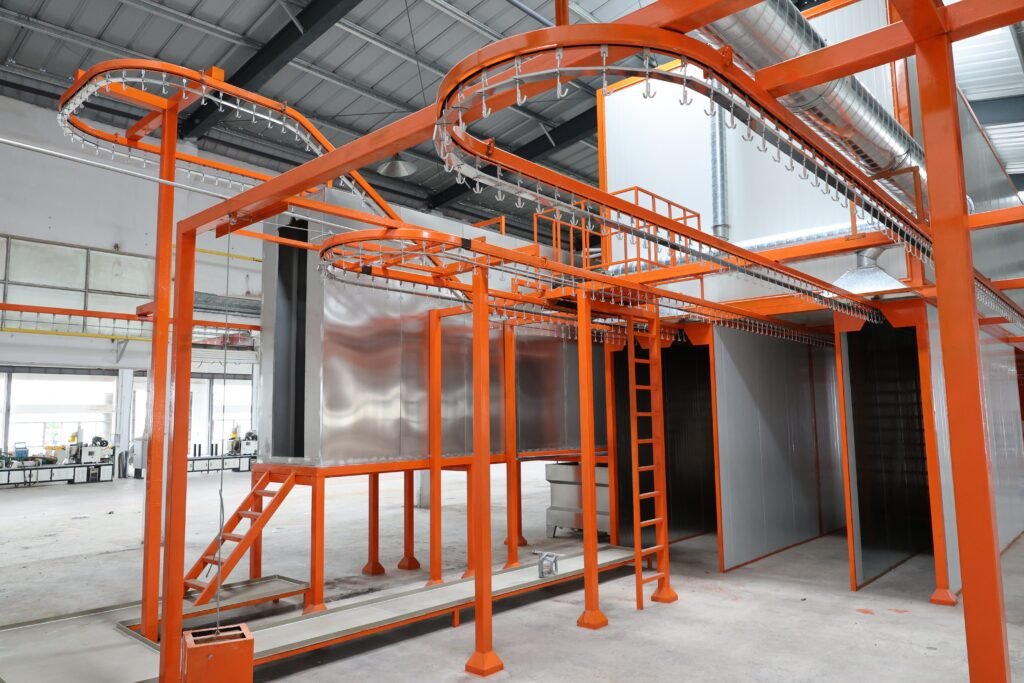
Ketu Powder Coating Line: Complete Transportation & Installation Guide
When you're investing in a Ketu electrostatic powder coating line, getting the equipment safely to your facility and properly installed is just as critical as the equipment's performance. From the moment we manufacture your system to the day it runs its first production batch, logistics, packaging, site preparation, and on-site support all play essential roles in determining whether your investment delivers results.
The reality is that transporting and installing a complete powder coating production line is far more complex than shipping a single machine. You need to understand site requirements, packaging protocols, delivery timelines, cost structures, and quality assurance procedures—before anything leaves our factory.
What Is Ketu Powder Coating Line Transportation Equipment?
When we talk about "Ketu powder coating line transportation equipment," we're referring to the complete logistics package involved in getting your customized electrostatic powder coating system from our facility in Foshan, China, to your manufacturing site anywhere in the world. This includes the pre-shipment planning, protective packaging, carrier selection, in-transit monitoring, and delivery coordination that ensure your equipment arrives in perfect operational condition.
Our powder coating lines are typically composed of modular components: pre-treatment systems, electrostatic spray chambers, curing ovens, conveyor systems, powder recovery units, and control systems. Each module must be individually protected, properly sequenced, and coordinated to ensure on-site assembly runs smoothly without delays or rework.
Our transportation approach is not one-size-fits-all. For a cabinet factory in Algeria needing a 5,100mm curing oven and complete spray booth assembly, the logistics and protection strategy looks completely different from what a Turkish furniture manufacturer or an Indian aluminum extrusion company would require. We design the transportation plan around your specific equipment configuration, destination infrastructure, and timeline expectations.
![powder coating line manufacturing in factory]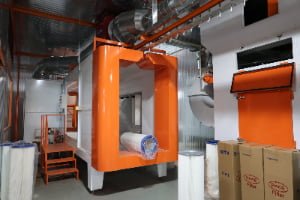
Standard Transportation Methods for Ketu Powder Coating Lines
Domestic Transportation Options
For customers within mainland China, we arrange dedicated heavy-load truck transport. Our standard practice involves:
Vehicle Selection & Load Planning
We match truck capacity (typically 13-17 meters flatbed) to your equipment dimensions. For larger integrated systems, we may use multi-truck coordination or staged delivery. Load weight for a complete line typically ranges from 8-15 tons depending on configuration.
Route Planning & Coordination
We confirm delivery routes 2-3 weeks before shipment, accounting for seasonal road conditions, weight restrictions on certain highways, and toll requirements. Our logistics team coordinates with local authorities for oversized cargo permits when necessary. Typical domestic delivery within China runs 3-7 days depending on distance.
Driver & Vehicle Standards
All transportation is handled by certified carriers with commercial vehicle insurance. Drivers must carry hazmat documentation where applicable (electrical systems, some fasteners). Vehicle GPS tracking is standard, allowing you real-time visibility of your equipment's location.
Protective Measures During Domestic Transport
Equipment is secured with ratchet straps and load locks. Vibration-sensitive components (electronic controllers, filters) are placed in the cargo center to minimize road shock. We cover the load with waterproof tarps to protect against weather exposure during transit.
International Shipping & Logistics
For overseas customers—whether in Algeria, Turkey, India, Europe, or elsewhere—we provide comprehensive international logistics coordination.
Ocean Freight (Primary Method)
Most of our overseas shipments go by sea, typically in 20-foot or 40-foot containers depending on equipment size. A complete integrated powder coating line (pre-treatment system + spray room + curing oven + recovery cabinet + conveyor system) usually occupies one 40-foot high-cube container. Shipping time from Foshan to major ports (Port Said for Africa, Rotterdam for Europe, Port of Singapore for Asia) typically runs 20-40 days depending on routing.
Container Preparation & FCL Loading
We load your equipment inside the container with proper blocking, bracing, and dunnage to prevent shifting during ocean transport. Each major component gets individual wrapping and cushioning. Our team completes container sealing with tamper-evident security seals. You receive the container number, bill of lading, and full shipment documentation before departure.
Customs Documentation & Export Compliance
We prepare all export documentation including commercial invoices, packing lists, certificates of origin, and manufacturer declarations. For EU customers, we ensure CE compliance documentation is included. For countries requiring pre-import notifications, we provide advance information to facilitate customs clearance.
Multi-Modal Transport Options
For customers in landlocked regions or requiring faster delivery, we can arrange rail transport from Foshan to inland ports, then ocean freight, with final truck delivery to your facility. For time-sensitive projects, we offer air freight for smaller components (control systems, filters, spare parts) with ocean freight for the main structure.
Last-Mile Delivery Coordination
Upon vessel arrival at your destination port, we coordinate with local freight forwarders or customs brokers to handle import clearance, port storage, and final truck delivery. We provide arrival notification and delivery scheduling information 7-10 days before container arrival.
![powder coating line modular assembly diagram]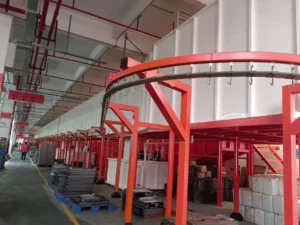
Equipment Packaging & Protective Measures During Transit
Protecting your powder coating line during transit is non-negotiable. A damaged spray room or misaligned conveyor system can cost weeks of rework and thousands in lost production. Our packaging strategy depends on component sensitivity and transport distance.
Spray Room & Chamber Packaging
The spray booth is our most sensitive component. We partially disassemble it into panels and base framework. Each panel (side walls, roof panels, internal baffles) is individually wrapped in bubble wrap and kraft paper, then placed in custom wooden crates with foam corner blocks. The internal spray gun fixtures and illumination systems are removed and packaged separately in shock-absorbing boxes. This approach reduces shipping volume by ~30% compared to shipping the complete assembled booth, while drastically reducing in-transit damage risk.
Curing Oven Protection
The fixed or electric curing oven is extremely sensitive to vibration and impact because thermal cycling and structural stress can affect the heating element alignment and insulation integrity. We remove the heating elements and temperature probes, package them in separate cushioned containers, and ship the oven shell wrapped in reinforced kraft paper with wooden bracing. The oven travels with its own securing points clearly marked for warehouse and installation crew guidance.
Conveyor System & Frame Elements
The suspended conveyor chain, track supports, and lifting mechanisms are carefully drained of any fluids, then wrapped and boxed. We provide detailed assembly diagrams and marking labels on every box so on-site teams know the exact sequence for reassembly.
Electrical Control Systems
Your PLC, variable frequency drives, temperature controllers, and electrical panels are packed in anti-static foam containers with desiccant packs to prevent moisture ingress. Control systems are never mixed with mechanical components to avoid contamination.
Documentation & Packing Lists
Every box is numbered sequentially. We provide detailed packing lists showing box contents, weight, dimensions, and assembly sequence. This documentation is critical for customs clearance and for your installation team to verify nothing was lost or damaged before starting assembly.
Moisture & Temperature Control
For ocean freight crossing tropical or humid regions, we include silica gel desiccant packs rated for 50+ kg moisture absorption per container. For customers in monsoon climates, we recommend humidity-controlled storage for at least the first week after arrival before beginning assembly.
| Component | Packaging Method | Protection Level | Transit Duration Tolerance |
|---|---|---|---|
| Spray Booth Panels | Wooden crates + foam blocking | Maximum | 45+ days |
| Curing Oven Shell | Kraft wrap + wooden bracing | Maximum | 45+ days |
| Conveyor System | Metal corner protectors + blankets | High | 30+ days |
| Control Systems | Anti-static foam boxes | Maximum | 60+ days |
| Fasteners & Hardware | Sealed cartons with desiccant | Medium | 60+ days |
Site Preparation Requirements Before Equipment Arrival
Space & Infrastructure Requirements
Before your Ketu powder coating line ships, you must have a site ready to receive it. Arrival of equipment to an unprepared location is the #1 cause of installation delays and on-site assembly problems we see in the field.
Spatial Footprint & Layout
A complete integrated powder coating line typically requires a footprint of 15-25 meters in length (depending on spray booth size, oven length, and conveyor configuration) and 5-8 meters in width. You need at least 3.5-4 meters of ceiling clearance if you're using suspended conveyor systems, or 2.5 meters for ground-level configurations. Before placing your order, we provide a detailed spatial layout drawing showing exact dimensions of every component relative to your facility walls, pillars, and existing equipment.
Floor Load Bearing Capacity
Curing ovens alone can weigh 3-5 tons. Fully laden spray booths with recovery cabinets may weigh 2-3 tons. Your facility's floor must support concentrated point loads—we typically recommend a minimum of 5 tons per square meter where equipment will rest. If your facility has structural concerns, consult a structural engineer before equipment arrives.
Electrical Supply Specifications
Our complete powder coating lines typically require 380V three-phase power at 50Hz (or 60Hz in some regions) with a capacity of 60-100 kW depending on your system configuration. Smaller manual systems may require only 30-40 kW. We provide exact electrical schematics during the design phase. Your electrical contractor must install dedicated circuits with appropriate circuit breakers and grounding systems before installation begins. We strongly recommend a 10-15% power buffer above your calculated system demand.
Compressed Air Supply
You will need a compressed air system delivering 4-8 kg/cm² with a minimum of 500-800 m³/hour volume for a complete line. Air must be filtered to remove oil and water, then passed through a refrigerated dryer. Many installation delays happen because the customer's air supply is undersized or unfiltered. We recommend installing your air system at least 4 weeks before equipment arrival.
Water Supply (If Pre-treatment is Water-Based)
If your system includes water-based pre-treatment (phosphating, degreasing), you'll need a stable water supply at 2.0 kg/cm² pressure. Water quality matters—sediment or mineral buildup can clog nozzles and filters. We can provide water filtration recommendations during site preparation discussions.
Natural Gas or LPG (If Curing Oven Uses Gas Heat)
Gas-heated curing ovens require secure gas supply at 0.5-2.0 kg/cm² depending on burner type. Gas lines must be professionally installed and certified before equipment connection. Electric-heated systems eliminate this requirement but increase electrical demand.
Receiving & Storage Conditions
Protected Storage Area
When equipment arrives, you need a dry, covered storage area for at least 2-3 weeks if installation can't begin immediately. This prevents weather exposure and gives your team time to verify shipment completeness and integrity. An unheated but dry warehouse is ideal. Avoid outdoor storage in tropical climates where salt spray or monsoon humidity can corrode metal components.
Verification & Inspection Upon Arrival
When containers arrive, inspect them immediately for signs of damage (crushed corners, bent seals, water entry). Before accepting delivery, open containers and visually inspect major components. Check that all boxes match your packing list. Look for any visible shipping damage. Document any discrepancies with photos and written notes. We provide a detailed receiving checklist that your team should complete within 48 hours of delivery.
Component Organization & Staging
Once containers are opened, organize components logically in your warehouse—group all spray booth parts together, all oven components together, all conveyor and control system boxes in a separate area. Label open boxes clearly with component names and installation sequence. This organization saves enormous time when installation begins.
Climate Control During Storage
If you're in a humid climate and installation will be delayed 2+ weeks, we strongly recommend storing electrical control systems and filters in a climate-controlled room with dehumidifiers running continuously. Moisture absorption into filter media can compromise filtration efficiency even before the system starts operating.
![powder coating line curing oven assembly]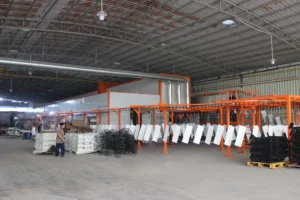
Installation Timeline & On-Site Support Services
Standard Installation Sequence
From equipment arrival to first production run, plan for 3-4 weeks of on-site work, not including final testing and operator training. This timeline assumes your site is fully prepared (electrical, compressed air, water supply all ready) and your team is available for daily coordination.
Phase 1: Foundation & Structural Setup (Days 1-3)
Our installation team arrives with detailed foundation drawings. We verify floor levelness, install anchor bolts, and set up the main structural framework. For spray booths and ovens, we use laser levels to ensure components will align properly during assembly. Any floor irregularities greater than 5mm must be shimmed or ground before component installation.
Phase 2: Component Assembly (Days 4-10)
Spray room walls, roof panels, and internal baffles are assembled. Conveyor systems (whether suspended chain or floor-mounted) are installed, leveled, and tested for smooth operation. The curing oven thermal jacket, heating elements, and insulation are installed. All interconnecting ducting between spray booth and recovery systems is fabricated and connected. This phase is material-intensive and requires your team's active participation in material handling.
Phase 3: Utility Connection (Days 11-14)
Electrical control panels are connected to facility power, with testing of all circuits and emergency stop systems. Compressed air lines are run from your central supply through filters and dryers to all spray guns and control valves. If using gas heating, gas lines are pressure-tested and connected by licensed technicians. Water and drain systems (if applicable) are connected and tested for proper flow and drainage.
Phase 4: System Testing & Parameter Setup (Days 15-18)
We conduct electrical safety tests, compressed air flow verification, and conveyor speed calibration. The control system is programmed with your specific parameters: curing temperature and time, conveyor speed, spray gun timing sequences. We run empty cycles to verify smooth operation and proper interlocks.
Phase 5: Commissioning & First Production (Days 19-21)
Your team runs actual sample products through the line under our supervision. We monitor spray pattern uniformity, curing quality, and coating thickness. We make on-site adjustments to spray gun distance, electrical voltage, or air pressure based on real-world results. Quality testing on finished samples confirms the system meets your specifications.
Ketu On-Site Support Services
We don't simply deliver equipment and walk away. Our installation and support package includes:
Technical Installation Team
2-3 specialized technicians from our factory work on-site for the full installation period. These team members understand every mechanical detail and every electrical connection. They can troubleshoot problems instantly, which prevents days of delay from trial-and-error diagnosis.
Parameter Optimization
Every facility has slightly different conditions—air humidity, power supply stability, foundational vibration levels, even water quality. Our team uses their field experience to fine-tune your system's parameters for your specific conditions. This optimization work is invisible to the customer but critical to long-term stability.
Operator Training
We conduct comprehensive training for your production team covering system startup, spray gun operation, color changeover procedures, basic troubleshooting, and safety protocols. We emphasize maintenance responsibilities—filter replacement, gun cleaning, conveyor lubrication—because operator care directly affects equipment lifespan.
Documentation Handover
We provide complete operation manuals, spare parts catalogs, maintenance schedules, and electrical schematics in your preferred language (English, Chinese, or local language where applicable). All critical phone numbers and emergency contact information are included.
Post-Commissioning Support
For 30 days after commissioning, our team remains available by phone/video for remote troubleshooting. If a critical issue emerges during those 30 days, we can arrange expedited spare parts delivery or send a technician back if necessary (travel costs apply).
![powder coating line electrical control system setup]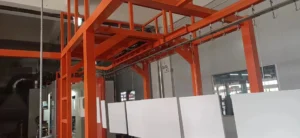
Transportation Costs & Commercial Terms
Shipping Cost Calculation
Transportation cost is NOT a fixed price—it depends on four major variables:
Equipment Configuration & Weight
A small, semi-automated spray room may weigh 2-3 tons and occupy minimal container space, resulting in lower shipping costs. A fully integrated system (pre-treatment + spray booth + recovery cabinet + curing oven + conveyor) can weigh 12-15 tons and require a full 40-foot high-cube container. Larger equipment costs proportionally more to transport.
Destination & Distance
Shipping to Turkey or Algeria costs considerably less than shipping to Australia or New Zealand due to distance and port availability. Landlocked countries (India, Kazakhstan) may require rail routing, increasing transport time and cost. We provide detailed quotes once you've confirmed your destination.
Seasonality & Market Rates
Ocean freight rates fluctuate monthly based on carrier capacity and global shipping demand. Shipping during peak seasons (September-November for Christmas inventory buildup) costs 20-30% more than off-season (January-March). We lock in rates at time of booking to provide cost certainty.
Insurance & Documentation
Full-value transit insurance (recommended) typically adds 2-3% to shipping cost. Custom documentation, certificates of origin, and pre-import notifications may add $500-$2,000 depending on destination country regulations.
Typical Cost Range
- Domestic transport within China: ¥3,000-¥8,000 ($450-$1,200 USD) depending on distance
- International ocean freight (door-to-port): $4,000-$12,000 depending on destination and equipment size
- Port clearance, last-mile delivery, and installation support: $2,000-$6,000 depending on local labor costs
Payment & Commercial Terms
Standard Terms
We operate on a 50% advance deposit (non-refundable, applied to final invoice) with balance due upon equipment shipment. For overseas orders, we can arrange letters of credit (L/C) at sight, which provides security for both parties.
Shipping Cost Handling
In most cases, shipping is quoted separately and invoiced at cost-plus-handling. We recommend that customers arrange their own freight forwarder after manufacturing is complete, which often saves 10-15% versus using our designated carrier. We'll coordinate directly with your forwarder.
Duty & Import Costs
Customers are responsible for all import duties, customs clearance fees, and in-country taxes. These vary dramatically by country and product classification. We provide a detailed commercial invoice to minimize customs valuation disputes.
Installation Services & Travel
Installation technician fees are typically $100-$150 per day per technician, plus airfare, accommodations, and meals. For most international projects, a 3-week installation visit costs $8,000-$15,000 including travel. We provide a detailed quote after site preparation details are confirmed.
Extended Support & Training
Post-commissioning support (30 days included; beyond that: $80-$120 per hour for remote support or $150+ per day + travel for on-site technician returns).
Quality Assurance: Inspection & Damage Management During Delivery
Factory Inspection Before Shipment
Every component is individually inspected before packing. We verify:
- Mechanical fit and alignment (no misaligned bolt holes, no stuck moving parts)
- Electrical continuity and insulation resistance (tested per IEC standards)
- Surface condition (no rust, corrosion, or cosmetic damage beyond acceptable wear)
- Functional operation of all systems (conveyor runs smoothly, spray guns trigger correctly, heating elements reach target temperature)
We document all findings in a pre-shipment inspection report, which you receive before shipping. If any component fails inspection, it's replaced before packing.
Damage Documentation & Claims
Upon arrival, if any equipment shows shipping damage:
- Photograph everything before opening—document crushed boxes, dented metal, cracked panels
- Open container carefully and inspect interior—water damage, shifting loads, component separation
- Complete damage report immediately with photos and itemized list of affected components
- Notify freight forwarder and shipper within 48 hours to file formal damage claim
- Contact Ketu with photos and inventory—we'll arrange replacement parts or components
Shipping insurance coverage typically reimburses replacement costs for damaged goods, but claims require documentation within specific timeframes (usually 14 days). We help coordinate this process with our shipping insurance provider.
Quality Verification During Installation
During on-site installation, our team conducts functional tests:
- Conveyor belt tension, alignment, and speed accuracy (±2% tolerance)
- Spray gun electrical continuity and trigger response (must trigger cleanly, no delay)
- Curing oven temperature uniformity (±5°C variance across oven width acceptable)
- Powder recovery system air flow (must achieve target CFM without excessive dust bypass)
- Control system logic and emergency stops (all safety interlocks must function)
If any component fails functional verification, we repair or replace it immediately at no additional cost during the warranty period (typically 12 months from commissioning).
Preventive Maintenance During First Year
To protect your warranty and ensure reliability:
Monthly Inspections
- Check spray gun nozzles for blockage or wear
- Inspect filter elements for excessive dust loading
- Verify conveyor chain tension and lubrication
- Check electrical connections for corrosion or looseness
Quarterly Maintenance
- Clean or replace spray room filter elements
- Inspect curing oven door seals and insulation
- Test emergency stop systems
- Calibrate temperature sensors
Annual Service
- Complete bearing and bushing lubrication
- Electrical system comprehensive testing
- Heating element inspection (for electric ovens)
- Gas burner inspection and cleaning (for gas-heated systems)
We provide a detailed maintenance checklist and recommend scheduling with a qualified local technician for years 2+. Many failures that appear catastrophic are actually prevented by simple scheduled maintenance.
Practical Guidance on Equipment Selection Based on Transportation Constraints
From our experience working with customers across three continents, I want to emphasize something that many factories overlook: transportation constraints should influence your equipment configuration choice from the beginning, not be treated as an afterthought.
For example, if you're in a remote facility with poor road access or in a country where oversized cargo permits are expensive and time-consuming, choosing a pre-assembled curing oven saves you installation time but costs significantly more to transport. Conversely, if you can receive equipment in modular sections and have skilled assembly capabilities on-site, the modular approach cuts transportation costs by 20-30% and shipping time by a week.
We've seen customers in Indonesia and India successfully receive and assemble modular systems that would have been impossible to deliver pre-assembled. Turkish customers, with more developed port infrastructure, prefer integrated systems with fewer on-site connection points.
The lesson: When we discuss configuration options with you, we always factor in your location, local infrastructure, and realistic on-site assembly capabilities. A system that's perfect for a customer 50 kilometers from Shanghai might be completely wrong for a customer in rural Algeria.
Conclusion: Making Transportation & Installation Smooth
Successful equipment delivery and installation depend on three factors working together: clear communication about requirements, proper planning from our side, and thorough site preparation from yours.
We've handled transportation for customers across Asia, Africa, the Middle East, and Europe. We've managed installations in factories with excellent infrastructure and installations in facilities where on-site challenges tested our flexibility. In every case, success came when all parties understood the process, agreed on timelines, and communicated early about potential obstacles.
Your action items right now:
-
Confirm your site's current status: Do you have electrical supply? Compressed air? Space layout finalized? The earlier you confirm these, the sooner we can finalize your shipping plan.
-
Set a realistic timeline: Equipment manufacturing takes 50-60 working days. Shipping takes 20-45 days depending on destination. Installation takes 3-4 weeks. Plan accordingly and don't expect faster delivery without premium rush fees.
-
Prepare your facility: Foundation work, electrical installation, and air supply setup should begin as soon as your order is confirmed. Don't wait for equipment to arrive—this is the #1 source of installation delay.
-
Decide on installation support: We can handle everything or you can arrange local assembly support—just be clear about this before we start manufacturing. Our on-site team knows your equipment intimately, but local support is always an option.
If you have specific questions about your site conditions, equipment configuration, shipping destination, or timeline expectations, contact us directly. We can provide a detailed transportation and installation plan customized to your exact situation.
Contact Ketu:
- WhatsApp: +8618064668879
- Email: ketumachinery@gmail.com
Let's make sure your powder coating line arrives on time, in perfect condition, and starts producing quality parts from day one.
 English
  German
  Vietnamese
  French