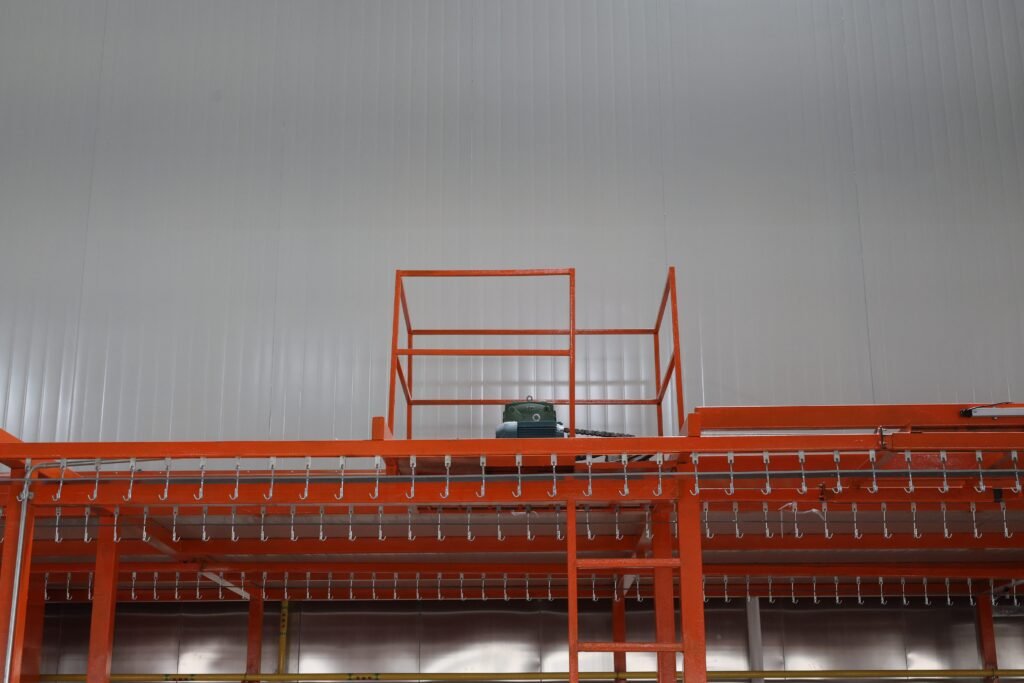
Your Powder Coating Conveyor Might Be Wasting Heavy — Diagnosis & Fixes
If your powder coating line is running but your costs keep climbing, your product quality feels inconsistent, or you're struggling to hit throughput targets, the problem might not be your spray guns or curing oven. From our experience running full-scale coating lines across different industries, we've found that conveyor system waste is one of the most overlooked — and most costly — efficiency killers on the floor.
Your conveyor system waste typically manifests in three ways: time lost to poor synchronization between stages, energy wasted by inefficient line speed settings, and material losses from improper powder recovery integration. Most operations recover only 10–20% of their capacity and cost optimization potential by fixing conveyor timing alone, while 60–70% of real waste lives in the mismatch between transport speed, dwell time, and downstream processing requirements.
Let's dig into what's actually happening on your line, how to spot it, and what to do about it.
Identifying the Real Waste in Your Powder Coating Conveyor System
When we walk into a factory for the first time, most people assume we'll focus on spray gun parameters or oven temperature curves. But after dozens of installations and commissioning projects across cabinet manufacturing, outdoor furniture, and aluminum profile operations, we've learned to look at the conveyor first.
Why? Because the conveyor is the heartbeat of your entire line. It doesn't just move parts—it dictates how long your workpiece spends in each zone, whether your spray guns have enough time to apply coating, whether your parts actually cure properly, and whether energy is being burned or saved.
Waste in a conveyor system shows up differently than waste in a spray booth or curing oven. You might not see it as a defect. Instead, you'll see it as creeping inefficiency: slower cycle times, higher energy bills than expected, inconsistent film thickness between the first and last part of your batch, or a feeling that your line "never quite reaches its nameplate capacity."
![powder coating conveyor system efficiency]
The core issue is this: a conveyor is not just a transport mechanism. It's a timing and synchronization device. When it's misconfigured, it creates bottlenecks that ripple through your entire process.
Common Conveyor Wasting Problems and Their Cost Impact
Speed Mismatch: Running Too Fast or Too Slow
This is the single most common problem we encounter. The line is set to a certain speed, but that speed wasn't optimized for your actual product and process requirements—it was either a carryover from the old line, or it was guessed at during commissioning.
When the conveyor runs too fast, your parts spend less time in the spray zone. The spray guns don't have enough time to build an even coating, so you get thin areas, coverage gaps, and later complaints about adhesion or durability. You end up reworking parts, applying extra coats, or—worse—letting defects slip through to the customer. We've seen factories running at 3 m/min when their spray booth layout actually required 1.8 m/min to allow proper powder application. The result was 15% rejection rates that disappeared once we recalibrated.
When the conveyor runs too slowly, you're burning energy for no reason. Your curing oven is idling longer, your HVAC system is running more to maintain spray booth conditions, and your hourly throughput collapses. One metal cabinet manufacturer we advised had set their line speed to 1 m/min when best-practice analysis showed 2.2 m/min was achievable without quality loss. They were leaving 45% of their potential capacity on the table every single day.
The cost impact: even a 10% speed mismatch typically translates to either 8–12% more energy spend (if you're running slow) or 15–25% more rework costs (if you're running fast).
Line Starvation and Accumulation from Poor Takt Synchronization
This is where most operations really start bleeding money, and it's almost invisible to the naked eye.
Your pre-treatment zone, spray booth, and curing oven all have different throughput rates. The pre-treatment system might be designed to process 30 parts per hour. Your spray booth can handle 28. Your curing oven can handle 35. When these aren't synchronized, you get either starvation (the oven sits empty, burning fuel for nothing) or accumulation (parts pile up in the spray booth, waiting to enter the oven, while the spray guns can't move forward).
From our experience working with whole-line configurations, the most common scenario is this: the spray zone becomes a bottleneck. Parts back up because the oven can't take them fast enough. Your spray operators are idle or working inefficiently. Your conveyor is moving parts, but parts aren't flowing—they're queuing. This kills two things: throughput and quality consistency. Parts sitting in the spray booth longer get uneven exposure, and the thermal stress of waiting affects adhesion.
We worked with an aluminum profile line where pre-treatment could handle 40 parts/hour, spraying was set for 35 parts/hour, but the curing oven was only rated for 28 parts/hour. For three hours every morning, the line looked busy. But the actual output was constrained by the oven. The spray zone was running hot and inefficiently, and energy was being wasted. Once we rebalanced the entire line—slowing down spray slightly, optimizing pre-treatment timing, and adjusting oven residence time—throughput actually increased by 18% and energy consumption dropped by 12%.
Undersized or Mismatched Conveyor Design
Sometimes the problem isn't how the conveyor is being used—it's that the conveyor itself isn't right for the job.
A common mistake: selecting a conveyor based on maximum workpiece size without considering actual production mix. If your conveyor is rated for 1500 mm parts but 60% of your production is 800 mm parts, you're wasting spacing and throughput. Conversely, if you're trying to fit 1200 mm parts onto a line designed for 1000 mm spacing, you either jam up or reduce density unacceptably, killing throughput.
Another mismatch we see often: chain speed versus bearing load design. A lightweight chain moving fast might be fine for small, light brackets. But if you're hanging heavier cabinets or using aggressive hangers, the chain wears faster, maintenance stops increase, and micro-stoppages become chronic. Every stoppage costs you cycle time and creates thermal inconsistency in the oven.
We've also encountered operations where the conveyor was designed for one product line but is now being used for three different product types. The hangers don't adapt well, parts tilt in the spray booth (creating uneven coverage), and the oven spacing becomes sub-optimal. The "solution" is often a manual rework station, but the real fix is a reconfigured or hybrid conveyor system.
Why Conveyor Waste Happens: Root Causes Beyond Single Equipment
Most conveyor waste doesn't come from the conveyor being broken or old. It comes from misalignment between what the line was designed to do and what the customer actually needs it to do.
Here's what we typically find:
First, there's usually no real takt analysis done at commissioning time. The line is installed, run through a few cycles, and deemed "good to go." No one actually measures: How long should pre-treatment take for this material? How long does spray need? How long should parts sit in the oven before they're fully cured? What's the optimal spacing? These questions get answered by trial and error, not by engineering. By the time your line has been running for six months, you're locked into a pattern that nobody questions.
Second, product mix changes aren't reflected in line configuration. You started making 50-mm brackets. Now you're also making 150-mm cabinets and 80-mm profiles. The same conveyor speed doesn't work for all three. But changing speed mid-shift is disruptive, so people run an average speed that's optimal for none of them.
Third, maintenance losses aren't tracked or managed. A sticky chain, a worn bearing, or a sensor that's slightly misaligned doesn't break the line—it just slows it incrementally. Over a week, these micro-stoppages add up to 8–12% lost throughput. Over a month, nobody noticed. Over a year, it's the difference between hitting target and missing it by 20%.
Fourth, energy consumption isn't tied back to conveyor behavior. The oven is running 24/7, whether parts are flowing through it or sitting backed up. HVAC is running to maintain spray booth conditions, regardless of whether the line is actively spraying. But nobody connects the dots between "conveyor ran slow today" and "our energy bill was 6% higher than expected." So the waste stays hidden.
![metal cabinet conveyor powder coating]
The Hidden Cost of Manual vs. Automatic Conveyor Systems
One of the first decisions you make when planning a coating line is whether to use manual (hand-pushed or operator-controlled) or automatic (continuous chain, servo-driven, or hybrid) conveyors.
From our experience across cabinet, furniture, and aluminum operations, the cost-benefit math is not what most people think.
Manual conveyor systems look cheaper upfront. No variable frequency drives, no precision bearings, no PLC control. Just a simple chain or rail that the operator pushes or pulls. And for very low-volume, high-variety operations (think job shops doing 10–15 parts per day), manual can work fine.
But here's what actually happens as volume scales: the operator's pace becomes inconsistent. Sometimes the parts move fast, sometimes slow. Dwell times in the spray booth vary by ±30%. Some parts get 8 seconds under the spray guns, others get 12. Quality becomes unpredictable. And because there's no hard constraint on timing, the line naturally gravitates toward "faster to finish the shift," which means shortcuts—lighter coats, less cure time, rushed handling. Rework and complaints increase.
The hidden cost of manual: 8–15% higher defect rates, chronic unevenness in film thickness, operator fatigue leading to mistakes, and inconsistent throughput that makes scheduling difficult.
Automatic conveyor systems (continuous chain at fixed speed, servo-controlled hangers, etc.) have higher upfront cost—typically 25–40% more than manual equivalent. But what you get is:
- Repeatable cycle time. Every part spends the exact same amount of time in spray and cure. Quality becomes predictable and consistent.
- Measurable throughput. You know exactly how many parts per hour the line can handle, so scheduling becomes reliable.
- Lower defect rates. We typically see 5–10% reduction in rework just from timing consistency alone.
- Lower labor cost. You need one operator to monitor, not two to move parts. Over a year, that's significant savings.
- Energy optimization. Because the line is always full and moving at consistent speed, the oven isn't running in start-stop mode, and HVAC can be tuned precisely.
Our recommendation: For day-to-day production above 50 parts per day (roughly 400–500 per week), automatic conveyors pay for themselves within 18–24 months through better quality, lower rework, and consistent throughput. For lower volumes or highly mixed production, hybrid systems (manual load, automatic transport) often make more sense than full manual.
How to Diagnose Your Conveyor's Efficiency: A Self-Check Framework
If you suspect your conveyor is wasting time and resources, here's a practical diagnosis framework we use on-site:
Step 1: Establish baseline metrics (Week 1)
- Measure actual cycle time for 20 consecutive parts. Time from when a part enters the line to when it exits the curing oven. Record time and note any pauses.
- Count how many times the line actually stops or slows, and why. (Jam? Sensor? Operator delay? Oven thermal cycle?)
- Record conveyor speed setting (if variable) and note whether it changes during the shift.
Step 2: Map dwell time by zone (Week 1–2)
For each zone (pre-treatment, dry-off, spray booth, cure zone), measure how long a part actually spends there:
| Zone | Target Time | Actual Time | Notes |
|---|---|---|---|
| Pre-treatment | 3–5 min | 4.2 min | Normal |
| Dry-off | 1–2 min | 1.8 min | Normal |
| Spray booth | 1–2 min | 0.9 min | Too fast — thin coating |
| Cure zone | 10–15 min | 12.5 min | Acceptable |
If any zone is significantly different from your process spec, that's your first indicator of mismatch.
Step 3: Measure actual production output vs. nameplate (Week 2)
Run the line for a full shift under normal conditions. Count actual parts completed. Divide by shift hours to get parts/hour. Compare to what the line is supposed to produce at its current speed setting.
If actual output is 20–30% below nameplate, there's significant waste from either stopping/starting or improper speed calibration.
Step 4: Check energy consumption by conveyor state (Week 2–3)
Work with your facilities team to correlate power consumption to line activity. Typical findings:
- Idle line (no parts, no spray): ~40–50 kW (oven baseline + HVAC)
- Line running light (parts moving, no spray): ~55–65 kW
- Line in full production (spray + cure active): ~85–120 kW
If your idle consumption is much higher, there's thermal bleed or HVAC over-sizing. If full production consumption is much higher without increased output, there's inefficient spraying or oven cycling.
Step 5: Audit spacing and hanging consistency (Week 3)
Walk the line with a tape measure. Measure spacing between hanging parts:
- Are all parts equally spaced?
- Do parts tilt in the spray booth? (Could indicate hanger misalignment or load imbalance.)
- Are some hangers carrying heavier load than others? (Uneven wear on chain.)
Inconsistent spacing kills spray quality and oven efficiency.
Step 6: Interview operators (Week 3)
Ask directly: What do they do to keep the line moving? Where are the frequent bottlenecks? Do they ever manually adjust the line? What's the most frustrating part of the day? Operators know where the waste is; they just might not have been asked.
From this data, you'll have a clear picture of whether your waste is from speed mismatch, synchronization problems, equipment design issues, or maintenance degradation.
Fixing Conveyor Waste: Quick Wins and Upgrade Strategies
Once you've diagnosed the problem, the fix usually falls into one of three categories: immediate tuning, intermediate optimization, or long-term upgrade.
Optimizing Takt Synchronization Between Stages
If your diagnosis shows that parts are backing up in the spray booth or sitting idle in the oven, your first fix is synchronization adjustment.
The principle: All stages should have roughly equivalent throughput. If pre-treatment can handle 30 parts/hour but spray can only handle 25, the bottleneck is spray. The fix is either to slow down pre-treatment slightly (so parts don't stack), or to speed up spray (more guns, faster application, etc.), or both.
From our experience, the quickest win is usually conveyor speed recalibration. If your line is running at 2.0 m/min but analysis shows 1.6 m/min is optimal (still getting good spray coverage, still getting full cure), you slow it down. This reduces starvation, improves quality, and often reduces energy because parts move more efficiently through each zone.
The second win is adjusting spacing. If parts are too close together, they interfere with spray patterns and oven airflow. If they're too far apart, you're wasting line capacity. Optimal spacing depends on workpiece size, but typically you want 20–40% of workpiece length as gap. For a 1000 mm cabinet, that's 200–400 mm gap. One furniture maker we worked with had parts spaced at 600 mm gap (wasting 30% of line space). Reducing to 350 mm gap increased throughput by 25% without quality loss.
The third win is pre-treatment residence time. Many lines run pre-treatment slower than necessary, "just to be safe." In reality, most materials need 2–4 minutes in cleaning and rinse stages, not 6–8. Tightening pre-treatment time by 30–40% usually has no quality impact and frees up the entire line rhythm.
Improving Recirculation and Powder Recovery Integration
If your diagnosis shows high powder consumption or inconsistent film thickness, the problem is often in how your recirculated powder is being integrated with fresh powder.
Most operations use a simple system: spray the part, collect excess powder in the spray booth, run it through a cyclone separator, mix some percentage back into fresh powder, and spray again. But this creates variability. The recirculated powder has different charge characteristics, particle size distribution, and contamination levels than fresh powder. So parts sprayed with high recirculation percentage look different from parts sprayed with low recirculation.
Our recommendation: Use a dedicated holding tank for recirculated powder. Test it weekly for cleanliness and charge. If it's degraded (more fines, more agglomeration, more contamination), replace it sooner. Mix recirculated and fresh in a consistent ratio (typically 30–50% recirculated) rather than guessing based on available inventory.
The second fix is conveyor-integrated powder recovery timing. Your powder recovery system should be actively pulling powder from the booth during spraying, not waiting until end-of-shift. This keeps the spray zone cleaner and reduces re-application of settled dust. Synchronize your recovery fan with your conveyor motion: when the line is moving and spraying, recovery is on. When the line is paused, recovery can pause too (saving energy). This simple coordination typically improves first-pass quality by 8–12% and reduces powder waste by 10–15%.
Maintenance and Component Lifecycle Management
Conveyor waste often accelerates over time due to maintenance neglect. A well-maintained chain running true and smooth can last 3–5 years. A neglected chain starts binding after 18–24 months, creating micro-stoppages that compound into 5–8% throughput loss.
Our standard maintenance protocol:
- Weekly: Visual inspection of chain tension, hanging alignment, and for visible wear or corrosion.
- Monthly: Measure chain sag under load. Adjust if sag exceeds tolerance (typically ±5 mm from spec).
- Quarterly: Clean and re-lube chain. Check bearing play and hanger connection integrity.
- Annually: Measure actual conveyor speed under load and compare to set speed. Recalibrate if drift exceeds ±5%.
- Every 2–3 years: Replace chain and bearings as preventive maintenance, before failure. Cost is ~$3,000–5,000; unplanned downtime costs are ~$5,000–10,000 per day.
We've found that operations following this protocol maintain throughput and quality consistency year-over-year. Operations skipping maintenance see gradual degradation and higher ultimate cost.
Multi-Product Production and Dynamic Conveyor Configuration
If your operation produces multiple product types (different sizes, different materials, different coating requirements), standard single-speed conveyor configuration becomes a liability.
You have three options:
Option 1: Fixed speed compromise. Run the line at a speed that's "good enough" for all products. Result: some products get sub-optimal processing, quality varies, throughput is never optimized for any single product. This is common and costly.
Option 2: Variable speed by product. Equip the conveyor with a VFD (variable frequency drive) and operator interface. When switching products, the operator selects the product type, and the line speed adjusts automatically. Spray booth lighting might adjust, too. This requires clear documentation of parameters for each product type, but gives you optimal processing for each. Extra cost: ~$8,000–12,000 in controls. Payback: usually 12–18 months through quality improvement and throughput consistency.
Option 3: Parallel or staged lines. Run separate conveyor systems for different product families (fast line for small light parts, slower line for heavy cabinets, etc.). Higher capex, but best throughput and quality control when volume justifies it.
From our projects, Option 2 (VFD + automated speed switching) is most cost-effective for mixed-product operations. It requires a small upfront investment and some process documentation, but then gives you near-optimal performance across all product types with minimal operator intervention.
![aluminum profile static powder coating]
More Related Questions
Q: How much does it typically cost to fix conveyor waste issues?
A: Diagnostic analysis runs $2,000–5,000 (about 2–3 days on-site). Quick fixes (speed adjustment, spacing optimization, maintenance SOP setup) cost $1,000–3,000 and often pay back within 2–4 weeks through reduced rework and energy savings. Larger upgrades (VFD installation, conveyor replacement, dual-line configuration) run $20,000–80,000 depending on scope, with payback typically 18–36 months.
Q: Can I fix conveyor waste without upgrading equipment?
A: Often yes. Many operations find 15–25% improvement in efficiency and throughput just by recalibrating speed, optimizing spacing, improving synchronization, and implementing maintenance discipline. Equipment upgrades amplify these gains but aren't always necessary first.
Q: How do I know if my powder recovery system is contributing to conveyor waste?
A: If your film thickness is inconsistent across the line, or if your first-pass quality rate drops throughout the day (suggesting powder degradation), your recovery integration is likely the culprit. Weekly powder testing and weekly recovery filter inspection usually reveal it quickly.
Q: What's the typical payback for moving from manual to automatic conveyor?
A: For operations running 400+ parts per week, payback is usually 18–24 months through reduced rework, lower labor, and better quality. For smaller volumes, manual or hybrid systems remain more cost-effective.
Conclusion
Your powder coating conveyor is almost certainly wasting time, energy, or material—not because it's broken, but because it wasn't optimized for your actual production needs. From our experience across cabinet, furniture, and aluminum manufacturing, the waste typically hides in speed mismatch, poor synchronization between stages, improper spacing, or neglected maintenance.
The good news: diagnosis is straightforward, and quick fixes often recover 15–30% of lost capacity and cost within weeks. Start with our self-check framework to identify where your waste lives. Then prioritize: speed adjustment first, synchronization second, maintenance discipline third. Larger equipment upgrades follow if the economics justify them.
If you're seeing inconsistent quality, lower-than-expected throughput, or higher energy bills than you can justify, your conveyor is likely the culprit. We're here to help diagnose it and recommend fixes that fit your operation and budget.
Let's talk about your line. Reach out to us at +86-18064668879 or ketumachinery@gmail.com to schedule a quick diagnostic conversation. No obligation, just clarity on where your waste is and how to recover it.
 English
  German
  Vietnamese
  French