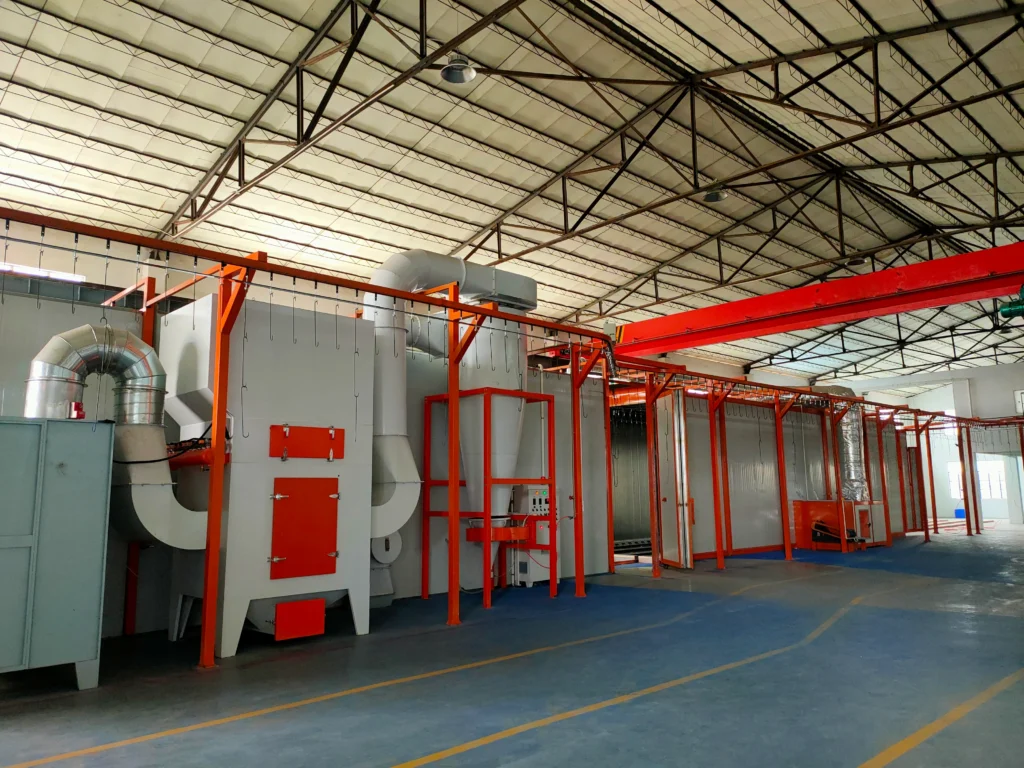
Powder Coating Applications and Industries: A Comprehensive Guide to Key Markets
If you're manufacturing metal products, you've likely wondered: where does powder coating actually fit in the production landscape? The truth is, powder coating has become the dominant surface treatment technology across far more industries than most people realize. From outdoor furniture to electrical cabinets, from aluminum profiles to automotive components, electrostatic powder coating is the go-to choice for manufacturers who demand durability, consistency, and cost efficiency.
What is Powder Coating and Why It Dominates Multiple Industries
Powder coating is an advanced surface finishing process that uses electrostatic principles to apply dry powder particles to metal surfaces, which are then cured under heat to form a durable, continuous protective layer. Unlike traditional liquid paints that rely on solvents to suspend pigment and binder, powder coating operates on a fundamentally different principle: charged powder particles are attracted to grounded workpieces and fuse together during the curing process. The result is a thick, uniform coating with superior performance characteristics.
From a factory perspective, what makes powder coating so dominant is its alignment with modern manufacturing priorities. It delivers superior surface quality, generates virtually zero VOC (volatile organic compound) emissions, achieves material transfer efficiency rates exceeding 95% when managed properly, and supports high-speed automated production. These aren't just technical advantages—they're economic realities that translate directly to profitability, market compliance, and long-term customer satisfaction.
We've spent years working with manufacturers across multiple sectors, and what consistently stands out is this: powder coating isn't a nice-to-have finishing option anymore. For quality-conscious manufacturers operating at scale, it's become the operational standard. The manufacturers still using liquid paint in high-volume scenarios are increasingly viewed as operating legacy processes, not competitive alternatives.
![electrostatic powder coating line in factory]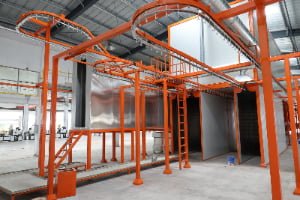
Key Industries Using Powder Coating
Powder coating is now the dominant finishing method across eight major manufacturing sectors. Each sector has evolved its own standards, performance requirements, and volume expectations. Understanding where your industry sits in this landscape directly impacts how you should approach coating line configuration and supplier selection.
Furniture and Cabinetry
The furniture industry—both indoor and outdoor segments—has been transformed by powder coating technology. Indoor furniture manufacturers benefit from the aesthetic consistency, color range, and scratch resistance that powder coating delivers. Outdoor furniture manufacturers have a more critical dependence on powder coating, because exposure protection is built into the product promise itself.
What distinguishes furniture applications is the emphasis on surface quality and aesthetic appeal. A furniture buyer doesn't just need corrosion protection; they need a finish that feels right, looks consistent across batches, and communicates quality at point of sale. Powder coating delivers this at production volumes that would be economically impossible with traditional methods. We've worked with furniture manufacturers producing runs of 500+ units monthly, where anything less than perfect color matching and surface uniformity becomes a competitive liability.
Architectural Aluminum and Fenestration
This is perhaps the most stringent segment in powder coating applications. Architectural aluminum—window frames, curtain walls, door systems, structural profiles—operates under intense performance scrutiny. These products face UV exposure, thermal cycling, moisture infiltration, and mechanical stress. The coating isn't cosmetic; it's structural integrity assurance.
Fenestration manufacturers typically specify polyester or polyvinylidene fluoride (PVDF) powders to achieve the durability standards that building codes and architects demand. The application requirements are equally demanding: uniform film thickness, precise color matching across architectural complexes, and adherence to specifications like AAMA 2604 or QUALICOAT standards. This is where coating line precision becomes non-negotiable.
Automotive and Transportation Components
The automotive sector uses powder coating for engine covers, structural brackets, suspension components, and interior frames. The coating must withstand thermal cycling, mechanical vibration, salt spray exposure, and in some cases direct contact with moving engine oil or transmission fluid.
What's interesting about automotive applications is the validation intensity. OEMs conduct salt-fog testing to 1000+ hours, impact resistance tests, adhesion testing, and chemical immersion testing. The coating line specification must anticipate these requirements from day one. Temperature control, cure time precision, and film thickness uniformity aren't manufacturing details—they're warranty insurance.
Home Appliances and Consumer Electronics
Appliances represent one of the highest volume applications for powder coating. Washing machines, refrigerators, air conditioning units, and microwave ovens all use powder-coated metal cabinets and structural components. This segment prioritizes three factors: appearance consistency, production speed, and durability under normal household use.
The economics here are interesting. Appliance manufacturers operate at very high volumes—thousands of units daily across multiple production lines. This scale drives demand for integrated coating lines that can handle multiple colors with minimal changeover time, maintain consistent output quality across 16+ hour production runs, and minimize reject rates below 2%.
Mechanical and Heavy Equipment
Construction equipment, industrial machinery, agricultural implements, and material handling systems all use powder coating for protection and branding. The requirements here are less about aesthetics and more about rugged durability. Equipment operating in mining, construction, or agricultural settings faces abrasion, impact, chemical exposure, and extreme temperature variation.
Powder coating succeeds in this segment because it builds coating thickness (typically 80-150 microns) that can absorb mechanical punishment that would compromise thinner liquid paint systems. The adhesion characteristics are also superior, which matters when equipment vibrates continuously throughout its service life.
Outdoor and Infrastructure Products
Metal shelving, storage racks, fencing systems, playground equipment, traffic control devices, and utility infrastructure—all are powder-coated at scale. These products often operate in corrosive environments (coastal salt spray, industrial pollution, UV-intensive regions) where coating performance directly correlates with product lifespan and replacement frequency.
From a manufacturer's perspective, this segment is particularly cost-sensitive. The buyer is making calculations about total cost of ownership: initial product price plus expected service life before replacement becomes necessary. A coating line that reliably delivers 800+ hour salt-fog performance creates competitive differentiation that justifies pricing premium.
Other Emerging Applications
Medical device housings, telecommunications enclosures, renewable energy equipment (solar inverters, wind turbine components), and emerging battery enclosure applications are all expanding their use of powder coating. These segments often demand specialized coating systems—corrosion-resistant primers, ESD-protective formulations, or biocompatible surface finishes—that require coating line flexibility and technical expertise.
Why Powder Coating Outperforms Traditional Liquid Paints Across Industries
The performance gap between powder coating and liquid paint has become too wide to ignore for quality manufacturers. This isn't marketing rhetoric; it's observable reality in factories operating both methods.
| Performance Factor | Powder Coating | Liquid Paint |
|---|---|---|
| Transfer Efficiency | 95%+ | 40-60% |
| Film Thickness | 80-150 microns | 50-100 microns |
| VOC Emissions | <5% of liquid paint | 40-50% solvent loss |
| Cure Time | 10-30 minutes | 4-8 hours |
| Salt-Fog Resistance (1000 hrs) | Pass (800+ hrs typical) | Often fails at 500 hrs |
| Adhesion (ASTM D3359) | 5B (no removal) | 3B-4B typical |
| Production Flexibility | Supports color changes in 15-30 min | 2-4 hours between colors |
| Waste/Overspray | <5% recoverable | 50-60% waste typical |
The numbers tell the story, but let me translate them into factory operations:
Transfer efficiency means that 95% of powder applied actually reaches the workpiece and stays there. With liquid paint, nearly half the material ends up as overspray that must be filtered and disposed of. Across annual production volumes, this represents a massive cost differential.
Film thickness advantage translates directly to durability. A powder coat at 120 microns provides corrosion protection that a liquid paint at 80 microns cannot match. The thicker the protective layer, the longer the workpiece survives in harsh environments.
Cure time creates production rhythm advantages. A powder-coated part is handled 15-30 minutes after application. A liquid-painted part requires 4-8 hours of careful drying time in climate-controlled spaces. This geometric difference in throughput capacity is why high-volume manufacturers have essentially abandoned liquid paint.
Salt-fog performance is the reliability insurance. Manufacturers specify salt-fog testing because it's the industry-standard accelerated corrosion test. Powder coating consistently passes tests that liquid paint fails, which means fewer customer warranty claims and reputation damage.
From our experience, the decision to move from liquid paint to powder coating isn't marginal improvement—it's transformational. Manufacturers typically see: 40-50% reduction in material costs, 60-70% faster production cycles, 90%+ reduction in VOC compliance headaches, and measurably superior product performance in field use.
![metal cabinet powder coating process]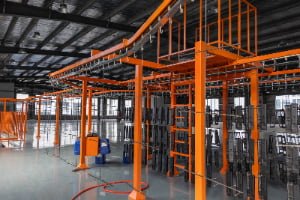
Industry-Specific Performance Requirements and Standards
Different industries operate under different coating performance expectations. These aren't arbitrary specifications—they're built from decades of real-world failure analysis and customer requirements.
Corrosion and Salt-Fog Resistance
Industries with outdoor exposure (architecture, furniture, infrastructure products) specify salt-fog resistance measured in hours. ASTM B117 salt-fog testing is the standard protocol. Typical specifications:
- Exterior architectural aluminum: 1000+ hours required
- Outdoor furniture: 800+ hours common
- Infrastructure products: 500-1000 hours depending on environment
- Appliances: 500 hours typical
What these numbers represent is years of field exposure protection. A coating that passes 1000 hours of accelerated salt-fog testing typically protects parts for 5-10 years in normal outdoor environments. This performance benchmark directly influences coating system selection (polyester vs. PVDF), film thickness requirements, and pretreatment specifications.
Durability and Impact Resistance
Mechanical equipment, automotive components, and transportation products need coatings that resist impact, abrasion, and flexing without cracking or chipping. ASTM D2794 (falling dart impact test) and ASTM D3359 (adhesion tests) measure these properties. Performance requirements vary:
- Automotive components: 40+ inch-pounds impact resistance
- Heavy equipment: 60+ inch-pounds typical
- Appliances: 30+ inch-pounds
- Infrastructure: 20+ inch-pounds
The relationship between impact resistance, film thickness, and substrate flexibility is critical. A coating applied to thin, flexible sheet metal requires different formulation and application parameters than coating applied to rigid structures.
Aesthetic and Color Consistency
Industries where appearance drives purchasing decisions—furniture, appliances, architecture—require color matching standards that leave no room for variation. Powder coating excels here because:
- Film thickness uniformity ensures consistent color appearance (thinner areas appear darker, thicker areas lighter)
- Electrostatic application creates predictable, repeatable deposition
- Color changeovers can maintain consistency across multiple production runs
- Gloss uniformity (high gloss, satin, or matte) remains stable across all parts in a batch
We've worked with furniture manufacturers where color consistency within Delta E 1.0 (barely perceptible to human eye) is the specification. Achieving this requires coating line precision that goes far beyond applying paint—it demands rigorous control of pretreatment chemistry, spray gun positioning, part orientation, and curing parameters.
Thermal and Chemical Resistance
Appliances operating near heat sources, industrial equipment in chemical environments, and automotive under-hood components need coatings that maintain integrity under temperature cycling and chemical exposure. Typical requirements:
- Heat resistance: Parts near ovens/stoves require coatings stable to 150-200°C
- Chemical resistance: Industrial environments may demand resistance to oils, solvents, detergents, or process chemicals
- Thermal cycling: Coatings must remain adhesive through freeze-thaw cycles (-20 to +60°C typical)
These requirements often drive selection of specific powder formulations (epoxy for chemical resistance, polyester for thermal cycling tolerance, hybrid formulations for balanced performance). One-size-fits-all approaches don't work in these applications.
![aluminum profile surface finishing]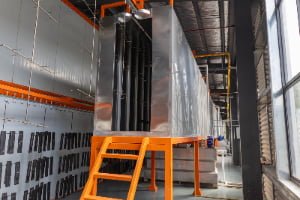
Critical Success Factors: From Pretreatment to Final Curing
In our factory experience, coating quality isn't determined at the spray booth. It's determined in the pretreatment system, and then preserved or destroyed by everything that follows.
The Foundation: Surface Preparation and Pretreatment
This is the reality that separates manufacturers who consistently deliver quality from those dealing with chronic defects: 80% of coating defects originate in pretreatment failures, not spray booth problems.
Pretreatment serves four essential functions:
- Remove surface contaminants (oils, cutting fluid, fingerprints, dust)
- Remove oxidation (rust, mill scale on steel; oxide layer on aluminum)
- Create surface chemistry that promotes adhesion
- Establish substrate uniformity so electrostatic spray patterns behave predictably
A proper pretreatment sequence for steel includes: alkaline degreasing → water rinse → acid pickling → water rinse → phosphate conversion coating → final rinse. For aluminum: alkaline degreasing → water rinse → acid etch → water rinse → zirconium or titanium conversion coating → final rinse.
The variables that control pretreatment quality—chemistry concentration, temperature, immersion time, spray pressure, rinsing thoroughness—create a quality foundation that no downstream adjustment can fully compensate for. A poorly prepared surface will eventually show defects: coating adhesion failure within months, pinhole corrosion under the coating, or premature rust breakthrough.
System Integration and Production Line Coordination
This is where coating line design becomes critical. A properly integrated system means that output from the pretreatment stage feeds seamlessly into the spray stage, which feeds into the curing stage, with no quality degradation at any transition.
In practical terms:
- Conveyor speed must match the spray booth design (too fast = under-application; too slow = over-application and edge accumulation)
- Part orientation as it enters the spray booth must allow the electrostatic guns to reach all surfaces (undercuts, internal corners, blind holes present challenges)
- Distance from pretreatment exit to spray booth entrance should be minimized to prevent surface reoxidation
- Temperature control through the line ensures powder flow characteristics remain consistent
- Dust management in the conveyor area prevents contamination of freshly prepared surfaces
We've observed that many coating line problems attributed to "spray booth issues" actually originate in poor system integration. A spray booth operating perfectly can still produce inconsistent results if upstream pretreatment speed isn't coordinated, or if transport delays allow surface chemistry changes.
Film Thickness Control and Quality Assurance
Film thickness is the single most important controllable variable affecting coating performance. Coating that's too thin fails prematurely; coating that's too thick creates cosmetic defects and unnecessary cost.
Optimal film thickness ranges vary by application:
- Architectural aluminum: 80-100 microns
- Outdoor furniture: 100-120 microns
- Appliances: 80-100 microns
- Heavy equipment: 120-150 microns
Achieving consistent film thickness requires control of:
- Spray gun electrical parameters (voltage, current)
- Spray gun distance and angle to the workpiece
- Powder feed rate from the supply system
- Part orientation as it passes through spray zone
- Part dwell time in the spray field
Modern coating lines should include film thickness measurement at end-of-line (either destructive testing on sample parts or non-destructive measurement using magnetic gauges). Real-time feedback allows operators to adjust parameters before entire batches drift out of specification.
Air Quality and Compressed Air Management
This is a technical detail that gets overlooked until problems appear. Compressed air quality is as critical to coating consistency as electrical parameters. Water and oil contamination in compressed air cause:
- Powder bridging and clumping in the supply system
- Inconsistent powder flow to the spray gun
- Surface defects (pinhole formations, curing irregularities)
- Premature gun component wear
Proper compressed air management includes:
- Moisture removal: Refrigerated dryer reducing dewpoint to -18°C or lower
- Oil removal: Multi-stage filtration (5 micron minimum)
- Particulate filtration: Pre-filters removing larger debris
- Pressure regulation: Stable supply at 6-8 bar for typical spray systems
In our experience, manufacturers who skip or defer air system maintenance invariably experience "unexplainable" coating quality variations that disappear once the air system is serviced. This isn't coincidental—it's physics.
![metal product manufacturing spray line]
Selecting the Right Powder Coating Solution for Your Industry
Choosing a coating line isn't a commodity purchase decision. It's a manufacturing system selection that will influence product quality, operational efficiency, and profitability for 10-15+ years.
The critical evaluation factors:
1. Product-line fit
Does the coating line's design actually accommodate your product geometry? Can spray guns reach all surfaces? Can the conveyor system handle your part weight and size? Can you physically load and unload parts efficiently? These seem obvious but are frequently overlooked in evaluations of "standard" coating systems that don't align with your specific products.
2. Capacity alignment
Does the line's rated throughput match your production requirements? A 30-piece-per-hour rated line is worthless if your target is 50 pieces per hour. Conversely, oversizing the system adds cost that produces no economic return. The calculation should include peak demand, not just average demand.
3. Pretreatment adequacy
Can the pretreatment system deliver the surface preparation quality your coating system and performance specification require? This is often where cost-cutting creates long-term quality problems. A $50,000 savings on pretreatment equipment becomes a $200,000 problem in warranty claims and reputation damage.
4. Flexibility for product mix
If you spray multiple products or multiple colors, can the line accommodate color changes efficiently? Can it handle different part sizes without major reconfiguration? Flexibility has economic value—it allows you to respond to market demand variation without line downtime.
5. Maintenance accessibility
Can spray guns be accessed for routine cleaning? Can filter elements be replaced without system shutdown? Is the equipment designed for practical maintenance, or does maintenance require extended downtime? These operational details accumulate across years of operation.
6. Technical support and training
Will the equipment supplier provide operator training? Is technical support available for troubleshooting? Do they have spare parts available? Can they provide documentation in your required language? For manufacturing equipment, supplier support often matters as much as equipment specification.
7. Local regulatory compliance
Does the system meet your local environmental regulations for emissions, waste disposal, and worker safety? This isn't negotiable and shouldn't be an afterthought. Some regions require specific emission control equipment or compressed air processing that impacts system cost.
From a practical standpoint, we advise manufacturers to prioritize these factors in order: product fit → pretreatment → capacity → compliance. Get these right, and the rest usually works out.
Future Growth Trends and Emerging Applications in Powder Coating
Powder coating is entering a growth phase driven by automation, sustainability focus, and application expansion into emerging industries.
Automation expansion: High-speed automatic production is becoming standard in high-volume manufacturing. Coating lines with robotic spray systems, integrated vision systems for part orientation, and real-time process monitoring are becoming increasingly common. These systems deliver consistency that manual spray operations cannot achieve.
Sustainability demand: Regulatory pressure on VOC emissions and solvent waste continues intensifying globally. Powder coating's inherent environmental advantages—zero VOC, minimal waste, full powder recoverability—position it as the preferred technology for manufacturers targeting carbon neutrality or ESG compliance.
Emerging material applications: Battery enclosures (electric vehicle and stationary storage), semiconductor equipment housings, medical device enclosures, and renewable energy equipment are all adopting powder coating at expanding volumes. These applications often require specialized powder formulations and precise application control, creating opportunities for coating system innovation.
Localization trends: As manufacturing regionalizes (nearshoring), more manufacturers in emerging markets are establishing coating capabilities. This creates demand for efficient, adaptable coating systems that can be installed in facilities with limited infrastructure investment.
In-line quality monitoring: Integration of film thickness measurement, color matching verification, and adhesion testing into continuous production lines is becoming more feasible and more commonly specified. This allows real-time quality feedback without requiring end-of-line sampling.
For manufacturers evaluating coating line investment, the trajectory is clear: powder coating capability is becoming a competitive necessity rather than a competitive advantage. Manufacturers without it are increasingly at a disadvantage relative to competitors who can deliver superior coating performance at lower cost.
More Related Questions
What coating thickness should I specify?
Optimal thickness depends on application severity. Outdoor products typically require 100-120 microns; indoor products 80-100 microns; high-wear applications 120-150 microns. Excessive thickness wastes material and creates cosmetic defects; insufficient thickness compromises durability.
How long does powder coating curing typically take?
Curing times range from 10-30 minutes depending on coating chemistry and oven temperature. Most commercial powders cure at 175-200°C for 15-20 minutes. Cooler cure formulations exist for heat-sensitive substrates but are less common.
Can powder coating be applied to non-metallic substrates?
Powder coating is primarily designed for conductive substrates (steel, aluminum). Some specialty powders can coat certain plastics, but application is more complex and less reliable than metal coating.
What waste disposal issues should I consider?
Unused powder in spray booths is collected, filtered, and recycled. Excess powder mixed with ambient dust cannot be reclaimed. Spent filter elements must be disposed of according to local regulations—typically as industrial waste, not hazardous waste, since powder contains no solvents.
How do I transition from liquid paint to powder coating?
The transition requires investment in pretreatment infrastructure, spray booth, curing equipment, powder storage, and operator training. Most manufacturers phase transition over 6-12 months to minimize production disruption. Total investment typically ranges from $150,000 for small manual lines to $500,000+ for automated systems.
Conclusion
Powder coating has evolved from a specialty finishing process into the dominant surface treatment technology across manufacturing. Its technical superiority over liquid paint—higher film thickness, faster curing, superior durability, zero VOC emissions, and exceptional cost efficiency—makes it the logical choice for quality-conscious manufacturers operating at scale.
The range of applications continues expanding. Industries that historically relied on liquid paint or traditional finishing methods are systematically converting to powder coating as equipment becomes more available and supply chains develop. For manufacturers not yet utilizing powder coating, the competitive window for transition is narrowing; eventually, powder coating capability will be a prerequisite for market access, not a competitive differentiator.
If you're currently evaluating coating technology for your manufacturing operation, or if you've been considering upgrading existing equipment, the technical and economic case for powder coating is compelling. The questions aren't really whether to invest in powder coating—but how to configure the optimal system for your specific product, market, and production requirements.
We've spent years helping manufacturers across multiple sectors navigate this transition and optimize coating line performance. If you're considering powder coating system implementation, we'd welcome the opportunity to discuss your specific requirements, review your product characteristics, and help develop a solution aligned with your manufacturing reality.
Contact us to discuss your coating needs: WhatsApp +8618064668879 or Email: ketumachinery@gmail.com
 English
  German
  Vietnamese
  French