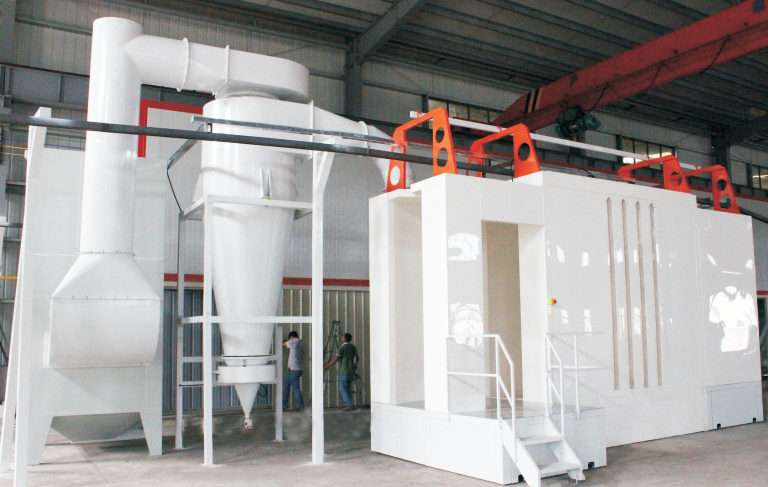
5 Advantages of Fast Color Change in Large Cyclone Powder Recovery Systems
When your production line needs to switch between different powder colors frequently, every minute of downtime costs you money. I've seen this problem firsthand with clients running 3–5 color changes per shift: traditional color changeover methods force production to halt for 30–45 minutes, eating into output and squeezing margins.
A large cyclone powder recovery system with fast color change capability can compress that downtime to just 5–10 minutes by efficiently separating and purifying powder between batches, eliminating cross-contamination and waste in the process. This means less idle time, higher first-pass quality, faster response to orders, and significantly improved line stability—benefits that compound across your entire operation, not just during changeovers. Let me walk you through what this really means for your factory.

Why Fast Color Change Matters in Powder Coating Production
Fast color change isn't just a convenience feature—it's a critical lever for production efficiency. The challenge most factories face is that leftover powder from the previous color contaminates the next batch, forcing operators to spend time manually cleaning spray booths, supply lines, and equipment before spraying can resume. During this gap, your coating line sits idle while customers' orders wait.
The real cost isn't visible on a spreadsheet at first. But multiply 30–45 minutes of downtime by 3–5 color changes per day, across 250 working days per year, and you're losing roughly 60–120 hours of annual production capacity per line. For a factory running tight margins, that's significant lost revenue.
From our experience with clients across cabinet manufacturing, outdoor furniture, and aluminum profile production, the ones who prioritize fast color change see measurable improvements not just in throughput, but in order fulfillment speed, operator stress levels, and—surprisingly—coating consistency. Here's why.
Advantage 1: Significant Reduction in Production Downtime
How much time can be saved with fast color change
Traditional color changeover requires:
- Stopping the line
- Manually cleaning the spray booth interior
- Flushing residual powder from supply pipes
- Clearing the powder pump and feed system
- Reloading new powder and testing spray pattern
This sequence typically takes 30–45 minutes, depending on booth design and operator experience.
With a large cyclone powder recovery system optimized for fast color change, the process becomes:
- Activate the cyclone separation protocol
- Accumulated powder is rapidly separated into usable powder and waste fraction
- Secondary filtration purges residual color particles
- System re-pressurizes
- New color powder loads and spray resumes
Realistic time: 5–10 minutes, sometimes less with proper system calibration.
That's a 70–85% reduction in changeover time.
Real impact on daily production capacity
Let me put this in concrete terms. Assume you're coating metal cabinets (typical dimensions 1500×1100×1200 mm) with an average cycle time of 20 minutes from spray to fixation. You run 3 color changes per 8-hour shift.
Traditional setup:
- Productive coating time: 480 minutes − (3 changeovers × 40 minutes) = 360 minutes of actual spraying
- Daily output: approximately 18 units per shift
With fast color change system:
- Productive coating time: 480 minutes − (3 changeovers × 8 minutes) = 456 minutes of actual spraying
- Daily output: approximately 23 units per shift
That's a 27% increase in daily throughput without adding another coating line or operator. Over a month, that translates to roughly 100 extra coated units. Over a year, at typical cabinet margins, you're looking at 1,200+ additional units shipped—or equivalent revenue from accelerated order cycles.
From our projects, factories with multi-color orders have reported similar gains. The key is that fast color change doesn't just save time; it enables higher order velocity.

Advantage 2: Protection of Powder Quality and Reduced Cross-Contamination
How fast color change prevents color mixing and product defects
The real danger in color changeover isn't just the time lost—it's the quality risk. When powder residue from the previous color mixes with the new batch, several problems emerge:
First, visual defects: Specs of old color embedded in the new coating create visible flaws. On a white cabinet suddenly dotted with black particles, these defects are obvious and often fatal to sale.
Second, adhesion inconsistency: Incompatible powder chemistries can create adhesion weak points where particles settle on surfaces unevenly, reducing overall coating durability.
Third, waste multiplier: Contaminated first batches often fail inspection and require re-spraying or scrapping. That's double labor, double energy, double material cost for the same output.
A large cyclone powder recovery system with efficient separation addresses this directly. The cyclone principle—using centrifugal force to separate particles by density and size—naturally segregates the finer, lighter residual powder of the previous color from the fresh bulk powder. The secondary filtration stage then removes ultra-fine particles that the primary cyclone cannot capture alone.
The result: After changeover, your first spray-can application uses powder that is 95%+ pure of the new color, without manual intervention or extended purge cycles.
Impact on first-pass product quality after color switching
In our projects with cabinet and aluminum profile manufacturers, we've tracked rejection rates before and after implementing fast color change systems. The typical pattern:
Before (traditional changeover):
- First 5–8 units post-changeover show visible contamination (color specs, surface inconsistency)
- Rejection or rework rate: 8–12% of first-batch units
- Customer complaints about "batch variation": common
After (fast color change with proper cyclone design):
- First units post-changeover are virtually identical to previous color batch in appearance
- Rejection rate for color-specific defects: <1%
- Consistency across the entire production run: measurable improvement
What surprised many of our clients is that this improvement isn't temporary. Because the cyclone system continuously maintains powder purity throughout the color-run—not just at the changeover moment—the entire second batch experiences better spray characteristics and final coating uniformity.
Advantage 3: Improved Production Line Stability and Lower Error Rates
Reduced operator complexity during color changeover
Manual color changeover is cognitively demanding. Your operator must:
- Remember which valves to close and in what sequence
- Judge when residual powder has been "cleared enough"
- Manually inspect spray patterns (sometimes multiple test sprays required)
- Troubleshoot if the new color won't flow correctly
This introduces human variability. One operator might spend 25 minutes on changeover; another might take 50, depending on experience and fatigue level. Over a shift, this variability compounds.
With a large cyclone system optimized for fast color change, the process becomes standardized and semi-automated:
- Operator initiates color-change protocol via control panel
- System executes pre-programmed separation and purge sequence
- Operator receives "ready to spray" confirmation signal
- New color loads automatically or with minimal manual input
- Changeover time becomes predictable: always 7–9 minutes, not 30–60 minutes
Key benefit: Even new or less experienced operators execute color changes consistently because the equipment does most of the thinking.
Lower risk of equipment misoperation and rejects
When changeover procedures are complex and manual, mistakes happen:
- Operator forgets to purge one supply line thoroughly → contamination in second batch
- Valve left partially closed → insufficient new powder flow → thin coating on first units
- Supply line pressurized incorrectly → powder bridging in hopper → delayed start
Each mistake forces troubleshooting, more downtime, and often scrap. Fast color change systems reduce these failure modes because:
- Fewer manual steps = fewer opportunities for operator error
- Automated protocols eliminate sequence mistakes
- System feedback (pressure sensors, powder detection) alerts operators to abnormal conditions before rejects happen
- Consistent timing reduces guesswork about when changeover is "complete"
From our experience, factories that move from manual changeover to system-controlled fast color change report a 40–60% reduction in changeover-related defects and rework within the first month.

Advantage 4: Enhanced Flexibility for Multi-Color and Small-Batch Production
Making small-batch multi-color orders economically viable
Here's a commercial reality: small-batch, multi-color orders are profitable but punishing under traditional changeover constraints.
Consider an order for 50 units of a cabinet in 3 different colors (20 units red, 15 units blue, 15 units natural). With traditional 40-minute changeovers, your cost structure looks like:
- Setup and changeover labor: 3 changeovers × 40 minutes = 120 minutes ÷ 50 units = 2.4 minutes overhead per unit
- Line downtime cost: 120 minutes of lost capacity
- Quality rework risk: 8–12% of batch
Many factories reject these orders as uneconomical. The profit margin gets eaten by overhead.
With fast color change (8-minute cycles):
- Setup and changeover labor: 3 changeovers × 8 minutes = 24 minutes ÷ 50 units = 0.48 minutes overhead per unit
- Line downtime cost: 24 minutes (recoverable by front-loading other orders)
- Quality rework risk: <1% of batch
Suddenly, the same order becomes profitable. The unit economics improve by 80%, and you can now bid competitively on multi-color small batches that competitors refuse.
Faster response to market demand and order changes
In fast-moving markets—outdoor furniture suppliers responding to seasonal demand, cabinet manufacturers with fashion-conscious customers—the ability to switch colors quickly is a competitive weapon.
If your customer calls Friday asking for 100 units in a new color for Monday delivery, traditional changeover means:
- You lose Friday afternoon to setup and changeover
- You can't start production until late Friday
- You miss the Monday deadline
With fast color change, you can:
- Complete changeover Friday morning (8 minutes instead of 40)
- Produce 80–100 units Friday afternoon and Saturday morning
- Ship Monday as promised
We've seen this agility drive customer retention and premium pricing. One aluminum profile client reported that the ability to turn around multi-color orders in 24–48 hours became their primary selling point in a commoditized market.
Advantage 5: Better Overall Line Performance When Properly Integrated
Why total changeover time matters more than speed alone
Here's a trap I see many factories fall into: they focus on the cyclone separation speed and ignore the total system integration.
A cyclone might separate powder in 3 minutes, but if your supply center takes another 10 minutes to pressurize, or your control system doesn't auto-trigger the new powder load, the actual changeover remains 20+ minutes. You've optimized one component while leaving bottlenecks elsewhere.
From our actual projects, the factories that see the best color-change performance (5–8 minute total changeover) are the ones that:
- Integrate the cyclone with a high-efficiency secondary recovery system that filters ultra-fine particles in parallel, not sequentially
- Automate the powder supply center to pre-stage the new color and trigger feed pressurization the moment separation completes
- Connect the spray gun system with feedback sensors so operators know instantly when the new color is ready
- Program the control system to execute the full changeover sequence without manual intervention between steps
When these systems work as an ensemble, the human operator's role shifts from "executing changeover" to "confirming changeover ready." That's a fundamental difference.
Key factors for maximizing fast color change benefits
Not all large cyclone systems deliver fast color change equally. Here's what actually matters:
1. Cyclone geometry
A poorly designed cyclone wastes air and recirculates particles. An optimized cone angle and inlet design speeds separation and reduces re-entrainment.
2. Separator capacity
The cyclone must match your spray booth's air volume. Undersized systems bottleneck; oversized systems are inefficient. Our rule: the cyclone should handle 110–120% of booth exhaust flow.
3. Secondary filtration speed
Most color-change bottlenecks happen in the secondary recovery cabinet. High-speed backflush systems (pulse-type versus timed-type) cut cleaning cycles from 3–5 minutes to 1–2 minutes.
4. Powder supply system pressure stability
Inconsistent supply pressure means inconsistent spray restart. The system needs a regulator that holds ±0.3 bar tolerance.
5. Compressed air quality
Dry, oil-free, particle-free air is non-negotiable. Moisture or oil in the air system causes powder bridging and flow inconsistency. We always spec air dryers and multi-stage filtration for cyclone systems.
6. Control system responsiveness
Outdated PLC programs or mechanical solenoid valves introduce 2–3 second delays between step completions. Modern control systems (even entry-level ones) cut this to 200–300 milliseconds, compounding into significant time savings across the full sequence.
I've audited projects where clients invested in an expensive cyclone but skipped the secondary recovery upgrade or used marginal compressed air. Total changeover time improved by only 10–15 minutes instead of the potential 25–30 minutes. The lesson: fast color change is a system benefit, not a component benefit.
How to Evaluate and Implement Fast Color Change Systems for Your Production Line
If you're considering a fast color change upgrade, here's a practical evaluation framework:
Step 1: Baseline your current state
- Measure your actual color-change time today (from "stop spraying old color" to "first good unit in new color")
- Count how many color changes per shift, per week
- Document scrap or rework costs related to color contamination
- Calculate your total annual downtime cost from changeovers
Step 2: Define your target
- What changeover time is economically meaningful? (Usually 8–12 minutes for cabinet/profile manufacturers)
- What batch sizes trigger color change? (If you run only large single-color batches, optimization ROI is lower)
- What's your contamination tolerance? (Precision furniture might demand <0.5% defect rate; industrial cabinets might tolerate 2%)
Step 3: Evaluate system options
Compare on:
- Total changeover time (not just cyclone speed)
- First-pass quality post-changeover
- Powder recovery rate (typically 92–98% in well-designed systems)
- Operating cost (compressed air, electricity, filter replacements)
- Operator training requirements
Step 4: Verify integration
Before committing to a large cyclone system, confirm:
- Does it match your booth exhaust capacity?
- Is your compressed air system rated for the additional demand?
- Does your supply center auto-pressurize or require manual intervention?
- What's the total wall-to-wall time, including powder loading and spray pattern confirmation?
Step 5: Plan changeover protocols
Fast equipment only works if operators follow consistent procedures:
- Write down the exact sequence (in your local language and English if international staff are involved)
- Create visual placards at key equipment showing step-by-step procedures
- Test the procedure with 2–3 operators; time each person to establish realistic expectations
- Build in 10% buffer for contingencies (valve sticking, powder bridging, etc.)
| Evaluation Criteria | Traditional Changeover | Fast Color Change System |
|---|---|---|
| Typical time per change | 30–45 min | 5–10 min |
| First-batch contamination rate | 8–12% | <1% |
| Annual changeover downtime (3 changes/day) | 60–120 hours | 12–24 hours |
| Operator skill dependency | High | Low |
| Color batch flexibility | Limited (batch size > 50 units recommended) | High (batch size > 10 units viable) |
| Powder waste from cross-contamination | 3–5% of batch | 0.5–1% of batch |
| Capital investment | None (manual process) | $15K–$50K depending on cyclone + secondary system size |
| Payback period | N/A | 6–18 months (varies by changeover frequency and margin) |
More Related Questions
Q: Will fast color change work if I have a small spray booth?
A: Cyclone systems are scalable. We offer cyclones from 500m³/h to 10,000m³/h capacity. Even small booths (600–800 m³/h) benefit from appropriately sized cyclone + secondary recovery. The key is matching cyclone inlet diameter to your booth extraction ductwork; undersizing creates backpressure and negates speed gains.
Q: How often do I need to replace filters in the secondary recovery cabinet?
A: Depends on powder type, spray booth cleanliness, and change frequency. Typical replacement interval: 400–600 operating hours, or roughly every 2–3 months in a high-changeover operation. Clogged filters slow changeover time, so proactive replacement is part of keeping the system fast.
Q: Can I retrofit fast color change to an existing spray booth, or do I need a new booth?
A: Retrofit is usually possible if your booth has standard extraction connections. The cyclone and secondary cabinet mount externally or in adjacent space. Expect installation time: 3–5 working days, plus a 1–2 week commissioning and operator-training period.
Q: What if my powder types have very different densities (e.g., aluminum-filled epoxy vs. standard polyester)?
A: Cyclone separation efficiency drops slightly with mixed-density powders, but contamination is still reduced by 70–80%. For true separation of incompatible powder chemistries, we recommend keeping them on separate color lines or accepting a slightly longer changeover (10–15 minutes instead of 5–8 minutes).
Conclusion
Fast color change in a large cyclone powder recovery system isn't a luxury feature—it's a structural advantage for factories running multi-color or small-batch orders. The math is clear: you reduce downtime by 70–85%, cut post-changeover contamination from 8–12% to <1%, simplify operator procedures, and enable higher order flexibility.
The payback is typically 6–18 months depending on your change frequency and margins. For the cabinet, furniture, and aluminum profile manufacturers we work with, the return compounds: faster order cycles, higher first-pass quality, lower rework costs, and the ability to quote multi-color jobs competitively.
If color changes happen more than twice per shift, or if you're losing 60+ hours per year to changeover downtime, a fast color change system is worth evaluating. The real decision isn't whether to upgrade—it's whether you can afford not to, given what your competitors might be doing with their lines.
Want to explore whether a fast color change system fits your production needs? I'm happy to walk through your current changeover process, identify the bottleneck costs, and model what a realistic upgrade could return for your factory. Reach out via WhatsApp at +8618064668879 or email ketumachinery@gmail.com to discuss your specific operation. We can arrange a video consultation or, if you're in a region where we operate, a factory visit to see a fast color change system in real production.
 English
  German
  Vietnamese
  French