Powder Coating Equipment: Types, Costs, and How to Choose the Right System
Powder coating equipment has become essential for factories producing metal parts, cabinets, furniture, and aluminum profiles. But selecting the right system is far more complex than comparing price tags. The core challenge is understanding how pre-treatment, spray booths, curing ovens, and powder recovery systems must work together—and how to match this integration to your specific production needs, workpiece size, and quality requirements.
In this guide, I'll walk you through what powder coating equipment actually is, break down the cost structure across different factory sizes, explain how to evaluate key performance factors, and show you how to make a practical purchasing decision. We've worked with cabinet manufacturers in Algeria, furniture producers in Turkey, and aluminum extrusion facilities in India—and we've learned that the factories making the smartest equipment choices are those who understand not just the individual components, but how they fit into their entire production workflow.
 )
)
What Is Powder Coating Equipment and Why Does It Matter?
Powder coating[^1] is an application process where finely powdered coating material is applied electrostatically to metal surfaces, then cured through heat to create a durable, uniform finish. The equipment that makes this possible is not a single machine—it's an integrated system where every component influences final quality and production efficiency.
Unlike liquid spray painting, powder coating offers several operational advantages: minimal waste (unused powder can be recovered and reused), superior finish consistency across batches, better coating durability, and cleaner factory environments. For factories producing cabinet bodies, steel enclosures, aluminum profiles, or outdoor furniture, these advantages translate directly into higher product quality, lower material costs, and faster market readiness.
The real value of powder coating equipment, however, lies in how well the entire system matches your specific production scenario. A system that works perfectly for high-volume steel cabinet coating may struggle with varying-thickness aluminum profiles. An oven optimized for sheet metal may not handle longer workpieces. This is why understanding equipment types, configurations, and total cost of ownership is critical before you make an investment.
Core Components of a Powder Coating System
Pre-Treatment System
This is where coating quality truly begins—and where many factories make critical mistakes. Pre-treatment involves cleaning, degreasing, and surface preparation[^2] to ensure powder adheres properly and provides long-term corrosion resistance. Neglect this step, and even premium powder and curing ovens cannot compensate.
A proper pre-treatment system typically includes: degreasing tank (removes oils and contaminants), rinsing stage (removes cleaning residue), optional phosphate conversion coating (improves adhesion and corrosion protection), and drying stage (removes water to prevent powder flow defects). For cabinet and metal enclosure manufacturers, this is non-negotiable. For aluminum profile manufacturers operating in humid climates, chemical conversion coating becomes even more critical for long-term outdoor performance.
Cost range for pre-treatment systems: $8,000–$30,000 depending on capacity and chemical configuration. Many factories underestimate this expense, then face consistency issues later.
Electrostatic Spray Gun and Booth
The spray booth is where powder is applied. Modern electrostatic spray systems[^3] use high-voltage (typically 60–100 kV) to charge powder particles, which are then attracted to grounded workpieces. This creates efficient transfer and reduces overspray waste compared to manual or non-electrostatic methods.
Key specifications include: spray coverage area (how much of the workpiece can be sprayed per cycle), number of spray guns (single-gun booths for small parts vs. multi-gun booths for larger surfaces), air flow management (ensures consistent spray pattern and worker safety), and powder delivery system (hopper capacity, feeder accuracy). Spray booth design also depends on workpiece dimensions—a booth designed for 800mm workpieces will struggle with 2-meter aluminum profiles.
Cost range: $15,000–$50,000+ depending on booth size and automation level. Fully automated spray systems with robot arms cost significantly more but deliver superior consistency for high-volume operations.
Curing Oven
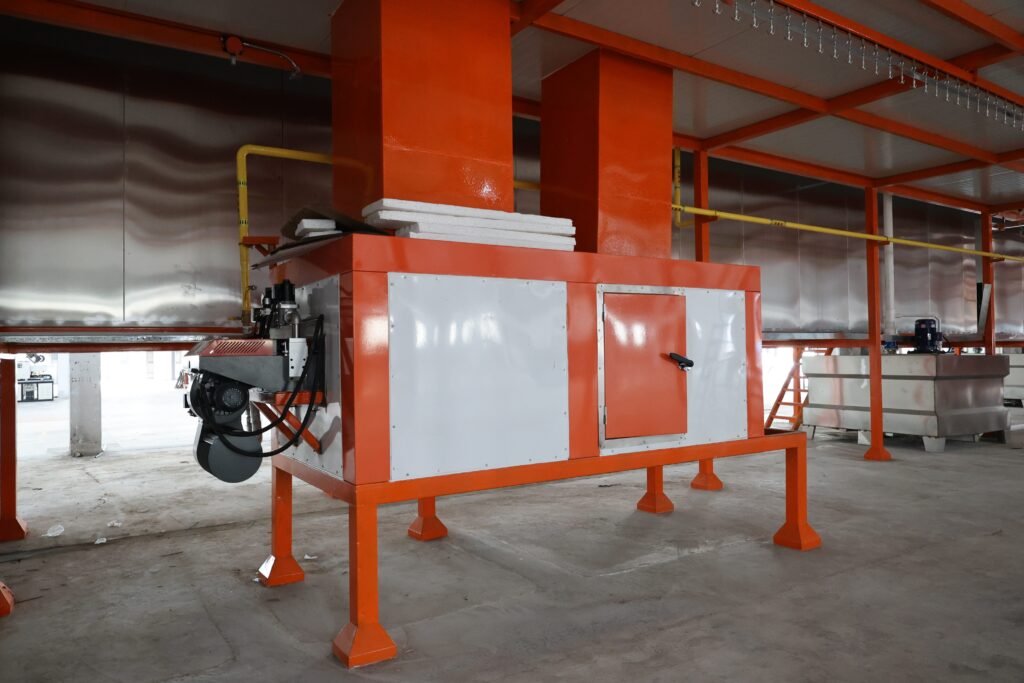
After powder is applied, workpieces must be heated to allow powder particles to melt, flow, and cross-link into a hard, protective coating. Curing ovens can be powered by gas, electric resistance, or combination heating. Temperature and dwell time vary by powder type and workpiece material, but typically range from 150–230°C for 10–30 minutes.
Oven selection depends on: production volume (batch vs. continuous conveyor), workpiece size and weight (bearing capacity and conveyor speed), energy efficiency requirements, and local utility availability. Gas-fired ovens offer lower operating costs in locations with cheap gas; electric ovens provide better temperature precision. For factories in areas with strict emissions controls[^4], electric or catalytic converter-equipped gas ovens may be required.
Cost range: $25,000–$80,000+ for standard industrial ovens. Custom-designed ovens with larger chambers or faster conveyor systems exceed $100,000.
Powder Recovery and Recycling System
Unused powder that doesn't stick to workpieces is captured and recycled. This reduces material waste and lowers operating costs significantly. Recovery systems use cyclone separators, cartridge filters, or baghouse collectors to capture airborne powder and feed it back into the spray booth hopper.
Recovery efficiency is critical to cost control. A well-designed system can recycle 95%+ of unused powder, effectively reducing your powder cost to one-fifth of the raw material price. Poor recovery design forces you to discard powder and purchase more frequently, destroying your economics.
Cost range: $8,000–$20,000 depending on booth size and filter technology. Often overlooked during budgeting, but one of the highest-ROI components.
How Powder Coating Equipment Works: Process Overview
Understanding the workflow helps explain why each component matters and why integration is critical:
Step 1: Pre-treatment. Parts enter the pre-treatment system where they are cleaned, degreased, rinsed, and dried. Total time: typically 15–30 minutes depending on soil level and part complexity.
Step 2: Electrostatic spray application. Cleaned parts are conveyed into the spray booth. Electrostatic guns charge powder particles, which are attracted to the grounded parts. Typically 1–3 minutes per workpiece depending on size and coating density.
Step 3: Powder recovery. Overspray (powder that didn't adhere) is captured by collection systems and recycled back to the hopper, reducing waste and cost.
Step 4: Curing in the oven. Powder-coated parts enter the heating oven where temperature and time allow the coating to flow and cure. Typical range: 10–30 minutes depending on part size, powder chemistry, and oven temperature.
Step 5: Cooling and unloading. Parts exit the oven, cool to handling temperature, and are stacked or packaged for shipment.
The efficiency of this entire workflow determines your actual hourly output, material utilization, and final product consistency. Many factories find that their bottleneck is not the spray booth or oven individually, but the mismatch between pre-treatment speed, spray capacity, and oven throughput.
Key Applications by Industry and Product Type
Metal Fabrication and Steel Components
Steel brackets, hinges, fasteners, and structural steel components benefit from powder coating's corrosion resistance and durability. These parts often require high-adhesion coatings and long-term outdoor performance, making pre-treatment and curing consistency critical.
Typical system configuration: compact pre-treatment line (3–5 minutes), single or dual-gun spray booth, electric or gas-fired oven. Production volumes range from 500–5,000 parts/day depending on part size and batch scheduling. Initial investment typically $80,000–$150,000 for a complete manual or semi-automated line.
Furniture and Outdoor Products
Outdoor furniture, metal garden equipment, and patio products demand exceptional coating uniformity and weather resistance. Powder coating outperforms liquid paint in these applications because it creates thicker, more durable coatings without drips or sag, even on complex geometries like chair frames and table legs.
Typical system configuration: pre-treatment for furniture-grade finish, multi-gun spray booth (to handle irregular shapes), oven with 20–25 minute dwell time for maximum cross-link strength. Production volumes: 1,000–8,000 pieces/day depending on product complexity. Investment range: $100,000–$250,000 for systems handling high-volume, varied-geometry parts.
Aluminum Extrusions and Architectural Profiles
Aluminum window frames, door profiles, and structural extrusions require precise coating thickness control (typically 60–80 microns) and exceptional surface consistency. The challenge is that aluminum is softer than steel, lighter, and requires different pre-treatment chemistry (chromate or non-chromate conversion coatings depending on environmental regulations).
Typical system configuration: continuous conveyor system (not batch), high-speed spray booth optimized for 2–5 meter profiles, electric oven with tight temperature control, advanced powder recovery to maintain color consistency across long production runs. Production volumes: 2,000–10,000 linear meters/day depending on profile dimensions. Investment range: $150,000–$400,000+ for fully automated, continuous systems.
Cabinets and Enclosures
Industrial control cabinets, electrical enclosures, server racks, and telecom boxes demand excellent appearance, uniform color, and flawless coverage. Cabinet manufacturers are particularly sensitive to surface consistency because defects are highly visible and directly affect product acceptance.
Typical system configuration: robust pre-treatment with drying, medium-to-large spray booth (to handle full cabinet panels), curing oven with 15–20 minute dwell time, high-efficiency powder recovery. Production volumes: 500–3,000 cabinets/day depending on cabinet size. Investment range: $120,000–$280,000 for systems optimized for cabinet throughput and finish quality.
 )
)
Equipment Specifications and Performance Factors to Evaluate
Spray Coverage and Efficiency Metrics
Spray coverage is measured by the area of workpiece surface that can be sprayed uniformly per unit time. Key factors include:
Number of spray guns: Single-gun booths (cost-effective but slower) vs. multi-gun booths (faster coverage, better consistency). Multi-gun setups typically cover 20–50% more surface area per cycle.
Spray pattern consistency: Quality electrostatic guns maintain uniform pattern across the spray envelope. Worn or poorly calibrated guns create thin spots and overspray waste.
Transfer efficiency: This measures what percentage of powder actually adheres to the workpiece vs. being wasted. Modern electrostatic systems[^5] achieve 85–95% efficiency. Older or non-electrostatic systems drop to 60–75%, dramatically increasing powder consumption and waste disposal costs.
For cabinet manufacturers, high transfer efficiency is non-negotiable because cabinet surfaces are large and visible—wasted powder means visible coverage defects. For aluminum profile manufacturers running continuous lines, maintaining consistent efficiency across hundreds of linear meters daily is the real challenge.
Curing Temperature and Speed
Curing time and temperature directly affect production speed and operating cost. Lower oven temperatures reduce energy consumption but require longer dwell time; higher temperatures cure faster but consume more gas or electricity.
Typical curing ranges:
Standard polyester powders: 180–200°C for 15–20 minutes. Polyurethane powders: 140–160°C for 20–30 minutes (require lower temperature to prevent degradation). Epoxy powders: 190–220°C for 10–15 minutes (cure faster at higher temperature).
The most cost-effective oven strategy depends on your powder chemistry and energy costs. In locations with expensive electricity, a larger oven running at moderate temperature (180°C, 20-minute dwell) may be cheaper to operate than a compact oven running hot (220°C, 10-minute dwell) because slower, lower-temperature operation reduces energy loss through the oven walls.
Powder Utilization Rate and Recovery Capability
This is where many factories hemorrhage money without realizing it. Powder utilization directly impacts your per-unit material cost, which for high-volume operations can exceed $1–2 per kilogram.
Benchmark figures: Well-designed systems recover 90–95% of unused powder. Poorly designed systems with inadequate filtration or ventilation lose 30–50% to waste disposal. Over a year, the difference between a 95% recovery system and a 70% recovery system can easily exceed $50,000–$100,000 in wasted material and disposal costs.
When evaluating equipment, ask suppliers directly: "What is your measured powder recovery rate on live production, and how do you validate it?" If they can't provide real data, they're hiding weak performance.
Capacity and Production Volume Requirements
Equipment capacity must match your actual production target, not your optimistic peak scenario. Oversizing increases capital cost and reduces efficiency on slower days. Undersizing forces rushed operation, quality drops, and bottlenecks.
Capacity calculation example: If you need 1,000 cabinet doors/day at 2 square meters each = 2,000 m²/day. A spray booth covering 30 m²/hour × 8 hours = 240 m²/day output. You'd need a multi-gun booth or multiple spray stations. An undersized single-gun booth would never meet this demand and would force 16-hour shifts—economically impossible.
Capacity planning must also account for: changeover time between colors, quality checks and rework, equipment downtime for maintenance, and realistic operating hours (7–8 hours/shift is typical, not 24 hours unless you run full three-shift operation).
 )
)
Total Cost of Ownership: Investment and Operating Expenses
Initial Equipment Investment by System Size
The installed cost of a complete powder coating system varies enormously based on scale and automation level. Here's a realistic breakdown:
Compact/Semi-Manual System (500–2,000 parts/day):
- Pre-treatment: $8,000–$12,000
- Single-gun spray booth: $15,000–$25,000
- Batch or small conveyor oven: $20,000–$35,000
- Powder recovery system: $8,000–$12,000
- Electrical, installation, commissioning: $10,000–$15,000
- Total: $61,000–$99,000
Mid-Range Semi-Automated System (2,000–5,000 parts/day):
- Pre-treatment: $15,000–$22,000
- Multi-gun spray booth (2–3 guns): $30,000–$50,000
- Continuous conveyor oven: $35,000–$60,000
- Advanced powder recovery: $12,000–$18,000
- Electrical, controls, installation: $15,000–$25,000
- Total: $107,000–$175,000
Full Automation (5,000–15,000 parts/day or high-speed continuous profiles):
- Pre-treatment (multi-stage): $25,000–$40,000
- Robotic or gang spray systems: $60,000–$120,000
- Large continuous oven: $80,000–$150,000
- Industrial powder recovery (cyclone + baghouse): $20,000–$35,000
- PLC controls, conveyor, installation: $30,000–$50,000
- Total: $215,000–$395,000
These are turnkey costs including equipment, delivery, site installation, electrical connection, and basic operator training. Custom systems (e.g., for unusually large workpieces or special requirements) can exceed these ranges.
Ongoing Operating Costs (Powder, Energy, Maintenance)
Annual operating costs are often underestimated and can rival the annual depreciation of equipment investment.
Powder material cost: Typical range $3–$6/kg depending on color, resin type, and purchase volume. For a system processing 2,000 parts/day at 500g powder per part = 1,000 kg/day = 250 tons/year at $4/kg = $1,000,000/year in raw material (this is massive for most factories).
This is why powder utilization and recovery rates are so critical. A 10% improvement in recovery efficiency can save $100,000–$200,000 annually on material costs alone.
Energy costs: Curing ovens are energy-intensive. A 50 kW oven running 8 hours/day at typical industrial electricity rates ($0.10–$0.15/kWh) costs approximately $20,000–$30,000/year. Gas-fired ovens can be cheaper or more expensive depending on local gas pricing.
Maintenance costs: Annual maintenance typically runs 5–10% of equipment capital cost. For a $150,000 system, budget $7,500–$15,000/year for spray gun replacement, filter changes, oven repairs, conveyor maintenance, and electrical service. Neglecting maintenance accelerates component failure and drives costs higher.
Labor: A typical powder coating line requires 1–2 full-time operators plus occasional maintenance technicians. Labor cost is usually your largest ongoing expense after materials.
Combined annual operating cost example: For a mid-range system processing 3,000 parts/day with 250 operating days/year = 750,000 parts/year:
- Powder material: $300,000–$500,000
- Energy: $25,000–$40,000
- Maintenance: $10,000–$20,000
- Labor: $60,000–$100,000
- Total: $395,000–$660,000/year
This illustrates why equipment selection matters: reducing powder waste by 10% saves $30,000–$50,000 annually. Improving oven efficiency by 15% saves $3,750–$6,000 annually. Over a 10-year asset life, these efficiencies compound significantly.
Powder Coating vs. Liquid Coating: Cost-Benefit Comparison
Many factories considering powder coating equipment ask: "Is it really cheaper than liquid spray painting?" The answer depends on your production volume and quality requirements.
Material efficiency: Powder coating achieves 85–95% transfer efficiency with recovery. Liquid paint (HVLP spray) achieves 60–75% transfer with zero recovery—wasted paint is discarded. For high-volume operations, this difference alone justifies powder coating investment.
Coating thickness: Powder achieves consistent 40–100 micron thickness uniformly. Liquid requires multiple coats to achieve equivalent corrosion protection, multiplying material and labor costs. For outdoor products (furniture, structural steel), powder's durability advantage is substantial.
Environmental and compliance costs: Liquid paint generates volatile organic compound[^6] (VOC) emissions requiring expensive air handling and capture equipment. Powder coating produces zero VOC emissions and minimal hazardous waste. In regions with strict environmental regulations (EU, California, parts of Asia), the compliance cost difference heavily favors powder coating.
Labor efficiency: Powder coating booth operation is faster and cleaner than liquid spray setup (which requires ventilation suits, respirators, and spill cleanup). One operator can run a powder coating line; liquid spray often requires two workers for safety.
ROI calculation example: Factory switching from liquid to powder coating on 5,000 parts/year:
- Equipment investment: $140,000
- Annual material savings (reduced waste): $40,000
- Annual labor savings: $15,000
- Annual environmental compliance savings: $10,000
- Total annual savings: $65,000
- Payback period: 2.2 years
- 10-year net benefit: $650,000 – $140,000 = $510,000
For factories with high volume (10,000+ parts/year), the payback period drops to 12–18 months. For low-volume operations (under 1,000 parts/year), powder coating may not be economically justified—a compact spray booth or manual application may be more practical.
 )
)
How to Select the Right Powder Coating Equipment for Your Needs
Assess Your Production Requirements and Budget
Before contacting equipment suppliers, clarify these fundamentals:
1. Target production volume (parts per day or linear meters per day): Be realistic. Don't exaggerate peak demand; use average steady-state production. A system sized for peak demand sits idle most of the time, wasting capital.
2. Workpiece dimensions (length, width, height, weight): Maximum dimensions determine booth and oven chamber size. Weight determines conveyor bearing capacity and motor sizing. Irregular shapes (like aluminum profiles with fins or furniture with legs) require larger spray booth coverage.
3. Target coating specification: Do you need thin protective coating (30–50 microns) or thicker wear-resistant coating (80–120 microns)? Thicker coating requires longer oven dwell time and more powder per part.
4. Color and powder change frequency: Single-color production allows simplified equipment. Multi-color production requires robust powder recovery and more frequent color changeovers, adding complexity and cost.
5. Local utility availability: Do you have reliable 3-phase electrical power? Is natural gas available? What are typical electricity and gas costs? An electric oven is simpler but may be expensive to operate in high-electricity regions. A gas oven requires gas infrastructure but may reduce running costs.
6. Available floor space: Measure your workshop. A complete powder coating system requires 200–500 square meters depending on equipment layout. Pre-treatment, spray booth, and oven must be arranged linearly or with turns. Cramped space forces compromises (shorter oven = slower throughput or higher temperature = higher energy cost).
7. Budget range: Determine your capital budget range. This filters equipment options immediately. A $100,000 budget eliminates full-automation systems but allows robust semi-automated equipment.
Evaluate Supplier Expertise and Local Compliance
Equipment suppliers vary dramatically in expertise, support quality, and understanding of local requirements. When comparing suppliers, assess:
1. Industry experience in your sector: Ask the supplier directly: "Have you sold equipment to cabinet manufacturers (or furniture makers, or aluminum extrusion companies) in my region or similar markets?" Request references you can contact and ideally visit. A supplier experienced in your industry will anticipate problems you haven't even considered.
2. Pre-treatment chemistry knowledge: Pre-treatment is often the weakest link in supplier proposals. Ask: "What is your pre-treatment chemistry strategy for my material (steel, aluminum, stainless)? What conversion coating do you recommend? How do you optimize drying to prevent powder flow defects?" Vague answers are red flags.
3. Local compliance and standards: Different regions have different electrical standards (voltage, frequency), environmental regulations (emissions, waste powder disposal), safety standards, and building codes. A global supplier may offer a system spec'd for Europe (380V 50Hz), but your facility needs 400V or 415V. Or emissions limits may require a specific oven design. Ask: "Have you adapted this system for local electrical, environmental, and safety standards in my country?" Require written confirmation.
4. Customization capability: Every factory has unique geometry and workflow. Can the supplier adapt standard equipment to your layout, workpiece size, and production sequence? Or do they only offer catalog solutions? Suppliers with strong engineering teams can solve custom challenges; those without become problems post-sale.
5. After-sales support structure: This is critical. Ask: "Do you have local service technicians or partners? How quickly can you respond to equipment breakdowns? What is your spare parts availability and typical wait time? Do you offer remote support?" A supplier with weak local support may strand you when equipment fails during critical production periods.
6. Training and documentation: Powder coating equipment requires operator knowledge. Does the supplier provide comprehensive operator training (not just 2 hours on-site)? Do they provide equipment manuals in your language? Video documentation? Without good training, operators make mistakes that compromise coating quality and equipment life.
Plan for Installation, Training, and Long-Term Support
Equipment purchase is not the end—it's the beginning. Factor these into your planning:
1. Installation timeline: Complete system installation typically requires 4–8 weeks from delivery to first production run. This includes: site preparation, electrical connection, gas line installation (if applicable), equipment assembly, alignment and testing, operator training, and process validation. Plan production disruption or temporary alternatives during this period.
2. Operator training: Budget time (typically 1–2 weeks on-site) for supplier technicians to train your operators on: safe system startup and shutdown, pre-treatment chemistry management, spray gun operation and maintenance, oven temperature control, powder recovery system operation, basic troubleshooting, and quality verification. Poor training directly causes quality issues and equipment damage.
3. First-run quality validation: Your first 500–1,000 parts will reveal process tweaks needed. Work closely with the supplier to adjust: conveyor speed, spray gun distance and angle, oven temperature, dwell time, and pre-treatment timing. This validation phase determines whether equipment meets your quality targets.
4. Preventive maintenance plan: Establish a maintenance schedule: daily operator checks (spray gun condition, powder hopper level, oven temperature stability), weekly filter cleaning, monthly bearing and motor inspection, quarterly spray gun overhaul, semi-annual oven inspection. Document everything. Equipment that receives preventive maintenance runs 30–50% longer before major repair.
5. Spare parts stockpiling: Identify critical failure points: spray guns, filters, conveyor bearings, oven thermocouples. Stock spares locally so a single component failure doesn't halt production. Typical spare parts investment: 5–10% of equipment cost annually.
Which Supplier Fits Which Type of Buyer?
Based on what I've learned from working with cabinet manufacturers, furniture producers, and aluminum companies, here's how different buyers should approach supplier selection:
Cabinet and enclosure manufacturers: You prioritize coating consistency and surface quality because your products are visible and customer-critical. Focus your supplier search on vendors experienced in cabinet production with proven quality control systems. Request to see cabinet production at their reference customers. Ask specifically about edge coverage, color uniformity across large panels, and adhesion testing[^7] protocols.
Aluminum profile manufacturers: You need technical depth on aluminum-specific pre-treatment, thickness consistency, continuous high-speed operation, and energy efficiency. Look for suppliers with experience in architectural or industrial profile coating, not just general metal fabrication. Verify their understanding of your production speed, profile length, and weight handling requirements.
Outdoor furniture producers: Your focus should be coating durability, weather resistance, and finish aesthetics. Find suppliers who can demonstrate long-term outdoor performance (ask for 2–3 year field data) and who understand UV-resistant powder formulations. Visit their reference installations if possible to see real outdoor furniture performance.
First-time powder coating adopters (transitioning from liquid spray): You need patient, educational suppliers. Look for vendors who take time to explain the transition, manage your expectations on timeline and costs, and provide robust training. Avoid suppliers who rush installation or minimize training—your success depends on thorough knowledge transfer.
High-volume, cost-conscious factories: Your focus should be on total cost of ownership, not equipment price. Prioritize suppliers with proven powder recovery efficiency, energy-efficient ovens, and strong maintenance support (minimizing downtime reduces cost more than purchase price ever will). Request detailed operating cost projections based on your production volume.
How to Choose the Right Supplier
Beyond equipment itself, supplier choice determines whether you get 10 years of reliable operation or 5 years of frustration. Here's my practical framework:
1. Multi-step evaluation process (not just price comparison): Never select a supplier based on a single quote. Request proposals from at least 2–3 qualified suppliers. Evaluate each on: equipment spec match, technical approach to your specific needs, reference customer quality and responsiveness, proposed timeline and training, after-sales support structure, and total cost of ownership (not just equipment price).
2. Site visit or video tour of their operations: Before committing, visit the supplier's facility or request a detailed video tour of equipment being manufactured and tested. See: how carefully equipment is built, whether quality control is evident, how past customers' systems are performing. This reveals operational competence that no proposal can hide.
3. Contact references directly (not just accept supplier suggestions): Ask the supplier for 5–10 recent customers similar to your operation. Contact them directly—not through the supplier. Ask: "Has equipment performed as promised? How responsive is after-sales support? Would you buy from them again? What surprised you (positively or negatively) after installation?" Honest reference feedback is invaluable.
4. Detailed technical proposal review: The proposal should spell out: exact equipment specifications (dimensions, weight, power consumption), precise capacity claims with backing calculations, chemical and powder consumables (with costs), installation timeline and requirements, training scope and duration, 12-month warranty and support terms, spare parts availability, and local service contact. Vague proposals indicate vague thinking.
5. Transparent total cost of ownership: Request a 5-year cost projection including: equipment depreciation, annual material costs (powder, pre-treatment chemicals, energy), maintenance costs, labor, and waste disposal. Compare suppliers on this basis, not just equipment price. A cheaper system that costs 20% more annually to operate is actually more expensive.
6. Contractual clarity on performance guarantees: Define upfront: what coating quality (adhesion, thickness, finish) the supplier guarantees, what production capacity is guaranteed, what happens if performance falls short, what training is included, what constitutes normal wear vs. supplier responsibility, warranty duration and coverage, and support response times for different issue types. Written clarity prevents disputes later.
Final Thoughts
Powder coating equipment is not a commodity purchase. It's a manufacturing system investment that will shape your product quality, production efficiency, and operating costs for a decade or more. The factories making the best choices are not those who found the cheapest equipment—they're the ones who took time to understand their own needs precisely, evaluated suppliers rigorously, and prioritized total cost of ownership and local support over price.
The questions that matter: Does this equipment match my actual workpiece dimensions and production volume? Will the supplier's team truly understand my specific product needs? Can I trust the after-sales support if something breaks? What will my actual annual operating cost be? Is the supplier experienced in my industry, or are they guessing?
Answer these honestly, and you'll navigate the powder coating equipment market with confidence. Ignore them, and you'll end up with a machine that technically works but never quite meets your needs, costs more to operate than expected, and leaves you frustrated when issues arise.
Need Help Choosing the Right Powder Coating System?
Send us your production requirements: workpiece dimensions, target daily output, product type (cabinets, furniture, profiles, metal parts), preferred powder colors, available floor space, and budget range. We'll analyze your needs and recommend practical equipment configurations with transparent cost projections. Our team has delivered systems to cabinet manufacturers in Algeria, furniture producers in Turkey, and aluminum extrusion facilities in India. We understand how pre-treatment, spray booth, oven, and recovery systems must integrate—and we can help you avoid costly mistakes.
Powder coating equipment investment is significant. Make it count by working with suppliers who understand your specific industry, your local requirements, and your long-term success—not just your equipment purchase.
[^1]: Explains the fundamental process of applying powdered coating material electrostatically to metal surfaces with heat curing for durable finishes.
[^2]: Covers cleaning, degreasing, and preparation techniques that ensure proper powder adhesion and long-term corrosion protection.
[^3]: Describes how high-voltage electrostatic systems charge powder particles and attract them to grounded workpieces for efficient transfer.
[^4]: Details environmental and safety standards for controlling industrial emissions, waste disposal, and equipment compliance requirements.
[^5]: Provides technical foundations of electrical charge and field principles used in spray application systems.
[^6]: Explains volatile organic compounds generated by liquid coatings and their environmental and health impact compared to powder alternatives.
[^7]: Outlines testing methods and standards for measuring coating adhesion strength to substrate surfaces.
 English
  German
  Vietnamese
  French