Aluminum Profile Powder Coating Equipment: Complete Selection & Application Guide
When you're sourcing powder coating equipment specifically for aluminum profiles, you're not just looking for a spray booth or curing oven. You're looking for a system designed to handle the unique challenges aluminum presents—from surface activation and charge holding to thermal properties and production consistency. After years of working with aluminum manufacturers across multiple markets, I've learned that equipment selection for aluminum is fundamentally different from selecting for steel or general metal parts.
An electrostatic powder coating system for aluminum profiles delivers precise, uniform coverage with controlled film thickness and strong adhesion to meet the demanding surface finish and durability requirements of aluminum extrusions. Designed to handle continuous production with optimized loading patterns and heat transfer for aluminum's thermal properties, the system combines energy-efficient powder recovery, automated spray control, and local standard compatibility to ensure stable, cost-effective operations for manufacturers processing aluminum from small-scale custom work to high-volume production runs.
The reality is that many manufacturers discover too late that their equipment wasn't truly optimized for aluminum. They end up dealing with inconsistent film thickness, poor adhesion, or unstable spray patterns that cost them production time and scrap rates.
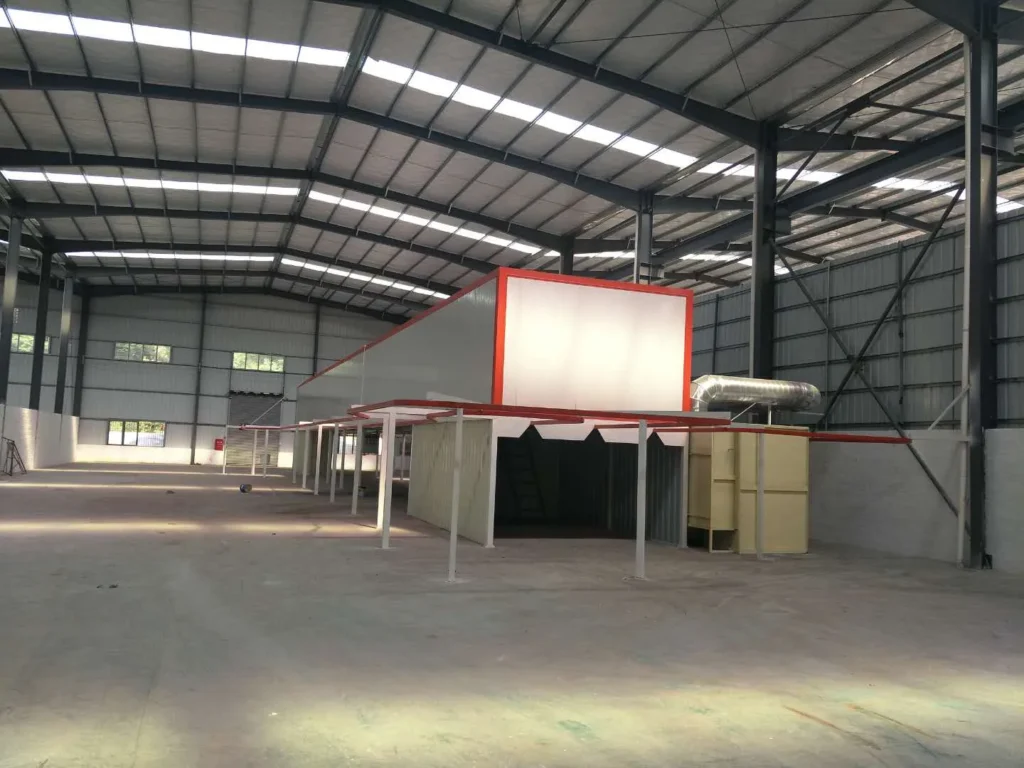
![powder coating line in factory]
Why Aluminum Profiles Require Specialized Powder Coating Equipment
Aluminum is fundamentally different from steel in how it responds to powder coating. Steel is forgiving—it holds electrical charge reliably, heats predictably, and provides stable surface characteristics. Aluminum, by contrast, is both more valuable and more demanding.
From my experience working with aluminum extrusion factories, the three biggest challenges are surface reactivity, thermal conductivity, and charge stability. Unlike steel, aluminum oxidizes extremely rapidly. Within hours of cutting or machining, a fresh aluminum surface develops an oxide layer that actively resists powder adhesion. This isn't a cosmetic issue—it directly impacts whether your coating will last five years or fail within months in outdoor or corrosive environments.
The thermal property difference matters equally. Aluminum conducts heat roughly three times faster than steel. This means that during curing, the temperature gradient inside your extrusions is much steeper than with comparable steel parts. If your curing system isn't designed for this property, you'll get uneven cure—some areas fully crosslinked, others under-cured. The result is inconsistent hardness, poor solvent resistance, and premature coating failure.
Charge stability is the third critical factor. Aluminum's higher conductivity means charge dissipates faster from the part surface. If your spray parameters and powder formulation aren't optimized for aluminum, you'll experience either heavy back-ionization (powder bouncing off) or localized charge accumulation that creates thick, inconsistent coverage at edges and corners.
This is why equipment selection for aluminum profiles isn't about finding the "best sprayer" in absolute terms. It's about finding equipment designed for these specific material challenges.
![aluminum profile surface finishing]
Key Components and System Architecture of Aluminum Profile Coating Lines
A truly effective aluminum coating line isn't just a spray booth connected to an oven. It's an integrated system where each component is calibrated to work specifically with aluminum's characteristics. Let me walk you through what matters at each stage.
Pre-treatment Systems and Surface Preparation
This is where 90% of aluminum coating failures originate. I cannot overstate this: excellent pre-treatment compensates for mediocre spray equipment, but no spray equipment compensates for poor pre-treatment.
For aluminum, the pre-treatment sequence is typically:
-
Alkaline cleansing / degreasing - Removes oils, cutting fluids, and production residues. For aluminum, you need formulations that lift contamination without attacking the base metal.
-
Water rinse - Removes alkaline residue completely. Residual alkali on aluminum can cause whitening, blistering, and adhesion loss.
-
Acid etching or activation - This is critical for aluminum. The process removes aluminum oxide and creates a micro-rough surface that mechanically locks powder. Without this step, adhesion is compromised from the start. Common approaches use dilute phosphoric, nitric, or zirconium-based conversion systems.
-
Phosphate conversion or zirconium conversion - Creates a thin, chemically bonded layer on the aluminum surface that dramatically improves adhesion and corrosion resistance. For export applications or outdoor aluminum, this step is non-negotiable.
-
Pure water rinse - Deionized water removes salt residues and ensures no ionic contamination remains. Any remaining chlorides or sulfates will cause pitting underneath the coating.
-
Drying - The aluminum must be completely dry before powder is applied. Any retained moisture creates pinholes, craters, or adhesion loss during curing.
From my experience, the most common failure point is inadequate drying or insufficient conversion film build. Aluminum retains water in micro-pores more stubbornly than steel. Many standard dryers aren't aggressive enough. I recommend slightly elevated drying temperatures for aluminum—around 60-80°C rather than the 40-50°C typical for steel.
Automated Spray Application Systems
The spray system for aluminum must be designed around two constraints: preventing charge instability and accommodating geometric complexity.
Most aluminum profiles have internal channels, slots, or cavities. These create what's called the Faraday cage effect—the electric field strength inside recessed areas drops dramatically, so powder has trouble reaching interior surfaces. Standard spray equipment treats this as a minor annoyance. Aluminum-optimized equipment solves it through:
- Adjustable electrode geometry - Allows the electrostatic field to be shaped to push powder into recesses
- Multi-angle spray positioning - Rather than single fixed-position guns, systems use rotating or angled spray stations so each profile face receives perpendicular coverage
- Variable voltage control - Reduces ionization near interior surfaces to prevent backflow, while maintaining adequate charge on exterior surfaces
The spray distance is also critical. For aluminum, the window is narrower than for steel. Too close (under 150mm) and you risk powder pile-up, crater formation, and poor flow. Too far (over 300mm) and your transfer efficiency drops, meaning excessive powder loss and poor film build consistency. The sweet spot is usually 200-250mm, but this varies based on powder formulation and profile geometry.
I've seen factories using generic spray systems struggle to maintain coating thickness within ±15% across different profile types. Aluminum-optimized systems can hold ±5-8%, which matters significantly when you're exporting to automotive or architectural specifications.
Curing and Cooling Systems
Aluminum's high thermal conductivity is both advantage and liability. It heats quickly—which is good for cycle time—but it also cools quickly, and the temperature gradient is extreme.
An aluminum extrusion entering the cure oven experiences different heating rates at different cross-sectional depths. The outer surface heats rapidly; the interior heats much more slowly. If your oven doesn't account for this, you get surface over-cure and interior under-cure in the same part.
Modern aluminum coating ovens address this through:
-
Multi-zone temperature control - Instead of uniform temperature, the oven is divided into zones with slightly different setpoints. Early zones are slightly cooler to allow interior heat penetration; later zones are slightly hotter for complete cure.
-
Enhanced air circulation - Forced convection with optimized fan patterns ensures uniform temperature distribution across all part surfaces, including interior cavities.
-
Extended time-at-temperature - Aluminum requires slightly longer total cure time than steel, roughly 15-20 minutes at 200°C versus 10-15 minutes for steel, because the interior must reach full cure temperature, not just the surface.
-
Cooling staging - After cure, aluminum must cool gradually. Rapid cooling can cause adhesion loss as differential contraction rates stress the coating. Staged cooling (natural air, then forced cool) reduces stress.
From a process control perspective, I strongly recommend documenting actual part temperature profiles (not just air temperature) during the first production run. Measure surface and cross-section temperatures at entry, mid-oven, and exit. This validates that your oven is actually curing the profile correctly—not just running at the programmed setpoint.
Critical Performance Specifications for Aluminum Powder Coating
When you're evaluating equipment, don't get lost in marketing claims. Focus on these measurable, testable performance standards that actually determine whether an aluminum coating system will serve you well.
Coating Thickness Control and Uniformity Standards
For aluminum profiles, especially those for export, thickness tolerance is often ±25 microns (e.g., 60-110 microns). This isn't arbitrary—it affects both the protective performance and the appearance.
A quality aluminum coating system maintains uniformity within ±10-15 microns across varying profile geometry. This means:
- Flat surfaces: ±10 microns
- Inside edges and cavities: ±12 microns (allowable variation is slightly higher due to Faraday cage challenge)
- External edges and corners: ±8 microns (these areas naturally attract powder, so tighter control is possible)
Measurement must be done with a calibrated thickness gauge (electromagnetic induction type for aluminum). Don't rely on visual assessment. I've seen operations that thought they had consistent coverage but actually had variations exceeding 40 microns when properly measured.
The spray system's ability to maintain this requires:
- Stable, regulated powder feed rate
- Consistent electrostatic parameters (voltage and current held within ±2%)
- Conveyor speed stability (±1%)
- Repeatable gun positioning and angle
This is why hand-spray operations, even with skilled operators, rarely achieve this level of consistency. It's also why equipment price varies dramatically—true control architecture costs significantly more than basic spray hardware.
Adhesion and Corrosion Resistance Requirements
This is where pre-treatment and cure system quality matter most. Adhesion for aluminum profiles is typically tested via:
-
Cross-hatch adhesion test (ASTM D3359) - The coating should rate 4B or 5B (meaning minimal flaking when scored and tape-stripped). For outdoor applications, 5B is the realistic requirement.
-
Salt spray / salt fog test (ASTM B117) - For outdoor or marine aluminum, 500-1000 hours without red rust is typical. For high-performance applications, 1500+ hours is required.
-
Humidity and thermal cycling - Coating must withstand repeated cycles of heat, cold, and humidity without blistering or peeling.
The most common failure pattern I see in poorly configured aluminum lines is adhesion loss after 2-4 months in humid or coastal environments. The coating looks fine at delivery but fails because either:
- Pre-treatment was inadequate (insufficient phosphate film or residual salts)
- Cure was incomplete (interior not fully crosslinked)
- Powder formulation incompatible with aluminum surface prep
This is why I always recommend a 48-hour accelerated humidity test before full production starts. It catches pre-treatment or cure defects before you're committed to a production run.
Production Capacity and Continuous Operation Capability
Aluminum profiles often run in smaller batch sizes than steel (e.g., 50-200 pieces per color vs. 500+ for steel), which means equipment must support rapid color changes and reliable short-run production.
Key metrics:
- Color change time: Maximum 15-20 minutes for true zero-contamination color change
- Uptime / MTBF (Mean Time Between Failures): Should exceed 95% during stable production
- Conveyor speed: Adjustable across a range to accommodate different profile lengths and curing requirements. Typical range 0.5 to 2 meters per minute.
- Recovery system efficiency: Powder recovery should exceed 90%, meaning minimal waste and low powder cost per unit
Most aluminum profile operations run 16-20 hour days with 1-2 color changes. The equipment must handle this without requiring constant adjustment or maintenance. If your system requires 30+ minutes to fully clean between colors or has frequent spray gun blockages, it's not truly optimized for aluminum.

Conveyor and Material Handling: Design Considerations for Variable Aluminum Profiles
Aluminum profiles vary enormously—from thin-wall tubing (2-3mm) to solid extrusions (20mm+), from small channel profiles to large structural sections. The conveyor and handling system must accommodate this range without sacrificing stability.
Load-bearing Requirements and Stability
The conveyor system—whether overhead chain, monorail, or custom suspension—must support aluminum profiles without deflection. Even small vertical flex (>2-3mm) during spraying causes inconsistent paint distance and coating variation.
For typical aluminum profiles:
- Light profiles (tubes, channels <100g/meter): Require precise hanging geometry to prevent rotation or tilt during transit
- Heavy profiles (structural sections >500g/meter): Require robust suspension points and load distribution to prevent hanger sagging
From my experience, the most common mistake is underestimating load per hanger. Aluminum profile factories often calculate average load but don't account for:
- Longest profile in the mix
- Moisture retention from pre-treatment (adds 5-15% weight)
- Multiple profiles hanging on single hangers during setup
I recommend designing conveyors for 150% of calculated maximum load. This gives operational margin and reduces vibration.
Conveyor speed stability is equally critical. Profile coating consistency depends heavily on consistent transit time through the spray zone. If line speed varies by more than ±2%, film thickness variation exceeds acceptable limits.
Flexibility for Different Profile Lengths and Specifications
A good aluminum line handles profiles ranging from 500mm to 6000mm without requiring extensive reconfiguration.
Key design features:
- Adjustable hanger spacing - Allows small profiles (requiring high density) to run tightly spaced without product contact, and large profiles to space appropriately
- Profile-sensing height adjustment - Automatically positions spray guns relative to profile height, maintaining proper spray distance even when profile dimensions vary
- Length-flexible exits - Cooler section and unload area accommodate various profile lengths without stacking or congestion
- Quick-change hanger system - Hangers are profile-specific but should swap in <5 minutes to minimize changeover
The sophistication of flexibility directly impacts profitability. A system that requires 30+ minutes to reconfigure for a different profile type will be run at reduced utilization (operators will run longer batches to avoid changeover pain). A system that reconfigures in <15 minutes gets run at 85%+ line utilization.
From a capital perspective, flexibility costs more upfront. But on a 10-year horizon, that flexibility translates to higher throughput, faster response to customer orders, and better asset utilization. Most aluminum profile makers I work with recoup the flexibility investment in 2-3 years.
Powder Recovery, Efficiency, and Long-term Operating Costs
Many buyers focus on capital cost and ignore lifetime cost of ownership. For aluminum coating lines, this is a critical mistake. Operating costs—especially powder consumption and energy—often exceed equipment depreciation.
Recovery Systems and Powder Waste Reduction
A high-efficiency powder recovery system isn't a luxury. For an aluminum operation running 16 hours daily, the difference between 85% recovery and 95% recovery is typically 15,000-25,000 kg of powder annually.
At current aluminum powder prices ($8-15 per kg), that's $120,000-375,000 annually in waste powder cost.
Good recovery systems use staged filtering:
- Primary separation - Cyclone or inertial separator captures 70-80% of overspray powder
- Secondary filtration - Cartridge or pleated filters capture ultra-fine particles, bringing total recovery to 93-96%
- Tertiary dust collection - Captures sub-micron particles that escape filters, maintaining clean air discharge
The powder recovered must be re-usable. Poor recovery systems collect contaminated powder (mixed colors, foreign material, degraded resin) that can't be reused. Good systems include powder screening and quality testing so reclaimed powder meets specification.
From my operational experience, systems that achieve 95%+ recovery typically have:
- Automatic pulse-cleaning of filter cartridges (prevents clogging)
- Separate collection for off-spec or mixed powder
- Powder moisture monitoring (aluminum powder is hygroscopic; humidity control is essential)
- Monthly filter element inspection and replacement schedule
Budget for filter element replacement every 6-12 months depending on line intensity. This isn't optional—worn filters reduce recovery rate and increase airborne powder, wasting material and creating environmental/health issues.
Energy Consumption and Cost Optimization
A mid-size aluminum profile line typically consumes:
- Spray booth fans: 20-30 kW
- Curing oven: 40-80 kW (depending on oven size and design)
- Compressed air system: 15-25 kW
- Conveyors and controls: 5-10 kW
- Total system draw: 80-145 kW
For a facility running 16 hours daily (about 5,800 hours annually), this represents 464,000-841,000 kWh annually, or $50,000-120,000 in electricity cost alone.
Energy-optimized systems reduce consumption through:
- High-efficiency oven insulation - Modern ovens with 150mm+ insulation and sealed design reduce heat loss by 30-40% vs. older designs
- Variable-speed fans - Booth exhaust fans run at reduced speed during slower production, cutting fan energy by 15-25%
- Heat recovery - Some systems capture oven exhaust heat to preheat incoming air or dry compressed air
- Energy management controls - Automated shutdown of non-essential systems during idle periods
The payback for upgrading to a high-efficiency system is typically 3-5 years if your existing system is older. For new installations, the upfront premium (5-15% higher equipment cost) is easily justified.
Additionally, consider local utility costs and incentives. Many jurisdictions offer rebates for high-efficiency coating equipment or industrial energy efficiency upgrades. In some cases, these cover 10-20% of equipment cost.
![aluminum profile surface finishing]
How to Evaluate and Select the Right System for Your Requirements
Equipment selection is overwhelming because the variables are genuinely numerous. Let me give you a framework that works.
Defining Your Technical Specifications and Production Needs
Start with non-negotiable requirements, not wants. Ask:
Product requirements:
- What's your profile geometry (tubes, channels, structural, other)?
- What are the minimum and maximum profile dimensions you'll process?
- What surface finish standard must you meet (appearance, adhesion, corrosion resistance)?
- Will you coat multiple materials (aluminum only, or mixed aluminum/steel)?
Production requirements:
- What's your target throughput in pieces per hour or kg per day?
- What's the longest profile you need to handle?
- How frequently will you change colors or specifications?
- What's acceptable downtime for maintenance (hours per month)?
Site requirements:
- What's your available floor space (length and height)?
- What's your electrical supply (voltage, phase, amperage)?
- What's your compressed air capability (CFM, pressure)?
- What are local environmental regulations (emissions, noise, waste)?
Commercial requirements:
- What's your total capital budget?
- What's your acceptable payback period for efficiency upgrades?
- What level of after-sales support do you need (local service, remote support, etc.)?
Once these are defined, you can actually compare systems meaningfully. A vendor whose equipment doesn't meet your production throughput target or requires site modifications beyond your budget isn't a realistic option, regardless of other qualities.
On-site Verification and Performance Testing
This is non-negotiable. Never buy equipment based on brochures, videos, or the vendor's test facility.
Visit the vendor's factory and observe:
- Active production - See the system coating actual parts, not a demonstration setup
- Color change procedure - Time an actual changeover; watch how thoroughly contamination is controlled
- Equipment cleanliness - Is the system clean and well-maintained, or do you see accumulated powder and dust?
- Operator workflow - Can a single operator manage the line, or does it require constant attention?
- Response to problems - If an issue occurs during your visit, how does the vendor respond?
If possible, request a test run with your actual profiles and your target powder coating. Many vendors allow this. Pay for it if necessary—it's worth $5,000-10,000 to avoid a $100,000+ equipment mistake.
During the test run, measure:
- Coating thickness uniformity (10+ parts, multiple measurement points per part)
- Color consistency
- Coverage of internal cavities and hard-to-reach areas
- Total cycle time
- Powder consumption / recovery rate
- Color change time
Get written documentation of these test results. This becomes your baseline performance expectation.
Also insist on visiting 1-2 reference customer installations where the vendor has installed similar equipment. Speak directly with the facility manager or production supervisor—not just the vendor's account manager. Ask specifically:
- Has the equipment met promised throughput and quality targets?
- What's the actual maintenance burden (hours per month)?
- How responsive is vendor support?
- What would they change if they could?
Reference customers rarely sugarcoat their experience. Their honest feedback is invaluable.
Local Adaptation and Regulatory Compliance
Aluminum profile coating equipment must comply with local electrical standards, environmental regulations, and safety requirements. This varies significantly by country.
Key areas:
- Electrical standards - Equipment certified for your local voltage and phase configuration (e.g., 380V 3-phase 50Hz in Europe; 480V 3-phase 60Hz in North America)
- Environmental compliance - Powder emission limits, dust collection requirements, wastewater standards (if wet pre-treatment is used)
- Safety standards - Guarding, emergency stops, lockout/tagout capability per local safety regulations
- Noise limits - Industrial equipment noise restrictions vary; some regions limit to 85dB, others 90dB
A reputable vendor should provide compliance documentation and be willing to make modifications to meet local requirements. Be very cautious of vendors who say "compliance isn't our concern" or suggest workarounds.
Additionally, ensure spare parts availability and service support in your region. Equipment is worthless if a critical component fails and you can't get a replacement for 6 weeks. Verify:
- Does the vendor have local representation or does a distributor?
- What's the typical lead time for common spare parts?
- Is technical support available in your language?
For international vendors, these logistics questions separate reliable suppliers from ones that view your market as secondary.
| Evaluation Criterion | Why It Matters | Red Flags |
|---|---|---|
| Product compatibility testing | Ensures equipment actually handles your profiles correctly | Vendor refuses on-site test with your material |
| Reference site visits | Real-world performance validation | Vendor can't provide recent references or references are evasive |
| Spare parts availability | Minimizes downtime | Vendor unsure about lead times or parts sourcing |
| Compliance certification | Ensures legal operation and safety | No documentation or claims "compliance varies by region" |
| Local service network | Supports long-term operation | No local representation or distributed service network |
| Performance guarantees | Creates accountability | Vague guarantees or "subject to site conditions" clauses |
Real-world Case Studies and Installation Support Expectations
Let me share what I've learned from actual aluminum profile installations and the support that determines success.
Case 1: Regional European Aluminum Extruder (Expansion Project)
A mid-size aluminum extrusion producer in Germany needed to increase capacity for automotive trim profiles. Their existing manual spray line couldn't meet quality consistency or throughput targets. They invested in a semi-automated line with height-adjustable spray guns and a multi-zone curing oven.
The installation took 4 weeks of factory assembly, 2 weeks of site installation and commissioning, and required 40 hours of operator training. The vendor provided on-site technicians throughout commissioning to optimize spray parameters for their specific profile geometry.
Critical success factor: The vendor's technical team stayed on-site for 2 weeks post-commissioning to establish standard operating procedures and train not just operators but also the maintenance team on system diagnostics. This investment in knowledge transfer prevented months of trial-and-error tuning and quality inconsistency.
Result: System met promised 30% throughput increase and achieved coating thickness consistency within ±8 microns—better than their previous manual process.
Case 2: Aluminum Profile Manufacturer in Southeast Asia (New Installation)
An aluminum extrusion factory in Thailand procured equipment from a Chinese vendor with lower capital cost. Installation faced challenges: local electrical supply was less stable than specified, humidity was higher than typical, and the vendor's after-sales support was limited to email communication.
The first 6 months involved recurring spray gun blockages, humidity-related powder flow problems, and curing inconsistency. The factory eventually invested in local electrical conditioning and humidity control equipment—costs that should have been identified during planning.
Critical failure factor: Insufficient front-end assessment of site conditions and inadequate local support. The lower capital cost was offset by operational inefficiency and extended commissioning.
Lesson learned: Support quality and site readiness assessment matter more than initial equipment cost.
Case 3: Large-scale Aluminum Profile Operation in India (Retrofit & Optimization)
An established aluminum profile manufacturer with mature production wanted to optimize energy consumption and reduce powder waste. They retrofitted an existing line with high-efficiency filters, variable-speed fans, and automated powder feed control.
The retrofit was performed over 3 weekends with minimal production interruption. The vendor's engineering team designed the retrofit to fit the existing line footprint and coordinated precisely with the customer's production schedule.
Result: 22% reduction in energy consumption, powder recovery improved from 87% to 94%, and payback period was 3.2 years.
Success factor: The vendor invested substantial engineering effort in understanding the existing system and customer's operational constraints before proposing changes. This prevented costly design mistakes and ensured rapid, effective implementation.
What effective installation support looks like:
I recommend expecting this from any professional vendor:
-
Pre-installation engineering review - Vendor reviews your site drawings, electrical specifications, water/air supply, and floor layout. They identify any conflicts or required modifications before equipment ships.
-
Factory acceptance testing - Before equipment leaves the vendor's facility, you (or your representative) witness full operation and document performance. This creates accountability and catches manufacturing defects.
-
On-site commissioning - Vendor's engineers oversee installation, electrical connection, and initial startup. They optimize spray parameters and curing profiles for your specific profiles and powder.
-
Operator and maintenance training - Minimum 40 hours of training covering daily operation, routine maintenance, troubleshooting, and spare parts management. Training should be documented, with trainees signing off.
-
Post-commissioning support - 30-60 days of remote and/or on-site support to address issues that emerge during initial production ramp-up.
-
Documentation package - Complete manuals, parts lists, electrical schematics, process parameters, maintenance schedules, and emergency contact information provided in your language.
-
Spare parts kit - Initial supply of critical consumables (filter elements, spray gun nozzles, electrode tips, heating elements) to cover the first 6-12 months of operation while you establish supply chains.
Vendors who treat installation as just "ship equipment and let the customer figure it out" will cost you exponentially more in downtime, quality issues, and remedial engineering than you saved on equipment cost.
Conclusion: Making the Right Choice
Aluminum profile powder coating equipment selection isn't primarily about choosing between competing spray technologies or oven designs. It's about choosing a vendor and system that genuinely understands aluminum's material characteristics and can deliver both technical performance and operational support.
The equipment that costs 10-15% less but lacks local support, doesn't provide adequate commissioning, or isn't truly optimized for aluminum profiles will frustrate you for 10+ years. The equipment that costs more upfront but delivers consistent performance, achieves the efficiency promises, and has responsive support becomes a profit center, not a liability.
From my experience across multiple markets and customer types, the vendors that succeed long-term are those who invest in understanding customer requirements upfront, provide realistic performance expectations, and stand behind their systems with competent support.
As you evaluate options, prioritize these factors in order:
- Product compatibility - Does it actually handle your profiles correctly?
- Performance consistency - Can it deliver the thickness tolerance and surface quality your customers require?
- Operational efficiency - Does it reduce energy, powder, and labor costs as claimed?
- Support infrastructure - Can the vendor provide the technical and logistical support you need?
- Capital cost - This should be your final consideration, not your first.
If you're serious about aluminum profile coating and want to discuss your specific requirements—profile dimensions, throughput targets, surface specifications, site constraints, or local regulations—I'm available for consultation. We serve aluminum profile manufacturers across multiple continents and can help you navigate equipment selection with confidence.
Contact us directly:
- WhatsApp: +8618064668879
- Email: ketumachinery@gmail.com
We're here to ensure your aluminum coating line becomes a genuine competitive asset, not just another expense.
 English
  German
  Vietnamese
  French