
Are There Different Kinds of Powder Coating?
Yes, powder coatings are not a one-size-fits-all solution. They come in several distinct types, each formulated with different resin systems to meet specific performance requirements and application needs. Understanding these differences is essential when selecting the right coating for your products—whether you're coating outdoor furniture, electrical cabinets, aluminum profiles, or metal fixtures.
The primary distinction lies in the resin chemistry, which determines how the powder behaves during application, how it cures, and what final properties it delivers. From my years working with manufacturers across different industries, I've found that choosing the right powder type can mean the difference between a coating that lasts months and one that performs reliably for years.
What Are the Different Types of Powder Coating?
The main types of powder coatings are classified by their resin systems. Each has distinct strengths and is suited to different applications and environments.
1. Epoxy Powder Coatings
Core Characteristics:
Epoxy powders are among the most widely used in industrial applications. They excel at chemical resistance and provide outstanding adhesion to metal substrates. The coating forms a hard, durable finish with excellent mechanical properties.
Performance Strengths:
- Superior adhesion to metal surfaces
- Excellent moisture and humidity resistance
- Outstanding chemical resistance
- High hardness and impact resistance
- Cost-effective for indoor applications
Limitations:
Epoxy powders have one significant weakness: they lack UV stability. When exposed to direct sunlight, they tend to yellow and chalk over time, making them unsuitable for outdoor applications.
Best Applications:
- Indoor electrical cabinets and switchgear
- Exchange machine enclosures and control panels
- Metal machinery and industrial equipment
- Storage shelving and racking systems
- Indoor metal fixtures and hardware
Why It Matters for Cabinet Manufacturers:
From our work with cabinet makers and electrical equipment producers, epoxy powder is the go-to choice when corrosion protection and surface uniformity are critical. Cabinet manufacturers particularly value epoxy's ability to maintain consistent color and gloss indoors, where the coating won't be challenged by UV exposure.
![electrostatic powder coating line]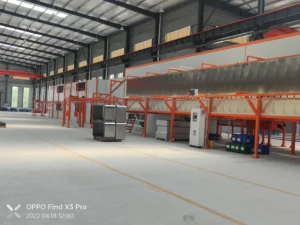
2. Polyester Powder Coatings
Core Characteristics:
Polyester powders are formulated to withstand outdoor environments. They contain UV stabilizers that protect the coating from sun degradation, making them ideal for products exposed to weather.
Performance Strengths:
- Superior UV and weather resistance
- Excellent color retention (maintains gloss and appearance for 3-5+ years)
- Strong humidity resistance
- Good mechanical properties
- Reliable outdoor durability
Limitations:
While polyester powders excel outdoors, they don't match epoxy's chemical resistance. They're not ideal for highly corrosive industrial environments or applications involving aggressive chemical exposure.
Best Applications:
- Outdoor furniture and patio products
- Architectural components and building facades
- Aluminum window frames and door frames
- Outdoor equipment and machinery
- Vehicles and transportation components
- Fixtures requiring long-term color stability
Why It Matters for Furniture Manufacturers:
We've worked with outdoor furniture producers across Turkey and other markets who depend on polyester powder to keep their products looking premium season after season. Outdoor furniture buyers notice color fading immediately—it signals poor quality. Polyester powder prevents this, protecting your brand reputation and customer satisfaction.
![powder coating spray booth]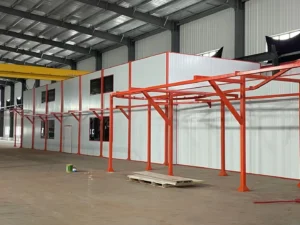
3. Epoxy-Polyester Hybrid Powder Coatings
Core Characteristics:
Hybrid powders blend epoxy and polyester resins to balance the strengths of both. They're often called "polyester-epoxy" or simply "hybrid" formulations and provide a practical middle ground.
Performance Strengths:
- Good adhesion (from epoxy component)
- Reasonable UV and weather resistance (from polyester component)
- Moderate chemical resistance
- Better outdoor durability than pure epoxy
- Lower cost than high-end polyester formulations
Limitations:
Hybrids don't excel in any single area—they're compromises. They won't match pure epoxy's chemical resistance or pure polyester's outdoor durability. They're best suited to general-purpose applications where moderate performance across multiple factors is acceptable.
Best Applications:
- General industrial equipment
- Building components with mixed indoor/outdoor exposure
- Products requiring both decent corrosion protection and some UV resistance
- Cost-sensitive projects where specifications allow compromise
When Hybrids Make Sense:
Hybrids are practical when you need to balance budget and performance. They're common in markets where equipment experiences both covered storage periods and occasional outdoor exposure.
4. Polyurethane Powder Coatings
Core Characteristics:
Polyurethane (PU) powders represent a specialty segment. They're more complex to process than other powder types but deliver exceptional surface properties and appearance.
Performance Strengths:
- Excellent surface smoothness and gloss retention
- Superior aesthetics and finish quality
- Good flexibility and impact resistance
- Decent chemical resistance
- Outstanding appearance in high-end applications
Limitations:
Polyurethane powders are more expensive than standard epoxy or polyester. They require careful handling during application and curing, and they're not as widely available. UV resistance is moderate, not excellent.
Best Applications:
- High-end consumer products requiring premium appearance
- Decorative metal components
- Architectural features where aesthetics are paramount
- Products where finish quality directly affects market positioning
Market Positioning:
Polyurethane powder is less common in industrial manufacturing but increasingly used in consumer-facing furniture and appliance markets where appearance is a key selling point.
5. Fluoropolymer Powder Coatings
Core Characteristics:
Fluoropolymer powders, often based on PVDF (polyvinylidene fluoride) resin, represent the highest performance tier. They're expensive but deliver unmatched durability.
Performance Strengths:
- Exceptional UV and weathering resistance (15+ year durability)
- Outstanding color and gloss retention
- Superior chemical and corrosion resistance
- Extreme durability in harsh environments
- Meets stringent performance standards
Limitations:
Cost is the primary barrier. Fluoropolymer powders can be 2-3 times more expensive than standard epoxy or polyester. They're also more challenging to apply and require precise spray parameters.
Best Applications:
- Architectural cladding requiring 20+ year performance
- High-value equipment in harsh environments
- Products where coating failure is extremely costly
- Marine and coastal applications
- Heavy industrial equipment in corrosive settings
When Investment is Justified:
We recommend fluoropolymer powder primarily when the cost of coating failure exceeds the premium you pay for the coating. For example, if a building facade costs $500,000 to refinish, spending extra on fluoropolymer powder in initial coating is economical.
Which Type of Powder Coating Is the Best?
The answer is straightforward: there is no universally "best" powder coating—only the best choice for your specific application.
I tell our clients that selecting powder type requires answering four questions:
1. Where will the product be used?
Indoor or outdoor? Covered or exposed? Harsh environment or mild? Your environment determines which resin system you need.
2. What performance properties matter most?
Do you prioritize adhesion, color stability, chemical resistance, or appearance? Different applications weight these differently.
3. What's your budget?
Budget constraints often narrow your options. Pure epoxy for protected environments can be highly cost-effective. Fluoropolymer for extreme durability requires significant investment.
4. What are your coating thickness requirements?
Thinner coatings work with most powder types, but specialized applications sometimes require specific chemistry to achieve adequate properties at low film thickness.
Comparative Performance Table:
| Property | Epoxy | Polyester | Hybrid | Polyurethane | Fluoropolymer |
|---|---|---|---|---|---|
| UV Resistance | Poor | Excellent | Good | Fair | Excellent |
| Chemical Resistance | Excellent | Good | Good | Fair | Excellent |
| Adhesion | Excellent | Good | Good | Very Good | Good |
| Cost | Low | Medium | Medium | High | Very High |
| Gloss Retention | Fair | Excellent | Good | Excellent | Excellent |
| Application Ease | Easy | Easy | Easy | Moderate | Difficult |
| Indoor Durability | Excellent | Good | Good | Very Good | Excellent |
| Outdoor Durability | Poor | Excellent | Good | Fair | Excellent |
Are There Different Grades of Powder Coating?
Yes—and this distinction is equally important as powder type. Within each resin category, powders vary significantly in formulation quality, pigment selection, and processing.
Standard Grade vs. Premium Grade
Standard Grade Powders:
- Use more economical pigments and additives
- May contain recycled resin components
- Adequate for protected indoor applications
- Faster color change capability
- Lower cost (typically 10-20% less)
- Acceptable for non-critical applications
Premium Grade Powders:
- Use higher-quality virgin resins
- Premium pigments and color stability additives
- Better batch-to-batch consistency
- Superior gloss and appearance
- Enhanced adhesion and durability
- Higher cost but justified in demanding applications
Specialized Formulations
Beyond standard/premium tiers, powders are formulated for specific needs:
- Wrinkle effect powders: Formulated for decorative appearance
- Textured powders: Designed for specific surface finishes
- Anti-static powders: For sensitive electronic component coating
- High-build powders: Optimized for thick, single-coat applications
- Low-temperature cure powders: For heat-sensitive substrates
- Food-contact approved powders: Meeting FDA and NSF standards
Impact on Spray Line Performance
From our experience managing production lines for cabinet makers and aluminum profile manufacturers, powder grade significantly affects line efficiency:
Standard grade powders offer faster color change and simpler color management, ideal for high-volume single-color production.
Premium grade powders require more careful parameter control but deliver superior coating consistency and appearance, essential for products sold on quality reputation.
How to Choose the Right Powder Coating Type for Your Application
A systematic approach prevents costly mistakes. Here's the framework I recommend:
Step 1: Identify Use Environment
Define whether your product will be indoor, outdoor, covered, or exposed. This single factor eliminates roughly 50% of inappropriate choices.
Step 2: Determine Performance Criticality
- Non-critical: Standard epoxy for indoor industrial use
- Important: Premium epoxy or hybrid for exposed indoor/storage applications
- Critical: Polyester for outdoor products or fluoropolymer for harsh environments
Step 3: Assess Substrate Material
- Steel/iron: Works with all powder types
- Aluminum: Requires careful substrate preparation; epoxy and polyester most common
- Non-ferrous metals: May require specialized pre-treatment and powder selection
Step 4: Consider Coating Thickness Requirements
- Thin coatings (2-3 mil): Most powders suitable
- Standard coatings (3-5 mil): All types work well
- Thick coatings (5+ mil): May require high-build formulations
Step 5: Factor in Budget and Volume
- High volume, standard application: Standard epoxy economical
- Low volume, critical appearance: Premium polyester or polyurethane justified
- Large outdoor project: Polyester or fluoropolymer investment spreads across many parts
Step 6: Verify Regulatory Compliance
Some industries require specific certifications:
- Food contact applications: NSF or FDA approved
- Automotive: OEM-specific requirements
- Medical devices: USP or ISO compliance
- Marine: Naval or commercial specifications
Performance Comparison of Different Powder Coating Types
Real-world performance differs from laboratory specs. Based on our work with manufacturers in different markets, here's what to expect:
Durability in Typical Environments:
| Application | Recommended | Expected Life | Recoat Interval |
|---|---|---|---|
| Indoor cabinet (climate controlled) | Epoxy | 10+ years | Not typically needed |
| Outdoor furniture (temperate zone) | Polyester | 4-7 years | 5-7 years |
| Industrial equipment (covered storage) | Hybrid | 6-10 years | 7-10 years |
| Architectural facade (exposed) | Fluoropolymer | 15-20+ years | 20+ years |
| Coastal/marine environment | Fluoropolymer | 10-15 years | 12-15 years |
| High-traffic indoor surface | Polyurethane | 5-10 years | 8-10 years |
Appearance Retention Over Time:
Epoxy powder typically maintains 70-80% of original gloss after 3 years indoor use. Color remains stable if protected from light.
Polyester powder maintains 85-95% gloss and color after 5 years outdoor exposure—this is why furniture makers prefer it for retail products.
Polyurethane powder holds appearance exceptionally well, retaining 90%+ gloss after 3-5 years even in moderately harsh conditions.
Fluoropolymer powder shows minimal appearance change over 10+ years, justifying its premium cost for high-value applications.
Curing and Application Requirements for Different Powder Coating Types
Different powders require different cure parameters. This affects your production line design and operating costs.
Epoxy Powder:
- Typical cure: 350-400°F (175-205°C) for 10-20 minutes
- Full strength: 24-48 hours at room temperature
- Early handling: 15-30 minutes after cure
- Oven type: Electric or gas furnace, standard heat circulation
Polyester Powder:
- Typical cure: 400-450°F (200-230°C) for 10-15 minutes
- Full strength: 24-48 hours
- Slightly higher temperature sensitivity than epoxy
- Oven type: Controlled temperature furnace essential
Polyurethane Powder:
- More temperature-sensitive
- Requires precise control ±5-10°F
- Longer cure times may be needed
- Risk of incomplete cure if parameters drift
- More skilled operator oversight required
Fluoropolymer Powder:
- Very specific cure window: typically 430-450°F for 10-15 minutes
- Highly temperature-sensitive
- Over-cure can cause color shift or brittleness
- Requires furnace with excellent temperature uniformity
- Best with data-logging systems to verify parameters
Application Differences:
From our spray line experience, epoxy and polyester powders are most forgiving during application—they work well with standard corona electrostatic guns and don't require exceptional air quality control.
Polyurethane powders demand higher electrostatic parameters and cleaner air; they're more sensitive to humidity and require more precise spray technique.
Fluoropolymer powders are the most demanding—they require friction-type spray guns (not corona), pristine compressed air quality, and precise spray patterns. This limits which manufacturers can economically use them.
![industrial spray room setup]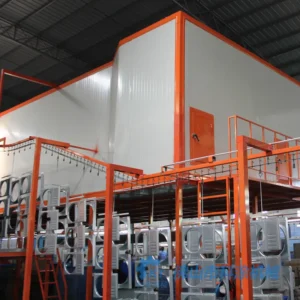
Cost Considerations Across Powder Coating Types
Material Costs (per pound, approximate US market ranges):
- Standard epoxy: $2-3/lb
- Premium epoxy: $3-4/lb
- Standard polyester: $3-4/lb
- Premium polyester: $4-5/lb
- Polyurethane: $5-8/lb
- Fluoropolymer: $8-15/lb
Important: Powder cost per finished part depends on film thickness and part size, not just powder price. Thinner coatings reduce material cost, but all powder types typically deliver 3-5 mil thickness on metal substrates.
Total Cost of Ownership:
When evaluating powder type, consider complete lifecycle costs, not just material price:
Epoxy powder for indoor cabinets:
- Material: ~$1.50-2/cabinet
- Application: Efficient, quick color change
- Re-coating: Usually not needed
- 10-year cost: ~$1.50-2 per cabinet
Polyester powder for outdoor furniture:
- Material: ~$2.50-3.50/piece
- Application: Slightly longer cure cycle
- Re-coating: Expected after 5-7 years
- 10-year cost: ~$5-6 per piece (includes one recoat)
Fluoropolymer for architectural cladding:
- Material: ~$8-12/panel
- Application: Requires specialized spray equipment
- Re-coating: Unlikely within 20 years
- 20-year cost: ~$8-12 per panel (one of lowest costs amortized)
Key Insight: The cheapest powder type isn't always the lowest-cost solution. If epoxy requires recoating every 5 years while polyester lasts 7 years, polyester's higher material cost is offset by fewer recoat cycles.
Summary: Selecting the Ideal Powder Coating for Your Needs
Powder coating selection requires balancing several competing factors. Here's the decision framework we recommend to manufacturing clients:
For Protected Indoor Environments:
Choose standard epoxy powder. Cost-effective, reliable, and proven. Excellent adhesion and corrosion protection eliminate the need for recoating. Best value for cabinets, electrical enclosures, and machinery.
For Outdoor Residential and Commercial Products:
Choose polyester powder. The UV and weather resistance justify the modest cost premium. Maintains appearance and extends time between recoating to 5-7 years. Optimal for furniture, fixtures, and architectural components.
For High-Performance Industrial Applications:
Choose fluoropolymer if durability is critical and recoating is expensive or disruptive. Choose polyester if standard durability is adequate. The 15-20 year service life of fluoropolymer makes financial sense for expensive infrastructure.
For Appearance-Critical Products:
Choose polyurethane if the product is sold on aesthetics and cost permits. Premium finish quality and gloss retention justify higher material and application costs. Ideal for consumer-facing furniture and decorative components.
For Specialized Requirements:
Consult your powder supplier about formulations optimized for your specific need—food contact, extreme cold, salt spray resistance, or specific colors and finishes.
The manufacturers we work with most successfully treat powder selection as a strategic decision tied to their target market and value proposition. Premium brands typically invest in premium powders; cost-focused producers optimize polyester or hybrid systems for their volume economics.
From our experience designing and operating spray lines across multiple continents, I can tell you that the right powder choice, matched to your product's actual use environment and your customers' expectations, delivers both quality satisfaction and economic performance.
Contact Us for Powder Coating Solutions
If you're planning a new spray line, upgrading existing equipment, or optimizing your coating performance, we're here to help. At Ketu, we design complete electrostatic powder coating lines customized to your specific products, production volume, and performance requirements. We've successfully implemented solutions for cabinet makers, furniture manufacturers, aluminum profile processors, and industrial equipment producers across multiple markets.
We can help you:
- Select the optimal powder type and grade for your application
- Design a spray line that maximizes coating quality and efficiency
- Optimize fixturing and conveyor systems for your specific products
- Train your team on spray technique and quality control
- Establish predictive maintenance programs to minimize downtime
Reach out to discuss your coating requirements:
WhatsApp: +8618064668879
Email: ketumachinery@gmail.com
Or visit our facility in Foshan, China—we welcome customers to see our operational spray lines and observe real-world coating performance on products similar to yours.
 English
  German
  Vietnamese
  French