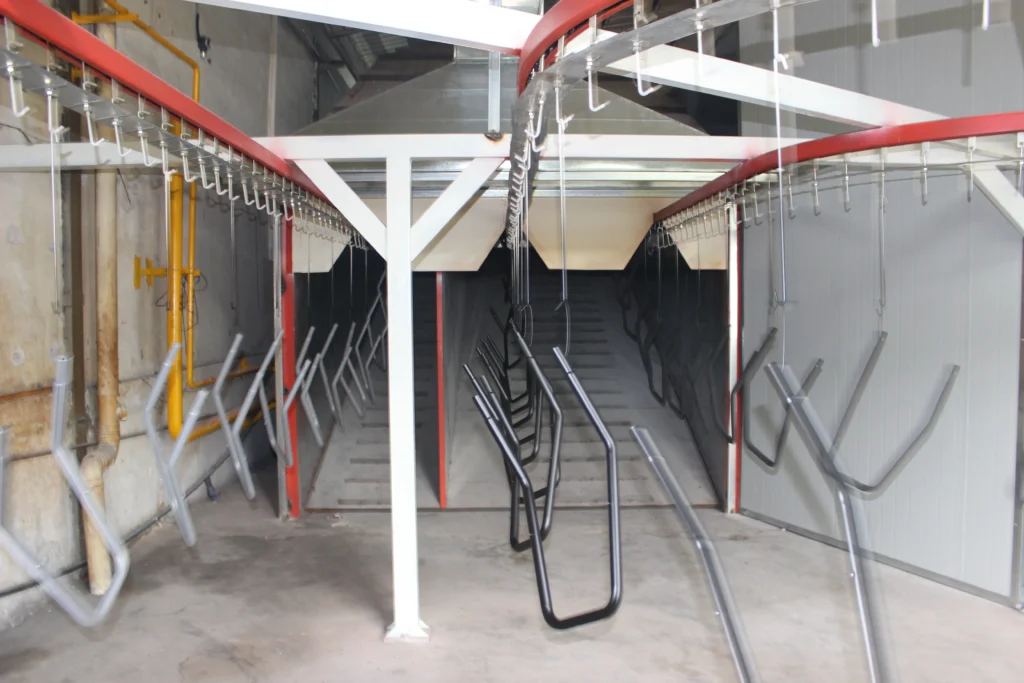
Causes and Benefits of Powder Coating for Aluminum Profiles
Why Aluminum Profiles Need Powder Coating
Bare aluminum is a beautiful material, but left unprotected, it's vulnerable. Aluminum naturally oxidizes when exposed to moisture, oxygen, and environmental contaminants—especially in coastal, industrial, or humid environments. This oxidation doesn't just dull the surface; it creates a gray or chalky appearance, reduces structural integrity at the surface level, and accelerates corrosion when salt, chemicals, or acidic conditions are present.
Without protection, bare aluminum profiles in harsh environments may degrade significantly within just 5 years. The cost of replacement, remediation, and production downtime far exceeds the upfront investment in quality powder coating. This is why we treat powder coating not as decoration, but as industrial-grade corrosion insurance.
![electrostatic powder coating line for aluminum]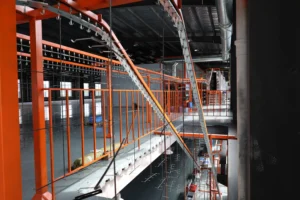
Key Problems Solved by Powder Coating
Corrosion and Oxidation Protection
Powder coating creates a continuous, dense protective barrier that seals the aluminum surface and prevents moisture and oxygen from reaching the base material. In our experience working with aluminum manufacturers across different regions, we've consistently observed that properly powder-coated aluminum profiles maintain structural and aesthetic integrity 2–3 times longer than uncoated alternatives.
The powder coating film bonds chemically to the aluminum surface (when proper pre-treatment is applied), forming a unified layer that resists:
- Salt spray and marine environments
- Industrial atmospheric pollution
- Acid rain and chemical exposure
- UV radiation and thermal cycling
In outdoor and coastal applications, this protection can extend service life from 5 years to 10–15 years or beyond, depending on environmental severity and coating system selection.
Enhanced Surface Durability and Wear Resistance
Powder-coated aluminum profiles exhibit superior hardness and abrasion resistance compared to bare aluminum. The cured coating resists scratching, scuffing, and impact damage that would otherwise expose the underlying aluminum to rapid oxidation.
This is particularly important for:
- Building facades and curtain wall systems, where profiles are handled during installation
- Industrial equipment and structural components subjected to mechanical wear
- Transportation and logistics applications where repeated contact is inevitable
The durability we observe translates directly into lower maintenance costs and fewer warranty claims for our customers' end products.
Improved Aesthetic Appearance and Color Consistency
Bare aluminum develops a non-uniform, oxidized surface within weeks of exposure. Powder coating delivers a uniform, high-quality finish with:
- Consistent color across the entire profile
- Controlled gloss levels (matte, satin, gloss, or specialty finishes)
- Superior surface smoothness and aesthetic appeal
- Customizable colors to meet design and branding requirements
For architectural and consumer-facing applications, this consistency is non-negotiable. Architects and designers specify powder-coated aluminum specifically because they can guarantee the appearance will remain stable throughout the product's lifecycle.
![pre-treatment system for aluminum coating]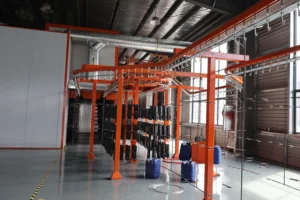
How Powder Coating Improves Aluminum Profile Performance
Extended Service Life and Cost Savings
The relationship between powder coating investment and total cost of ownership is straightforward but often overlooked. Yes, powder coating adds upfront cost—typically 15–25% per profile depending on complexity and volume. But over a 10-year lifecycle:
- Uncoated aluminum: replacement, remediation, warranty losses, production delays
- Coated aluminum: stable performance, minimal maintenance, predictable durability
We've analyzed projects where clients chose cheaper uncoated alternatives, only to face costly recalls and remanufacturing within 3–5 years. The lesson is clear: powder coating is not an expense; it's a hedge against much larger costs.
Chemical and Environmental Resistance
Different environments demand different coating systems. In industrial areas with exposure to aggressive chemicals, acidic emissions, or alkali-rich environments, the coating system becomes the critical performance variable.
Epoxy powder coatings excel in chemically harsh indoor environments—offering superior resistance to oils, solvents, and alkaline materials. Polyester and polyurethane systems are essential for outdoor and coastal exposure, where UV and weathering resistance determine whether the coating maintains color, gloss, and integrity over years of sunlight exposure.
Selecting the wrong powder system is a costly mistake that manifests as chalking, color fading, loss of gloss, and eventual adhesion failure within 1–2 years. We always recommend matching the coating system to the application environment.
Uniform Coating Quality and Consistency
This is where many customers discover the true value of our approach. Uniform coating thickness, consistent color, and reliable adhesion across complex aluminum profiles aren't accidents—they're the result of properly designed electrostatic powder coating systems with:
- Optimized pre-treatment that removes oil, oxidation, and contaminants
- Precision spray gun positioning and parameter control
- Stable, calibrated high-voltage electrostatic systems
- Controlled coating thickness (typically 60–100 micrometers for aluminum)
- Monitored curing that achieves full cross-linking
In our work with aluminum manufacturers across Asia, the Middle East, and Europe, we've found that consistency is what separates premium suppliers from commodity producers. When your customers know they can rely on uniform appearance and performance across every shipment, they choose you over cheaper alternatives.
![powder coating spray booth immersion tank]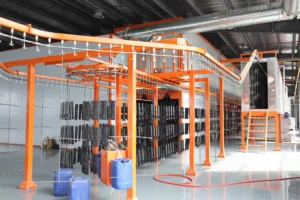
Powder Coating Systems: Epoxy vs. Polyester
Choosing the right powder formulation is as important as choosing the coating process itself. The two dominant systems serve different purposes and environments.
Indoor Applications and Chemical Resistance
Epoxy powder coatings are the industry standard for indoor and heavily chemical-exposed applications:
- Superior adhesion to metal surfaces
- Excellent resistance to oils, solvents, and alkali
- Strong mechanical properties (hardness, impact resistance)
- Cost-effective for high-volume indoor production
Applications: electrical enclosures, industrial equipment, appliances, machinery housings, chemical storage containers.
Typical performance: 10+ years of reliable performance in controlled indoor environments.
Outdoor and Coastal Applications
Polyester and polyurethane powder coatings are engineered for harsh outdoor conditions:
- Superior UV resistance (maintains color and gloss under sunlight)
- Enhanced weathering resistance
- Better salt spray performance (critical for coastal environments)
- Higher gloss retention over years of exposure
Applications: architectural profiles, building facades, outdoor furniture, structural components, coastal infrastructure.
Typical performance: 10–15 years in temperate climates; 5–10 years in severe coastal or industrial air environments.
| Coating System | Best Application | UV Resistance | Chemical Resistance | Cost | Typical Lifespan |
|---|---|---|---|---|---|
| Epoxy | Indoor, industrial | Moderate | Excellent | Low | 10+ years |
| Polyester | Outdoor, moderate UV | Excellent | Good | Medium | 10–15 years |
| Polyurethane | Outdoor, high UV | Excellent | Excellent | High | 12–15+ years |
| Hybrid (Epoxy-Polyester) | Mixed exposure | Good | Good | Medium | 8–12 years |
Specifying the wrong system is a common and expensive mistake. We always conduct an environmental assessment with customers to ensure they're investing in the right coating for their specific application.
Critical Success Factors in Aluminum Powder Coating
Performance is never determined by the powder alone or the spray system alone. Success requires orchestration across the entire process. From our experience managing hundreds of aluminum coating projects, three factors stand out as make-or-break.
Pre-treatment as the Foundation
This is the single most important determinant of coating success, and it's where approximately 60–70% of real-world failures originate—not from spray parameters or curing, but from inadequate pre-treatment.
Pre-treatment accomplishes critical work:
- Removes oil, dirt, and organic contaminants that prevent adhesion
- Removes oxide layer and corrosion products that undermine bonding
- Creates chemical conversion layer (phosphate or zirconium-based) that improves adhesion and corrosion resistance
- Ensures surface cleanliness before the coating is applied
Common pre-treatment failure modes we observe:
- Degreasing not thorough enough
- Rinsing incomplete, leaving salt or chemical residue
- Drying insufficient, trapping moisture that causes later adhesion failure
- Time lag between pre-treatment and spraying, allowing re-oxidation
We've implemented rigorous pre-treatment validation on aluminum projects because we know that cutting corners here means coating failure downstream. The investment in proper pre-treatment pays dividends.
Coating Thickness Control and Surface Uniformity
Aluminum profiles present a particular challenge: the thickness of the powder coat must be controlled within tight tolerances (typically 60–100 micrometers) to ensure:
- Adequate protection without waste
- Consistent appearance and color
- Proper flexibility (too thick = brittle; too thin = inadequate protection)
- Uniform coverage even in complex geometric sections
Thickness variation of ±10 micrometers can be visible to the customer and compromise perceived quality. We've designed our spray systems with sophisticated monitoring and automatic feedback to maintain consistency across profiles of different sizes and shapes.
Proper Equipment Selection and Line Configuration
The entire electrostatic powder coating line must be designed as an integrated system:
| System Component | Function | Criticality |
|---|---|---|
| Pre-treatment module | Remove contaminants, apply conversion layer | Critical |
| Drying oven | Remove all surface moisture | Critical |
| Spray booth design | Optimize electrostatic field, minimize waste | High |
| Spray gun positioning | Ensure uniform coverage, even complex sections | High |
| Powder supply system | Maintain consistent, regulated powder flow | High |
| Curing oven | Achieve complete cross-linking, stable temperature | Critical |
| Conveyor speed control | Match spray time to coverage requirements | High |
An improperly configured line—with mismatched conveyor speed, inadequate spray gun placement, or insufficient drying time—will produce inconsistent results regardless of powder quality.
Powder Coating Applications Across Different Industries
Aluminum profiles are used across multiple industries, and each has distinct requirements that inform coating strategy.
Building and Architectural Use
Architectural profiles—including curtain wall systems, window frames, cladding, and structural elements—demand the highest standards:
Requirements:
- Uniform appearance across large facade areas
- Long-term color and gloss stability (10+ years minimum)
- Weathering resistance without chalking or fading
- Compliance with building codes and fire ratings
- Aesthetic consistency for design-sensitive applications
Coating recommendations: Polyester or polyurethane systems; typical film thickness 80–100 micrometers.
Typical lifespan: 12–15 years in temperate climates; 8–12 years in coastal or heavily polluted areas.
Industrial and Outdoor Equipment
Industrial aluminum components—heat sinks, equipment housings, machinery frames, structural supports—prioritize durability over aesthetics:
Requirements:
- Corrosion protection in industrial and salt-spray environments
- Mechanical durability (impact, abrasion)
- Thermal stability in some applications
- Cost efficiency for high-volume production
Coating recommendations: Epoxy for indoor; polyester for outdoor; hybrid systems for mixed exposure.
Typical lifespan: 5–12 years depending on environment and coating system.
Furniture and Interior Components
Furniture—both indoor and outdoor—combines aesthetic and functional requirements:
Requirements:
- High-quality finish and color uniformity
- For outdoor furniture: superior UV and weathering resistance
- Flexibility and impact resistance
- Safety compliance (food contact, childproofing, etc.)
Coating recommendations: For outdoor furniture, polyester or polyurethane; for indoor, epoxy or hybrid systems.
Typical lifespan: Outdoor 8–10 years; indoor 10+ years.
![powder coating curing oven thermal processing]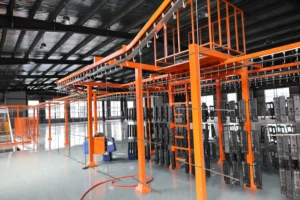
Return on Investment: Planning Your Powder Coating Line
For aluminum manufacturers considering a powder coating investment, ROI calculations must account for both direct and indirect factors.
Capacity Planning and Production Requirements
The starting point is honest assessment of your production needs:
Questions to answer:
- What's your current monthly or annual aluminum profile volume?
- What's your growth trajectory over the next 3–5 years?
- What profile sizes and complexities are you coating?
- How many color changes do you require per production run?
- What throughput (pieces per hour) do you need to be competitive?
Oversizing the line wastes capital and energy; undersizing creates bottlenecks. We've seen both. In our projects across India, Indonesia, and the Middle East, we typically recommend matching line capacity to 1.2–1.3× current volume to provide flexibility without excessive overhead.
Typical aluminum profile line capacities:
- Small profile (< 50 mm): 30–50 pieces/hour
- Medium profile (50–200 mm): 15–30 pieces/hour
- Large or complex profile (> 200 mm): 5–15 pieces/hour
Equipment Stability, Maintenance Costs, and Long-term Support
The cheapest equipment up front often becomes the most expensive equipment long-term. Frequent repairs, downtime, and component replacements create hidden costs that dwarf the initial purchase price.
What matters most for long-term ROI:
Equipment reliability
- Spray gun stability and consistency
- Conveyor system uptime and speed consistency
- Oven temperature stability and uniformity
- Pre-treatment system reliability
- Electrical and pneumatic system robustness
Maintenance and spare parts
- Availability and cost of replacement components
- Ease of routine maintenance and cleaning
- Access to technical support (local or remote)
- Training for operators and maintenance staff
Vendor stability and support
- Manufacturer's track record for equipment longevity
- Willingness to provide on-site installation and commissioning
- Availability of operator training and documentation
- Post-sale technical support response time
- Commitment to spare parts availability over 10+ years
From our experience with aluminum manufacturers across multiple countries, the most successful deployments combine reliable equipment with vendors who understand the customer's business and are invested in their success—not just in the initial sale.
When calculating ROI, factor in:
- Improved product quality → fewer returns and warranty issues
- Consistent appearance → higher market value and brand premium
- Extended product lifespan → reduced customer complaints and reputation risk
- Production efficiency → lower per-unit cost through scale and consistency
- Energy efficiency → lower operating costs (electricity, gas)
A well-designed, properly maintained aluminum powder coating line typically delivers 2–3× return on investment within 5–7 years, and continues generating value for 10+ years.
![electrostatic powder coating line production overview]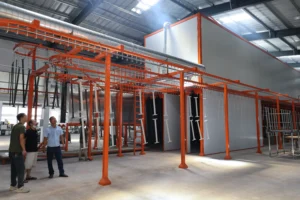
Conclusion
Powder coating aluminum profiles is not optional for manufacturers seeking long-term competitiveness. It transforms bare aluminum from a time-limited commodity into a durable, aesthetically consistent product that commands premium positioning in the market.
The choice is not whether to coat, but how to coat well. Proper pre-treatment, appropriate coating system selection, reliable equipment, and stable process control separate industry leaders from competitors. The investment in a well-engineered electrostatic powder coating line—designed to match your specific production profile requirements—pays for itself through improved quality, extended product lifespan, reduced waste, and market differentiation.
If you're evaluating powder coating solutions for aluminum profiles, we recommend assessing potential partners based on:
- Their direct manufacturing experience with aluminum
- Their ability to design a line matched to your specific products and volumes
- Willingness to provide equipment demonstrations or customer references
- Clarity on pre-treatment, spray parameters, and curing specifications
- Post-sale support and training commitment
At Ketu, we've invested in understanding the nuances of aluminum profile coating across multiple geographies and industries. We design lines that don't just spray powder—they deliver consistent, durable, market-ready results.
Ready to upgrade your aluminum coating capability? Contact us to discuss your production requirements, see our equipment in operation, and develop a customized solution.
Email: ketumachinery@gmail.com
WhatsApp: +8618064668879
 English
  German
  Vietnamese
  French