I often see people think an “automatic line” works because it has automatic guns. Then they buy the equipment, and the line still drifts. The finish changes by shift. Edges go thin. Color changes take forever. The oven runs hot but parts still fail.
An automatic powder coating line works by moving parts through a fixed, continuous flow—pretreatment, dry-off, automatic spraying, recovery, and curing—while locking key variables like takt time, grounding, airflow, powder feed, and part-temperature curing so results stay repeatable.
I explain it in factory language: the line is a “variation control system.” The machines only matter because they help me keep the same surface condition, the same deposition window, and the same cure completion every day.
What Is a Powder Coat Line?
Many people define a powder coat line as “booth + oven.” That is the visible part, not the working logic. In an automatic line, conveying and control are what make it automatic.
A powder coat line is a production system that prepares the part surface, deposits powder by electrostatics, and cures it into a solid film, using controlled movement, time, airflow, and safety interlocks to keep quality stable.
The three core jobs the line must complete
H3: 1) Make the surface consistent
If the surface condition changes, adhesion and corrosion performance drift. The line prevents that by controlled pretreatment and rinsing.
H3: 2) Make powder deposition stable
Electrostatic spray works only when the part is grounded well and the booth airflow is stable. The line controls both.
H3: 3) Make curing complete
Curing must be verified by part metal temperature and time in the cure window, not only by oven setpoint.
What Are Powder Lines?
People use “powder lines” to mean different layouts and automation levels. In real projects, I use the term to describe how parts flow and where variation is controlled.
Powder lines are the different system types used to run powder coating, from batch and semi-automatic conveyor lines to fully automatic lines with automatic spraying, and the best type depends on volume, mix, and color change frequency.
Where an automatic line is different
An automatic line adds:
- continuous conveying and buffering
- fixed dwell time per stage
- recipe-based spray parameters
- monitored airflow and recovery
- interlocked safety logic
That is how the line “works” without relying on operator feel.
What Is the Powder Coating Process Step by Step?
A step list is only useful if it includes what each step is controlling. Below is the automatic-line flow from load to pack, with the control purpose of each stage.
Step by step, an automatic powder coating line runs: load and rack → pretreatment → rinsing → dry-off → automatic spray in booth → powder recovery/dust collection → curing oven → cooling → unload, inspect, and pack.
Step A: Load, racking, and grounding (the master switch)
Parts enter on hangers or fixtures tied to the conveyor.
I control:
- contact point cleanliness
- grounding continuity
- hang point position to avoid shadowing
- loading speed and spacing
If ground is unstable, automatic guns cannot fix edge coverage. Thin edges and rough finish appear fast.
Step B: Pretreatment (adhesion and corrosion base)
Parts go through spray or immersion pretreatment and rinses.
I control:
- chemical concentration
- temperature and dwell time
- spray coverage and nozzle health
- rinse water quality and conductivity
This step makes the surface repeatable. If it drifts, rework rises even if the booth is perfect.
Step C: Dry-off (remove water risk)
Parts go through a dry-off oven.
I control:
- “dry everywhere,” including seams and cavities
- stable exit condition before booth entry
If water remains, you see pinholes and bubbles after cure. Many people blame powder for this, but it is often dry-off.
Step D: Automatic spraying in the booth (repeatable deposition)
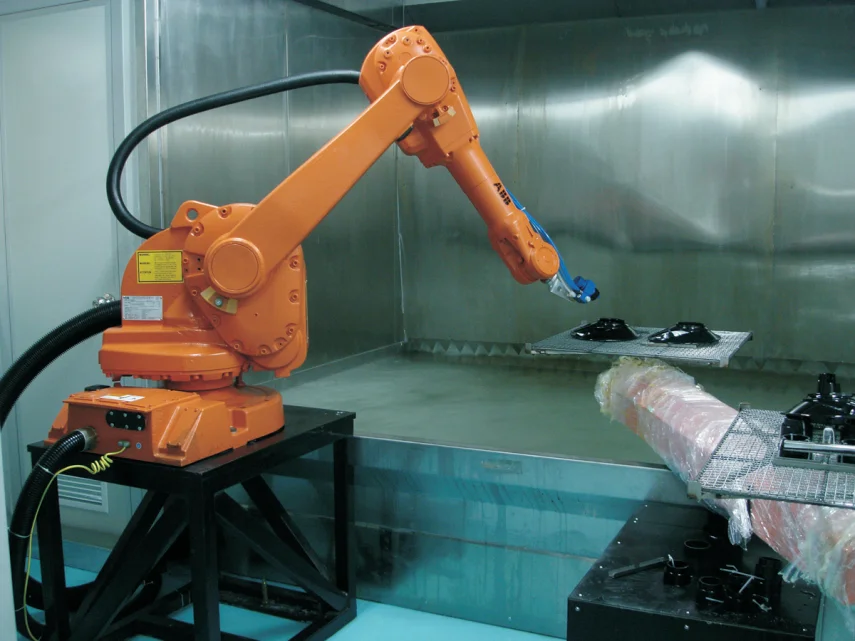
Parts enter the booth. Automatic guns on reciprocators or robots spray with fixed motion.
I control:
- gun-to-part distance and angle
- kV/current settings
- powder flow rate and air settings
- part speed and spacing
- booth negative pressure and airflow balance
Automatic spraying works because motion is repeatable. But it is only stable if grounding and airflow are stable.
Step E: Powder recovery and dust collection (keep powder and air stable)
Overspray is pulled into recovery:
- cyclone + cartridge filters, or
- filter-only recovery, depending on design
I control:
- stable suction and negative pressure
- filter loading and cleaning routine
- reclaimed powder quality and contamination control
- changeover procedure for multi-color lines
If recovery is unstable, powder loss rises and dust defects increase. Changeovers become slow and unpredictable.
Step F: Curing oven (make the coating a real film)
Parts enter the curing oven. Powder melts, flows, and crosslinks.
I control:
- part metal temperature profile
- effective time in the cure window
- oven airflow and exhaust balance
- safety interlocks (over-temp, door, fan)
I never accept cure by setpoint only. Thick parts and heavy racks need more time to reach metal temperature. Under-cure and over-cure both cause failures.
Step G: Cooling, unloading, inspection, packing (protect the finish)
Parts cool to a safe handling temperature, then unload.
I control:
- handling tools and contact points
- stacking and packing protection
- inspection points for thickness and appearance
Many “coating complaints” are actually scratches from unloading and packing, not spray defects.
What Is a Coating Line?
A coating line is the general category. Powder coating lines are one type.
Understanding this helps you explain the system to a buyer who is not technical.
A coating line is a production system that prepares the surface, applies a coating material, and then sets it by drying or curing, using controlled movement, utilities, and quality checks to repeat results.
The automatic powder line “control loop” in one view
| Zone | Input | Control | Output |
|---|---|---|---|
| Pretreatment | dirty parts | chemistry + time + water | consistent surface |
| Dry-off | wet parts | temperature + airflow | dry parts |
| Booth | dry grounded parts | kV + flow + airflow | stable film build |
| Recovery | overspray | suction + filtration | clean air + usable powder |
| Cure | coated parts | part temp + time | cured film |
| Handling | cured parts | protection SOP | shippable finish |
This is how an automatic line works: it turns variable inputs into stable outputs by controlling the few variables that matter.
Conclusion
An automatic powder coating line works by using continuous conveying and fixed process control to keep surface prep, electrostatic deposition, recovery airflow, and part-temperature curing stable, so quality repeats across shifts and batches.
 English
  German
  Vietnamese
  French