
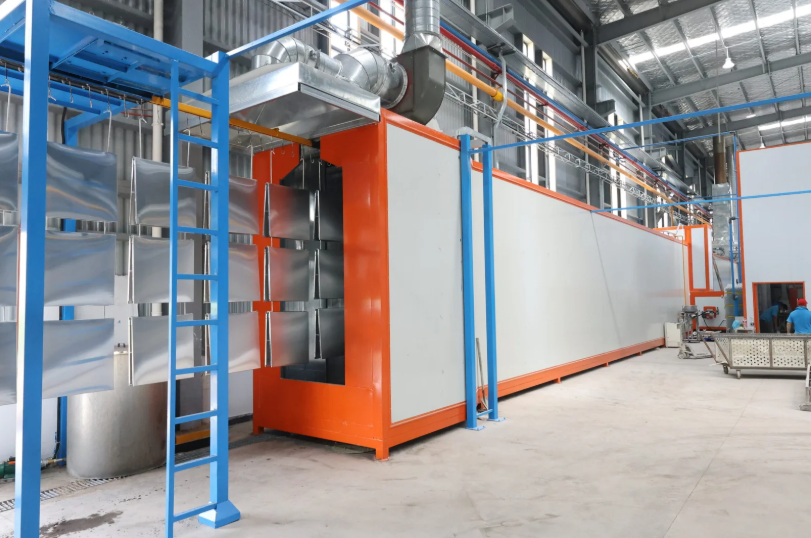
Powder Coating Curing Temperature: How Hot Do You Really Need?
Introduction: Why Temperature Control Matters More Than You Think
When we work with powder coating lines in our factory, one of the most common questions from production teams is: "How hot does the oven really need to be?" The answer seems straightforward—but it's not. Over the past years of helping clients optimize their electrostatic powder coating lines, I've learned that most shops focus on the wrong number: they watch the oven thermometer and assume the parts are curing properly. That's where problems start.
From my experience with cabinet manufacturers, furniture producers, and aluminum material companies, I can tell you that temperature control is the silent killer of coating quality. Get it wrong, and you'll face adhesion failures, color issues, and premature corrosion—sometimes months after the parts leave your facility. Get it right, and your coatings will perform exactly as engineered.
This guide is based on what we've learned from dozens of production lines we've commissioned and optimized. I'm going to walk you through the real numbers, the hidden pitfalls, and the practical checks you can do on the shop floor to make sure your parts are actually reaching the temperature they need.
What Is the Standard Curing Temperature for Powder Coating?
Most powder coatings cure between 350°F to 400°F (175°C to 200°C), with typical formulations clustering around 375°F–400°F. But here's the catch: this range isn't arbitrary—it's the workpiece surface temperature that matters, not the air temperature inside your oven.
In my discussions with cabinet and electronics manufacturers, I've found that many shops confuse oven temperature with part temperature. A 400°F oven doesn't mean your metal workpiece has reached 400°F. Depending on material thickness, density, and how tightly you're loading the oven, the actual part temperature can lag 10–30°F behind the air temperature. For thick steel frames or aluminum structures, this gap can be even larger.
Here's the practical standard I recommend:
- Epoxy and polyester powders (most common): Aim for 375°F–400°F workpiece temperature, held for 10–20 minutes
- Low-bake formulations: 250°F–325°F for 20–40 minutes
- Fast-cure / high-speed systems: Can reach full cure in 5–10 minutes at higher temperatures
The key is knowing which temperature you're measuring. If you're only watching the oven dial, you're flying blind.
Why Temperature Matters: The Role of Metal Temperature vs. Oven Temperature
This is the distinction that separates production lines that run smoothly from those that generate constant warranty claims.
When powder hits a cold part, it doesn't fully melt and flow. The resin molecules don't cross-link properly. The result? A coating that looks acceptable when it comes out of the oven but fails in real-world use—it chips, it cracks, it doesn't protect against salt spray or chemicals.
In my experience working with cabinet factories and outdoor furniture producers, the most common failure I see is undercuring caused by temperature measurement errors. A client will say "Our oven is set to 400°F," but when we measure the actual part temperature using thermocouples, it's only 360°F. Three months into service, their customer's product starts showing rust under the coating.
The physics is straightforward: powder coating is a chemical process. The polymers need to reach a specific temperature to undergo cross-linking. If the temperature is too low, the reaction happens too slowly or incompletely. If the time at temperature is too short, the same problem occurs.
How to Measure Actual Part Temperature (Not Just Oven Air Temperature)
Here's my recommended on-site method that doesn't require expensive equipment:
Method 1: Surface Thermocouple Probe
Place a fine-wire thermocouple directly on the workpiece surface (or embed it in a dummy test part that matches your actual part weight and material). This gives you the most accurate reading. Many shops resist this, saying it adds complexity—but one batch of rejected parts costs far more than a quality thermocouple kit.
Method 2: Infrared Thermometer
Aim an IR gun at the part surface as it exits the oven. Pros: non-contact, fast, no physical probes needed. Con: surface emissivity matters, so calibrate against a known standard first.
Method 3: Temperature Strips
Adhesive strips that change color at specific temperatures. Low-cost, no batteries. Useful for quick checks, but less precise than electronic methods.
What I recommend: Use a combination approach. Thermocouples during commissioning to establish baseline profiles, then periodic IR gun checks during production to verify stability.
Here's the critical point: measure the part at the coolest location—usually the thickest section or the part's interior (if it's a cabinet or enclosed structure). That's where the temperature lags the most.

How Temperature Varies by Powder Type
Not all powders cure the same way. This is where specificity saves production lines from constant troubleshooting.
Epoxy Powder Coatings
Typical cure: 375°F–400°F, 10–20 minutes
Epoxy powders are known for excellent chemical and corrosion resistance. They're standard in industrial cabinet production, electronics housings, and heavy equipment. They require solid heat to cross-link properly.
Key characteristic: Epoxies are sensitive to undercuring. If your temperature is 20°F below spec, you'll see dramatically reduced salt-spray resistance. I've seen cabinet makers struggle because they're running their ovens at 380°F thinking it's "close enough" to 400°F—but with thick steel parts, the actual cure temperature might be 360°F, which produces a coating that looks fine for a month then starts corroding.
Polyester Powder Coatings
Typical cure: 375°F–400°F, 10–20 minutes
Polyester powders excel at outdoor performance and UV resistance, making them popular for outdoor furniture and architectural aluminum. They share similar temperature requirements with epoxy but offer better aesthetics (higher gloss, smoother appearance).
Key characteristic: Polyesters are somewhat more forgiving than epoxies on the low end (they tolerate 360°F better) but are extremely sensitive to overcuring. Push them 20°F too high or hold them too long, and you'll see yellowing, loss of gloss, and brittleness. I've had furniture manufacturers call complaining that their coatings look "old" three weeks after production—that's typically overcured polyester.
Hybrid and Specialty Powders (Polyurethane, Low-Bake, Fast-Cure)
Low-bake: 250°F–325°F, 20–40 minutes
Polyurethane: Often 350°F–390°F, with strict time windows
Fast-cure: 400°F–420°F, 5–10 minutes
These are less common but increasingly important for customers with specific needs:
- Low-bake powders are used when substrates can't handle high heat (some plastics, certain adhesives, or assembled components). The tradeoff is longer cure times and sometimes slightly reduced final properties.
- Polyurethane powders demand precise temperature control—they're formulated for a narrow window, and deviations in either direction cause problems.
- Fast-cure systems are designed for high-speed production lines where energy efficiency is critical. They cross-link very quickly, so temperature and time coordination is essential.
My advice: Don't assume "standard" parameters apply to specialty powders. Always request the technical datasheet from your powder supplier and honor it exactly. I've seen aluminum material processors try to use fast-cure powder formulas with standard oven settings—it doesn't work. The powder doesn't fully cure in the time window available.
What Happens When Temperature Is Too Low
This is the scenario that appears in most coating failures I investigate.
Impact on Adhesion and Durability
When powder doesn't reach full cure temperature, the resin network doesn't fully cross-link. The result is a coating that appears normal—good color, decent gloss—but has weak mechanical properties.
Adhesion failures: The powder hasn't melted completely, so it doesn't form a continuous chemical bond with the substrate. It sits on top like a shell rather than integrating with the metal surface. You'll see this in pull-off adhesion tests (often scoring 2–3 on the ASTM D3359 scale instead of 4–5).
Hardness loss: An undercured coating will be softer, more prone to scratching, more susceptible to denting. Outdoor furniture or cabinets that get bumped during transport or installation will show damage quickly.
From our cabinet-maker clients: One manufacturer was running their oven at 380°F (oven setpoint), but their actual part temperature was measuring 355°F due to loading density and metal thickness. Within two weeks, their customer reported that coating was scratching off with fingernails. The coating was undercured—the cross-linking wasn't complete enough to provide hardness.
Long-Term Performance Risks (Salt Spray, Chemical Resistance)
This is where undercuring becomes expensive. An undercured coating may pass visual inspection but fail catastrophically under environmental stress.
Salt spray resistance is one of the most revealing tests. A properly cured coating can withstand 500–2000 hours of salt-spray exposure (depending on the powder formulation and substrate prep). An undercured coating might fail in 100 hours, with corrosion tunneling under the edge of the test scribe.
Chemical resistance suffers similarly. In industrial or laboratory settings where coatings face solvents, detergents, or other chemicals, an undercured coating will absorb them, swell, and eventually flake away.
From my conversations with aluminum manufacturers serving harsh environments: They've learned that salt-spray performance is non-negotiable. A batch of parts that fails salt-spray testing triggers a full line halt and rework. The cost of validation testing alone ($200–500 per batch) makes it cheaper to ensure proper cure than to debug failures months later.
| Temperature Scenario | Adhesion | Hardness | Salt Spray (500hrs) | Chemical Resist. | Typical Failure Mode |
|---|---|---|---|---|---|
| Too Low (20°F under) | Poor (2/5) | Low | Fails (~100–200hrs) | Fails | Corrosion tunneling, peeling edges |
| Optimal Range | Excellent (5/5) | Good | Passes | Passes | None expected |
| Too High (20°F over) | Good (4–5/5) | Brittle | Passes | Good | Cracking, yellowing, loss of gloss |
What Happens When Temperature Is Too High
Overcuring is less common than undercuring, but it causes equally visible—and costly—problems.
Color Change, Gloss Loss, and Brittleness
When you push a powder beyond its designed temperature range, the resin chemistry accelerates. The polymer chains cross-link excessively, creating a brittle, over-hard coating. Additionally, thermal degradation of certain resin components or pigments can occur.
Visual defects:
- Yellowing or darkening: Especially noticeable on lighter colors (whites, pale grays). The heat degrades pigments or causes oxidation of the resin.
- Loss of gloss: The coating surface becomes dull or chalky rather than smooth and shiny.
- Micro-cracking or crazing: The coating becomes so hard and brittle that it cracks under stress (vibration, temperature cycling, impact).
From outdoor furniture producers we've worked with: One client was running polyester powder at 420°F (20°F above spec) because they thought "hotter = better cure." Within a month, customers reported that the furniture coating was yellowing in sunlight and cracking at stress points like welds and joints. They had to scrap the batch and adjust their oven down to 400°F. Cost: thousands of dollars in rework, plus customer dissatisfaction.
Energy Cost vs. Quality Trade-Offs
There's also an operational cost to overcuring: you're using more energy to achieve worse results. Modern production managers think about cost-per-part. Running your oven hotter than necessary increases your energy bill without improving the end product—it actively degrades it.
Quick ROI calculation: If overcuring by 20°F costs an extra $0.30 per part in energy but increases scrap/rework by 3%, and you're doing 10,000 parts/month, you're losing money fast.
Temperature and Time: Is There a Trade-Off?
One of the most common questions I hear is: "Can we run hotter and spend less time in the oven?" The answer is nuanced and depends on understanding cure curves.
Understanding Cure Curves
A cure curve is a graph showing how much cross-linking happens at a given temperature over time. For most powders, there's an optimal path—you can run at 400°F for 15 minutes, or 380°F for 25 minutes, and achieve similar cure levels. But you can't run at 350°F for 10 minutes and expect the same result. The reaction rate doesn't scale linearly.
General principle: For every 10°C increase in temperature, the reaction rate roughly doubles (this is the Arrhenius principle). So higher temperature × shorter time can work—but there's a limit. You can't compress cure time indefinitely.
From a production line optimization perspective: If you're trying to increase throughput, raising temperature by 10–15°F is often more practical than extending the oven dwell time, because oven capacity is limited. But you must verify that your specific powder formulation supports this adjustment by consulting the technical datasheet.
Thickness and Material Considerations
Part thickness and material conductivity directly affect how long it takes for heat to penetrate to the interior.
Thick steel parts (3–5mm): Heat penetration is slow. You might need to run 20+ minutes even at 400°F to ensure the interior reaches temperature. Shorter times won't work, even if oven temperature is high.
Thin aluminum or steel (1–2mm): Heat penetration is faster. 10–15 minutes at 400°F is usually sufficient.
Aluminum vs. steel: Aluminum conducts heat much better than steel, so aluminum parts reach oven temperature faster. If you're mixing part types in the same oven, you have to account for the worst case (thickest steel) or separate your production.
My recommendation: Create a time-temperature profile for each major part type you produce. Use thermocouples to measure the internal temperature of your thickest or least conductive part. That measurement becomes your baseline. Anything faster or cooler risks undercuring.
How to Control and Verify Curing Temperature on the Production Floor
This is the practical part—the stuff that prevents problems before they happen.
Common Temperature Setting Mistakes
I've seen the same errors repeatedly:
-
Only checking oven setpoint, not actual part temperature. The most dangerous mistake. Your oven says 400°F, but the part says 360°F.
-
Ignoring loading density. Cramming too many parts into the oven blocks heat circulation. Parts in the center of a dense load heat more slowly.
-
Not accounting for conveyor line speed changes. When you speed up the line (to increase throughput), dwell time in the oven drops. Many operators don't recalculate and don't realize they're undercuring.
-
Switching powder suppliers without re-optimizing. New powder = new cure specifications. Don't assume the old temperature settings work.
-
Environmental neglect. Cold ambient air, high humidity, or poor oven door seals can affect internal oven temperature stability.
-
Poor oven maintenance. Clogged air circulation fans, damaged heating elements, or bad thermostats cause temperature drift.
Quick Field Checks for Proper Cure
Here's what we recommend for daily or weekly validation:
Check 1: Adhesion Pull-Off Test
Remove a freshly cured part from the oven (after it cools). Use a cross-hatch cutter to score the coating in a grid, then use strong tape to pull off the coating. You should see adhesion rating of 4–5 (minimal removal). If you see large flakes coming off, temperature is too low.
Check 2: Hardness Test
Use a pencil hardness tester (hard to pencil scale) or a simple scratch test with a coin. A properly cured coating should be hard enough that a coin scratch shows no visible damage. If a coin scratches easily, cure is incomplete.
Check 3: Temperature Probe Check
Once per shift, place a thermocouple probe on a representative part or use an IR gun. Compare the reading to your expected spec. If it's trending down, investigate: is the oven heating element failing? Are thermostats drifting?
Check 4: Visual Inspection
Look for color consistency, gloss uniformity, and absence of micro-cracking. Yellowing, dull spots, or visible crazing indicate overcuring or process drift.
My strong recommendation: Establish a daily checklist. It takes 15 minutes, and it'll catch 90% of cure problems before they reach your customers.
Key Takeaways: Getting Temperature Right the First Time
Let me distill this into actionable points you can use immediately:
On specifications:
- Standard powder coatings cure at 375°F–400°F (workpiece temperature), held for 10–20 minutes
- Always check the powder supplier's technical datasheet for exact specs
- Don't assume "close enough"—10°F matters
On measurement:
- Measure workpiece surface temperature, not oven air temperature
- Use thermocouples or IR guns, not just oven dials
- Measure the slowest-to-heat location (thickest part or interior)
- Establish baseline profiles for each part type
On undercuring (too cold):
- Leads to adhesion failure, poor hardness, corrosion risk
- May look acceptable initially but fails in field use within weeks
- Most common problem I see; also most preventable
On overcuring (too hot):
- Causes yellowing, loss of gloss, brittleness, micro-cracking
- Wastes energy without improving results
- Often driven by misguided attempts to "guarantee" cure
On throughput optimization:
- Higher temperature + shorter time can work, but verify with your specific powder
- Don't sacrifice quality for speed; the cost of rework exceeds the savings
- If you increase line speed, recalculate oven dwell time
On process control:
- Establish daily checks: adhesion, hardness, temperature, visual inspection
- Change powder? Get new specifications and re-qualify your process
- Maintain your oven regularly—thermostats and heating elements drift
- Track temperature trends; downward drift signals equipment problems
On long-term reliability:
- Proper cure is the foundation of salt-spray performance and environmental resistance
- Invest in validation testing (salt spray, chemical resistance) to confirm cure quality
- One batch of rejected parts often costs more than a decade of preventive measurement
In Summary
Powder coating temperature is not a set-and-forget parameter. It's the single most critical lever for controlling coating quality, durability, and customer satisfaction. In my years supporting production lines for cabinet makers, furniture manufacturers, and aluminum processors, I've learned that the difference between a thriving coating line and a problematic one often comes down to this: does the team actually measure what's happening, or do they just trust the oven thermostat?
The answer should be obvious. Measure what matters.
If you're currently struggling with coating adhesion, durability issues, or quality variability, temperature control is the first place to investigate. If you're designing or optimizing a powder coating line and want to ensure it's configured correctly for your specific parts and materials, this is foundational.
Ready to Optimize Your Powder Coating Line?
At Ketu, we've commissioned and fine-tuned electrostatic powder coating lines across multiple industries—cabinet manufacturing, outdoor furniture, aluminum processing, and more. One of the most impactful things we do during startup is establish proper temperature profiling and process validation.
If you're building a new line, upgrading an existing one, or troubleshooting quality issues, we'd be happy to discuss your specific requirements.
Contact us:
- WhatsApp: +8618925987762
- Email: ketucoatingline@gmail.com
We work with manufacturers worldwide. Let's make sure your coating line delivers the quality—and reliability—your customers expect.
 English
  German
  Vietnamese
  French