Powder Coating Line: A Complete Buyer's Guide to System Selection and Implementation
Based on our experience working with industrial manufacturers across different regions, a powder coating line is rarely just about equipment. It is about building a production system that can reliably deliver consistent surface quality, stable output, controlled operating cost, and long-term process repeatability.
We have seen factories invest in advanced spray guns and large curing ovens, only to discover later that weak pretreatment design, unstable conveyor speed, poor drying, or poor powder recovery coordination undermined the whole project. This guide is built on what we have learned from helping cabinet makers, furniture manufacturers, aluminum profile producers, and sheet metal factories select, configure, and implement powder coating lines that match real production needs.
 )
)
What Is a Powder Coating Line and Why It Matters
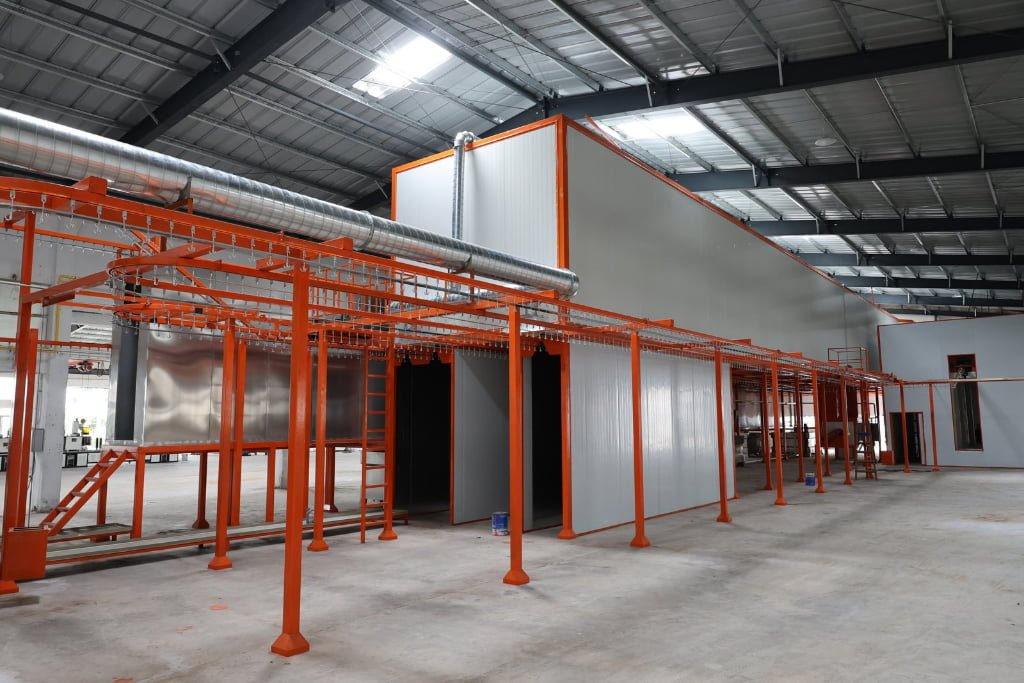
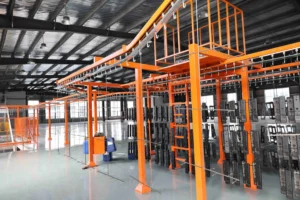
A powder coating line[^1] is an integrated manufacturing system that applies dry powder coating to metal products through electrostatic spraying, then cures the coating through controlled heating. The process usually includes pretreatment, drying, powder application, powder recovery, curing, cooling, conveying, and electrical control.
Compared with many liquid spray painting[^2] processes, powder coating can offer high material utilization, low solvent-related emissions during application, good film durability, and stable batch-to-batch appearance. The powder is applied as a dry material, and the final coating film forms after the powder melts, flows, and crosslinks in the curing oven.
Many thermoset powder coatings cure after the workpiece reaches a specified metal temperature, often around 160°C to 200°C depending on powder chemistry. The exact curing condition should always follow the powder supplier's technical data sheet. Oven air temperature alone is not enough. The real metal temperature of the part must be verified during commissioning.
For cabinet manufacturers, outdoor furniture producers, aluminum profile factories, and sheet metal workshops, the line can transform coating from a manual bottleneck into a controlled production process. But this only happens when the system is designed around the actual workpiece, output requirement, factory utilities, and quality standard.
Why This Buying Topic Matters
Purchasing a powder coating line is a significant capital investment. Small or semi-automatic systems may start from a lower budget range, while complete automatic or customized systems can require much higher investment depending on line size, automation level, pretreatment complexity, oven length, conveyor structure, and installation scope.
The real decision pressure is not only upfront cost. Buyers also need to understand whether the selected line will:
- Match product dimensions, weight, material type, and surface finish requirements
- Achieve practical production throughput without sacrificing coating quality
- Operate reliably with manageable maintenance and spare parts support
- Adapt to possible changes in product size, color, or production volume
- Generate ROI through stable powder utilization, energy management, and lower rework
Factories rarely struggle with the basic idea of powder coating. They usually struggle with matching line configuration to real production conditions. A line that works well for small lightweight components may perform poorly on heavy steel cabinets. A continuous line optimized for aluminum profiles may be inefficient for batch-style cabinet production. A pretreatment process copied from another project may fail if the new factory has different contamination, material, or corrosion resistance requirements.
The stakes are real. A poorly matched line can cause coating defects, high powder waste, energy loss, downtime, delayed ROI, and customer complaints.
How We Evaluated the Components in This Guide
This guide follows the real buying journey of industrial manufacturers. It is structured around the core decision points: understanding system architecture, matching configuration to product type, evaluating performance metrics, and planning implementation.
Each section connects technical specifications with practical production outcomes. This matters because professional buyers do not buy equipment only by catalog parameters. They want to know whether the line can coat their real products, inside their real factory, at the output level they need, with stable quality over time.
Table of Contents
- Core Components and How the System Works
- How Product Type and Workpiece Characteristics Drive Line Configuration
- Key Performance Metrics: Capacity, Efficiency, and Cost Analysis
- Surface Quality Standards and Quality Control Across Applications
- System Integration: Why Overall Coordination Matters
- Critical Factors for On-Site Implementation and Long-Term Success
- How to Choose the Right Powder Coating Line for Your Factory
- Final Thoughts
Core Components and How the System Works
A powder coating line is not a single machine. It is a sequence of process stages working together. Understanding each stage and how they connect is essential because weakness in one section can create problems downstream.
Pretreatment System and Surface Preparation
Before powder reaches the workpiece, the metal surface must be clean and properly prepared. Oil, mill scale, rust, dust, fingerprints, welding residue, or coolant residue can prevent the powder from bonding properly. This may lead to poor adhesion, chipping, blistering, corrosion, or peeling during service.
A typical pretreatment system may include degreasing, rinsing, rust removal or surface activation, conversion coating, final rinsing, and drying. The exact process depends on substrate material, contamination level, end-use environment, and required coating performance.
The critical specification is not only tank size. Chemical composition, bath concentration, temperature control, spray pressure, residence time, water quality, and maintenance discipline all matter. Cabinet factories receiving oily stamped parts may need stronger degreasing. Aluminum profile producers need aluminum-compatible pretreatment. Outdoor furniture manufacturers may need stronger corrosion resistance because products face humidity, sunlight, and handling damage.
Pretreatment design should start with raw material analysis. Where does the metal come from? What process created it? What contamination is on it? What coating failure risk matters most? The system should be designed for the worst normal contamination condition, not only the average condition.
 )
)
Dry-Off Section
After pretreatment, the workpiece must be fully dry before entering the spray booth. Moisture left in holes, seams, tubes, folded edges, or welded corners can create pinholes, craters, bubbles, poor powder attraction, and unstable film flow during curing.
The dry-off section may use hot air, infrared heating, or a drying oven. The correct design depends on workpiece shape, material thickness, line speed, and water retention areas. A simple flat panel dries faster than a tubular furniture frame or a deep cabinet structure. Drying performance should be tested with real workpieces during commissioning.
Powder Application and Spray Booth Configuration
The spray booth is where powder coating is applied. Electrostatic spray[^3] guns charge powder particles and apply them to grounded workpieces. The main variables include gun quantity, gun angle, spray distance, powder flow rate, air pressure, booth airflow, conveyor speed, and grounding quality.
Gun configuration: Single-gun, dual-gun, or multi-gun systems determine how quickly and evenly large surfaces can be covered. A single gun may work for small brackets, while large cabinet panels or long aluminum profiles may require multiple guns or reciprocators.
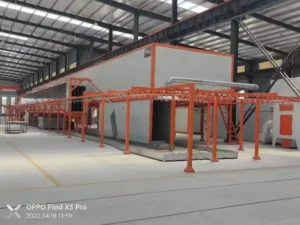
Spray booth design: The booth must contain overspray powder and direct it into the recovery system without disturbing the powder cloud. Cabinet factories often need larger booths with several spray positions. Aluminum profile lines often use narrower and longer booth designs optimized for continuous workpieces.
Powder recovery integration: Booth airflow, fan capacity, cyclone or filter design, and powder transfer should be coordinated. If the recovery system cannot handle actual booth airflow, powder utilization drops and cleaning becomes difficult.
Conveyor coordination: The workpiece must move through the spray booth at a speed that allows sufficient coverage. If the conveyor is too fast, film thickness may be too low or uneven. If it is too slow, output falls and powder may build up excessively.
Curing Oven and Temperature Control
After spraying, the powder-coated workpiece enters the curing oven. Heat melts the powder particles and allows them to form a continuous crosslinked coating film. Temperature and dwell time are critical. If curing is insufficient, the coating may remain weak. If curing is excessive, energy is wasted and some colors or substrates may be affected.
Important oven specifications include:
Heating method: Electric ovens are clean and easy to control, and they may be suitable for smaller lines or factories without gas supply. Gas-fired ovens are often economical for larger production if gas is available. Hybrid or infrared systems may be used for special applications.
Temperature uniformity: The oven should avoid hot spots and cold zones. Uneven temperature can create under-cured coating, over-baking, color variation, or inconsistent gloss. Temperature mapping should be performed during commissioning.
Metal temperature: Workpiece metal temperature is more important than oven air temperature. A heavy steel cabinet takes longer to heat than a thin sheet metal cover. Aluminum profiles also require stable temperature control to avoid color variation and unnecessary heat exposure.
Dwell time and throughput: Many powder coatings require 10–30 minutes after the part reaches the required metal temperature. The exact time depends on powder chemistry and part mass. The oven must be long enough to provide this dwell time at the required conveyor speed.
Load capacity: Some ovens are designed for continuous conveyor operation, while others are more suitable for batch or semi-batch production. The correct choice depends on product variety and volume stability.
Powder Recovery and Recycling System
Overspray powder must be captured and reused where possible. A powder recovery system may include a booth collection area, cyclone separator, cartridge filters, sieving equipment, powder transfer devices, and a reclaim mixing system.
Powder recovery directly affects operating cost. However, buyers should not judge recovery performance only by a theoretical percentage. Practical powder utilization depends on first-pass transfer efficiency, part geometry, booth airflow, filter condition, color-change loss, reclaimed powder quality, and reject rate.
Recovered powder should be screened and mixed with fresh powder according to powder supplier recommendations and surface quality requirements. Reclaimed powder may absorb moisture, collect contaminants, or change particle behavior if not managed correctly.
Recovery systems also require maintenance. Filters clog, airflow changes, powder hoses wear, and sieves need cleaning. A system designed well but maintained poorly can lose efficiency within months.
 )
)
How Product Type and Workpiece Characteristics Drive Line Configuration
This is where many purchasing decisions fail. Buyers may request a line based on a simple capacity number, such as pieces per hour, without defining what those pieces actually are. A cabinet factory and an aluminum profile producer may both ask for similar output, but the required system configuration can be completely different.
Cabinet and Metal Enclosure Production
Cabinet factories produce electrical enclosures, server racks, control panels, telecom housings, and industrial cabinets. These products usually require stable coating thickness, strong adhesion, edge coverage, smooth appearance, and corrosion resistance.
Size and weight variability: Cabinets may range from small wall-mounted units to large free-standing frames. Conveyor and fixture systems must support the heaviest expected workpiece safely.
Surface consistency priority: Cabinets are visible products. Customers often inspect color uniformity, gloss, edge coverage, and surface smoothness. This requires stable spray control and careful gun positioning.
Batch production: Cabinet production is often batch-based. A factory may run one cabinet size today and another tomorrow. This requires adjustable conveyor speed, flexible fixtures, and spray settings that can be changed without excessive downtime.
Pretreatment demands: Stamped and welded cabinet components may carry oil, dust, welding residue, and surface contamination. Pretreatment must be strong enough to support adhesion and corrosion resistance.
For cabinet production, coating consistency is usually more important than maximum speed. A slower but stable line often creates better value than a fast line that produces rework.
Outdoor Furniture and Decorative Metal Products
Outdoor furniture manufacturers produce chairs, tables, benches, garden structures, shelves, frames, and decorative metal products. These products require both appearance and durability.
Aesthetic requirements: Furniture is both functional and visual. Customers see and touch the finish. The coating should be smooth, consistent, and free from obvious defects.
Outdoor performance: Furniture may face sunlight, rain, humidity, temperature change, and handling damage. Powder type, film thickness, pretreatment, and curing all affect outdoor performance.
Product variety: Furniture production often involves many colors, shapes, and materials. A line optimized only for one product may become inefficient when frequent changeovers are required.
Long or curved workpieces: Furniture parts often include tubes, curves, frames, and welded joints. Spray access and fixture design are especially important.
For furniture applications, we usually recommend flexible fixtures, practical color-change design, multi-angle spray access, and stable oven control. Appearance consistency should be treated as a core requirement.
Aluminum Profile and Extrusion Coating
Aluminum profile producers supply window frames, door frames, curtain wall profiles, industrial structures, automotive components, and decorative profiles. These products have specific technical demands.
Continuous production: Aluminum profiles are often processed in long and repeated batches. The coating line should support stable long-part handling and continuous operation.
Thickness consistency: Architectural aluminum[^4] and industrial profiles often require controlled coating thickness and stable color along the full profile length. Variation may appear as visible color difference or dimensional issues.
Heat sensitivity: Aluminum requires careful curing control. The line must achieve powder curing requirements without unnecessary overheating or color shift.
Powder recovery: Profile production may run continuously, so powder utilization and recovery efficiency have a strong cost impact.
End-use standards: Aluminum profiles may serve architectural, automotive, or industrial markets. Coating quality control should align with the customer's required standard from the beginning.
For aluminum profiles, a continuous-feed system, stable conveyor movement, multi-angle spraying, aluminum-compatible pretreatment, and controlled oven temperature are usually more important than simple low purchase price.
Key Performance Metrics: Capacity, Efficiency, and Cost Analysis
Most purchasing discussions start with output capacity. But "pieces per hour" can be misleading unless the workpiece size, surface area, coating requirement, and process time are clearly defined.
Production Capacity and Throughput Requirements
Define capacity accurately: For cabinet lines, pieces per hour may be useful. For aluminum profiles, linear meters or tons per day may be more meaningful. For sheet metal parts, square meters of coated surface per hour may be more accurate.
Link capacity to workpiece size: A small bracket and a large cabinet panel cannot be compared as one "piece." The larger part needs more surface preparation, spray time, oven space, and cooling space.
Consider volume variation: Many factories do not operate at constant volume. Seasonal demand, color changes, maintenance, and order mix affect real output. A line should be selected for realistic sustained production, not only theoretical peak capacity.
Plan for real-world throughput: Actual output is usually lower than theoretical capacity because of loading, unloading, inspection, color change, cleaning, maintenance, and operator learning. It is safer to leave a reasonable capacity margin.
Total Cost of Ownership and Investment Benchmarks
Initial equipment cost is only one part of total cost of ownership. A complete analysis should include capital investment, installation, energy, powder, chemicals, labor, maintenance, downtime, and spare parts.
Equipment cost: Basic or semi-automatic lines may fit smaller factories, while larger automatic or customized lines require higher investment. Cost depends heavily on line length, oven size, conveyor design, pretreatment process, automation level, and customization.
Installation and commissioning: Buyers should budget for foundation work, utility connections, electrical installation, gas or water piping, compressed air, safety systems, dust control, and operator training. These items are often underestimated.
Energy cost: Energy use depends on heating method, oven insulation, operating hours, part mass, exhaust volume, dry-off section, fans, pumps, and compressed air. Local electricity and gas prices should be modeled before selecting heating method.
Material cost: Powder cost depends on coating area, target film thickness, powder density, utilization rate, reclaim management, color-change loss, and reject rate. Pretreatment chemicals, water, compressed air, and waste handling should also be included.
Labor cost: Even automatic lines need loading, unloading, inspection, cleaning, powder management, and maintenance. A semi-automatic line may require more labor but can be more flexible.
Maintenance and spare parts: Filters, spray gun parts, powder pumps, hoses, conveyor components, oven seals, sensors, and electrical parts need periodic maintenance or replacement. Buyers should confirm spare parts availability before signing.
Powder Utilization Efficiency and Operating Expenses
Powder utilization directly affects profitability. A useful basic formula is:
Estimated powder consumption = coating area × film thickness × powder density ÷ actual utilization rate
For example, if the coated area is 1 m², film thickness is 80 microns, powder density is about 1.5 g/cm³, and actual utilization is 85%, estimated powder consumption is about 0.141 kg for that coated area.
Transfer efficiency, recovery efficiency, reclaim ratio, color-change waste, and reject rate all affect the real material cost. The operational insight is simple: small improvements in recovery efficiency, maintenance discipline, and color-change planning often save more money than buying a faster line that wastes more powder.
 )
)
Surface Quality Standards and Quality Control Across Applications
Powder coating quality should not be judged only by appearance. Professional manufacturing requires measurable standards for thickness, adhesion, color, gloss, corrosion resistance, and durability.
Coating Thickness and Uniformity
Coating thickness is usually measured in microns. Many industrial applications fall around 60–120 microns, but the correct range depends on product type, powder chemistry, customer specification, and use environment.
Uniformity is just as important as average thickness. Thin areas may reduce protection. Excessive thickness may waste powder and create appearance or curing problems. Thickness should be checked with a suitable dry film thickness gauge at several locations, including flat surfaces, edges, corners, and difficult areas.
Surface Appearance and Defect Standards
Surface appearance may include gloss, smoothness, texture, color consistency, particles, pinholes, orange peel, bubbles, and edge coverage. Furniture and architectural products are usually more appearance-sensitive than hidden industrial parts.
Color consistency should be controlled by powder batch, curing condition, and process stability. For critical products, visual inspection may not be enough. Gloss meters or color measurement tools may be needed depending on customer requirements.
Adhesion and Durability Testing
Adhesion and durability testing should be selected according to product specification. Common methods may include cross-hatch adhesion testing[^5], pull-off testing, impact testing, bending tests, and salt spray testing[^6]. ASTM D3359, ASTM D4541, ASTM B117, or other standards may be used depending on buyer requirements and product application.
The key point is to define the test method and acceptance criteria before production starts. This prevents disputes after coating and helps the supplier design pretreatment, curing, and quality control correctly.
System Integration: Why Overall Coordination Matters
Many buyers compare individual components: spray gun brand, oven temperature rating, conveyor model, and booth size. But the success of a powder coating line depends more on how these components work together.
The Coordination Problem
Pretreatment and spray booth mismatch: If parts are not fully dry before entering the booth, powder application may fail. The dry-off section must match conveyor speed and part geometry.
Spray booth and recovery mismatch: Booth airflow determines overspray behavior. The recovery system must be sized for real booth conditions, not generic capacity.
Conveyor speed and spray coverage mismatch: If the conveyor moves too fast for the gun layout, coating thickness becomes inconsistent. If it moves too slowly, output falls and powder buildup may occur.
Oven capacity and line throughput mismatch: If the spray booth can coat faster than the oven can cure, the oven becomes the bottleneck. If the oven is too large for actual production, energy cost rises unnecessarily.
How Proper System Integration Works
Proper system integration starts with understanding the workpiece and production target completely. The supplier should know the workpiece size, weight, material, surface condition, coating thickness, quality standard, expected output, available floor space, and utility conditions.
Then the complete process should be designed together:
- Pretreatment is sized according to contamination and corrosion requirement.
- Dry-off is designed to remove water before spraying.
- Spray booth is configured for workpiece size and coating coverage.
- Conveyor speed is matched to pretreatment, spraying, curing, and cooling.
- Oven dimensions are matched to curing time and part thermal mass.
- Recovery system is matched to booth airflow and powder type.
- Utilities are checked to support all systems at the same time.
This integrated approach helps the line run at a stable speed, reduce bottlenecks, improve coating repeatability, reduce powder waste, and simplify maintenance.
Critical Factors for On-Site Implementation and Long-Term Success
Equipment only performs well when it is properly installed, commissioned, operated, and maintained. Implementation quality often determines whether the project succeeds.
Site Preparation and Infrastructure Requirements
Electrical power: A complete powder coating line may require significant three-phase power depending on heating method, motors, fans, pumps, and controls. Verify actual available power before finalizing the design.
Water and compressed air: Pretreatment requires stable water supply. Spray guns, powder transfer, air knives, and pneumatic devices may require clean, dry compressed air. Poor water or air quality can create coating problems.
Drainage and environmental control: Pretreatment produces wastewater and sludge. The factory should understand local discharge and waste-handling requirements before selecting chemicals.
Space and layout: Include pretreatment, dry-off, spray booth, recovery system, curing oven, cooling area, loading, unloading, inspection, and maintenance access. Insufficient space can reduce operating efficiency.
Dust collection and ventilation: Powder coating requires controlled booth airflow, powder dust filtration, safe ventilation, and proper housekeeping.
Installation and Commissioning Challenges
Foundation and leveling: Conveyors, tanks, ovens, and booth structures should be installed level and aligned correctly. Poor installation can cause conveyor vibration, uneven heating, or material handling issues.
Utility connection and testing: Water, drainage, gas, compressed air, and electrical systems should be tested before production.
Oven temperature mapping: The oven should be tested at multiple points to verify temperature uniformity. Metal temperature should also be measured on actual workpieces.
System coordination testing: Before full production, the entire line should be tested at target speed with real or representative parts. This helps identify bottlenecks before orders are affected.
Operator Training and Skill Development
Equipment performance depends strongly on operator skill. A poorly operated advanced line can produce worse results than a simpler line operated well.
Training should include:
- Pretreatment chemical monitoring
- Spray booth operation and gun adjustment
- Powder storage and reclaim powder management
- Grounding inspection and hook cleaning
- Oven temperature monitoring
- Coating thickness measurement
- Color change and booth cleaning procedure
- Filter replacement and recovery system maintenance
- Daily startup and shutdown
- Basic troubleshooting and safety procedures
Operators usually need a learning period before stable output is achieved. Buyers should include this ramp-up period in their production and ROI planning.
How to Choose the Right Powder Coating Line for Your Factory
Choosing the right line starts with defining the real production scenario. Before asking for a quotation, prepare the following information:
- Workpiece dimensions and maximum weight
- Material type, such as steel, aluminum, galvanized steel, or stainless steel
- Surface condition and contamination level
- Target coating thickness and finish appearance
- Required corrosion resistance or adhesion test
- Daily or monthly output target
- Color-change frequency
- Available floor space and ceiling height
- Electrical, gas, water, compressed air, and drainage conditions
- Local environmental and safety requirements
- Expected budget and project timeline
After preparing this information, compare suppliers based on their ability to design a complete process, not just their ability to quote machines. A good supplier should ask technical questions, provide a line layout, explain process assumptions, discuss operating cost, and support installation and training.
Important supplier evaluation questions include:
- Have you built lines for similar products before?
- Can you provide reference projects?
- How do you calculate conveyor speed and oven length?
- What pretreatment process do you recommend for my material?
- How will the booth handle corners, edges, and recesses?
- How do you estimate powder utilization?
- How will the oven temperature and metal temperature be verified?
- What spare parts should I stock?
- Who handles installation and operator training?
- What are the acceptance criteria during commissioning?
A supplier who answers these questions clearly is more likely to understand your project. A supplier who avoids these questions may be selling a standard line without fully understanding your production needs.
Final Thoughts
A powder coating line is a long-term production asset. The right line can improve coating quality, reduce rework, control powder cost, increase delivery stability, and support higher-value products. The wrong line can create bottlenecks, coating defects, high energy use, and frequent downtime.
The best selection strategy is simple: start from your product and process requirements, not from a machine catalog. Define your workpiece, coating standard, output target, factory utilities, and budget. Then choose a supplier who can design pretreatment, drying, spraying, recovery, curing, conveyor, and control as one coordinated system.
For cabinet manufacturers, focus on pretreatment, edge coverage, coating consistency, and oven stability. For outdoor furniture producers, focus on appearance, corrosion resistance, color-change flexibility, and fixture design. For aluminum profile factories, focus on aluminum-compatible pretreatment, stable long-part handling, thickness control, and continuous production efficiency.
If you are planning a new powder coating line or upgrading an existing finishing process, the most useful first step is a custom line assessment based on your real production conditions.
Need a Powder Coating Line Designed for Your Factory?
Send us your workpiece dimensions, material type, coating requirement, monthly production volume, and workshop layout. We can help evaluate the right powder coating line configuration for your factory and recommend a practical system based on your production needs.
Contact us directly:
WhatsApp: +8618064668879
Email: ketumachinery@gmail.com
[^1]: Overview of powder coating as a dry finishing process including application methods, curing mechanisms, and advantages over liquid coating systems.
[^2]: Information about spray painting processes, equipment types, and comparison with alternative coating application methods.
[^3]: Details on electrostatic spray technology, particle charging principles, and application in powder coating systems.
[^4]: Guide to architectural aluminum profiles, specifications, installation methods, and coating requirements for building applications.
[^5]: Technical standard for evaluating coating adhesion through cross-hatching and tape pull testing procedures.
[^6]: Standard methodology for assessing coating corrosion resistance and durability through salt spray salt fog exposure testing.
 English
  German
  Vietnamese
  French