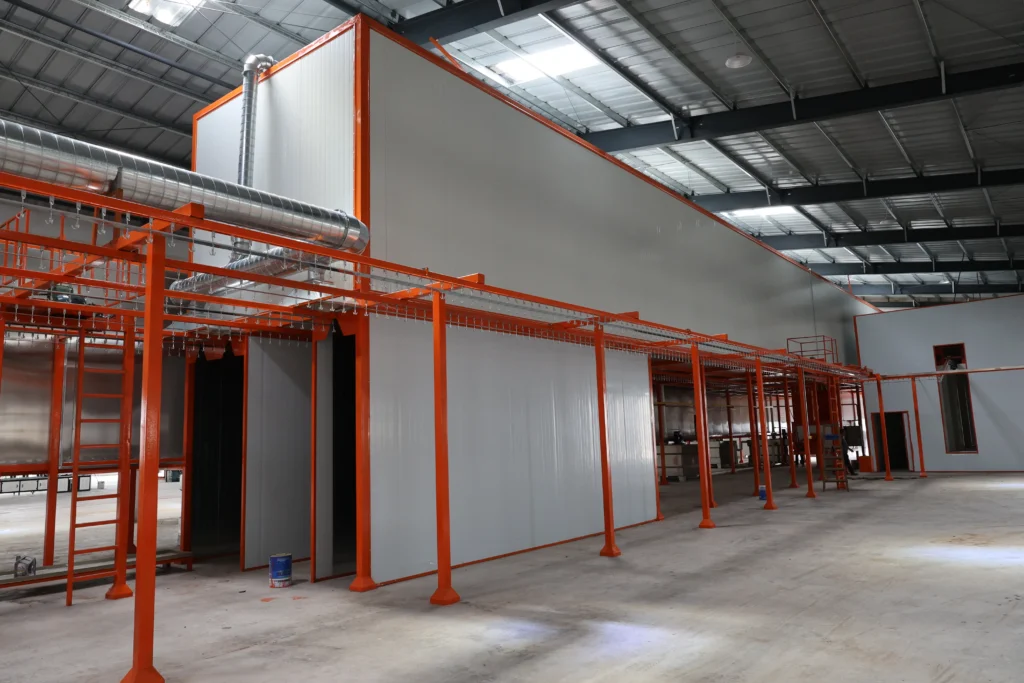
Ketu Technology Analysis: Key Problems in Domestic Electrostatic Powder Coating Lines and Solutions
When I work with manufacturing clients across cabinet production, outdoor furniture, and aluminum extrusion, I see the same pattern emerge repeatedly: they've invested in powder coating equipment, but the results are inconsistent, defect rates are climbing, and energy costs are eating into margins. What surprises most of them is where the real problems actually originate.
From my years working on spray line installations and troubleshooting, I've learned that unstable coating lines aren't usually failures of individual components. They're failures of system integration. This article breaks down the critical problems I encounter most frequently in domestic coating lines—and more importantly, what I've found actually works to fix them.
Domestic Electrostatic Powder Coating Lines: Common Problems and Industry Status
The electrostatic powder coating industry in China has grown rapidly, but adoption has often outpaced understanding. Most factories now have some form of powder coating capability, yet many still struggle with basic consistency.
The problems I see aren't rare edge cases. They're systemic. A factory might have purchased a capable spray room, an adequate oven, and a reasonable transport system—but when these components don't work in harmony, the line performs like three separate machines, not one integrated production system.
The core issue is this: we've become good at manufacturing individual components. We're still learning how to design them to work together reliably.
![electrostatic powder coating spray booth system setup]
What I'm seeing on the ground—at cabinet makers in Foshan, furniture factories in Guangdong, and aluminum processors across the Pearl River Delta—are coating lines that meet specifications on paper but fail in daily production. The defect rates hover between 15-25% in many facilities, when they should be below 5%. Energy consumption per unit is 30-40% higher than international benchmarks. And the real kicker: factories don't know if these problems are "normal" or fixable.
They are fixable. But first, you need to understand where they come from.
Root Causes of Low Stability and High Defect Rates in Current Coating Lines
After analyzing coating line performance across multiple customer sites, I've identified two primary failure points that cascade through the entire system.
Why Pre-Treatment System Mismatch Is the Primary Source of Surface Quality Issues
Here's what I've observed: 80% of surface coating defects trace back to the pre-treatment stage, not the spray booth or oven. Yet most factories treat pre-treatment as the most disposable part of the line.
The problem is visible in the data. When I conduct site diagnostics, I check five basic pre-treatment parameters: oil residue on workpiece arrival, water rinse quality, phosphate film uniformity, drying completeness, and time elapsed before spraying. In roughly 70% of problematic lines I've reviewed, at least three of these parameters are out of specification.
Here's why this matters: powder cannot adhere properly to dirty or wet surfaces. It doesn't matter how precisely your spray gun is calibrated. If the workpiece surface has oil residue, salt deposits, or residual moisture, the electrostatic charge will not distribute evenly, powder transfer efficiency drops, and adhesion fails. I've seen this cause:
- Coating adhesion scores of 1-2 on the tape test (should be 4B or 5B)
- Pinhole and crater defects across 20-30% of workpiece surface
- Peeling and flaking within 2-3 weeks of production
- Uneven color on parts treated at different times of day (thermal variation in water rinse temperature)
The root cause isn't complexity. It's usually specification drift. A factory installs a pre-treatment line, runs it correctly for 6 months, then—without documentation or clear responsibility—parameters shift. Phosphate tank concentration rises, degreasing temperature drops, rinse water gets reused too long. Nobody notices because the line still runs.
I recommend implementing pre-treatment parameter tracking before any other upgrade. Most improvements to coating line performance come from optimizing pre-treatment, not replacing equipment.
![coating line pre-treatment degreasing phosphate system]
How Conveyor Speed, Spray Gun Position, and Curing Oven Capacity Create Cascading Line Problems
The second problem is less obvious but equally damaging: equipment specifications that don't align with each other.
I call this the "rhythm mismatch." Consider this typical scenario:
A factory purchases a spray room rated for 15 pieces per hour, a conveyor line set to 8 meters per minute, and a curing oven with a 5-minute residence time. In theory, this should work. In practice, workpieces either spend too little time in the spray zone (under-coated parts) or stack up waiting for the oven (production bottleneck at curing stage).
When I measure actual production on these lines, the result is predictable: coating thickness varies between 80-150 microns on parts that should all be 120±20 microns. The thinner parts fail adhesion tests. The thicker parts show orange-peel surface defects.
The problem compounds. When thickness varies, so does curing time. Thin sections may be under-cured. Thick sections may show color shift or gloss loss from over-curing. And since the line is already inconsistent, there's no stable baseline to adjust toward.
The three most critical alignment points are:
-
Conveyor speed vs. spray gun dwell time: If a workpiece moves too fast, the spray gun can't cover the surface evenly, especially on complex geometries. If it moves too slow, you're wasting booth capacity and energy.
-
Spray gun configuration vs. workpiece geometry: I've seen factories with 6-gun setups trying to coat both flat panels and complex cabinets without adjustment. This doesn't work. Flat parts get over-sprayed at edges; complex parts get under-coated in recesses.
-
Oven residence time vs. powder system and line speed: If the oven's thermal profile doesn't match the conveyor speed, parts exit at different temperatures. A 30°C difference between early and late parts in the oven means different cure states.
The fix isn't usually new equipment. It's synchronization—matching the line's rhythm so that every workpiece experiences consistent conditions.
Energy Waste and Long-Term Operating Costs—A Hidden Financial Trap
Most factories calculate coating line ROI by dividing equipment cost by annual units produced. They miss the actual cost driver: operating expenses.
I've analyzed energy consumption across dozens of domestic coating lines. The pattern is consistent: poorly integrated systems waste 30-40% more energy than well-tuned lines producing the same output.
Temperature Control Instability and Its Impact on Powder Recovery Rate
Here's a concrete example from a cabinet manufacturer I worked with:
Their curing oven was set to 200°C (target), but actual temperature at the workpiece surface ranged from 185°C to 215°C depending on position in the oven. Why? The heating elements cycled on and off based on a single temperature sensor, but hot air distribution wasn't uniform.
The consequence: powder didn't cure evenly. Soft-cured areas attracted dust, reducing the effective coating quality. Hard-cured areas sometimes showed micro-cracking.
More importantly, the oven was burning energy to maintain 200°C while parts actually needed only 190°C in some zones and 210°C in others. The excess energy—about 18% of total consumption—was wasted heating the oven itself, not the parts.
When I helped them redesign the airflow and add zone-specific temperature control, they reduced energy consumption by 22% while improving cure consistency.
Temperature instability also degrades powder recovery. Most cyclone recovery systems work best within specific airflow ranges. If the oven creates variable exhaust temperature and volume (due to inconsistent heating), the recovery system's efficiency drops. I've seen recovery rates fall from 94% to 82% just from temperature fluctuation.
How to Calculate True Cost of Ownership Beyond Equipment Purchase Price
Let me show you the real math. A factory recently told me they purchased a coating line for 350,000 RMB. They thought their cost was controlled.
Here's what their actual annual cost looked like:
| Cost Category | Annual Cost (RMB) | Notes |
|---|---|---|
| Equipment depreciation (10 years) | 35,000 | Initial purchase price |
| Electrical consumption (peak 85 kW average) | 180,000 | Running 16 hrs/day, 250 days/year at 1.05 RMB/kWh |
| Natural gas (curing oven heating) | 90,000 | Estimated 12 tons/year |
| Compressed air (generation and drying) | 42,000 | Often overlooked; ~3 RMB per cubic meter for quality air |
| Powder waste (poor recovery, 15% loss rate) | 78,000 | At 30 RMB/kg powder, 100 tons annual throughput |
| Filter and spare parts maintenance | 28,000 | Cyclone filters, spray gun nozzles, bearings |
| Labor and training | 120,000 | One operator + supervisor time + ongoing adjustments |
| Annual Total | 573,000 | Equivalent to 1.64x equipment cost per year |
The factory's expected savings from automation was supposed to be 300,000 RMB annually (from reduced labor). But because the line wasn't optimized, they were actually only saving 180,000 RMB while spending 573,000 to operate.
This is why proper commissioning and optimization pay back within 18-24 months. Small improvements in energy efficiency, powder recovery, and defect reduction can save 80,000-120,000 RMB annually.
How to Diagnose and Optimize Pre-Treatment Processes Before Upgrading Spray Systems
If a factory asks me, "Should we buy a new spray gun system?" I always start by asking about their pre-treatment. More often than not, that's where the solution lives.
Pre-treatment diagnosis requires systematic checking. Here's my standard approach:
Step 1: Surface inspection at line exit
Before any parts enter the spray booth, I look at surfaces with a blacklight. Oil residue fluoresces. I also run a water-break test—if water beads up, the surface isn't properly degreased. If I see this, pre-treatment is the problem, not the spray system.
Step 2: Chemical analysis of process baths
Degreasing concentration, phosphate film weight, and water rinse purity should be measured weekly. Most factories do this monthly or never. I've found concentration drift of 20-30% from nominal values—enough to visibly degrade performance but invisible to the naked eye.
Step 3: Thermal profiling
Temperature stability in degreasing, rinse, and phosphate stages directly affects reaction rates. A 5°C drop in degreasing temperature can halve the cleaning rate. I use thermal imaging to map bath temperature across the tank, not just at the sensor.
Step 4: Drying efficiency check
Water carryover from rinse to spray booth is one of the fastest ways to wreck a coating. I measure residual moisture on parts using a moisture meter. If readings exceed 1-2%, the drying stage needs attention—either the hot air isn't sufficient, or the part residence time is too short.
Optimization priorities (in order):
- Fix degreasing concentration and temperature (highest ROI)
- Improve rinse water purity (second highest ROI; often involves adding DI water circulation)
- Optimize drying (thermal efficiency gain; reduces defects)
- Monitor phosphate film uniformity (ongoing; prevents adhesion issues)
Most factories see 30-50% improvement in coating defect rates from pre-treatment optimization alone, with zero equipment investment.
Stability vs. Speed: Rethinking Automation in Coating Line Design
This is where I diverge from much of the industry messaging. The sales narrative around powder coating lines emphasizes speed and automation. "Our line can do 30 pieces per hour!" "Fully automatic spray system!"
But here's what I've learned: a line that does 15 pieces per hour with 99% first-pass quality is more profitable than one doing 30 pieces per hour with 85% first-pass quality.
Why Parameter Precision and Fault Prevention Matter More Than Equipment Speed
Let me break this down with real numbers from two factories I advised:
Factory A: Invested in a high-speed automatic line (30 pph target). Spray gun parameters adjusted automatically based on "learning" from sensors. Result: 2-3 parameter adjustments per shift due to sensor drift. Defect rate averaged 18%. Actual throughput: 24 pph (80% of capacity) after accounting for rework.
Factory B: Chose a semi-automatic line (15 pph target). Spray parameters manually set once per shift, with documented procedures and operator training. Defect rate: 3%. Actual throughput: 14.5 pph (97% of capacity) with minimal rework.
Over a year producing 100,000 pieces:
- Factory A: 100,000 ÷ 24 pph = 4,167 hours of line time; rework cost for 18% defect rate ≈ 180,000 RMB
- Factory B: 100,000 ÷ 14.5 pph = 6,897 hours of line time; rework cost for 3% defect rate ≈ 30,000 RMB
Net economics: Factory B produces the same volume with better profitability, less energy waste, and lower stress on equipment.
Why does this happen? Automated systems optimize for speed, not stability. When a sensor drifts or environmental conditions change slightly, the automatic system cascades those small errors into production-wide problems before anyone notices. A well-trained operator using consistent, documented procedures catches drift immediately.
I'm not advocating for primitive equipment. I'm saying prioritize stable, understood processes over complex, variable systems.
Color Change Safety vs. Quick Changeover: What Should Factories Prioritize?
Factories often complain about changeover time. "We need to do 5-6 color changes per day, and each one costs us 30 minutes."
My response: if those 30 minutes include proper cleaning, airflow stabilization, and parameter verification, don't rush it.
I've seen factories optimize changeover to 10 minutes by skipping critical steps. The result is color contamination—the new color picks up traces of the previous color, requiring scrap or rework. One contaminated batch can erase the time savings from 20 changeovers.
My recommendation for changeover optimization:
| Phase | Time (min) | Why This Matters |
|---|---|---|
| Empty powder hopper and collect residue | 3-4 | Prevents mixing old and new colors |
| Blow out spray lines with compressed air | 4-5 | Eliminates powder pockets that cause streaking |
| Wipe spray gun nozzle and electrode | 2-3 | Oil or powder buildup kills spray quality |
| Verify new powder quality and mix | 3-4 | Moisture absorption or contamination causes defects |
| Run 2-3 test pieces without production pressure | 5-8 | Confirms color accuracy before committing to full batch |
| Total | 17-24 minutes | Factory can do 5-6 colors per day safely |
Skipping steps might get you to 10 minutes, but the real cost is in rework, scrap, and customer rejection.
What International and High-Performing Domestic Coating Lines Do Differently
I've had the opportunity to visit and learn from advanced coating operations in Canada, Turkey, and within China's best-performing manufacturers. The difference isn't equipment brand or capital investment. It's methodology.
Here's what I observe in high-performing lines:
1. They start with comprehensive baseline diagnostics, not equipment purchases.
Before optimizing anything, they map current performance: defect types, distribution, root causes. They use this data to prioritize. Most domestic factories skip this; they guess at problems and buy equipment hoping it fixes them.
2. They maintain strict pre-treatment specifications.
Not "approximately 50°C" but "49-51°C maintained ±1°C." Not "adequate degreasing" but "alkalinity 3.0-3.5 pH measured daily." Every major step has a documented spec and a responsible person.
3. They treat the spray booth and oven as integrated, not separate.
They understand that spray booth humidity, temperature, and airflow directly impact how powder behaves and how well the oven can cure it. They design both stages to work together, not independently.
4. They measure what matters: not just output volume, but coating quality metrics.
First-pass defect rate, adhesion scores, consistency of film thickness, cure completeness. Weekly reporting. Monthly trend analysis. This data drives decisions, not assumptions.
5. They invest in operator training and documentation, not just equipment.
A well-trained operator running 15 pph with documented procedures beats an unskilled operator running 25 pph with undocumented processes. The difference in output quality is dramatic.
6. They plan maintenance, not just react to breakdowns.
Predictable maintenance schedules for spray guns, filters, conveyor chains, temperature sensors. This prevents the cascading failures that plague many domestic lines.
The global leaders aren't using more advanced spray guns or ovens. They're using discipline.
![powder coating line automation control system setup]
How to Select a Coating Line Partner: Key Factors Beyond Equipment Specifications
When a factory is ready to invest in a new coating line or upgrade an existing one, they usually focus on specs: spray system type, oven capacity, throughput rate.
These matter, but they're not the deciding factor. The decision should rest on something deeper: Does the supplier understand the integration challenge and have a track record solving it?
Here's what I evaluate when selecting coating line partners:
1. Do they ask about pre-treatment?
If a supplier says, "Just tell us your product dimensions and we'll design a spray room," they're not thinking in system terms. A good partner asks: What's your current pre-treatment? What surface condition do parts arrive in? What defects are you seeing?
2. Can they show working examples?
Not just photos. Can they bring you to a running customer line? Can they show you real parts being produced, not just brochure samples? Can you interview the customer operator?
3. Do they offer commissioning and training, or just delivery?
Equipment sitting in your factory isn't useful. It needs to be tuned to your products, your environment, your team. Does the supplier allocate time for this, or do they hand over manuals and leave?
4. Do they have a clear optimization plan?
A good supplier should say: "Here's what we expect from day one. Here's our plan to improve it over the first 3 months. Here are the parameters we'll monitor." Not: "Buy this and hope it works."
5. Are they transparent about limitations?
Any coating line has constraints. No spray booth works equally well on both flat panels and deep recesses. No oven reaches perfect temperature uniformity everywhere. A supplier who acknowledges these and explains how to work around them is being honest. One who claims their system "works on everything" is overselling.
6. Do they stand behind their work with clear SLAs?
Service Level Agreements on response time, spare parts availability, technical support. If something fails, how quickly can they help? If you need help optimizing, how accessible are they?
| Evaluation Criterion | What to Look For | Red Flags |
|---|---|---|
| Pre-treatment integration | Ask specific questions about your product and current issues | Generic response; assumes standard process |
| Track record | Can show 5+ customer references in similar industries | Only 1-2 recent projects; reluctant to share contact info |
| Commissioning plan | Detailed timeline, specific deliverables, on-site training | Vague timeline; expects you to figure it out |
| Parameter optimization | Willingness to tune system post-installation; ongoing support | "Comes as-is; your job to optimize" |
| Problem transparency | Acknowledges equipment limitations and proposes workarounds | Claims universal suitability; no mention of constraints |
| SLA commitment | Written response time and spare parts availability | Verbal promises only; no formal commitments |
Conclusion: Diagnosing Before Upgrading, Optimizing Before Expanding
The coating lines I see struggling most aren't failing because of bad equipment. They're failing because the systems aren't integrated, the processes aren't controlled, and the root causes of defects were never properly diagnosed.
Before your next equipment investment, I'd recommend this sequence:
Phase 1: Diagnose (2-3 weeks)
What defects are actually occurring? Where in the process? Why? Most factories skip this and jump to "buy a better spray gun." Wrong problem.
Phase 2: Optimize existing systems (1-2 months)
Pre-treatment parameters locked in. Conveyor speed matched to spray booth capacity. Oven thermal profile validated. Spray gun parameters documented. Operator training completed. This phase typically yields 20-30% improvement in defect rates with zero capital investment.
Phase 3: Upgrade strategically (3-6 months)
Now you know exactly what additional capacity or capability you need. You can specify equipment that fills the gap, not equipment that's "good" in general.
This approach is less dramatic than "buy a new line." It's also far more profitable.
If you're evaluating coating line solutions or working through chronic quality issues on an existing line, I'm happy to discuss your specific situation. We've solved these problems for cabinet makers, furniture producers, and aluminum processors across multiple markets.
Reach out to discuss your coating line challenges:
WhatsApp: +8618064668879
Email: ketumachinery@gmail.com
We'll start with a diagnostic conversation—no obligation, just clarity on what's actually happening and what's actually fixable.
 English
  German
  Vietnamese
  French