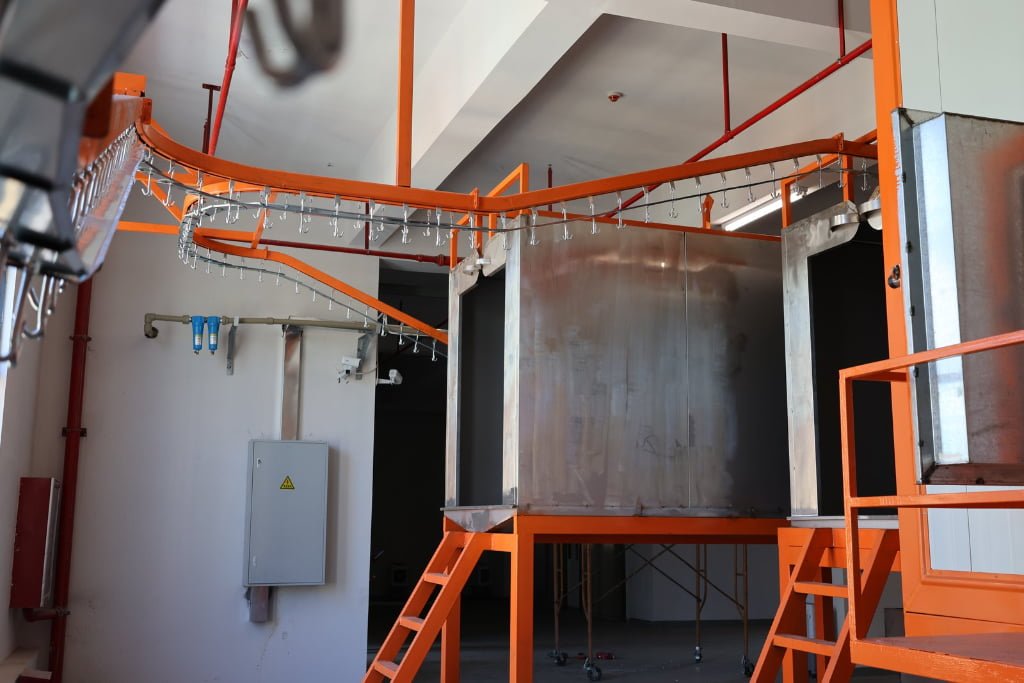
Key Powder Recovery Equipment in Powder Coating: Types, Selection Criteria, and Efficiency Optimization
When I design electrostatic powder coating production lines for our customers, one question comes up more often than I'd expect: "Why are we spending so much on powder recovery?" The answer is simple but critical—because powder recovery equipment isn't optional. It directly controls your material costs, production efficiency, environmental compliance, and long-term profitability. I've seen factories waste thousands in powder per month simply because they underestimated this component.
Powder recovery equipment is a critical component in electrostatic powder coating systems, directly affecting both operational efficiency and environmental compliance. It captures unused powder from the spray booth and separates it from exhaust air, achieving recovery rates of 90–99% depending on the system type. By recycling recovered powder back into production, manufacturers can significantly reduce material waste and coating costs, while minimizing dust emissions to meet environmental standards. Common recovery solutions include cyclone separators for high-volume recovery, secondary filter cabinets for fine particle filtration, and integrated multi-stage systems for maximum efficiency and adaptability across different production scales and workpiece types.
What makes powder recovery so critical is that most people focus only on the spray gun and curing oven performance, overlooking the fact that 10–30% of the powder you buy never reaches your product. That loss is money walking out the door—or getting expelled into the atmosphere if you don't manage it properly.
Why Powder Recovery Equipment Matters: Direct Impact on Cost and Compliance
Let me be direct about this: powder recovery is where you actually make money on a spray line, not where you spend it. Here's why I keep coming back to this emphasis.
In my experience with cabinet manufacturers, furniture producers, and aluminum profile suppliers, the single biggest cost driver after labor isn't equipment depreciation—it's coating material. And within that material cost, powder recovery efficiency determines whether you're recycling 50% of your overspray or 95% of it. The difference between a poorly configured recovery system and a well-matched one easily amounts to 15–30% of your per-unit coating cost.
From a factory floor perspective, I've watched two identical spray lines produce completely different economics. One had a single large cyclone recovery system matched to its production volume and particle size distribution. The other had an undersized recovery unit that would clog frequently, forcing manual cleaning downtime and wasting recovered powder through improper separation. The first operation recycles cleanly, maintains consistent powder properties, and completes color changes in minutes. The second struggles with everything—powder degradation, color carry-over, longer changeover times, and higher waste.
Environmental regulations add another layer. Most regions now enforce dust emission standards—in China, GB16297 sets clear limits on particulate matter concentration in exhaust air. If your recovery system doesn't achieve the required separation efficiency, you either exceed regulations (and face penalties) or you buy more expensive secondary filtration to compensate. The right recovery strategy upstream eliminates this pressure entirely.
From a practical implementation point of view, powder recovery isn't just about "capturing more powder." It's about choosing the right separation method for your production profile, matching recovery capacity to your spray booth airflow, and ensuring recovered powder quality doesn't degrade your next batch of products.
Types of Powder Recovery Equipment and How They Work
The market offers several recovery approaches. Each works on a different principle and suits different production scenarios. Let me walk through the main types I encounter in real projects.
Single-Stage Recovery Systems (Large Cyclone Separators)
A large cyclone separator is the workhorse of powder recovery in continuous, high-volume production. Here's how it works: exhaust air carrying overspray powder enters the cyclone tangentially. The air spirals downward inside a conical chamber, creating centrifugal force. Heavy particles (the powder you want to recover) get thrown toward the wall and slide down into a collection hopper. Clean air exits through a central outlet at the top.
The math is straightforward. A well-designed cyclone can achieve 90–95% separation efficiency in a single pass. For cabinet or aluminum profile lines running 8+ hours daily at stable production, this single-stage approach often works perfectly. You get high recovery rates, simple maintenance, and reasonable capital cost.
However—and this is important—cyclone efficiency depends heavily on particle size consistency. If your overspray contains a broad particle size distribution (which it typically does), finer particles slip through to the exhaust. These microfine particles are a problem. They either escape as dust (environmental issue) or you need secondary filtration anyway (defeating the economy argument for single-stage recovery).
![powder coating line in factory]
From my involvement in projects serving the cabinet and shelf manufacturing sectors, I've found that single-stage cyclone recovery works best when:
- Production volume is consistent and relatively high
- You're spraying the same powder type repeatedly (minimizing color change frequency)
- Your facility has adequate floor space for the cyclone structure
- You accept that some fine powder will exit with exhaust air
Two-Stage Recovery Systems (Cyclone + Secondary Filter Cabinet)
A two-stage system adds a second layer of separation after the primary cyclone. The primary cyclone does the bulk work—removing particles down to roughly 10–15 microns. Remaining finer particles then pass into a secondary filter cabinet equipped with pleated filter media (typically polyester or coated cartridge filters).
Here's what makes two-stage systems superior for many real-world scenarios:
Stage 1 (Primary Cyclone): Removes 90–95% of powder, handles the volume efficiently, minimal pressure drop.
Stage 2 (Secondary Filter Cabinet): Captures 95%+ of remaining particles, achieving total system recovery rates of 98–99%. The filter cartridges are typically pulse-cleaned automatically, so you don't lose collected powder during cleaning.
From my experience configuring lines for furniture manufacturers with frequent color changes, two-stage recovery is the smarter choice. Why? Because the secondary filter solves two real problems: it captures fine powder that would otherwise violate emissions standards, and it lets you keep product color purity higher between color changes (because carryover particles are trapped, not re-sprayed).
The tradeoff is higher capital cost and slightly more complexity in maintenance (cartridge filter replacement, which should happen every 6–12 months depending on volume). But the payback is swift. You recover more powder (lower material cost), you meet environmental regulations without retrofit, and your color change procedures become faster.
![metal cabinet powder coating process]
Other Recovery Methods (Water-Based, Advanced Filtration)
Water-based recovery systems exist but are niche. They work by pulling overspray into a water curtain or collection tank, where powder falls to the bottom. The advantage is very high recovery (near 100%) and no complex filters. The disadvantage is complexity in water management, disposal of wet powder sludge, and incompatibility with certain powder types. I rarely recommend these unless a facility has specific constraints (extreme dust hazard, very specialized powder types).
Advanced dry filtration systems (sometimes called "high-efficiency" or "coated media" cartridge systems) are gaining traction in premium installations. These use ultra-fine, electrostatic-enhanced filter media that can capture submicron particles. The payoff is exceptional recovery (99%+) and minimal re-entrainment of collected powder. The cost is higher, but for high-value products (automotive components, precision aluminum extrusions), the investment often makes sense.
Key Performance Metrics: Recovery Rate, Separation Efficiency, and Emission Standards
Choosing recovery equipment requires understanding the metrics that actually matter. Clients often ask for "99% recovery rate," but I need to clarify what that number really means.
Understanding Recovery Rate vs. Separation Efficiency
Recovery Rate is the percentage of overspray powder that exits the spray booth and enters the recovery system (as opposed to escaping as airborne dust before capture).
Separation Efficiency is the percentage of powder entering the recovery equipment that actually gets collected and reusable.
These are not the same number.
In a properly designed spray booth with good airflow management, your recovery rate might be 95%. That remaining 5% escapes as ambient dust around the booth perimeter—a booth design and ventilation issue, not a recovery equipment issue.
Of the powder that does enter recovery, a well-matched cyclone achieves 90–95% separation. A two-stage system achieves 98–99%. So your "effective recovery"—powder actually returned to production—is recovery rate × separation efficiency.
Example: If your recovery rate is 95% and your separator efficiency is 90%, your effective recovery is 85.5% of original overspray.
From a practical standpoint, I focus clients on effective recovery. That's the number that shows up in your monthly material consumption and cost-per-part calculations.
Meeting Local Environmental Regulations (GB16297 and Beyond)
Dust emission standards vary by region, but they're tightening globally. In China, GB16297 (Integrated Emission Standard for Air Pollutants) sets particulate matter concentration limits for different industrial sectors. For powder coating, the typical limit is around 30–50 mg/m³ depending on facility type and local amendments.
What this means practically: your exhaust air leaving the recovery system and exiting the facility must meet this standard. If it doesn't, you face fines and operational shutdowns.
Here's the critical point I've learned from projects in India, Southeast Asia, and the Middle East: never design a recovery system without confirming local emissions standards first. A customer in India once wanted a single-stage cyclone recovery. When we checked the state environmental board requirements, we discovered they required 20 mg/m³—tighter than the national standard. One cyclone wouldn't meet it; we needed two-stage recovery plus a final polishing filter. The solution cost 40% more, but it was the only path to compliance.
| Factor | Single-Stage Cyclone | Two-Stage System (Cyclone + Filter) |
|---|---|---|
| Typical Separation Efficiency | 90–95% | 98–99% |
| Pressure Drop | 150–250 Pa | 200–350 Pa |
| Emissions Compliance (GB16297) | Often borderline; may need secondary | Typically meets without retrofit |
| Color Change Purity | Moderate (fines carryover) | High (fines captured) |
| Capital Cost | Lower | 30–60% higher |
| Maintenance Complexity | Low | Moderate (filter replacement) |
| Powder Degradation Risk | Moderate (especially fines) | Low |
| Best For | Stable, high-volume, single-color runs | Frequent color changes, tight regulations |
How to Select the Right Recovery System for Your Production Line
The most common mistake I see is customers choosing recovery equipment based purely on airflow specifications without considering their actual production profile. Let me walk through the real decision factors.
Assessing Your Product Type, Production Volume, and Color-Change Frequency
Start with these questions:
What's your daily production volume? This determines the total air volume your spray booth needs to exhaust. Recovery equipment must handle that volume without excessive pressure drop (which would starve the booth of suction and degrade spray quality).
What are your product dimensions and spray area per unit? Larger products or more complex geometries require longer spray times, which means more powder usage and more overspray per shift.
How often do you change colors? This is critical. If you spray the same color 100 shifts per year, single-stage recovery is fine—you don't worry much about fines carryover. If you change colors 3 times per week, fine powder accumulation becomes a major issue. Fines cross-contaminate, degrade your next color, require longer changeover cleaning, and might exceed emission limits if not captured.
What powder types do you use? Different formulations (epoxy, polyester, hybrid) have different particle size distributions. A wide distribution (which many industrial powders have) means more fines—more reason for two-stage recovery.
What's your local emissions standard? Non-negotiable. Check your environmental agency requirements before you size any equipment.
From these inputs, I build a simple matrix:
- High volume, stable color, spacious facility → Consider single-stage cyclone (cost-efficient)
- High volume, frequent color changes → Two-stage system (purity + compliance)
- Lower volume, high complexity products → Two-stage system (fines management + flexibility)
- Strict emissions standard → Two-stage minimum, possibly advanced filtration
Single-Stage vs. Two-Stage: When to Upgrade Your Recovery Setup
If you're operating an existing line with a single-stage cyclone and experiencing these symptoms, upgrading to two-stage is usually the right call:
-
Color carry-over between batches. You finish red and switch to white, but the white comes out slightly pink because fine red particles didn't get recovered and got re-sprayed.
-
Environmental complaints or emissions notices. Dust visible exiting your stack, or regulatory push-back.
-
Frequent filter replacement on downstream equipment. If your booth filters or air handlers are clogging quickly, your recovery isn't capturing fines.
-
Production slowdown during color changes. If you're spending 30+ minutes manually cleaning the booth between colors, a secondary filter that auto-cleans will pay for itself in labor time alone.
The payback on a secondary filter cabinet is typically 18–36 months, depending on production volume and powder cost. Beyond that, it's pure operational and compliance benefit.
![aluminum profile surface finishing]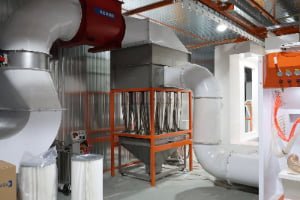
Recovery Equipment Performance and Operational Costs
Here's where the decision becomes quantitative. You need to understand not just the recovery rate, but the total cost of ownership.
Powder Recovery Rates and Cost Savings Potential
Let's use a concrete example from one of my cabinet manufacturing customers:
Scenario: 5,000 pieces per month, average 0.3 kg powder per piece = 1,500 kg powder consumed per month at a cost of $8/kg = $12,000/month.
With single-stage cyclone (92% effective recovery):
- 8% waste = 120 kg/month = $960 waste cost
- 92% recovered and reusable
With two-stage system (98% effective recovery):
- 2% waste = 30 kg/month = $240 waste cost
- 98% recovered and reusable
Monthly savings: $960 − $240 = $720/month or $8,640/year
If the two-stage system costs $25,000 installed, you recover the investment in ~3 years. After that, it's pure margin improvement.
But there's more: the recovered powder quality matters. If your single-stage cyclone captures mostly coarser particles and lets fines escape, the recovered powder you do get back might have degraded properties—worse flow, off-color, reduced shelf life. This can force you to blend recovered powder at lower ratios (say 60/40 recovered-to-virgin) or scrap it entirely. The two-stage system captures consistent particle distribution, so recovered powder quality stays high and you can recycle it at 80–90% ratios confidently.
Maintenance Requirements and Total Cost of Ownership
Single-stage cyclone:
- Weekly: Inspect accumulation level in collection hopper
- Monthly: Check for material buildup in cone, clean if needed
- Annual: Inspect cone interior for wear, replace liner if eroded
- Typical maintenance cost: $500–1,500/year
Two-stage system (cyclone + filter cabinet):
- Weekly: Monitor filter pressure drop gauge
- Monthly: Inspect filter cartridges for visible damage
- Every 6–12 months: Replace filter cartridges ($2,000–4,000 per set depending on size)
- Annual maintenance cost: $3,000–6,000/year
The filter cartridge replacement is the biggest ongoing cost. But here's the key: modern filter cabinets have automatic pulse-cleaning systems that backflush the cartridges with compressed air on a timer. This keeps the pressure drop stable, extends cartridge life, and maintains consistent recovery performance without downtime.
From my real-world experience, total cost of ownership including energy consumption, maintenance, and powder waste usually favors two-stage systems for any facility with:
- More than 2,000 parts/month
- Color changes more than once per week
- Local emissions standards stricter than ~100 mg/m³
For lower volumes or very stable single-color production, single-stage cyclone remains viable.
![powder recovery system design]
Integration with the Complete Coating System: Synchronization and Optimization
Here's something I emphasize strongly to clients: powder recovery equipment doesn't work in isolation. It must coordinate with the spray booth, the curing oven, and the supply system.
Coordination Between Recovery System, Spray Booth, and Curing Oven
The spray booth exhaust volume, recovery system capacity, and booth pressure differential must all be balanced. If your recovery system is undersized, booth pressure rises, spray quality degrades (poor atomization, uneven coating). If it's oversized, you waste energy on unnecessary airflow.
Here's the practical sequence:
-
Booth suction draws powder onto workpiece. Static field pulls charged particles from spray gun to grounded part.
-
Excess powder and air exit booth. Typical booth exhaust is 100–200 m³/min depending on booth size.
-
Exhaust enters recovery system. Cyclone or filter cabinet must have capacity to handle this volume smoothly.
-
Recovered powder falls into hopper. This powder is either manually scooped back to supply system or pneumatically conveyed.
-
Clean air exits to atmosphere or secondary treatment. If two-stage system, secondary filter polishes final exhaust.
The curing oven timing also matters. If your recovered powder accumulates moisture (from humidity in the booth or improper storage), it degrades before being re-sprayed. I've seen customers in humid climates recover powder, leave it sitting in open hoppers overnight, then re-spray degraded material the next morning—resulting in poor surface finish without understanding why. The solution: either keep recovered powder in sealed containers with desiccant, or size the recovery system to clear hoppers more frequently (reducing accumulation time).
Managing Pressure Fluctuations and Coating Film Thickness Stability
One of the trickier coordination challenges is pressure stability. As powder accumulates in the recovery system's collection hopper, back-pressure in the booth can fluctuate. This isn't just a comfort issue—it directly affects film thickness uniformity on your parts.
Why? Because spray gun performance depends partly on ambient booth pressure. If pressure drifts 20–30 Pa during a shift, atomization changes slightly, powder transfer efficiency changes, and your parts end up with variable film thickness. Quality inspection catches this eventually, but by then you've already sprayed and cured hundreds of parts.
From my installations, I specify recovery systems with:
-
Automatic level sensors in collection hoppers. When hopper reaches 70% full, trigger a discharge cycle (vacuum conveying or manual removal). This keeps back-pressure consistent.
-
Pressure gauges on both inlet and outlet sides. Monitor booth inlet pressure throughout the shift. If it drifts more than ±10 Pa, stop production and investigate (usually hopper needs clearing or cyclone is clogging).
-
Secondary filter with pulse-cleaning. The automatic backflush maintains consistent pressure drop on the filter cartridges, preventing the pressure creep that degrades spray quality over hours.
These details separate average operations (variable thickness, rework, waste) from controlled operations (tight tolerance, first-pass yield, efficiency).
Practical Selection Framework and Real-World Considerations
Let me give you a structured approach to choosing recovery equipment that I use in customer consultations.
Key Technical Specifications to Evaluate
When evaluating a recovery system, don't just look at headline specs. Ask these specific questions:
1. Separation Efficiency Under Actual Operating Conditions
Manufacturers quote "95% efficiency" in lab conditions. Ask for efficiency at your expected exhaust volume and your actual powder type. Have them test with your powder, not generic test powder.
2. Pressure Drop Characteristic
A cyclone or filter should have predictable pressure drop across its operating range. If a system spec shows 150 Pa at rated volume and 400 Pa at 80% volume, that's non-linear and problematic. Linear performance means booth pressure stays stable as you vary spray operations.
3. Hopper Capacity and Discharge Method
How long can recovered powder sit before it needs removal? For humid climates, small hoppers that discharge frequently are better than large hoppers that let powder absorb moisture. Discharge methods: manual (cheap but labor-intensive), pneumatic conveying (sealed, clean, reliable for medium volumes), or screw conveyor (good for continuous high-volume recovery).
4. Filter Cartridge Service Life and Cost
If you're looking at two-stage systems, filter replacement is your biggest recurring cost. Ask for typical cartridge life at your production volume. If they say "12 months," verify: is that 8-hour days or 16-hour days? Is that for your powder type or a different one?
5. Local Parts Availability and Lead Time
I once specified a filter cabinet for a facility in Southeast Asia. When a cartridge finally needed replacement after 10 months, the lead time for new cartridges was 8 weeks because they were sourced from Europe. The line stayed down. Always check: are replacement parts available locally or regionally? What's the typical lead time?
6. Noise Level
This matters more than people think. A high-velocity cyclone or fan can hit 85–90 dB, which is legally significant for worker safety in many countries. Ask for sound levels and check against your local occupational safety standards.
Localization and Compliance for Export and International Operations
If you're setting up a coating line outside your home country, recovery system localization is non-negotiable.
From my projects in India, Indonesia, Algeria, and Turkey, here are the common localization factors:
Electrical standards: Some countries use 380V 50 Hz, others 440V. Some have voltage stability issues requiring better transformers. Fan motor and control system must match local supply.
Emissions regulations: I mentioned GB16297 earlier. But every country has different limits. India has state-level variations. Indonesia's regulations differ from Malaysia's. Before purchasing, get the specific standard for your location and confirm the supplier can meet it. If not, add secondary filtration in your budget.
Humidity and climate: Tropical climates mean higher moisture risk for recovered powder. You'll need sealed hoppers and possibly desiccant dryers. Dry desert climates mean lower maintenance burden but potentially more dust (worse starting point).
Available spare parts ecosystem: In developed markets, you can source most components locally. In emerging markets, you depend on the supplier for everything. Budget longer for component replacement and consider stockpiling critical parts.
Installation infrastructure: Does your facility have adequate compressed air already? Recovered powder disposal—is there a powder reclamation vendor nearby, or will you haul it yourself? These seem like details, but they affect operating cost significantly.
From my experience, selecting a recovery system supplier with regional presence (or partnerships) in your target market is worth 10–15% premium over a purely imported solution. They understand local standards, can provide faster support, and won't leave you stranded when something fails.
More Related Questions
How much does powder recovery equipment cost?
A single-stage cyclone separator typically ranges $8,000–$18,000. A two-stage system (cyclone + secondary filter cabinet) runs $20,000–$50,000 depending on airflow capacity and automation level. Installation, ductwork, and integration add 30–50% to equipment cost.
Can I retrofit powder recovery to an existing spray line?
Usually yes, but it depends on booth configuration and available space. Adding a cyclone or filter cabinet requires proper ductwork sizing, structural support for mounting, and electrical connections. Most retrofits are feasible but need site assessment first.
How often should I replace filter cartridges?
Typically every 6–12 months at moderate production volumes (2,000–5,000 parts/month). High-volume facilities might replace quarterly. Check pressure drop gauges—when differential pressure exceeds the manufacturer's recommended threshold (usually 300–400 Pa), cartridges are due for replacement.
Conclusion
Powder recovery equipment is one of the most underrated levers for improving coating line profitability and compliance. The choice isn't between "expensive" and "cheap" recovery systems—it's between managed costs and hidden waste.
From my perspective running production lines and consulting on installations, here's what I know works:
For stable, high-volume, single-color production: A well-sized single-stage cyclone is sufficient and economical.
For variable production, frequent color changes, or tight emissions standards: Two-stage recovery (cyclone + secondary filter) is the practical choice. The payback is 2–4 years, and the operational benefits—color purity, emissions compliance, minimal downtime for maintenance—are immediate.
For international or tightly regulated environments: Localized two-stage systems with compliance verification upfront prevent costly retrofits later.
The key is to match recovery equipment to your actual production profile, not to generic specifications. Every facility is different. The powder recovery system that works brilliantly for a cabinet manufacturer running 5,000 units/month might be wrong for an aluminum profile shop running 20,000 meters/month.
If you're evaluating recovery equipment or planning a new coating line, I recommend starting with a clear picture of your production volume, color change frequency, local emissions standard, and available facility space. From there, the choice becomes straightforward.
If you'd like to discuss powder recovery optimization for your specific production scenario, or if you need help evaluating options for a new or existing coating line, we're here to help. Contact us at WhatsApp: +8618064668879 or Email: ketumachinery@gmail.com to arrange a consultation.
 English
  German
  Vietnamese
  French