Powder Coating Equipment: Cost Factors, Selection Guide & Investment Breakdown
Investing in a powder coating line is one of the most significant equipment decisions a metal manufacturing factory will make. Unlike buying a single spray gun or small tool, a complete electrostatic powder coating system[^1] involves hundreds of thousands of dollars, multiple integrated components, and long-term operational costs that extend far beyond the initial purchase price. The challenge is that powder coating equipment costs vary dramatically depending on your specific production scenario—and many buyers don't realize this until they've already received their first quotes.
From our experience working with metal cabinet factories, outdoor furniture manufacturers, and aluminum profile producers across multiple countries, we've seen that the difference between a well-suited $150,000 system and an oversized $400,000 setup often comes down to three things: understanding what actually drives cost, knowing how to evaluate total cost of ownership instead of just equipment price, and choosing a supplier who will design specifically for your workpiece and production rhythm rather than selling you a standard configuration off the shelf.
This guide breaks down exactly what determines powder coating equipment costs, walks you through real-world budget scenarios by application type, and provides a framework for making a procurement decision that protects your factory's economics long-term.
 )
)
What Is Powder Coating Equipment & Why Should You Invest in It?
Powder coating equipment is a complete production system designed to apply a dry electrostatic powder coating to metal workpieces, then cure it into a durable, high-quality finish. Unlike liquid spray painting, which relies on solvents and creates significant waste, electrostatic powder coating uses charged particles that adhere to grounded metal through electromagnetic attraction. The result is a process that delivers superior adhesion, uniform appearance, corrosion resistance, and material efficiency.
The core advantage for manufacturing operations is straightforward: powder coating produces consistent, professional results at scale. For cabinet manufacturers, outdoor furniture producers, and aluminum profile makers, this consistency directly translates into competitive advantage. Your products look better, last longer in the field, and command higher prices. At the same time, powder coating generates less waste than liquid methods, which means lower powder consumption and cleaner shop floor operations.
However, powder coating is not a simple plug-and-play investment. It requires integrated system thinking. Your pre-treatment chemistry[^2] must match your metal type. Your spray booth design must accommodate your workpiece dimensions and desired output. Your recovery system must minimize powder waste to justify the equipment investment. Your curing oven must deliver the right temperature and dwell time for your specific powder formulation. Get any one of these wrong, and your entire line underperforms.
This is why equipment cost varies so dramatically. You're not just buying machines—you're buying a complete workflow solution tailored to your production reality.
Key Components of a Powder Coating Line
Before discussing cost, it helps to understand what you're actually purchasing. A complete electrostatic powder coating line comprises four primary systems:
Pre-Treatment System
This is where workpieces enter the line. The pre-treatment system cleans away oils, oxides, and contaminants from the metal surface, then applies a conversion coating (typically zinc phosphate or chrome-free alternative) that ensures powder adhesion and corrosion protection. Pre-treatment quality directly affects coating durability and appearance consistency. A poorly designed pre-treatment system is one of the most common reasons for coating defects later in the line.
Pre-treatment systems can be manual (operator sprays parts in a wash tank), semi-automatic (parts move through spray stations on a conveyor), or fully automatic with integrated chemistry management. Cost ranges from $15,000 for basic manual setups to $60,000+ for automated systems with filtration, heater control, and pH monitoring.
Electrostatic Spray Booth & Gun Technology
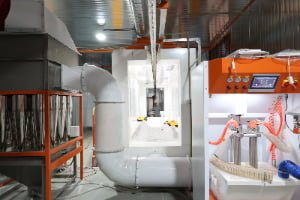
This is where the actual powder application happens. The spray booth is an enclosed chamber where operators (or robots in automated lines) use electrostatic guns to apply charged powder particles to the workpiece. The booth design controls powder overspray, allows excess powder to fall to the bottom for collection, and maintains proper lighting and ventilation for operator safety.
Spray gun technology has evolved significantly. Manual guns cost $2,000–$5,000 each, but require skilled operators. Automatic spray systems with motion control and preset patterns cost $30,000–$80,000 but deliver far more consistent coverage. For high-volume production, robotic spray systems[^3] start at $80,000 and can exceed $200,000, but eliminate operator variation entirely.
Curing Oven
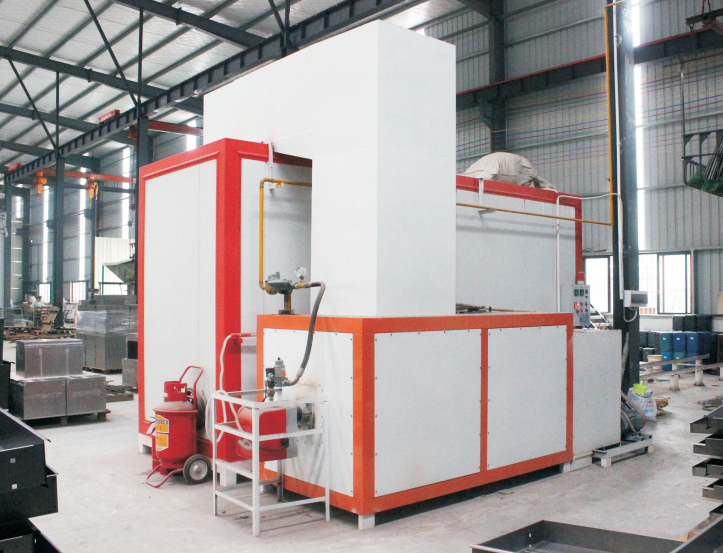
After powder is applied, the workpiece must be heated to melt and cure the powder into its final durable finish. Curing ovens are one of the most expensive line components. They must reliably maintain precise temperature ranges (typically 350–450°F depending on powder chemistry) while continuously moving parts through the chamber. The oven must be large enough to accommodate your workpiece, with sufficient dwell time to fully cure the coating.
Curing oven costs depend heavily on heating method (gas vs. electric), size, automation level, and insulation quality. A small electric batch oven might cost $40,000. A continuous conveyor oven sized for cabinet production ranges from $80,000 to $200,000. Large custom ovens for heavy industrial parts can exceed $300,000. Energy efficiency directly impacts long-term operating costs—a poorly insulated oven will cost you tens of thousands in wasted energy annually.
Powder Recovery System
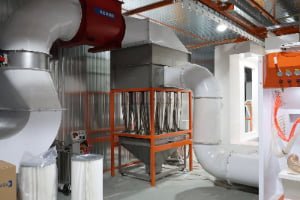
Not all powder sprayed reaches the workpiece. Excess powder falls to the booth floor, and this recovered powder can be recirculated back into the spray system if it's clean and undamaged. A powder recovery system—typically a cartridge filter dust collector—captures this powder, filters it, and returns it to the powder hopper. This is critical to your economics. Good recovery efficiency means you use 85–92% of your powder. Poor recovery means 60–70% efficiency, which costs you significantly in material waste.
Recovery systems cost between $25,000 and $80,000 depending on booth size, filtration quality, and automation level. Many factories underestimate recovery importance, then suffer years of unnecessarily high powder consumption.
Core Factors That Determine Your Equipment Cost
Now that you understand the major components, let's examine what actually drives price variations. These eight factors will determine whether your powder coating line investment is $120,000 or $500,000:
Production Capacity & Line Speed
How many parts do you need to coat per hour or per day? This is the single biggest cost driver. A line designed for 10 cabinet bodies per hour requires different equipment than a line for 50 per hour. Higher throughput demands faster conveyors, larger ovens with longer dwell chambers, more powerful spray systems, and more robust material handling. Each component scales in both physical size and capability.
Here's the practical impact: a small-capacity cabinet line might run $150,000–$200,000. The same factory might require a 3x-capacity version costing $280,000–$350,000. The difference isn't proportional because you're scaling multiple systems simultaneously. Many buyers underestimate their future capacity needs, then find themselves equipment-limited five years later.
Workpiece Size & Coating Area
What is the largest piece you need to coat, and how much surface area does it have? A cabinet factory coating 36" × 24" × 18" enclosures has very different requirements than an outdoor furniture maker coating 72" × 36" lounge chair frames or an aluminum profile factory coating 20-foot-long extrusions.
Larger workpieces require larger spray booths, longer curing ovens, heavier-duty conveyors, and more complex material handling fixtures. An aluminum profile line designed for continuous 20-foot lengths involves an entirely different mechanical architecture than a cabinet line. This directly translates into cost. A compact cabinet line with reasonable part sizes might be achievable in a semi-standard configuration. A custom-sized line for unusual workpieces can easily cost 30–50% more because it requires engineering redesign.
Automation Level & Material Handling
How much of the process do you want to automate? The spectrum ranges from fully manual (operator loads parts, manually sprays, manually unloads) to fully automatic (parts automatically move through all stations with minimal human intervention).
Manual or semi-automatic lines cost less initially but require more operator labor, generate more variation, and limit your output potential. Fully automatic lines with part tracking, spray motion control, and integrated conveyor systems cost significantly more but deliver consistent results and higher throughput. Between these extremes lies semi-automation: parts move on a conveyor, but spray operations are manual or partially automated.
Real-world cost example: a semi-manual cabinet line for small operations might cost $140,000–$180,000. Adding full spray automation and integrated handling systems to that same application could push cost to $240,000–$300,000. The premium buys you consistency, higher capacity, and reduced operator skill requirements.
Configuration Grade & Brand Selection
Are you specifying economy, mid-range, or premium components throughout the system? A budget pre-treatment system with basic spray guns and a simple electric oven will cost less than a premium system with advanced spray controls, industrial-grade curing oven, and fully integrated powder recovery.
However, here's where many buyers make mistakes. Choosing budget components for a high-volume production scenario creates long-term problems. You end up with inconsistent coating quality, excessive maintenance, energy waste, and often end up retrofitting the system within three years. Conversely, overspecifying premium features for a small batch operation burns money unnecessarily.
The right approach is specification matching: choose component grades that align with your actual production demands and quality requirements. For a cabinet factory producing custom high-end enclosures, mid-to-premium components make sense. For a mid-volume furniture maker, mid-range specification often delivers optimal ROI.
Powder Coating Line Investment: Budget by Application & Scale
Let's move from theory to real numbers. Here are approximate investment ranges for three common manufacturing scenarios:
Small-Scale Operations (Batch/Prototype)
Typical application: Custom metal enclosures, specialty hardware, one-off parts, prototype production
Production volume: 5–15 parts per day (or batch coating of varied items)
Equipment scope: Manual or semi-automatic line with modest footprint; basic pre-treatment; manual spray; compact electric curing oven; small recovery system
Investment range: $80,000–$150,000
This segment includes factories that need professional coating but don't have the volume to justify large systems. Equipment is often semi-manual and floor-space-efficient. Pre-treatment might be simpler (manual wash tank + spray or small automatic unit). Spray operation is typically manual with single-gun setup. Curing oven is smaller, batch-style or short continuous. This configuration works well for job shops, small contract manufacturers, and custom fabricators.
The challenge in this segment is capital efficiency. You want professional results without oversizing. Many small operations make the mistake of buying a standard cabinet-production-sized line when they actually need a 40% smaller system. Conversely, some underestimate future growth and buy too small, then hit capacity limits within two years.
Mid-Scale Manufacturing (Cabinets, Furniture, Aluminum Profiles)
Typical application: Metal cabinet production, outdoor furniture frames, aluminum profile coating, small-to-medium metal components
Production volume: 30–80 parts per hour (or equivalent throughput for continuous extrusion)
Equipment scope: Semi-automatic to automatic line; integrated pre-treatment with chemistry management; manual or powered spray option; continuous electric or gas-heated curing oven; automated powder recovery
Investment range: $180,000–$380,000
This is where most manufacturing investments cluster. Equipment is designed for meaningful production volume but without extreme customization. Pre-treatment is automated with temperature and pH control. Spray system is often manual but may include powered positioning or basic automation. Curing oven is larger, designed for continuous operation, with better insulation and temperature control. Powder recovery is integral to the system design.
A typical 40-cabinet-per-hour line for a furniture manufacturer might budget $220,000–$280,000. The same capacity for aluminum profile coating might range $250,000–$320,000 due to longer part length and different handling requirements. A high-end custom cabinet line designed for premium enclosure production might reach $350,000–$400,000.
This segment is where equipment specification most directly impacts ROI. Choosing the right pre-treatment chemistry for your material type, selecting spray automation that matches your operator skill levels, and sizing the oven correctly for your powder formulation—these decisions have massive implications for your coating quality and operational costs over the system's life.
Large-Scale Production (High-Volume Assembly Lines)
Typical application: High-volume cabinet OEM production, automotive component coating, industrial fastener coating, large furniture manufacturing
Production volume: 100+ parts per hour (or continuous high-volume throughput)
Equipment scope: Fully automatic line with integrated material handling; advanced pre-treatment with multi-stage chemistry; robotic or advanced spray automation; large gas-heated or industrial electric curing oven; sophisticated powder recovery with recirculation
Investment range: $400,000–$800,000+
High-volume operations justify premium equipment and full automation. Pre-treatment includes multi-tank systems with heating, filtration, and chemistry dosing. Spray systems are often robotic with multiple guns and motion programming. Curing ovens are industrial-scale, typically gas-heated for energy efficiency. Powder recovery includes advanced filtration and recirculation logic.
A true high-volume cabinet line (200+ parts/hour) can easily cost $500,000–$650,000. An automotive-grade coating line with strict quality control and advanced automation can exceed $800,000. However, at this scale, the per-unit cost of coating becomes very low, which justifies the investment.
Large-scale operations also benefit from another factor: economies of scale with suppliers. Custom engineering becomes more cost-effective when you're investing half a million dollars. Suppliers are more willing to design exactly for your needs rather than selling standard equipment.
 )
)
Total Cost of Ownership: Beyond Equipment Purchase Price
This is where many equipment buyers make critical mistakes. They focus on the equipment purchase price, sign a contract, and then discover that the real cost of powder coating extends far beyond the initial investment. Here's what you actually need to budget for:
Installation, Commissioning & Training
Equipment doesn't arrive ready to use. Installation includes site preparation, utilities connection, equipment assembly, mechanical alignment, electrical integration, and safety testing. Commissioning means running the system with actual production powder, troubleshooting temperature profiles, calibrating spray systems, and optimizing recovery efficiency. Training means teaching your operators how to run and maintain the equipment safely and effectively.
Budget expectation: Installation and commissioning typically add 8–15% to the equipment cost. For a $250,000 line, expect $20,000–$37,500 in installation and startup costs. Training and documentation add another $3,000–$8,000. These aren't optional expenses—they're essential to getting a functioning system.
Many buyers negotiate equipment price aggressively, then run out of budget for proper installation. This is a classic false economy. A poorly commissioned line starts with coating defects, equipment misalignment, and operator confusion that can take months to resolve.
Powder Consumption & Material Costs
Once your line is running, the biggest recurring cost is powder. The powder consumption rate depends directly on three factors: your overspray percentage (how much powder misses the part), your recovery efficiency (how much of the overspray is recaptured and reused), and your coating film thickness[^4] requirement.
A well-designed line with 90% recovery efficiency might consume 12–15 pounds of powder per 100 parts coated. A poorly designed or maintained line with 65% recovery might consume 22–25 pounds per 100 parts. That's nearly double the material cost.
Real economics: If you're coating 50,000 parts annually and industrial powder costs $8–12 per pound, the difference between efficient and inefficient powder consumption is $40,000–$60,000 per year. Over a 10-year equipment life, that's $400,000–$600,000 in unnecessary material costs.
This is why recovery system quality matters so much. A $45,000 premium recovery system on a $250,000 line pays for itself within 1–2 years through reduced powder waste.
Energy Consumption & Utility Requirements
Your curing oven runs constantly during production hours. Depending on whether it's electric or gas-heated, insulation quality, and ambient temperature, the energy cost can be substantial.
An electric curing oven typically consumes 25–50 kW during operation. At $0.12 per kWh (typical U.S. industrial rate), a line running 8 hours daily consumes $240–$480 monthly in oven electricity alone. Over a year, that's $2,880–$5,760 just for oven heating, plus spray booth ventilation, pre-treatment heating, and compressed air.
Gas-heated ovens are generally more efficient for high-volume production but require natural gas infrastructure. A gas oven might cost $30,000–$50,000 more to install but could reduce annual energy costs by 40–50% depending on local utility rates and your production volume.
Budget guideline: For a typical mid-scale operation, allocate $8,000–$15,000 annually for oven-related energy costs. For high-volume operations, $20,000–$35,000 annually. These are not trivial costs and should factor into your equipment selection.
Maintenance, Parts & Long-Term Support
Powder coating equipment requires regular maintenance. Conveyor chains need lubrication and eventual replacement. Spray gun nozzles wear out and need replacing ($50–$200 each, perhaps 2–4 annually). Filters in recovery systems become clogged and need replacement ($300–$800 per set, perhaps 4–6 times yearly depending on production volume). Oven heating elements eventually fail. Pre-treatment chemistry loses effectiveness and needs replacing.
Annual maintenance budget for a typical mid-scale line: $4,000–$8,000 in consumables and parts, plus labor. Over 10 years, that's $40,000–$80,000 in maintenance alone.
Additionally, you need reliable supplier support. If your equipment breaks down during peak production season, how quickly can you get spare parts? Does your supplier have local service capabilities, or do you wait weeks for international shipping? This is less glamorous than discussing spray gun technology, but it's absolutely critical to long-term satisfaction.
Reputable suppliers typically offer service packages[^5] covering spare parts availability, technical support, and optional maintenance contracts. These services often cost 2–4% of equipment value annually, but provide peace of mind and uptime assurance.
 )
)
How to Select the Right Equipment Supplier & Avoid Common Mistakes
Understanding cost factors is half the battle. The other half is actually choosing the right supplier. We've seen factories make five critical mistakes in this process, and most of them involve ignoring the real-world factors that matter most.
Match Line Configuration to Your Product Specifications
Here's what we've observed repeatedly: a factory will send general inquiries to three suppliers asking for a "standard cabinet coating line." Each supplier returns a quote for roughly similar equipment. The factory picks the lowest-cost option. Six months after installation, they discover the line doesn't quite match their actual workpiece dimensions, the spray booth layout forces awkward handling, or the oven dwell time doesn't align with their specific powder chemistry. Retrofitting costs $15,000–$30,000 and causes months of downtime.
The solution: Before contacting suppliers, document your actual specifications with precision. Maximum workpiece dimensions (length × width × height). Desired output (parts per hour or annual volume). Specific coating thickness requirements. Material type (steel, aluminum, stainless, etc.). Current shop floor dimensions and utilities available. Desired level of automation. Required surface quality standard (industry/customer specification).
Share these specifications with suppliers and require them to confirm exact fit before quoting. A good supplier will say, "Your cabinet depth is 28 inches; our standard 36-inch spray booth width allows sufficient side clearance for safe operation and complete coverage. Your target of 45 parts/hour requires 32-second dwell time in the oven; we're configuring a 72-foot oven chamber." That's specificity. If a supplier's response is vague, move on.
Evaluate Real-World Performance & Production Stability
Supplier demonstrations are useful but limited. A carefully managed demo with a few pristine parts tells you almost nothing about how the line performs under real production conditions: multiple operators, varied part conditions, 8-hour production runs, peak ambient temperatures, real-world powder batches.
Our strongest recommendation: Visit the supplier's factory and inspect actual customer systems in operation. Watch a full production run if possible. Look at the coating quality on real parts (not demo parts). Ask the supplier's customer directly: "Is the line easy to operate? How often does it break down? Did the coating quality match expectations? Would you recommend this supplier?"
If a supplier resists letting you visit or talk to existing customers, that's a warning sign. Confident suppliers welcome site visits because they know their systems actually work.
Assess Recovery Efficiency & Operational Cost Impact
Recovery efficiency is often overlooked until long after equipment is installed. By then, you're committed to years of unnecessarily high powder costs. Before purchasing, require the supplier to specify:
– Rated recovery efficiency (typically 85–92% for modern systems)
– Filter type and replacement frequency
– Powder loss per 1,000 parts coated (in pounds)
– Estimated annual powder consumption at your projected volume
– Annual powder cost estimate
Ask the supplier to calculate 10-year powder consumption and cost. If a system proposal doesn't include this analysis, request it. The difference between 85% and 92% recovery efficiency can represent $20,000–$40,000 in material savings over a decade. That's not trivial.
Verify Supplier Adaptability & On-Site Support Capability
Equipment rarely lands perfectly. Small adjustments—spray booth height, conveyor speed, oven temperature tuning, fixture design—are almost always needed once production starts. Can your supplier make these adjustments quickly? Do they have local technical staff, or are you always waiting for engineering from headquarters?
Ask suppliers directly: "If we need to adjust the spray booth layout or oven parameters after startup, how quickly can you respond?" "Do you have technical support available via phone or video during our production hours?" "If we need spare parts, what's the typical delivery timeframe?" "How much does extended support or maintenance contracts cost?"
A supplier that plans to disappear after installation signing is a supplier that will leave you frustrated. Choose suppliers that position themselves as long-term partners.
Powder Coating vs. Liquid Coating: When Should You Switch to Powder?
Before closing, we should address an important decision that precedes equipment selection: should you use powder coating at all, or would liquid spray be better for your application?
Powder coating advantages:
– Superior adhesion and corrosion resistance[^6] compared to liquid paint
– Virtually zero volatile organic compounds (VOCs), making it environmentally friendly
– Better material utilization (90%+ efficiency possible with good recovery vs. 60–70% for liquid spray)
– Thicker, more durable coatings achievable in single pass
– Lower health/safety risk for operators (no toxic fumes)
– Professional, uniform appearance at scale
– Compliant with increasingly strict environmental regulations worldwide
Powder coating disadvantages:
– Higher equipment investment ($80,000–$500,000+ vs. $30,000–$150,000 for liquid spray)
– Requires curing oven (adds complexity and energy cost)
– Cannot coat non-conductive materials or very small parts efficiently
– Steeper operator learning curve
– Longer lead time for equipment delivery
When powder coating makes sense:
– You need professional, consistent coating quality at significant volume
– Your customers expect durable finishes (outdoor furniture, industrial equipment, architectural products)
– You have environmental regulations requiring low-VOC coating methods
– Your annual production volume exceeds 10,000–15,000 parts annually
– You value material efficiency and can justify recovery system investment
When liquid spray might be better:
– Your production volume is below 5,000 parts annually
– You need extreme color variety or custom colors frequently
– Your workpieces are very small or non-conductive
– You lack space for a curing oven
– Your upfront capital is severely limited
The investment threshold: Most manufacturers break even on powder coating investment (vs. liquid spray) somewhere between 20,000–40,000 coated parts annually, assuming you optimize recovery efficiency and oven energy use. Below that, liquid spray is likely more economical. Above that, powder coating typically delivers better economics and superior results.
 )
)
Which Supplier Fits Which Type of Buyer?
The powder coating equipment market includes many suppliers, from large multinational equipment manufacturers to specialized regional builders. No single supplier is "best" for everyone. Your ideal supplier depends on what you actually need:
If you need deep customization and full-line system integration: Look for suppliers who position themselves as system integrators rather than component vendors. They should be willing to design pre-treatment, spray booth, oven, and recovery as an integrated solution tailored to your workpiece and production goals. These suppliers typically have higher equipment costs but deliver better application-specific solutions.
If you need established references in your specific industry: Seek suppliers with documented case studies and customer references in your sector. A cabinet maker benefits from suppliers who have successfully deployed systems to other cabinet producers. An aluminum profile maker should choose suppliers with extensive extrusion-coating experience. This alignment dramatically reduces risk.
If you operate overseas and need reliable long-term support: Choose suppliers with global service capabilities or established partnerships in your country. Equipment is only valuable if you can maintain it, get spare parts, and access technical support when needed. A cheap system from a supplier with no local presence becomes very expensive when it breaks down and you wait 8 weeks for parts from overseas.
If you need rapid deployment and proven designs: Semi-standard systems from established manufacturers often deliver faster lead times and lower costs than fully custom solutions. If your workpiece and production goals align reasonably well with established configurations, this can be an efficient path.
If you need to balance cost control with quality assurance: Mid-market suppliers (not the largest global firms, not tiny startups) often provide excellent ROI. They're invested in customer satisfaction because their reputation depends on it. They're small enough to offer customization but established enough to deliver reliable support.
Final Thoughts
Powder coating equipment represents a substantial investment in your factory's capability. The cost ranges from $80,000 for small operations to $800,000+ for high-volume manufacturing, with real total cost of ownership often reaching $150,000–$1.2 million over the equipment's lifetime when you include installation, materials, energy, and maintenance.
The most successful equipment purchases happen when manufacturers approach the decision systematically. First, they honestly evaluate their actual production volume, workpiece specifications, quality requirements, and available capital. Second, they understand that equipment cost is only one part of total cost; material consumption, energy efficiency, and maintenance support matter equally. Third, they choose suppliers who will design specifically for their application rather than sell standard configurations off the shelf. Fourth, they verify everything through supplier visits, customer references, and realistic performance assessments.
A well-selected powder coating system will improve your product quality, increase your production capacity, reduce your coating material waste, and position your factory for profitable growth. A poorly selected system will frustrate your operators, constrain your capacity, inflate your operating costs, and become a capital anchor you're stuck with for a decade.
Take the time upfront to specify correctly. Visit suppliers in person. Talk to their existing customers. Verify that equipment matches your real needs, not vendor convenience. The difference between a good choice and a poor one is often worth $100,000–$200,000 in long-term operating performance.

Need Help Evaluating Powder Coating Equipment for Your Factory?
Share your workpiece dimensions, target output volume, material type, preferred coating quality, available shop floor space, and production timeline. We'll help you understand which equipment configuration makes sense for your specific application and connect you with suppliers who've successfully deployed similar systems.
[^1]: Electrostatic spray painting technology uses charged particles to adhere coatings to grounded conductive surfaces through electromagnetic attraction.
[^2]: Phosphatizing is a chemical pre-treatment process that creates a protective conversion coating on metal surfaces to enhance adhesion and corrosion resistance.
[^3]: Industrial robots in manufacturing automate repetitive spray operations with consistent motion control and can cover large work areas efficiently.
[^4]: Film thickness refers to the measurement of coating depth on a substrate, critical for durability and performance in powder coating applications.
[^5]: Service level agreements define the terms, response times, and quality standards for technical support and maintenance services provided by equipment suppliers.
[^6]: Corrosion resistance measures how well a coating protects underlying metal from oxidation and environmental degradation over time.
[^7]: Electrostatic spray painting technology uses charged particles to adhere coatings to grounded conductive surfaces through electromagnetic attraction, detailed further on painting industry standards.
 English
  German
  Vietnamese
  French