Powder Coating Line: Selection Guide, Cost, and Efficiency Optimization
A well-designed powder coating line is not just about spray equipment. It is about how pretreatment, powder application, recovery, curing, cooling, and material handling work together to deliver stable coating quality at production scale.
In recent customer visits and project discussions, we have received electrical cabinet manufacturers from Algeria, furniture industry representatives from Turkey, and aluminum profile producers from India. These cases show one clear pattern: most production problems do not come from one machine alone. They usually come from a mismatch between product size, throughput target, coating quality requirements, workshop layout, and line configuration.
This guide explains what a powder coating line does, how its main systems work, how to evaluate cost and efficiency, and what questions to ask before choosing a supplier.
![Powder coating production line overview showing spray booth, curing oven, and conveyor system]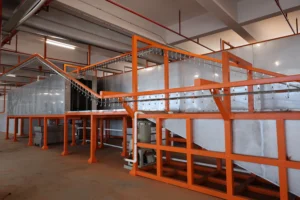
Table of Contents
- What Is a Powder Coating Line and Why Does It Matter?
- Key Components and How They Work Together
- Powder Coating vs. Liquid Coating and Other Methods
- Industries and Applications: Is Powder Coating Right for You?
- Cost Analysis: Investment, Operating Expenses, and ROI
- Critical Selection Criteria: How to Evaluate Line Performance
- How to Choose a Powder Coating Line Supplier
- Final Thoughts
What Is a Powder Coating Line and Why Does It Matter?
A powder coating line is a production system that applies dry powder coating to metal workpieces by electrostatic spraying, then cures the coating with heat to form a solid, durable film. Compared with traditional solvent-based liquid coating, powder coating generally contains no solvent and produces very low VOC emissions. It can also recover and reuse part of the overspray powder when the recovery system is properly designed and maintained.
A typical powder coating line works in a clear sequence. Metal parts first enter the pretreatment system for cleaning and surface preparation. Then they move into the drying stage. After that, they enter the electrostatic spray booth, where charged powder particles are applied to the grounded workpiece. The parts then move into a curing oven, where the powder melts, flows, and forms a continuous film. Finally, the parts cool down before inspection, packaging, or assembly.
This process matters because coating quality depends on the whole line, not only the spray gun. A good curing oven cannot solve poor pretreatment. A high powder recovery system cannot compensate for unstable airflow or worn spray guns. A fast conveyor does not improve output if loading, spraying, or curing becomes the bottleneck.
Many buyers first think they only need a better spray gun, a larger oven, or a faster conveyor. In real production, the more important question is whether the whole line is balanced. A powder coating line should be designed as one complete process. The goal is not only to coat parts, but to coat them repeatedly with stable thickness, strong adhesion, consistent color, and controlled operating cost.
Key Components and How They Work Together
Pre-treatment System
Before powder reaches the metal surface, the workpiece must be clean and properly prepared. Oil, dust, rust, welding residue, and oxide layers can all reduce coating adhesion. If the surface is not ready, even a high-quality powder and spray system may produce weak coating performance.
A common pretreatment system includes degreasing, rinsing, surface conversion, and final rinsing. The exact process depends on the substrate. Steel parts may need alkaline cleaning, rust removal, and phosphate treatment. Aluminum parts may require specialized cleaning and chromate-free conversion treatment. For outdoor products, pretreatment is especially important because corrosion resistance depends heavily on surface preparation.
For electrical cabinets and enclosures, pretreatment supports adhesion, corrosion protection, and surface consistency. For outdoor furniture, it helps the coating resist sun, rain, humidity, and handling damage. For aluminum profiles, stable pretreatment helps improve coating uniformity and long-term weather resistance.
When evaluating a supplier, ask how the pretreatment process is selected for your product. A good supplier should not give one standard answer for all substrates. They should ask about material type, oil contamination, rust level, part size, required corrosion resistance, workshop space, and local environmental requirements.
Powder Application and Recovery
The spray booth is the main application area of the powder coating line. Electrostatic spray guns charge the powder particles, and the grounded metal workpiece attracts the powder. This helps powder cover many exposed surfaces, including edges and outer corners.
However, powder does not automatically reach every surface. Deep recesses, narrow gaps, and sharp internal corners can create a Faraday cage effect[^1], where powder has difficulty entering the area. For this reason, gun position, voltage setting, airflow control, part hanging method, and operator skill all matter.
The spray booth should also control overspray. Powder that does not attach to the part can be collected, filtered, screened, and reused when the system is designed for recovery. In a well-maintained line, powder recovery can reduce waste and lower material cost. But the actual result depends on transfer efficiency, booth airflow, filter condition, cyclone or cartridge recovery design, powder quality, color-change frequency, and maintenance discipline.
This point is very important. Some buyers compare powder coating lines only by gun quantity or booth size. In practice, booth design has a direct effect on coating quality and operating cost. Poor airflow can create uneven powder clouds. Dirty filters can reduce recovery efficiency. Worn spray gun parts can create unstable powder output. These issues increase powder consumption and reject rate.
For cabinet and furniture production, the booth should match the product size and batch pattern. For aluminum profile production, the booth must support continuous coating, stable hanging, and consistent powder application along long workpieces. The right booth is not simply the largest booth. It is the booth that matches your part geometry, output target, color-change frequency, and maintenance capacity.
Curing Oven and Material Handling
After powder is applied, the workpiece enters the curing oven. The oven heats the part until the powder melts, flows, and cures into a solid film. Many powder coatings cure within about 10 to 30 minutes after the metal reaches the required part temperature[^2]. The required temperature and time depend on powder chemistry, coating thickness, substrate material, and workpiece mass.
It is important to understand that oven air temperature is not always the same as part temperature. A thick steel part takes longer to heat than a thin sheet metal cover. A heavy aluminum profile may need a different heat-up curve from a small bracket. For this reason, line design should consider actual workpiece size and material, not only the powder supplier's curing data sheet.
Oven uniformity is one of the key factors in coating quality. Cold areas can cause incomplete cure, weak adhesion, poor hardness, or reduced corrosion resistance. Hot areas can cause discoloration, over-baking, gloss change, or deformation of thin parts. Good oven design requires proper insulation, stable air circulation, suitable burner or heating element layout, and accurate temperature control.
The conveyor system connects pretreatment, spraying, curing, cooling, and unloading. It must carry the parts safely and keep the line moving at a stable speed. For small batch production, a simple manual or semi-automatic conveyor may be enough. For higher-volume production, an overhead conveyor, chain conveyor, or customized handling system may be needed.
Material handling also includes loading, hanging, spacing, cooling, inspection, and unloading. These steps are sometimes ignored during early quotation, but they can become real bottlenecks after installation. A well-designed line reduces unnecessary handling, prevents part collision, and helps operators work safely and efficiently.
![Curing oven temperature control and thermal distribution system for consistent coating quality]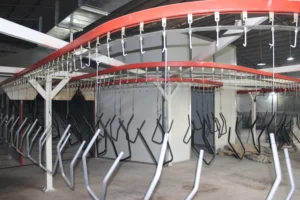
Powder Coating vs. Liquid Coating and Other Methods: When to Choose
Powder Coating vs. Liquid Spray Paint
Liquid spray paint uses solvent-based or water-based coating materials. The paint is atomized into a fine mist and sprayed onto the part. The coating then dries by solvent evaporation, water evaporation, or chemical reaction. Powder coating uses dry powder and heat curing instead.
- Material use: Powder coating can recover and reuse part of the overspray, while liquid coating usually creates more wet waste and exhaust loss.
- Environmental control: Solvent-based liquid coating may require VOC control and exhaust treatment. Powder coating normally has much lower VOC emissions.
- Coating durability: Powder coating often provides strong impact resistance, good film build, and stable surface quality for metal products.
- Production speed: Powder coating can be efficient for batch or continuous production because the coating is cured in an oven and does not need long air-drying time.
- Equipment investment: A powder coating line usually requires higher initial investment than a simple liquid spray booth, but it can reduce material waste and improve process control at scale.
Liquid coating may still be suitable for very small production volumes, frequent color matching, on-site repair work, or products that cannot pass through a curing oven. Powder coating is usually more suitable for metal parts that need stable coating quality, repeated production, and controlled operating cost.
Powder Coating vs. Anodizing
Anodizing is mainly used for aluminum. It is an electrochemical process that converts the aluminum surface into an oxide layer. Powder coating is different because it forms a coating film on top of the substrate.
- Appearance: Anodizing gives a metallic or natural aluminum appearance. Powder coating offers a wider range of opaque colors, textures, gloss levels, and decorative finishes.
- Protection mechanism: Anodizing changes the surface layer of aluminum. Powder coating provides a barrier film over the surface.
- Application range: Anodizing is mainly for aluminum. Powder coating can be applied to many conductive metal substrates after proper pretreatment.
- Repair: Anodized surfaces are difficult to repair. Powder-coated parts can be repaired with compatible touch-up coating, but full powder recoating normally requires proper surface preparation and curing.
Anodizing may be the better choice for high-end aluminum products that need a natural metallic appearance or very tight dimensional requirements. Powder coating is often preferred when the buyer needs wider color options, thicker decorative film, and efficient production for aluminum profiles, cabinets, furniture, and industrial parts.
Powder Coating vs. Galvanizing and Electroplating
Galvanizing and electroplating deposit a metal layer on the substrate. They are often used for corrosion protection, conductivity, wear resistance, or decorative metallic appearance. Powder coating provides protection mainly through a polymer barrier film.
- Galvanizing: Often used for structural steel, outdoor steel parts, and harsh environments where zinc protection is needed.
- Electroplating: Often used for small parts, automotive components, hardware, and products requiring metallic finish or special surface properties.
- Powder coating: Often used for cabinets, furniture, aluminum profiles, machinery parts, appliance parts, and metal products that need both appearance and durability.
In many manufacturing applications, powder coating offers a practical balance of appearance, durability, efficiency, and environmental performance. But the best choice still depends on substrate, use environment, coating specification, production volume, and budget.
Industries and Applications: Is Powder Coating Right for You?
Metal Cabinets and Enclosures
Electrical enclosures, switch cabinets, server cabinets, telecom housings, control cabinets, and electrical panels all require stable coating quality. These products may be shipped over long distances, installed in demanding environments, and handled many times before final use. A weak coating can lead to scratches, corrosion, and customer complaints.
For this type of product, powder coating is a strong choice because it can provide consistent film thickness, good edge coverage, durable surface protection, and repeatable color quality. The line should be designed around cabinet size, hanging method, door-panel handling, edge coverage, and production rhythm.
In one recent Algerian customer visit, the buyer focused on a powder coating line suitable for switch cabinet production. The main concerns included line length, spray station quantity, automation level, coating consistency, energy use, and environmental compliance. This type of project shows why cabinet manufacturers need a customized line rather than a general-purpose coating system.
Metal Furniture and Outdoor Fixtures
Powder coating is widely used for office furniture, outdoor furniture, park benches, metal tables, chairs, shelving, storage racks, and garden products. These products need attractive appearance, strong adhesion, good wear resistance, and weather resistance.
Outdoor furniture is especially demanding because the coating must resist sunlight, rain, humidity, temperature changes, and repeated use. A good powder coating line for furniture production should focus on pretreatment quality, coating uniformity, smooth surface finish, color-change efficiency, and stable curing.
During a Turkish furniture industry visit, the customer group paid close attention to the real operation of powder coating lines for outdoor furniture production. They examined the coating effect, production flow, automation level, and practical suitability for furniture factories. This type of visit reflects a common need in the furniture industry: buyers want equipment that can improve finish quality while supporting stable batch production.
Aluminum Profiles and Extrusions
Aluminum window frames, door frames, architectural profiles, industrial profiles, and decorative aluminum products are common powder coating applications. These products usually require good appearance, stable color, weather resistance, and consistent coating thickness over long workpieces.
Aluminum profile powder coating lines are often designed as continuous systems. The conveyor speed should be selected according to profile length, oven length, curing time, loading density, hanging method, and target output. In many practical profile lines, speeds are usually in the low single-digit meters-per-minute range rather than extremely high line speeds[^3]. The real goal is not simply speed, but stable pretreatment, uniform powder application, and complete curing.
In a recent Indian aluminum profile customer visit, the customer focused on customized line configuration, spraying precision, production capacity, powder recovery, electrical adaptation, and environmental requirements. This type of project shows that aluminum profile lines need careful design for part length, load capacity, conveyor stability, and coating uniformity.
Heavy Equipment and Industrial Metal Parts
Machinery bases, brackets, motor housings, industrial fittings, frames, and structural components can also benefit from powder coating. These parts may face humidity, oil, temperature changes, and mechanical handling. Powder coating provides a strong protective film and a clean industrial appearance.
For heavy parts, line design should consider hanging strength, conveyor load, part spacing, oven heating capacity, and operator safety. A line designed for small sheet metal parts may not be suitable for heavy equipment parts.
Automotive and Appliance Components
Powder coating is also used for automotive components, appliance parts, brackets, frames, wheels, and functional metal parts. These industries often require strict coating specifications, stable process control, and repeatable inspection results. In these applications, automation, quality testing, and documentation become more important.
Is powder coating right for you?
Powder coating may be a good fit if you produce metal parts in regular volume, need consistent surface quality, want to reduce liquid coating waste, have space for a production line, and can support oven curing. It may not be the best choice if your production is very small, your parts cannot tolerate heat, or your work requires frequent one-off colors and on-site repair.
![Powder coating application booth with electrostatic spray guns and recovery system]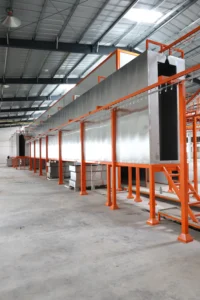
Cost Analysis: Investment, Operating Expenses, and ROI
Equipment Purchase Price
The cost of a powder coating line varies widely. It depends on line size, automation level, oven type, pretreatment process, spray booth design, conveyor system, control system, local installation conditions, and customization requirements.
As a general reference, a small manual or batch-type system may start from a lower investment range. A semi-automatic line for cabinet, furniture, or general metal parts usually requires a higher budget because it includes pretreatment, spray booth, curing oven, conveyor, control cabinet, and installation support. A fully automatic or high-capacity line for continuous production, large workpieces, or aluminum profiles requires a much larger investment.
Instead of asking only for a machine price, buyers should ask for a complete project quotation. A complete quotation should include equipment, electrical configuration, heating system, conveyor design, installation guidance, training, spare parts, packaging, shipping terms, and after-sales support.
The main cost drivers include:
- Oven size and heating capacity: Larger ovens and heavier workpieces require more heating capacity and better insulation.
- Heating source: Gas, electric, diesel, and infrared heating all have different installation and operating requirements.
- Pretreatment process: A simple manual cleaning process costs less, while multi-stage automatic pretreatment requires more space, tanks, pumps, heating, and wastewater planning.
- Spray booth configuration: Manual booths, automatic booths, cartridge recovery systems, cyclone recovery systems, and quick color-change systems have different costs.
- Automation level: Automatic spray guns, reciprocators, PLC control, sensors, and automatic conveying increase investment but can improve consistency and reduce labor.
- Customization: Special conveyor routes, non-standard oven dimensions, heavy-load design, and workshop layout restrictions all affect price.
Energy Consumption and Powder Efficiency
Operating cost usually includes powder material, energy, labor, compressed air, water, pretreatment chemicals, maintenance parts, and rejected product cost. Among these, powder consumption and oven energy are often the largest cost items.
Powder consumption should be calculated from coating area, target film thickness[^4], powder density, transfer efficiency, recovery efficiency, color-change loss, and reject rate. It is not enough to look only at the powder price per kilogram. A cheaper powder may cost more in the long run if it has poor coverage, unstable charging performance, or higher reject rate.
Powder recovery also needs realistic evaluation. A well-designed recovery system can reduce overspray waste, but actual performance depends on booth airflow, filter condition, cyclone or cartridge design, sieve quality, humidity control, powder type, and maintenance. Color-change frequency also matters. A factory that changes colors many times per day will usually lose more powder than a factory running long batches of one color.
Energy cost mainly comes from the curing oven, pretreatment heating, compressed air, pumps, fans, conveyor motors, and control systems. Oven cost should be calculated based on oven dimensions, insulation, heating source, operating hours, part loading, workpiece weight, and local gas or electricity price.
A practical supplier should help you estimate energy use according to your real production conditions. They should not only say "low energy consumption" in a brochure. They should explain oven power, burner capacity, insulation design, air circulation, heat loss, and expected running cost under your working schedule.
Labor, Maintenance, and Hidden Costs
A powder coating line also needs trained operators. Even a semi-automatic line still requires people for loading, unloading, inspection, powder management, cleaning, and basic maintenance. If color changes are frequent, labor time for booth cleaning and powder changeover becomes more important.
Maintenance cost includes spray gun parts, nozzles, hoses, filters, conveyor chains, bearings, burners, heating elements, sensors, and electrical components. Preventive maintenance is cheaper than emergency repair. A factory that cleans the booth, checks filters, maintains guns, and records oven temperature regularly will usually get more stable coating quality and lower operating cost.
Hidden costs can include workshop modification, ventilation, gas piping, electrical wiring, wastewater treatment, operator training, spare parts inventory, and rejected parts during the learning period. These costs should be discussed before purchase.
ROI: How to Think About Payback
ROI should be calculated carefully. A powder coating line can create value in several ways:
- Reducing outsourcing cost
- Improving delivery control
- Reducing coating defects and rework
- Improving product appearance and customer acceptance
- Reducing liquid coating waste and environmental burden
- Increasing production flexibility
A simple ROI model can compare current outsourced coating cost with in-house coating cost. For example, if a factory currently pays an external supplier for coating, the annual outsourcing cost can be compared with the estimated annual cost of powder, energy, labor, maintenance, and depreciation after installing its own line.
The calculation should also include production volume. A powder coating line makes more sense when the factory has stable coating demand. If production volume is too low, the payback period may be long. If production volume is high and outsourcing cost is expensive, payback can be much faster.
The safest way is to ask the supplier for a project-based cost model. Provide your part drawings, material type, annual output, target film thickness, coating color, working hours, and local energy price. A serious supplier should be able to help build a realistic estimate rather than giving a simple "six-month payback" promise.
Critical Selection Criteria: How to Evaluate Line Performance
Production Capacity and Throughput
Throughput is not only about oven size. It is determined by the slowest stage of the whole line. The bottleneck may be loading, pretreatment, drying, spraying, curing, cooling, unloading, or color change.
For example, a large oven does not guarantee high output if operators cannot load parts fast enough. A fast conveyor does not help if the powder cannot cure completely. A multi-gun spray booth does not improve productivity if the pretreatment stage is too slow.
When discussing capacity with a supplier, provide real part dimensions, weight, material, hanging method, coating area, target output per shift, and color-change frequency. Ask the supplier to explain the line speed, oven residence time, number of hanging positions, spray time, and expected output per hour.
Important questions include:
- What is the expected output for my specific part size and weight?
- What is the required curing time based on part temperature, not only oven air temperature?
- Which stage will become the first bottleneck?
- How many operators are needed per shift?
- Can the line be upgraded later if output increases?
Coating Uniformity and Quality Standards
A fast line has little value if it cannot produce consistent coating quality. Coating quality should be checked by measurable standards, not only by visual inspection.
Important quality indicators include:
- Film thickness: Many industrial powder coatings are applied in the range of about 50 to 120 microns, depending on product specification. The target should be confirmed according to the powder type and end-use requirement.
- Adhesion rating: Adhesion can be checked by cross-hatch or tape adhesion testing, such as ASTM D3359. Many industrial buyers target high adhesion ratings depending on the specification.
- Color consistency: Finished parts should show stable color under proper lighting, without obvious batch-to-batch variation.
- Surface appearance: The coating should be free from obvious pinholes, heavy orange peel, sagging, contamination, and exposed substrate.
- Edge and corner coverage: Edges, corners, and recesses should be checked carefully because they are common weak points.
- Curing quality: The coating should reach the required hardness, adhesion, and chemical resistance after curing.
Before ordering a line, it is better to send sample parts to the supplier for trial coating. The sample should use your actual material, actual part geometry, and actual powder requirement if possible. Check the finished sample carefully and ask for film thickness data, curing settings, and process explanation.
Automation Level and Operational Ease
Automation can improve consistency, reduce labor, and support higher production volume. But too much automation can also increase cost and maintenance difficulty if the factory is not ready for it.
A manual line may be suitable for small batches, flexible production, and lower investment. A semi-automatic line is often a good balance for cabinet, furniture, hardware, and general metal parts. A fully automatic line may be suitable for high-volume production, continuous aluminum profile coating, or factories with strict process control requirements.
Operational ease is just as important as automation level. Operators should be able to understand the control interface, adjust basic settings, clean the booth, change powder, and respond to alarms after proper training. If the system is too complicated, daily operation becomes dependent on a few technicians, which increases risk.
Ask the supplier:
- How long does color change usually take?
- Can operators adjust spray gun position easily?
- Is the control panel simple and clear?
- Can the line run in manual mode if part of the automation fails?
- Are spare parts easy to replace?
- What daily, weekly, and monthly maintenance tasks are required?
Safety and Environmental Requirements
Powder coating equipment must be designed with safety in mind. Spray booths should have proper ventilation, grounding, dust control, and interlocks. Ovens should have temperature protection, airflow control, and safe heating systems. Operators should receive training on powder handling, grounding, cleaning, and emergency procedures.
Environmental requirements also vary by country and region. Buyers should discuss exhaust, powder recovery, wastewater from pretreatment, chemical storage, and local compliance needs before finalizing the line design. A supplier with export experience should be able to adapt the electrical system, voltage, safety configuration, and documentation to the destination market.
How to Choose a Powder Coating Line Supplier: Key Evaluation Checklist
Application Experience in Your Industry
Do not only ask whether the supplier has built powder coating lines before. Ask whether they have experience with your specific product type. A cabinet manufacturer, an aluminum profile factory, and an outdoor furniture producer may all need powder coating, but their line requirements are different.
Cabinet manufacturers need good edge coverage, stable color, and efficient handling of panels and boxes. Furniture factories need smooth appearance, weather resistance, and flexible color changes. Aluminum profile factories need continuous conveying, long-part handling, stable pretreatment, and consistent coating along the full profile length.
A supplier with relevant application experience can help avoid common mistakes in line length, booth size, conveyor layout, oven design, and pretreatment configuration.
Factory Visit and Line Demonstration
If possible, visit the supplier's factory before ordering. A factory visit helps you see their production process, assembly quality, workshop management, and engineering capability.
During the visit, check whether the supplier has real equipment under production, whether the welding and assembly quality is stable, whether electrical cabinets are clean and organized, and whether they can explain the line design clearly. If they can show a running line or arrange a visit to an existing customer site, that is even better.
A serious supplier should be willing to explain both the advantages and limitations of the line. Be careful with suppliers who only promise high output, low cost, and perfect coating without asking detailed questions about your product.
Reference Customers and Case Studies
Ask for references or case information from customers with similar products. The most useful reference is not the biggest project, but the most relevant project.
For example, if you produce electrical cabinets, a reference from a cabinet or sheet metal factory is more valuable than a reference from a small hardware shop. If you produce aluminum profiles, ask about profile length, conveyor type, pretreatment process, curing oven length, and real production output.
When checking references, focus on practical questions:
- Was the line delivered according to the agreed configuration?
- Was installation and training smooth?
- Did the line reach expected output?
- Were there coating defects after commissioning?
- How responsive was the supplier when problems appeared?
- Are spare parts and technical support easy to obtain?
Customization and Line Design Flexibility
Most factories do not have identical workshops, products, or production plans. A good powder coating line supplier should be able to customize the line according to your actual conditions.
Useful customization options include conveyor route adjustment, oven width and length selection, spray booth configuration, heating source selection, pretreatment process design, loading and unloading layout, control system options, and future upgrade space.
Customization does not mean making the line unnecessarily complex. It means matching the equipment to your real production target. The best design is usually the one that balances investment, output, quality, energy cost, maintenance, and operator skill level.
Installation, Training, and After-sales Support
Powder coating line success does not end when the equipment leaves the factory. Installation, commissioning, training, and after-sales service are critical.
Ask whether the supplier provides installation drawings, foundation requirements, electrical diagrams, gas or heating requirements, operating manuals, spare parts list, and maintenance schedule. Also ask whether they can provide online guidance, on-site installation support, or local service support depending on your country.
Operator training should cover more than button operation. It should include powder handling, gun adjustment, booth cleaning, oven temperature control, pretreatment maintenance, color change, daily inspection, safety, and basic troubleshooting.
Transparent Quotation and Technical Documentation
A clear quotation should list the main equipment, technical parameters, material specifications, motor and electrical brands, control system, heating method, conveyor type, spray booth design, recovery method, and included services.
A vague quotation may look cheaper at first, but it often creates problems later. Missing items may appear during installation. Important parts may be downgraded. The final project cost may become higher than expected.
Before making a decision, compare suppliers by total project value, not only by the lowest price. A reliable line should help you produce stable coating quality for many years. Saving too much on key systems such as pretreatment, recovery, oven insulation, and control design can create higher operating costs later.
Final Thoughts
A powder coating line is a long-term production investment. The right line can improve coating quality, reduce outsourcing dependence, shorten delivery time, and give the factory better control over its surface finishing process. The wrong line can create bottlenecks, unstable coating quality, high powder loss, high energy cost, and frequent maintenance problems.
When choosing a line, do not evaluate only the spray booth, oven, or conveyor separately. Look at the whole process. Start from your product size, material, annual output, coating quality requirement, available workshop space, labor level, energy source, and future growth plan. Then design the line around those facts.
For cabinet manufacturers, the key focus is stable adhesion, smooth surface finish, color consistency, and efficient handling of panels and enclosures. For outdoor furniture producers, pretreatment quality, weather resistance, and appearance are critical. For aluminum profile factories, continuous handling, coating uniformity, curing stability, and line balance are the main concerns.
A good supplier should ask detailed questions before offering a solution. They should help you calculate capacity, explain the pretreatment process, design the spray booth and recovery system, size the curing oven correctly, and plan installation and training. They should also be honest about what the line can and cannot do.
If you are planning a new powder coating line or upgrading an existing coating process, the best first step is to prepare your product drawings, target output, coating requirements, workshop dimensions, and local energy conditions. With this information, a supplier can provide a more accurate proposal and help you avoid costly design mistakes.
[^1]: In electrostatic powder coating, a Faraday cage effect occurs when the geometry of parts prevents charged powder particles from reaching certain areas like deep recesses and internal corners.
[^2]: Curing time varies significantly depending on powder formulation, substrate thickness, and part mass; supplier data should be verified against actual part conditions.
[^3]: Aluminum profile lines typically operate at slower speeds to ensure uniform coating coverage along the entire length of the profile during oven residence time.
[^4]: Film thickness in powder coating is typically measured in microns (μm); common industrial specifications range from 50 to 120 microns depending on application and durability requirements.
[^5]: The ASTM D3359 standard defines adhesion test methods for coatings, commonly used for cross-hatch and tape adhesion testing in industrial quality control.
 English
  German
  Vietnamese
  French