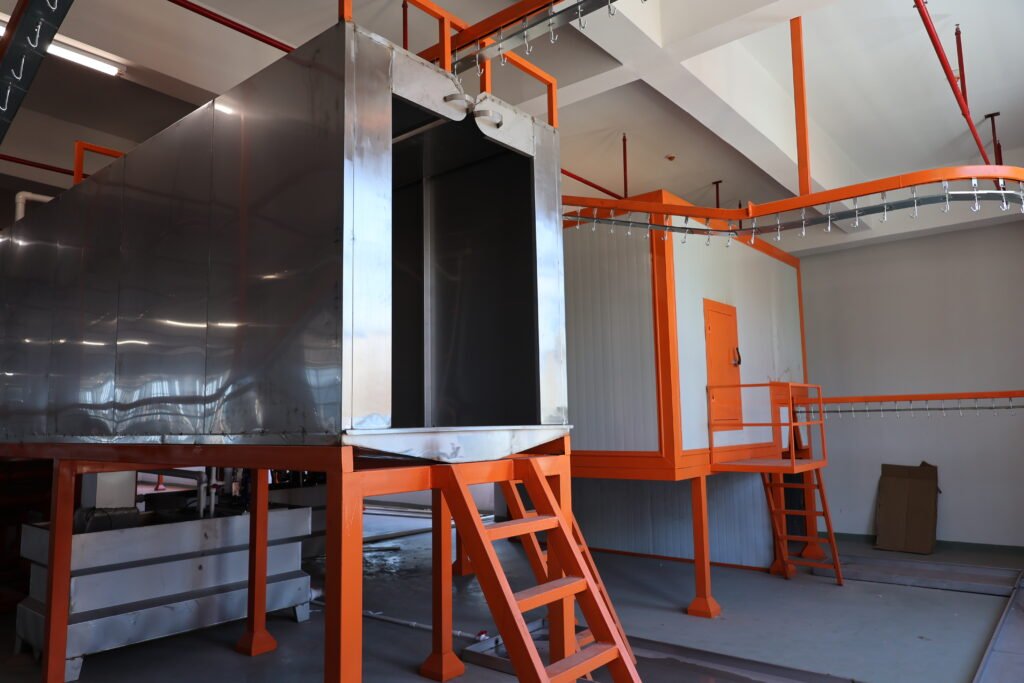
I often meet teams who can list every step in powder coating, but they still fight defects and rework. I also see people blame the powder or the spray gun first, while the real issue is process drift that no one is measuring.
Powder coating is not complicated in sequence. It is complicated in control. If I lock four variables—surface cleanliness, deposition efficiency (grounding/racking), film thickness window, and part-temperature cure completion—I can make quality repeatable and reduce rework fast.
From our factory view at Ketu, the whole process is basically “put variation in a cage.” Each step has a few key variables. If those variables are not fixed, you will see the same symptoms again and again: unstable appearance, drifting thickness, weak adhesion, corrosion complaints, and delivery chaos. Below I break the process down in a way that is useful for production, not only for theory.
What Is the Powder Coating Process Step by Step?
Many “step by step” guides stop at the list. I do not stop there. I list the steps and the control goal of each step, because that is how you keep the line stable.
The powder coating process step by step is: incoming inspection → cleaning/pretreatment → rinsing → dry-off → racking and grounding check → powder spraying → powder recovery/dust control → curing by part temperature → cooling → un-racking/packing → inspection and records.
Step A: Incoming parts and pre-check (sets the quality floor)
I control: oil, rust, weld slag, silicone contamination, and surface profile.
- Oil or silicone often causes fisheyes and craters.
- Rust and scale often cause weak adhesion and later corrosion.
- Sharp weld spatter often creates thin edges and bare spots.
I treat many “powder defects” as incoming problems first. If I do not sort parts by risk, the line becomes chaotic. One batch needs heavy cleaning, the next batch is clean, and the team keeps changing settings. That creates drift.
Step B: Pretreatment route (controls adhesion and corrosion base)
I control: concentration, temperature, time, spray pressure, water quality, and conductivity.
A common route is:
- degrease → rinse → condition → conversion coat → rinse → DI/final rinse (as required)
My goal is not “looks clean.” My goal is “same surface condition every batch.” When adhesion is sometimes good and sometimes bad on the same product, pretreatment consistency is usually the root.
Step C: Dry-off (removes water risk)
I control: “dry everywhere,” especially seams and cavities.
- Residual water can cause pinholes, bubbles, and other defects.
- Over-aggressive dry-off can also waste takt time or create surface issues on some parts.
For me, dry-off is not just heating. It is removing uncertainty.
Step D: Racking and grounding (the hidden master switch)
I control: grounding continuity, hang point design, shadowing areas, and loading speed.
- Poor ground often causes thin corners, poor wrap, and rough texture.
- Bad hang points cause bare spots or over-build.
- Dirty hangers can contaminate finish and create particles.
This is why I say: racking is the master switch for both quality and throughput. Many lines are not limited by spray guns. They are limited by hangers and handling.
Step E: Powder spraying (booth + guns + powder feed + recovery)
I control: kV/current, air pressure, powder flow, gun distance, travel speed, and powder condition.
I focus on three areas:
1) coverage on corners, recesses, inside edges
2) film thickness window (not too thin, not too thick)
3) cleanliness and color change for high-mix shops
If your booth has dead zones, changeovers become slow and contamination becomes common. That is a system design issue, not an operator issue.
Step F: Curing (the oven)
I control: part metal temperature curve and effective time in the cure window.
- Under-cure can cause weak hardness, poor chemical resistance, and adhesion issues.
- Over-cure can cause gloss loss, yellowing, and brittleness in some systems.
I do not accept cure by setpoint only. Thick parts and heavy hangers heat differently. The same “200°C for 10 minutes” can produce totally different results across different parts.
Step G: Cooling, un-racking, and packing (protect the good parts)
I control: safe handling temperature, friction, stacking pressure, and packaging protection.
I have seen many “coating complaints” that were actually caused by scratches during unloading and packing. The coating was fine. The handling was not.
Step H: Inspection and records (make quality repeatable)
I keep at least four records:
- film thickness checks at multiple locations
- cure verification (part temp/time)
- defect photos with cause-action mapping
- changeover time and powder usage (for high-mix)
If you want stable mass production, you need traceability. If you do not record, you cannot repeat.
What Is a 7 Time Process Powder Coating?
People often say “7 time” when they mean a multi-stage pretreatment flow with several timed steps. In daily factory language, it usually points to a staged process where each step has a fixed dwell time and a fixed control target.
A “7 time process” in powder coating usually means a staged pretreatment flow with seven timed steps, such as degrease, rinse(s), conditioning, conversion coating, final rinse, and related steps before dry-off, where each stage has controlled time, temperature, and chemistry.
The key point is not the number. The key point is repeatability. If you run a staged pretreatment, you must lock:
- dwell time in each stage
- temperature and concentration
- spray coverage
- rinse quality and conductivity
If these drift, the surface condition drifts. Then adhesion and corrosion performance drift.
Why “timed stages” matter to real production
Timed stages reduce operator variation. They also make troubleshooting easier. If a defect appears, you can check records and see what drifted. That is how a shop becomes stable over time.
How Do You Understand Powder Coating?
Many people understand powder coating as “a better paint.” That is not wrong, but it is incomplete. I understand powder coating as a controlled chemical and physical process that needs stable inputs.
I understand powder coating as a controlled system: I prepare the surface so it is consistent, I deposit powder efficiently with stable electrostatics and racking, and I complete the cure reaction by controlling part metal temperature over time.
The four core variables I always lock
1) Surface cleanliness and surface condition
If the surface is not consistent, nothing later is stable.
2) Deposition efficiency
This is grounding, racking contact, and booth airflow. If transfer efficiency is low, you waste powder and lose quality on edges.
3) Film thickness window
Too thin causes poor coverage and weak protection. Too thick can cause texture issues and waste.
4) Cure completion
The part must reach the correct metal temperature for the correct time. Setpoint is not enough.
When these four are locked, powder coating becomes simple. When any one is loose, powder coating feels unpredictable.
What Is the 9 Tank Process for Powder Coating?
The 9-tank process is a more detailed pretreatment sequence than a basic line. Shops use it when they need stronger corrosion performance, better consistency, or more control of rinsing and sealing steps. The exact chemistry varies by region and requirement, but the logic stays similar.
A 9 tank pretreatment process is an extended multi-stage surface preparation route that adds more cleaning, rinsing, conditioning, conversion, and sealing control steps to improve consistency and corrosion resistance before powder coating.
A common 9-tank flow example (one practical version)
| Tank # | Stage | Purpose | What I control |
|---|---|---|---|
| 1 | Pre-degrease | remove heavy soil | time + temperature |
| 2 | Main degrease | remove oil films | concentration + spray |
| 3 | Rinse 1 | reduce carryover | flow + overflow |
| 4 | Rinse 2 / DI rinse | stabilize water quality | conductivity |
| 5 | Desmut/etch (as needed) | stabilize metal surface | chemistry control |
| 6 | Condition | improve conversion uniformity | dosing stability |
| 7 | Conversion coat | build adhesion/corrosion layer | pH + temp + routine checks |
| 8 | Rinse / DI rinse | remove residue | conductivity target |
| 9 | Seal / passivation | improve corrosion performance | stable chemistry + time |
Then I run dry-off. I treat dry-off as part of pretreatment, because moisture risk is part of surface preparation risk.
When 9 tanks are worth it
I see it make sense when:
- outdoor durability targets are strict
- corrosion performance is a selling point
- customer audits require documented control
- parts have mixed contamination risks
- quality drift must be reduced across shifts
Still, more tanks are not magic. If control routines are weak, a 9-tank line can still drift. The value comes from consistency and records.
Conclusion
Powder coating becomes stable when I lock four variables—surface condition, grounding/racking, film thickness window, and part-temperature cure—then I record the process so the same results repeat across batches and people.
 English
  German
  Vietnamese
  French