Spray Booth Design and Use Precautions: Essential Guide for Efficient and Safe Powder Coating Operations
When you're running a powder coating operation, the spray booth is where everything matters. It's the one place where precision, consistency, and safety all converge. From my experience working with hundreds of coating lines across different industries, I've learned that spray booth design isn't just about making something work—it's about making something work reliably, day after day, month after month.
A spray booth must balance efficient powder recovery, operator safety, and coating quality through proper structural design and operational discipline. Key design elements include corrosion-resistant materials, effective filtration systems, and adequate ventilation to control dust concentration. During operation, maintain stable spray distance and pressure, monitor temperature and humidity levels, and follow strict cleaning protocols—particularly during color changes. Pre-operation checks should verify air quality, filter condition, and grounding integrity, while regular maintenance of cyclone separators and filter cartridges ensures consistent performance and prevents equipment failures that compromise coating uniformity and workplace safety.
The difference between a spray booth that delivers consistent, high-quality coatings and one that creates endless headaches often comes down to understanding what happens before the powder even leaves the spray gun—and what happens after it doesn't stick to the workpiece. This guide walks you through the design fundamentals, operational best practices, and the precautions that will keep your booth performing at its best.
Understanding Spray Booth Design Fundamentals
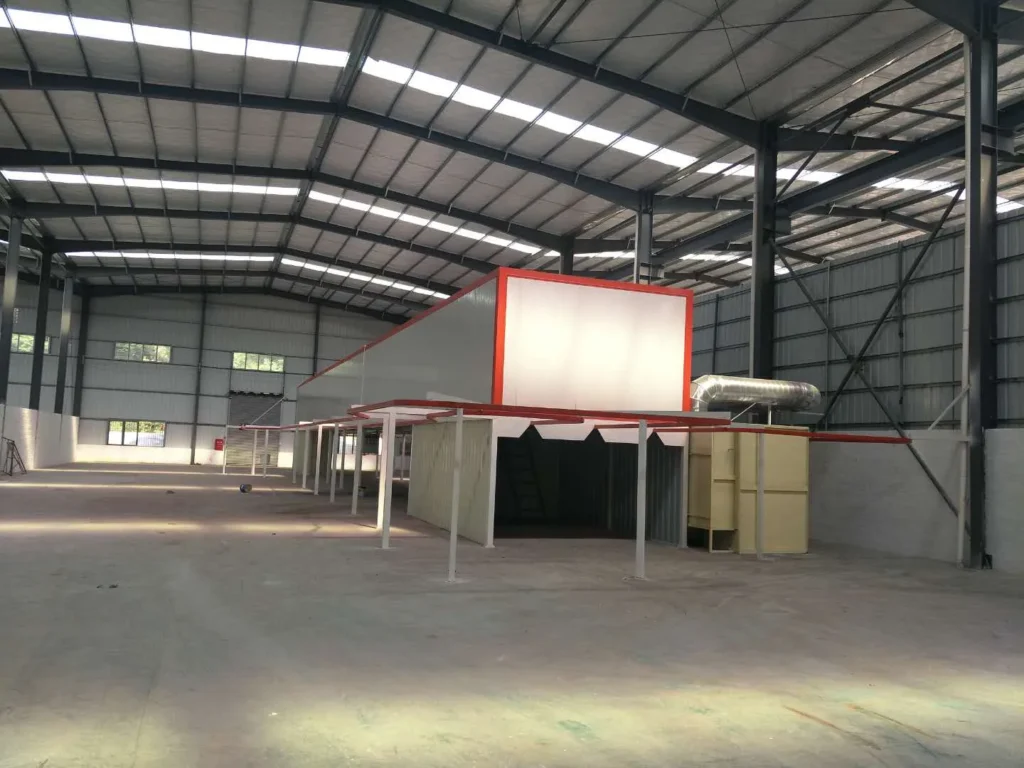
A spray booth isn't just a box where you spray powder. It's a carefully engineered environment where air movement, powder recovery, operator access, and coating quality all need to work together. The basic principle is straightforward: containment, separation, and recovery. You spray powder onto a grounded workpiece, the powder that misses gets sucked into a collection system, and clean air exits. Simple in concept, but the details determine whether your booth delivers uniform coatings or creates frustration and waste.
Key Structural Components of a Spray Booth
The booth body itself is the foundation. At our factory, we typically construct booth walls and ceilings using materials like PP (polypropylene) or anti-static coated steel. PP is popular because it doesn't absorb static electricity and resists powder accumulation better than standard materials. The walls need to be sturdy enough to handle the exhaust pressure from the recovery system—usually 4,000 to 4,200 Pa—without flexing or creating leaks that let powder escape into the workshop.
Lighting is often overlooked but matters more than people realize. You need to see the surface you're coating clearly, especially when checking for coverage and defects. We typically install 30W LED panels that provide even illumination without creating hot spots or shadows. Poor visibility leads to missed coverage, which leads to rework.
The floor of the spray booth should be smooth and easy to clean, but not slippery when wet or dusty. Some facilities use removable collection trays or mesh floors that allow powder to fall through to collection bins below. This speeds up color changes and cleanup.
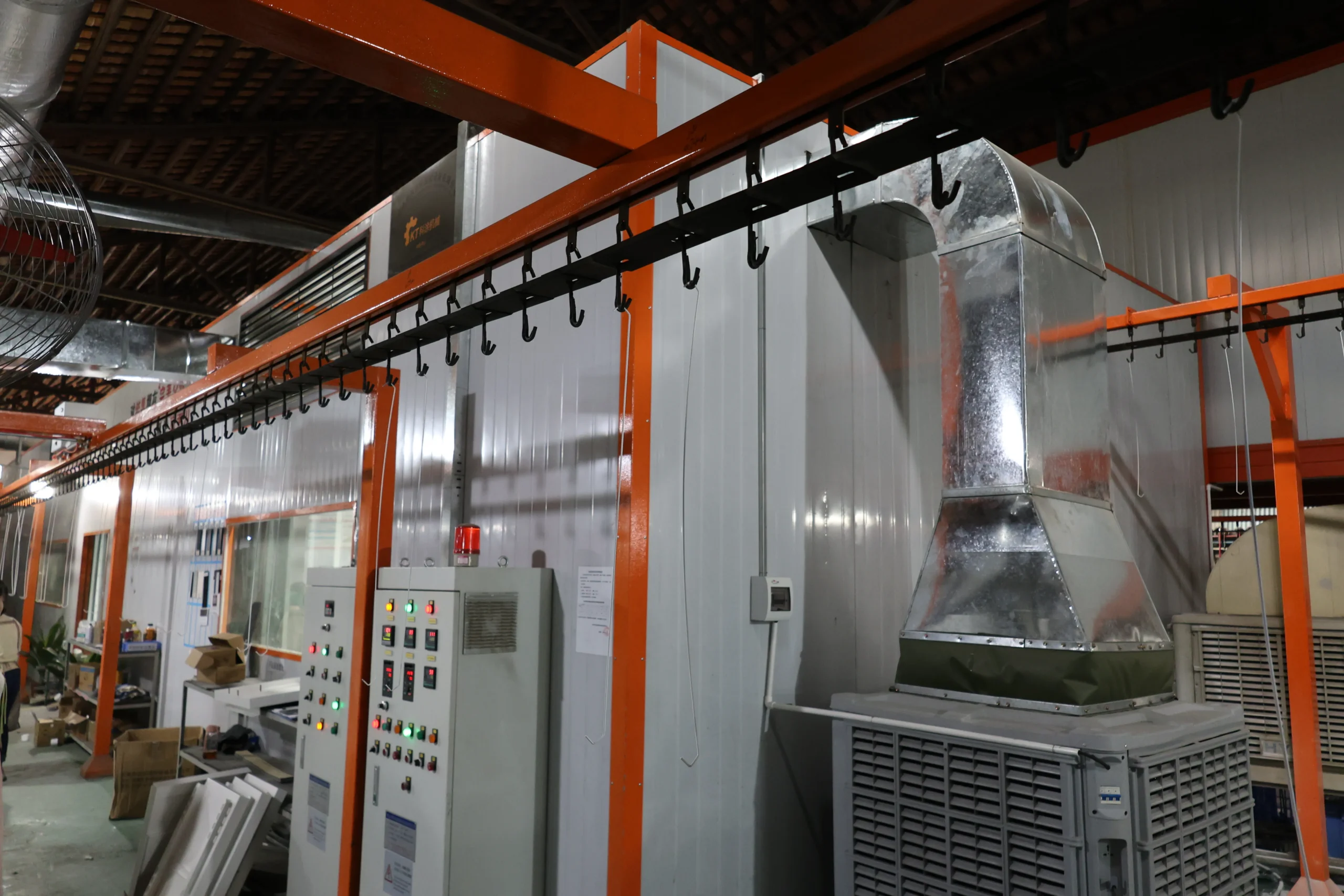
The exhaust system is where the actual separation happens. Most modern booths use either a large cyclone separator or a two-stage recovery system. The cyclone works through centrifugal force—powder-laden air spins rapidly, throwing heavier particles outward where they fall into a collection hopper. The cleaned air then exits. Two-stage systems add a secondary filter (usually with cartridge-type filter elements) to catch the finest particles and achieve near-complete air purification before exhaust.
Design Principles for Optimal Performance
The air velocity inside the booth needs to be high enough to capture powder drift but not so high that it disturbs the spray pattern or causes powder to bounce back. We typically design for air movement between 0.5 and 1.0 m/s at the workpiece level—fast enough to work, gentle enough not to interfere with the spray plume.
The booth shape matters too. Most industrial booths use a rectangular chamber with the spray gun positioned at one end and collection points at the other. Some facilities use a booth with sloped sidewalls or floor to direct powder flow toward collection points naturally. The idea is to minimize dead zones where powder can accumulate and potentially create contamination sources.
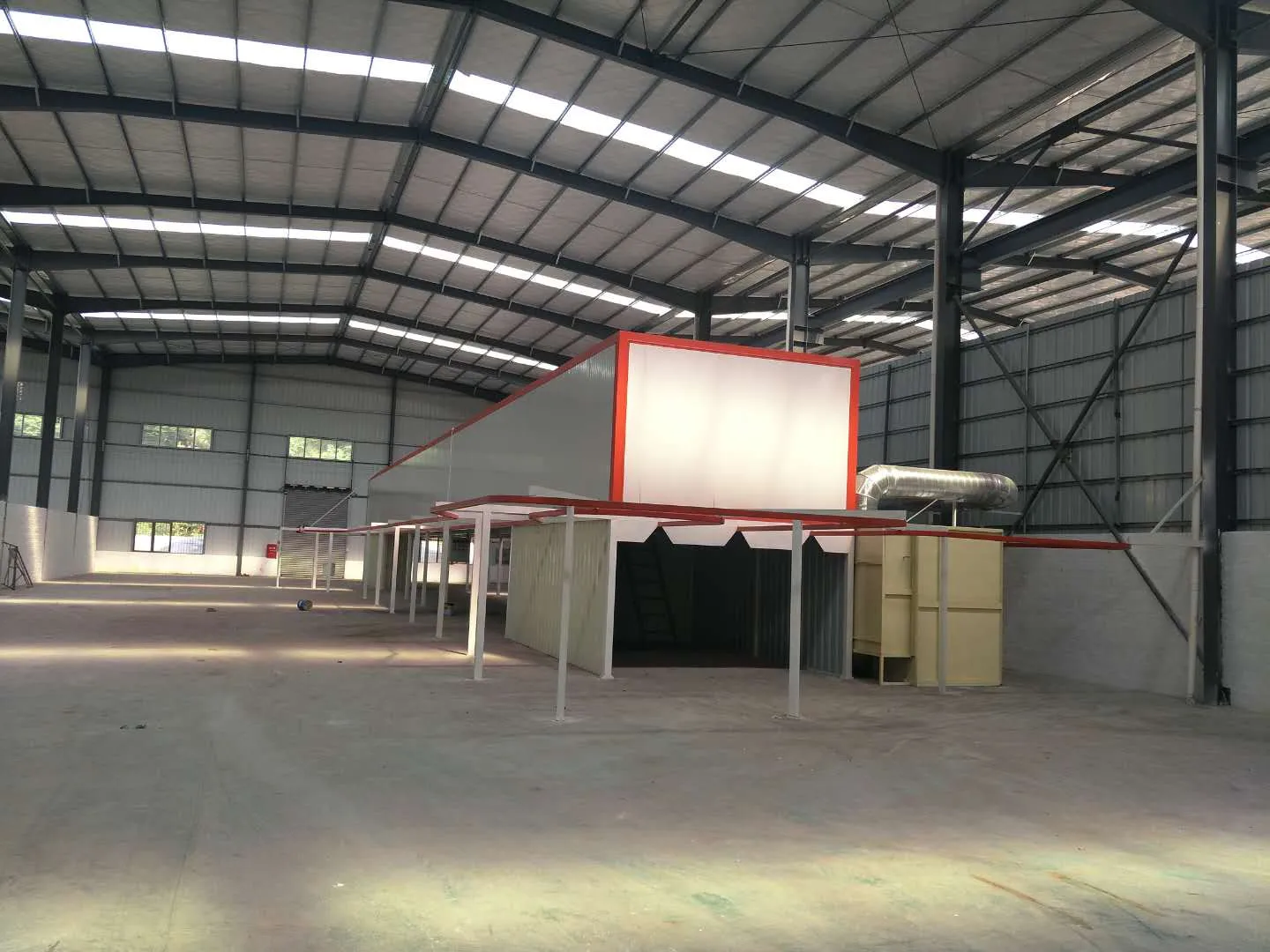
From our experience, the booth dimensions should be sized to your workpiece, not oversized just because a larger booth sounds "more capable." An oversized booth uses more air, consumes more energy, and can actually create dead zones where air stagnates. We typically design booth height at 2.1 to 2.3 meters, width based on workpiece dimensions plus 300-400 mm clearance on each side, and length sufficient for the spray gun operator to maintain safe working distance without reaching awkwardly.
Critical Design Parameters and Material Selection
The materials you choose for your spray booth aren't incidental—they directly affect durability, maintenance, and ultimately your operating costs over the booth's lifetime.
Sizing Considerations Based on Workpiece and Production Requirements
Before building or ordering a booth, ask yourself these specific questions: What's the largest workpiece I'll coat? What's my target production volume per shift? Do I need multiple guns operating simultaneously, or is single-gun operation enough? What's my available floor space?
At our facility, we've built booths for workpieces ranging from small brackets (500 mm × 300 mm) up to large cabinets (1500 mm × 1100 mm × 1200 mm or larger). For small parts, a compact booth around 1.5 meters wide is efficient. For large cabinet work, we often go to 3.6-4.0 meters wide to give operators comfortable spray angles on all sides without repositioning the workpiece constantly.
Production volume influences booth configuration. If you're spraying 20-30 pieces per hour in a batch process, a smaller booth with efficient color-change capability might be ideal. If you're running a continuous conveyor line spraying 100+ pieces per hour, you need a larger booth with dual recovery systems to handle the powder volume and maintain air quality.
We always consider the powder recovery rate target as part of sizing. Most booths are designed to recover 85-95% of powder, with the remaining 5-15% being ultra-fine particles that get filtered by the secondary recovery system. If your application demands higher recovery (say, for expensive specialty powders), you might need additional filtration or even a tertiary collection stage.
Material Specifications and Internal Coating Systems
The internal surfaces of your booth take a beating. Powder particles hit them at velocity, moisture in the air can condense on them, and operators are constantly cleaning and maintaining. We specify materials carefully.
For the booth chamber itself, PP is excellent for most operations. It's lightweight, doesn't conduct static electricity (reducing risk), and resists most powder types. The downside is that PP has lower rigidity than steel, so for large booths we sometimes use thicker gauge or reinforce with steel frames.
For high-wear areas—particularly around the spray gun area where powder concentration is highest—we sometimes apply a protective coating or use higher-grade materials. Stainless steel is superior for durability but increases cost and weight, so we typically reserve it for specific wear points.
The internal surfaces should be as smooth as practical to minimize powder accumulation. Rough or textured surfaces trap powder, which becomes a contamination source during color changes. We sometimes apply a low-friction coating to the walls, but regular cleaning is what really matters.
Anti-static properties are critical. If your booth walls develop a charge, powder can stick to them rather than falling to collection points. All booth materials, structural elements, and collection systems should be grounded to ensure charge dissipation. This is one area where I always recommend not cutting corners—poor grounding leads to inconsistent powder behavior and can be a fire/explosion hazard.
powder coating booth filter cartridge system" />
Ventilation and Powder Recovery Systems: The Core of Spray Booth Efficiency
If I had to identify the single most important system in a spray booth, it would be the ventilation and recovery system. Everything else—spray guns, control systems, even the booth structure itself—supports this one core function: moving air and powder in a controlled, efficient manner.
System Design for Stable Air Flow and Dust Concentration Control
The ventilation system starts with the exhaust fan. Most medium-to-large booths use centrifugal fans in the 30-45 kW range, capable of moving 18,000 to 22,000 cubic meters of air per hour. The fan needs to be powerful enough to maintain booth pressure slightly negative (about -100 to -150 Pa relative to the ambient workshop), which prevents powder from leaking out while the booth is operating.
The ductwork connecting the booth to the fan matters more than many people realize. Ducts should have smooth internal surfaces and gradual bends to minimize air resistance and powder settling. Dust settles in ducts with tight bends or horizontal sections—this isn't just inefficient, it's a fire hazard because powder accumulation creates potential explosion risk if an ignition source appears.
We typically slope horizontal ductwork downward at a slight angle (2-3 degrees) to encourage powder to flow with gravity toward collection points rather than settling mid-pipe.
Inside the booth, the air distribution system is equally important. The booth needs negative pressure at the spray gun working area—typically created by intake vents positioned above the gun zone. This pulls contaminated air upward and away from the operator's breathing zone while moving it toward collection points. The layout creates a flow pattern: air enters from the sides and top, moves across the spray area, and exits through collection ports at the base or back of the booth.
Dust concentration inside the booth is the metric that determines whether your recovery system is working. If you have 30 mg/m³ of powder in the air, powder recovery is functioning well. If you hit 100+ mg/m³, the booth is getting overloaded—this is when you see powder bridging (forming channels in collection hoppers), inconsistent spray performance, and potential safety issues. We monitor booth air quality with spot-checks during operation and adjust fan speed or spray gun positioning if concentration rises too high.
Two-Stage Recovery and Filtration Technology
Most modern booths I install use a two-stage approach: primary recovery (cyclone or centrifugal separator) followed by secondary filtration (usually cartridge filters with backflush cleaning).
The cyclone separator is the workhorse. Powder-laden air enters tangentially, creating a vortex. Heavy particles are thrown outward by centrifugal force and drop into the collection hopper at the bottom. The cleaned air spirals upward and exits. Under optimal conditions, a well-designed cyclone recovers 90-95% of powder in a single pass. The remaining ultra-fine particles (those under 10 microns) pass through to the secondary stage.
The secondary recovery cabinet uses cartridge filters—typically cylindrical elements with a large surface area folded inside a corrosion-resistant housing. These filters capture ultra-fine powder and are cleaned by a reverse-air pulse system. A compressed-air pulse (usually 1-2 times per minute during operation, adjustable) reverses the air flow momentarily, causing the filter cake to crack and fall back into the collection hopper.
From our experience, this two-stage approach achieves outlet air cleanliness of 99.9%+, which means the dust leaving your booth is nearly imperceptible and easily handled by standard workshop exhaust systems or air pollution control equipment.
One important detail: filter elements degrade over time. We typically specify cartridge replacement every 3,000-5,000 operating hours depending on powder type and booth workload. Polyester filters work well for most polyester and epoxy powders. Specialized coatings may require different filter materials—for example, fine metallic powders sometimes need pre-filters to extend main filter life.
Pre-Spray Preparation and Foundation Work
Before you spray a single piece, your booth needs to be ready. This is where many operations fail without even realizing it. They blame inconsistent coatings on spray gun parameters when the real problem is that pre-operation checks were skipped.
Equipment Inspection and Maintenance Checklist
Every shift should start with a quick walk-through. Check these items before production begins:
Cyclone separator and collection hoppers. Are they empty or nearly empty? If the previous shift's powder is still sitting in the hopper, it can absorb moisture from the air overnight, potentially bridging (forming domes) in the collection system. This creates air leaks and reduces recovery efficiency. We empty collection hoppers at end-of-shift as standard practice.
Filter elements. Do they look clean, or is there a visible dust cake? If the outlet air from the secondary recovery cabinet feels noticeably warm or has any visible haze, the filters probably need backflush cleaning or replacement. A clogged filter reduces air flow, which increases booth pressure and eventually triggers alarms.
Spray gun and nozzle. Is the gun's spray pattern consistent, or is it beginning to distort? Powder accumulation around the electrode or nozzle degrades pattern quality. Clean the gun nozzle and electrode at the start of shift. If your gun hasn't been cleaned, do it now before spraying.
Compressed air supply. This is often overlooked but absolutely critical. Feel the compressed air line—is condensation coming out, or does it feel dry? Air that carries moisture ruins powder flow and creates surface defects. Check that your air dryer is functioning (it should have a sight glass or indicator showing desiccant condition). If air feels wet, do NOT start spraying.
Booth interior. Look for powder residue from the previous shift. If you see a thick coating of powder on the booth walls or floor, clean it out. Powder that's been sitting can absorb moisture, contaminate your fresh supply, and during booth startup, can be stirred up into the air stream, degrading surface quality.
Workpiece grounding. This is non-negotiable. Poor grounding is one of the top reasons for poor powder adhesion and coverage inconsistency. Before loading your first workpiece, test the grounding connection with a multimeter. The resistance from the workpiece through the hanging fixture to ground should be under 1 megohm, ideally under 100 kilohm. If grounding is poor, no amount of spray gun adjustment will fix it.
Compressed Air Quality and Workpiece Grounding Requirements
Compressed air quality deserves its own section because it's so fundamental to success.
Your compressor is producing air containing oil vapor, water vapor, and particulates. Without treatment, this air will degrade into your powder supply within minutes. Standard treatment includes:
- Oil removal – An oil separator removes large oil droplets. A coalescing filter removes ultra-fine mist.
- Water removal – A refrigerated dryer cools the air to remove moisture, or a desiccant dryer chemically absorbs water.
- Final filtration – A 5-10 micron filter removes remaining particles.
This sounds expensive, and yes, it requires investment. But I can tell you from experience: booths that skip air treatment consistently have surface defects, powder flow problems, and operator frustration. It's one area where the ROI is immediate—clean air eliminates a category of problems.
For workpiece grounding, the setup is straightforward but details matter. The workpiece must make electrical contact with a conductive hanging fixture (usually a steel rod or rail). That fixture connects through a conductive cable to a grounding point on the booth structure, which ultimately connects to earth ground. If any link in this chain is poor—corroded contact, broken cable, loose connection—grounding fails.
I recommend checking grounding resistance monthly. We use a digital multimeter set to resistance mode. Contact one probe to the workpiece, the other to the booth ground point. You should see under 1 megohm resistance, ideally much lower. If resistance is high, clean the contact points with a wire brush and retry.
Monitoring Key Parameters During Spray Operations
Once production starts, your job is to monitor the system and make real-time adjustments. Spray booth operation isn't "set it and forget it"—it's active management.
Critical Operating Parameters and Their Impact on Coating Quality
The spray gun voltage and current are the two most active controls. Voltage is what creates the electrostatic attraction between powder and workpiece. Too low, and powder adhesion is weak. Too high (over 100 kV), and you risk striking through (electrical arc), which damages the coating and wastes powder. We typically operate between 70-90 kV for most applications.
Current is the measure of how much charge the powder is carrying. Higher current means more powder can be applied per pass, but too much current (over 20 microamps) can cause edge buildup and may indicate the system is on the verge of electrical discharge. We monitor current to detect problems early.
Spray distance is the distance from the gun nozzle to the workpiece. This is probably the single most-adjusted parameter during daily operation. At 150 mm, the powder hits hard and builds thick, but you risk hitting sharp edges hard. At 300 mm, coverage is gentler but transfer efficiency (the percentage of powder that actually sticks to the workpiece) drops. For most cabinet and structural work, we operate in the 200-250 mm range. For delicate surfaces or edge work, we might go closer.
Supply powder quantity (controlled by the powder pump or feeder) affects both efficiency and appearance. Too little and you get thin, uneven coverage. Too much and you get thick, potentially over-applied coatings that can sag or not fully cure. The sweet spot is usually around 80-90% of the maximum pump flow for your system.
Air pressure to the spray gun (usually 4-6 kg/cm²) controls atomization. Too low and powder comes out in clumps rather than a fine mist. Too high and the spray becomes too diffuse, reducing efficiency. Most guns have an optimal range marked in the manual—stay within it.
Environmental Factors and Real-Time Adjustments
Temperature and humidity in the booth affect powder behavior profoundly. Powder is hygroscopic—it absorbs moisture. When humidity rises above 70%, powder in the hopper can start clumping. Clumped powder doesn't flow smoothly to the gun, leading to inconsistent output.
Booth temperature should ideally be 18-28°C. If the booth is too cold, powder becomes brittle and doesn't flow well. If too hot (sometimes happens in summer or if the curing oven is nearby), powder can pre-cure or lose charge too quickly.
We monitor booth conditions with a simple hygrometer and thermometer, checking them a few times during each shift. If humidity climbs above 60%, we might open a desiccant cartridge in the powder hopper or reduce booth temperature slightly. If temperature swings wildly, we investigate why—sometimes it's ambient conditions, sometimes it's the exhaust air being recirculated (a design flaw).
As you spray, watch the first few pieces closely. Look for coverage consistency, edge quality, and any signs of powder bridging in collection hoppers. If you notice the coverage is starting to thin out, it might mean:
- The filter is beginning to clog (booth air resistance rising)
- Powder in the hopper is absorbing moisture and not flowing smoothly
- Spray distance has shifted (workpiece positioning changed)
- Gun voltage has drifted
Most of these are quick fixes, but you need to catch them early before rejecting a batch of parts.
Safety Hazards and Prevention Measures
Powder coating involves legitimate hazards. It's not dangerous if managed properly, but it becomes dangerous quickly if safety protocols are ignored.
Static Electricity, Powder Explosion, and Heat-Related Risks
Static electricity is the most insidious hazard because it's invisible. Powder is flammable in high concentrations—this is called powder flash. Under normal booth operation with adequate ventilation and recovery, the powder concentration stays below the lower explosive limit and the risk is minimal. But if the booth is poorly maintained, powder accumulates, and concentration rises, you're approaching dangerous territory.
The spark source that could ignite powder usually comes from static discharge—a worker touching a charged part, a tool sparking against metal, or an electrical fault. That's why grounding is so critical. Everything conductive in and around the booth—workpieces, fixtures, collection hoppers, metal surfaces—needs to be grounded to earth.
We treat electrostatic risk with multiple layers: grounding to dissipate static, booth design to prevent charge accumulation, proper ventilation to keep powder concentration low, and worker training on safe practices.
Personnel hazards include:
Inhalation risk. Powder inhalation over long-term exposure can cause respiratory issues. That's why we always ensure the booth exhaust doesn't recirculate back into the operator's breathing zone, and we recommend respiratory protection if you're working in a booth all day without proper ventilation management.
Thermal burns. If you work near the curing oven or touch a freshly coated workpiece before it cools, you'll get burned. We mark hot zones, ensure curing oven doors have guards, and train operators on thermal hazards.
Hand and fingers. Spray guns operate at pressure. Getting your hand between a spraying gun and the workpiece isn't fatal but is painful. Safety training and awareness matter here.
Eyes. Powder in the eyes is uncomfortable and can scratch the cornea. We require safety glasses in the booth at all times.
Personal Protective Equipment and Emergency Protocols
Standard PPE for booth operation includes:
- Safety glasses (polycarbonate, rated for impact)
- Respiratory protection (if booth ventilation is marginal or if you're working extended hours; P100 or P95 filters catch powder particles)
- Work gloves (nitrile or leather; some people prefer leather for better grip and thermal protection near the oven)
- Anti-static shoes (crucial to prevent static charge buildup in personnel)
- Hair tie or protective cap (loose hair in a powder booth gets messy)
- Work apron or coveralls (powder sticks to clothes; aprons are easier to change than full clothing)
Emergency protocols:
- Color change procedure. Many incidents occur during color changeovers. Always clean the entire booth—walls, floor, hoppers, ducts—before introducing a new powder color. Residual powder from the previous color acts as a contaminant.
- Power outage. If the booth fan stops, pressure inside the booth will rise, pushing powder out into the workshop. Stop all spraying immediately. Clear the booth of personnel until the fan restarts and booth pressure normalizes.
- Fire. Powder fires are rare but serious. If you suspect combustion inside the booth, evacuate and contact emergency services. Do not use water on a powder fire—use dry powder fire extinguishers rated for Class D fires.
Cleaning, Maintenance, and Color-Change Procedures
If you want your spray booth to perform consistently month after month, year after year, cleanliness and preventive maintenance are non-negotiable.
Daily Maintenance and Filter Replacement Best Practices
At end of shift:
- Empty collection hoppers. Don't leave powder sitting overnight. It absorbs moisture and becomes unusable.
- Clean spray gun. Wipe down the gun exterior and run a cleaning cycle (if your gun has one). A little powder residue on the gun becomes baked-on over time and affects spray quality.
- Wipe booth interior. Use a dry cloth or brush to remove loose powder from surfaces. A thin coat of powder is fine; thick accumulation is a problem.
- Check filter condition. Look at the visual indicator (if your filter system has one). If the indicator shows the filter needs cleaning, run a backflush cycle.
Weekly:
- Spray gun electrode inspection. Look at the electrode tip under magnification. Is it pitted or eroded? If so, it's time for replacement. A degraded electrode produces inconsistent electrostatic field.
- Ductwork inspection. Open a few access ports and look inside the ducts. Is powder settled on the bottom? If so, increase slope angle or add a duct-cleaning routine.
- Grounding continuity test. Using a multimeter, confirm grounding from workpiece to ground is still solid.
Monthly:
- Filter cartridge replacement. Most setups require filter replacement every 3-6 months depending on workload. Inspect the cartridge. If it's visibly clogged or torn, replace it. A worn filter reduces air flow and increases energy consumption.
- Fan motor inspection. Listen to the fan during operation. Does it sound the same as last month, or is there a new noise? Bearing wear sometimes announces itself with noise before failure.
- Cyclone separator interior inspection. If the booth has been running hard, open the cyclone and look for powder buildup inside. If the cyclone walls have a thick layer of powder caked on, it's reducing efficiency. Clean as needed.
Quarterly:
- Complete system air flow test. Measure air velocity at various points in the booth. Compare to your design baseline. If velocity has dropped significantly, there's likely a blockage somewhere.
- Electrical system inspection. Check all connections, terminals, and control circuits for corrosion or looseness.
Optimizing Color-Change Efficiency and Powder Recovery Rate
Color changes are where maintenance becomes operationally critical. If your color-change procedure is slow or leaves contamination, it eats into productivity and risks batch defects.
Standard color-change procedure:
- Stop all spraying and let the booth run exhaust for 2-3 minutes to clear residual powder from the air.
- Shut down the powder supply system.
- Remove the old powder container and set aside.
- Clean the entire spray gun with compressed air (use a small nozzle to reach into tight spots). Wipe with a dry cloth.
- Clean the powder lines by running clean compressed air through them (optional but recommended for frequent color changes).
- Wipe down all internal booth surfaces, particularly walls and the gun area. Use dry cloths or soft brushes.
- Empty the cyclone collection hopper and secondary filter hopper into a disposal container.
- Install the new powder container, ensuring it's properly seated and no powder spills.
- Run the powder feeder for 10-20 seconds without spraying to prime the lines.
- Test spray on a scrap part or into the booth (with exhaust running) to verify color purity and spray pattern.
- Resume production.
Total time for this procedure: typically 15-30 minutes depending on complexity. If it's taking much longer, look for inefficiencies—maybe your powder containers are hard to swap, or your gun design requires extensive disassembly. These are design problems worth solving.
For powder recovery rate optimization: Most booths recover 85-95% of powder as-sprayed. The remaining 5-15% is ultra-fine material filtered by secondary systems. You can improve recovery by:
- Ensuring booth air flow is stable (velocity drifts kill recovery efficiency)
- Keeping filters clean (pressure drop from clogged filters reduces air velocity)
- Maintaining grounding integrity (charged powder doesn't recover well)
- Using powder suited to your booth (different powder types have different particles size distributions; work with your powder supplier to select a grade optimized for your booth)
In my experience, the single biggest recovery efficiency gain comes from keeping the cyclone separator properly maintained and cleaned. A fouled cyclone might recover only 80% instead of 92%. Regular inspection and cleaning usually fixes it.
Practical Decision Points: When to Invest in Booth Upgrades
When to upgrade filter systems: If you're running above 3,000 hours per year and filter replacement is becoming expensive, consider upgrading to a more efficient secondary filtration system (like a rotary-vane backflush system instead of pulse-clean). The higher upfront cost is recovered in lower filter consumption and reduced energy use.
When to upgrade recovery systems: If powder recovery rate is dropping year-over-year despite maintenance, cyclone efficiency may be degrading. At that point, investing in a larger or newer cyclone can significantly improve recovery, reduce powder waste, and pay for itself.
When to upgrade booth size: If your workpiece specifications are creeping larger, or if you're trying to spray parts that barely fit your current booth, consider expanding. An undersized booth creates operator frustration, reduces efficiency, and increases defects. A properly-sized booth pays dividends.
More Related Questions
Q: What's the best way to prevent powder bridging in collection hoppers?
A: Powder bridges when it absorbs moisture and particles bond together, forming an arch that prevents powder from flowing out. Prevention: (1) Empty hoppers at end of shift; (2) Store powder in a dry environment; (3) Use desiccant packs in powder containers if humidity is high; (4) Install a vibrator on the hopper outlet if bridging persists despite these measures.
Q: How often should I test compressed air quality?
A: At minimum, monthly visual checks of the dryer and filter. If you're doing frequent high-precision work (where even slight air contamination matters), test weekly by sending a sample through a particle counter or moisture analyzer. Budget for annual professional air quality testing if booth performance is critical.
Q: Can I recycle recovered powder indefinitely?
A: Recycled powder can be mixed with fresh powder, but there's a limit. Most operations mix 20-40% recycled powder with 60-80% fresh powder. Beyond that, impurities and oxidized particles accumulate, degrading coating quality. Additionally, recovered powder tends to have a broader particle size distribution than virgin powder, which can affect spray pattern and consistency.
Conclusion
Spray booth design and operation comes down to fundamentals: proper ventilation, effective powder recovery, solid grounding, clean air supply, and consistent maintenance. From our experience across hundreds of installations, we've learned that the booths that perform best are the ones where operators understand why each system matters and take ownership of maintenance routines.
The booth is the heart of your coating operation. Invest in it properly—right-sized, well-maintained, and safely operated. Treat it as a precision instrument rather than just another piece of equipment, and it will deliver consistent results that differentiate your products in the market.
If you're designing a new coating line or troubleshooting an existing booth, understand that every workpiece type, every production volume, and every facility has unique requirements. There's no one-size-fits-all spray booth. What works beautifully for cabinet spraying might not be optimal for aluminum profiles. That's precisely why we believe in design consultation and real-world validation before commitment.
If you'd like to discuss your specific coating requirements—whether you're spraying small components, large cabinets, outdoor furniture, or aluminum profiles—we're here to help. Our team has designed and installed booths for dozens of industries and can walk you through sizing, configuration, and optimization for your exact application.
Contact us at WhatsApp: +8618064668879 or email: ketumachinery@gmail.com to discuss your spray booth needs and how we can help optimize your coating operation.
 English
  German
  Vietnamese
  French