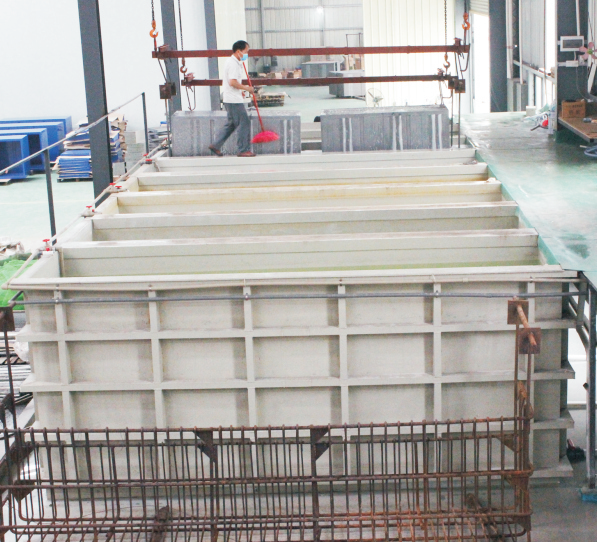
The Key Link in Industrial Spraying Production: Why Pretreatment Technology Matters
When manufacturers ask me what separates a consistently high-quality powder coating line from one that struggles with defects, coating failures, and customer complaints, my answer is always the same: pretreatment. Not the spray booth. Not the curing oven. Pretreatment.
I've spent years working with factories across different industries—cabinet makers, furniture producers, aluminum processors, metal fabricators—and I can tell you this with certainty: most coating problems that appear downstream actually start in the pretreatment stage. We've seen customers waste countless hours adjusting spray gun parameters, tweaking oven temperatures, and replacing powder batches, only to discover that the real culprit was inadequate surface preparation three steps earlier.
Pretreatment is the foundational step that directly determines powder coating quality and longevity. Poor pretreatment—such as incomplete degreasing, inadequate rust removal, or insufficient drying—leads to coating defects including poor adhesion, peeling, bubbling, and premature corrosion failure. Effective pretreatment involves degreasing to remove oils and contaminants, rust removal or chemical conversion, and thorough drying to create a surface chemically and physically prepared for powder adhesion. By controlling pretreatment parameters such as solution concentration, temperature, immersion time, and final rinse quality, manufacturers can eliminate the root causes of coating failures rather than troubleshooting problems downstream in the spray booth or curing stage.
This is why I've made it a core principle in how we design and support our electrostatic powder coating lines: get pretreatment right first, and everything that follows becomes manageable and consistent.
What Is Pretreatment and Why Is It the Critical Foundation for Spray Coating Quality?
Pretreatment is a series of chemical and mechanical processes designed to clean, condition, and prepare the metal surface before it enters the spray booth. Its job is deceptively simple-sounding but critically important: remove everything that shouldn't be there, and create conditions that make powder adhesion stronger and more durable.
In my experience working with real production floors, I've found that most people underestimate this stage. They think of it as just "washing the parts." But pretreatment is actually a controlled sequence of steps, each with specific chemical actions and timing requirements. Get any one of them wrong—the degreaser concentration, the water temperature, the immersion time, the rinse thoroughness, the drying completeness—and you'll pay for it later with coating failures that are hard to troubleshoot because they don't show up until the parts are in use or in the customer's hands.
From our perspective as equipment manufacturers, we know that the quality of what comes out of the pretreatment stage determines roughly 80% of the coating's final durability and appearance. The spray booth and curing oven can be perfectly tuned, but if the surface arrives at that point contaminated, damp, or improperly prepared, the entire coating system fails. This is why modern electrostatic powder coating lines integrate pretreatment as a core system component, not an afterthought.
![immersion pretreatment system]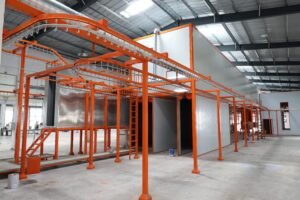
How Pretreatment Fits Into the Complete Industrial Spraying Workflow
To understand why pretreatment is called the "key link," you need to see it in the context of the complete workflow. It's not a standalone step—it's the bridge between raw material and the final coating.
Here's how the typical powder coating line flows:
Parts Arrival and Loading → Pretreatment System → Drying Station → Spray Booth → Curing Oven → Cooling and Unloading
What happens in pretreatment determines what reaches the spray booth. And what reaches the spray booth determines whether the electrostatic attraction works efficiently, whether the powder adheres uniformly, and whether the final cured layer will hold up to environmental stress, mechanical wear, or chemical exposure.
The pretreatment system itself typically consists of multiple stages working in sequence:
- Degreasing tank(s) – where alkaline solutions break down oils, cutting fluid, and organic contaminants
- Rinse tanks – where water removes the degreaser residue
- Acid treatment or rust removal – where chemical or mechanical methods remove oxidation and corrosion
- Conversion coating tank – where a protective chemical film forms on the bare metal
- Final rinse – where any remaining salts or chemicals are flushed away
- Drying station – where heat and air circulation remove residual moisture
Each stage has measurable parameters: solution pH and concentration, temperature, immersion time, water quality, and air flow. In a well-managed line, these are monitored continuously. In a poorly managed one, they drift, and coating defects follow.
From our work with cabinet makers, aluminum processors, and furniture manufacturers, we've learned that the pretreatment stage is where the biggest gains in consistency and quality happen. Not from buying a fancier spray gun. Not from upgrading the curing oven. From getting pretreatment right.
![spray rinse pretreatment]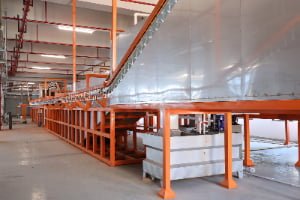
The Core Pretreatment Process: Degreasing, Surface Preparation, and Phosphating Explained
Let me walk through the three primary steps that matter most, because this is where I see the most variation between factories that succeed consistently and those that struggle.
Degreasing and Oil Removal
This is the first real chemical action in pretreatment, and it's non-negotiable. Metal parts come from machining, stamping, or forming operations carrying oils, cutting fluids, hydraulic residue, and handling oils. Some of these are heavy and obvious. Others are invisible molecular films that your eyes can't see but that will destroy coating adhesion.
The degreasing stage typically uses an alkaline cleaning solution. The parts are either immersed in heated tanks or sprayed with high-pressure degreaser jets. The alkaline chemistry breaks down the hydrocarbon bonds in oils, turning them into particles that can be rinsed away with water.
The critical variables here are:
- Concentration of the alkaline cleaner (usually measured as a ratio or in grams per liter)
- Temperature of the solution (warmer = faster chemical action, but also faster aging of the solution)
- Immersion or spray time (longer = more complete removal, but slower throughput)
- Agitation or flow (better circulation = more thorough contact with the surface)
Here's what I've learned from real production: most degreasing problems come from one of two mistakes. First, facilities reduce the degreaser concentration to save money, and then they wonder why coating adhesion is inconsistent. Second, they let the degreaser solution age too long without replacement, so the oil-removing capacity drops off, and contaminated rinse water starts being recycled back onto the parts.
A well-maintained degreaser tank should be monitored weekly. The concentration should be checked and adjusted. The solution should be replaced on a schedule, not just "when it looks dirty." This is a cost. But it's a cost that saves far more downstream.
Rust Removal and Surface Conditioning
Once the oils are gone, we deal with what's underneath: oxidation, rust, mill scale, and the results of storage conditions. If parts have been sitting on a shop floor for weeks or months, they'll have surface rust. If they came from a stamping operation, they might have mill scale. If they're aluminum, they'll have a natural oxide layer that, while protective in normal use, will interfere with powder adhesion if not chemically converted.
For steel and iron parts, this stage typically uses an acidic solution that chemically dissolves the oxide layer and converts it into a more stable form. For aluminum, the process is gentler—usually a conversion coating or a mild etch that prepares the surface without aggressively attacking the base metal.
The variables that matter:
- Acid type and concentration (ferric chloride, hydrochloric, or proprietary formulations have different reaction rates)
- Temperature (faster at higher temperatures, but risk of over-etching)
- Immersion time (long enough to dissolve rust, but not so long that it attacks the base metal)
- pH monitoring (as acid is consumed by the rust removal reaction, pH rises, and removal effectiveness drops)
From my experience with cabinet manufacturers and metal fabricators, the most common failure here is underestimating the amount of rust or mill scale. A part that looks relatively clean to the eye might still have a thin oxide layer that won't accept coating properly. This is why inspection and testing—even simple visual tests under magnification—matter.
Phosphating and Passivation
This is where pretreatment shifts from "cleaning" to "surface engineering." After the part is clean and the oxides are managed, we apply a conversion coating—typically zinc phosphate for steel parts, or a chromium-free alternative like zirconium or titanium conversion for aluminum and environmentally sensitive applications.
The conversion coating does something remarkable: it chemically bonds to the bare metal surface, forming a thin, crystalline layer that is more receptive to powder than bare metal alone. This layer also provides some built-in corrosion resistance, adding another layer of protection below the powder coating.
The chemical reaction is precisely calibrated:
- Solution concentration and pH must be within narrow ranges or the conversion layer doesn't form properly
- Immersion time needs to be long enough for the crystalline structure to develop
- Temperature affects the reaction rate and coating thickness
- Water hardness and purity can interfere with or enhance the conversion process
This is the stage where I see the most variation between well-managed lines and struggling ones. A high-quality phosphating process creates a visible, uniform coating—you can actually see the gray or tan conversion layer on the part if you look closely. A poor process leaves the surface dull or patchy, with inconsistent coverage. And I can tell you from experience: parts with patchy conversion coatings will develop patchy adhesion failures.
After the conversion coating, a final passivation or stabilization rinse locks in the chemistry and prevents hydration of the fresh conversion layer while it dries.
![flow-line pretreatment]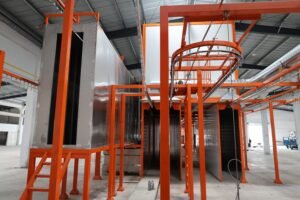
Why Pretreatment Quality Directly Determines Coating Adhesion and Durability
Let me explain the mechanics of why this matters. Powder coating adhesion depends on two things: electrostatic attraction during application, and chemical bonding during curing.
During the spray stage, the powder particles are charged and attracted to the grounded workpiece. But this is a temporary electrostatic hold. What makes it permanent is what happens during curing: the powder melts, flows, and the resin polymers cross-link, chemically bonding to the surface below.
That bond can only be as strong as the surface it's bonding to. If the surface is oily, the powder particles don't get close enough to the base metal for the curing process to create a strong bond. If the surface is wet, moisture gets trapped at the interface, creating a weak point where the coating will blister or peel. If the surface has a layer of loosely adherent oxide or rust, the coating is essentially bonding to something that isn't firmly attached to the workpiece itself.
This is why we see the pattern I mentioned earlier: coating failures that don't make sense based on spray parameters or oven temperature. The factory adjusts the spray gun voltage. They increase the dwell time in the oven. The failures continue. Why? Because the surface was never properly prepared in the first place.
From our work with real customers—cabinet makers in Algeria concerned about salt-fog corrosion, aluminum processors in India focused on coating thickness uniformity, furniture manufacturers in Turkey aiming for flawless outdoor durability—the most consistent finding is this: when coating adhesion fails, the root cause is pretreatment about 80% of the time. Not spray parameters. Not oven settings. Pretreatment.
This is why in our complete electrostatic powder coating line solutions, we give pretreatment system design the same engineering attention we give to the spray booth or curing oven. It's not secondary. It's foundational.
Common Coating Defects Caused by Inadequate Pretreatment and How to Identify Them
Let me map the defects we see most often back to the pretreatment stage, because this diagnostic chain is exactly how we help customers fix recurring problems.
| Coating Defect | Most Likely Pretreatment Cause | How to Diagnose |
|---|---|---|
| Poor adhesion / easy peeling | Incomplete degreasing; residual oils on surface | Parts feel oily even after rinse; adhesion test shows coating lifts easily; defects are random/scattered |
| Blistering or bubbling | Inadequate drying; residual moisture at interface | Defects appear as small bubbles; concentrated in recesses or hard-to-dry areas; increases in humid conditions |
| Salt-fog corrosion starts early | Weak or incomplete conversion coating; residual salts | Rust appears under coating within weeks of exposure; concentrated at edges or weld seams |
| Uneven coating thickness | Inconsistent surface preparation; patchy conversion layer | Thickness varies significantly across single part; some areas glossy, others dull |
| Coating flakes or powders after cure | Surface contamination after drying; recontamination before spray | Occurs in spots or localized areas; not across entire part |
| Color variation or mottling | Inconsistent surface conductivity due to poor conversion layer | Visual pattern follows material surface features or previous defect patterns |
The diagnostic principle is simple: if the defect is localized, random, or inconsistent, pretreatment is the likely culprit. If it's uniform across all parts in a batch, the problem is usually downstream (spray parameters, oven settings, powder batch).
From my experience, the fastest way to confirm pretreatment is the issue is to pull a part mid-production, let it air-dry (without spray), and inspect the surface carefully. Look for oily residue, water droplet patterns, or dull/patchy areas that suggest conversion coating failure. These visual cues tell the story.
Key Variables in Pretreatment Control: Temperature, Concentration, Immersion Time, and Drying Quality
To wrap up the technical side, let me isolate the four variables that, in my years working with production lines, have the most impact on consistency.
Temperature – Affects reaction rate for every chemical stage. Warmer degreaser = faster oil removal. Warmer acid stage = faster rust removal. Warmer conversion bath = faster layer formation. The catch: too warm, and the chemistry accelerates beyond control, and solution aging speeds up. We typically recommend monitoring and controlling temperature within ±5°C for critical stages.
Concentration – This is where I see the most cost-cutting go wrong. The degreaser concentration, acid concentration, and conversion coating concentration are all titrated to specific levels. When facilities reduce concentration to stretch the solution longer or reduce chemical costs, the chemistry doesn't work as designed. Parts look clean but aren't. Conversion layers are thin or incomplete. Adhesion failures follow. We always recommend regular concentration checks—weekly for busy lines—and strict adherence to supplier specifications.
Immersion Time – This is the balance between thoroughness and throughput. Too short, and the chemistry doesn't complete. Too long, and you're slowing the line without additional benefit (and potentially over-etching in the acid stage). The right time depends on part size, contamination level, and solution condition. This is why we design pretreatment systems with timing flexibility—different part types might need different dwell times in different tanks.
Drying Quality – This is the final frontier, and it's where many lines fail. A part can pass through perfect degreasing, rust removal, and conversion coating, but if it arrives at the spray booth with water droplets, dust, or residual moisture, adhesion suffers. We recommend drying stations with both heating (typically 60–80°C) and active air circulation. The goal is a completely dry surface—no visible moisture, no dampness to touch. In humid climates or high-volume operations, this might need additional drying capacity.
The table below summarizes typical parameter ranges for an industrial powder coating pretreatment system:
| Process Stage | Temperature (°C) | Time (sec–min) | Typical pH or Concentration | Key Monitoring Point |
|---|---|---|---|---|
| Degreasing | 50–65 | 2–5 min | Alkalinity check weekly | Solution concentration; odor/overflow |
| Rinse 1 | Ambient | 30–60 sec | — | Water cleanliness; rinse thoroughness |
| Acid/Rust Removal | 20–40 | 1–3 min | pH 0.5–2.5 | Visible oxide dissolution; no over-etching |
| Conversion Coating | 30–50 | 1–3 min | Solution gravity/pH | Uniform gray/tan film appearance |
| Final Rinse | Ambient | 30–60 sec | Deionized if possible | Water quality; no residual salts |
| Drying | 60–80 | 2–5 min | — | Complete surface dryness; no moisture |
From our work designing and commissioning pretreatment systems for customers, we've found that the factories with the most consistent coating quality are the ones that treat these parameters as process controls, not just "settings."
![pretreatment system]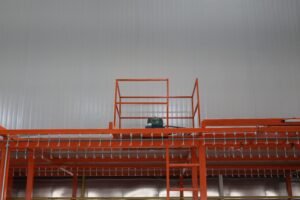
Special Considerations for Powder Coating: Why Pretreatment Is Even More Critical
Powder coating has specific pretreatment requirements that differ from traditional liquid spray or plating operations. Understanding these differences is essential because powder coating adhesion is less forgiving of surface imperfections than some other coating methods.
First, powder coating relies entirely on electrostatic attraction and subsequent thermal bonding. There's no solvating action (like with liquid paint) that can partially "wet" and bond around minor surface imperfections. The powder particles must make direct contact with a clean, dry, properly prepared surface. Any film—oil, water, or loose oxide—breaks that contact and breaks the adhesion chain.
Second, the powder particle size is much larger than liquid paint particles. This means powder is less able to flow into microscopic imperfections or compensate for surface irregularities. What this means practically: pretreatment surface quality matters more for powder than for paint.
Third, powder coating cure is a chemical cross-linking process that requires the resin to contact the base material directly. Moisture or contaminants at the interface don't just reduce adhesion—they actually interfere with the cross-linking reaction itself. This is why we see coating adhesion failures with powder that cured properly (the oven temperature was right, the time was right), but the surface wasn't right.
From my perspective working with customers across different coating types, this is why I always emphasize: powder coating pretreatment is not optional. It's not "nice to have." It's essential. The spray parameters and oven can be forgiven some variation. Pretreatment cannot.
Additionally, for powder coating lines serving demanding markets—outdoor furniture requiring salt-fog durability, cabinet makers shipping to corrosion-prone environments, aluminum processors in humid regions—the conversion coating stage becomes even more critical. A high-quality conversion layer adds 500+ hours of salt-fog protection before corrosion begins. A poor one might add only 100 hours. That's the difference between customer satisfaction and warranty claims.
This is also why, when we design electrostatic powder coating lines for customers in different regions, we customize the pretreatment system. A line for aluminum processors in India might emphasize zirconium conversion coatings to meet local environmental standards and achieve specific durability targets. A line for cabinet manufacturers in Algeria might emphasize heavy-duty phosphating and add an extra rinse stage to ensure salt removal. A line for furniture in Turkey might include additional drying capacity for high-humidity conditions.
The pretreatment system isn't generic. It's part of the integrated solution.
Conclusion: Why Getting Pretreatment Right Pays Long-Term Dividends
Let me bring this back to the practical reality we see in factories: pretreatment is where quality is built, not where it's compromised by cost-cutting, rushed timing, or inadequate monitoring.
From our years working with cabinet makers, furniture manufacturers, aluminum processors, and metal fabricators across multiple continents, the pattern is consistent. Factories that invest in pretreatment—proper chemical management, parameter monitoring, regular maintenance, and equipment investment—don't struggle with coating defects. Factories that treat pretreatment as a cost center to minimize struggle constantly.
The coating failures we see aren't spray booth mysteries or oven temperature problems. They're pretreatment failures that show up downstream, making them hard to diagnose. This is why the best coating lines treat pretreatment as the foundation, the spray booth as the execution, and the oven as the finalization. All three matter. But pretreatment matters most.
If you're currently experiencing recurring adhesion issues, salt-fog corrosion concerns, or inconsistent coating quality, my first recommendation is always the same: audit your pretreatment system. Check the chemical concentrations. Monitor the temperatures. Verify the immersion times. Inspect the drying effectiveness. More often than not, that's where you'll find the answer.
From our experience designing and supporting complete electrostatic powder coating lines, we've learned that a well-engineered pretreatment system is the single best investment you can make in coating quality. It pays dividends in fewer defects, faster throughput, better adhesion, longer durability, and ultimately, satisfied customers.
If you're evaluating or upgrading an electrostatic powder coating line, or if you're struggling with coating quality and looking for where to start, let's talk about pretreatment. We can help you audit your current system, identify bottlenecks, and design improvements tailored to your specific products and production goals. Contact us at WhatsApp +8618064668879 or email ketumachinery@gmail.com to discuss your coating challenges.
 English
  German
  Vietnamese
  French