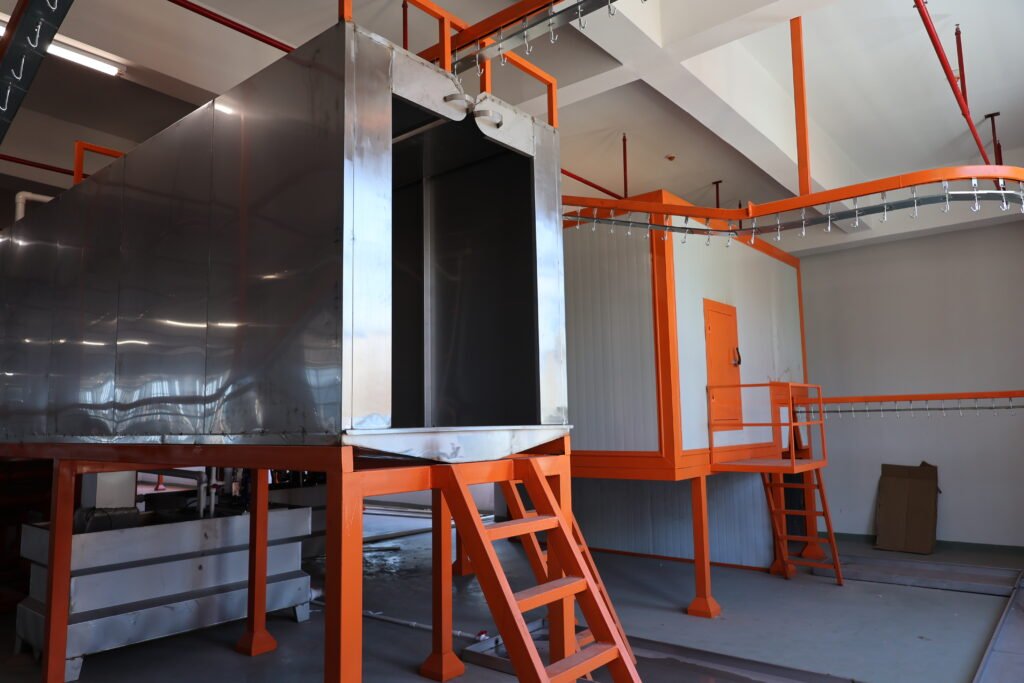
I often see people describe a powder coating line as “spray then bake.” Then they wonder why film thickness drifts, appearance changes, adhesion fails, and rework explodes. I also see shops miss delivery because takt time changes every time the operator changes.
A powder coating line process is a system that reduces quality variation, takt variation, and rework variation by locking the key variables at each stage: racking/grounding, pretreatment consistency, dry-off stability, booth airflow and powder circulation, part-temperature curing, and careful handling after cure.
From our factory view at Ketu, the sequence looks simple. But each section has a few “make-or-break variables.” If those variables are not locked, the line will still run, but you will see unstable appearance, drifting thickness, unstable adhesion, high rework, and delivery chaos. I explain the process below in a way you can actually use on a shop floor.
What Is the Powder Coating Process Step by Step?
I see many “step-by-step” lists that are correct but not useful. They do not tell you what to control. So I list the steps and the control variables together, because that is how you keep results stable.
Step by step, the powder coating process is: racking and grounding → pretreatment/cleaning → rinsing → dry-off → powder application in the booth → recovery and dust control → curing by part temperature → cooling → un-racking and packing → inspection and records.
The “process with controls” map I use
| Step | What happens | The key variable I lock | What goes wrong if I don’t |
|---|---|---|---|
| 1. Racking | hang parts on fixtures | hanger contact + hanging points | thin edges, bare spots, drops |
| 2. Pretreatment | remove oil/rust + create base | cleanliness consistency | fisheyes, poor adhesion |
| 3. Rinse | remove carryover | water quality + flow | stains, residue, defects |
| 4. Dry-off | remove moisture | “dry everywhere,” not “hot” | pinholes, bubbles |
| 5. Spray | apply powder | grounding + airflow + gun stability | orange peel, thin corners |
| 6. Recovery | reclaim powder + control dust | stable recovery + low dead zones | contamination, powder waste |
| 7. Cure | melt + crosslink | part temp curve + effective time | under/over cure, yellowing |
| 8. Cool | protect finish before touch | handling timing | scratches, dents |
| 9. Pack | protect finished parts | packaging standard | “last-step damage” claims |
| 10. Inspect + record | keep traceability | thickness + cure + defects log | “cannot repeat good batch” |
This is the real difference between “a line that runs” and “a line that ships good parts every day.”
The first hidden truth: racking comes before everything
If racking is wrong, every later step becomes unstable. I treat racking and grounding as the master switch. I do not tune guns first.
What Is a Powder Coat Line?
Many people call a booth and an oven a “powder coat line.” For production stability, that definition is too small. A real line is a repeatable flow system with utilities, controls, and acceptance rules.
A powder coat line is a connected production system that moves parts through surface preparation, drying, powder application, curing, and handling in a controlled way, so quality and takt time stay repeatable across batches and operators.
When I design or audit a powder coat line, I do not only look at equipment. I look at whether the line can “repeat.” Repeat means the same quality with different operators, different days, and different part mixes. That repeatability comes from locked interfaces and locked process windows.
The “line goal” I use in real projects
I judge a line by three stability targets:
- Quality stability: thickness and appearance stay inside spec
- Process stability: pretreatment, airflow, recovery, cure curve stay stable
- Delivery stability: takt time stays predictable with your real product mix
If any one fails, the line becomes a rework machine.
The five “variation cages” inside a good line
These are the five cages I build:
1) racking/grounding cage
2) pretreatment consistency cage
3) dry-off stability cage
4) booth airflow + recovery cage
5) cure curve cage (by part temperature)
If you only buy machines without building these cages, you will still fight variation.
What Are Powder Lines?
People use “powder lines” to mean different system types. In my factory language, “powder lines” are the ways you arrange equipment and material flow to match your production reality.
Powder lines are the different system layouts used to run powder coating, such as batch setups, semi-automatic conveyor lines, and fully automatic lines, and the right choice depends on mix, throughput, and color-change frequency.
Fabricators often run high-mix, small batches, and frequent inserts. That changes what “best” means. The best system is not always the most automatic. The best system is the one that keeps switching fast and keeps the process window stable.
The main powder line types and what they trade
| Line type | What it is | What it is good at | The weak point I watch |
|---|---|---|---|
| Batch | booth + oven, manual handling | max flexibility, low capex | operator variation, slow takt |
| Semi-auto | conveyor flow, manual loading | stable flow + flexibility | racking speed + changeover |
| Full-auto | high automation, continuous flow | high throughput, consistency | changeover design, scheduling |
If your shop changes color often, I focus on booth clean-out, recovery design, and SOP discipline. If those are weak, a “faster line” becomes slower in reality.
Why hangers and grounding decide the true line type
Two factories can both say “semi-auto.” One can produce stable quality. The other can fight thin corners all day. The difference is often the hanger system:
- stable contact points
- stable grounding path
- fast loading without drops
- no shadowing on key faces
This is why I call racking the invisible master switch.
What Is the 7 Tank Process for Powder Coating?
Many buyers hear “7 tank” and think it is a fixed recipe. In reality, the exact chemistry can vary, but the logic is stable: clean, rinse, condition, convert, rinse, and protect, then dry. The point is not “more tanks.” The point is “consistency.”
The 7 tank process is a common pretreatment sequence that typically includes degreasing, rinsing, conditioning, conversion coating, rinsing, and final sealing or passivation steps before dry-off, to build consistent adhesion and corrosion resistance.
A common 7-tank flow (one practical version)
| Tank # | Stage | Purpose | The variable I lock |
|---|---|---|---|
| 1 | Degrease | remove oil/soil | concentration + temp + time |
| 2 | Rinse 1 | remove cleaner carryover | flow + overflow |
| 3 | Rinse 2 / desmut (as needed) | stabilize surface | water quality |
| 4 | Condition | improve conversion uniformity | dosing stability |
| 5 | Conversion coat | build adhesion/corrosion layer | pH + temp + control routine |
| 6 | Rinse / DI rinse | reduce residue | conductivity target |
| 7 | Seal / passivation (optional) | improve corrosion | chemistry stability |
Then comes dry-off. I do not treat dry-off as optional. Water trapped in seams and tubes becomes defects later.
What “consistency” means in pretreatment
If you only chase “looks clean,” you will still drift. Consistency means:
- the same bath control routine
- the same nozzle coverage
- the same rinse quality
- the same dwell time and temperature
- the same daily records
If pretreatment is not consistent, your line will have a low ceiling. You can spray perfectly and still fail adhesion or corrosion targets.
The “process cage” view of a 7-tank line
I treat the 7-tank line as a way to lock variability:
- remove oil consistently
- remove carryover consistently
- build conversion layer consistently
- avoid residue consistently
This is why pretreatment decides rework rate more than any other module.
Conclusion
A powder coating line process is not just linking machines. It is locking the key variables at each stage—pretreatment consistency, racking and grounding, cure curve by part temperature, recovery and changeover, and post-cure handling—so quality and takt stay repeatable.
 English
  German
  Vietnamese
  French