Many people call it “powder coat paint,” so they assume it works like liquid paint. Then they set up a booth and an oven and still fight defects, slow output, and inconsistent finish. The problem is not the powder. The problem is that coating needs a controlled flow, not a one-off action.
A powder coat paint line (more commonly called a powder coating line) is a production system that applies dry powder to parts using electrostatic spray, then cures it in an oven so the powder melts and crosslinks into a durable protective film.
In factory terms, the “line” matters because it turns coating into a repeatable process. It fixes timing, airflow, grounding, and curing conditions so different shifts can produce the same result.
What Is a Powder Coat Line?
Some shops think a powder coat line is only a spray booth and a curing oven. That can work for basic jobs. But a true powder coat line includes the steps that control adhesion, appearance, and repeatability.
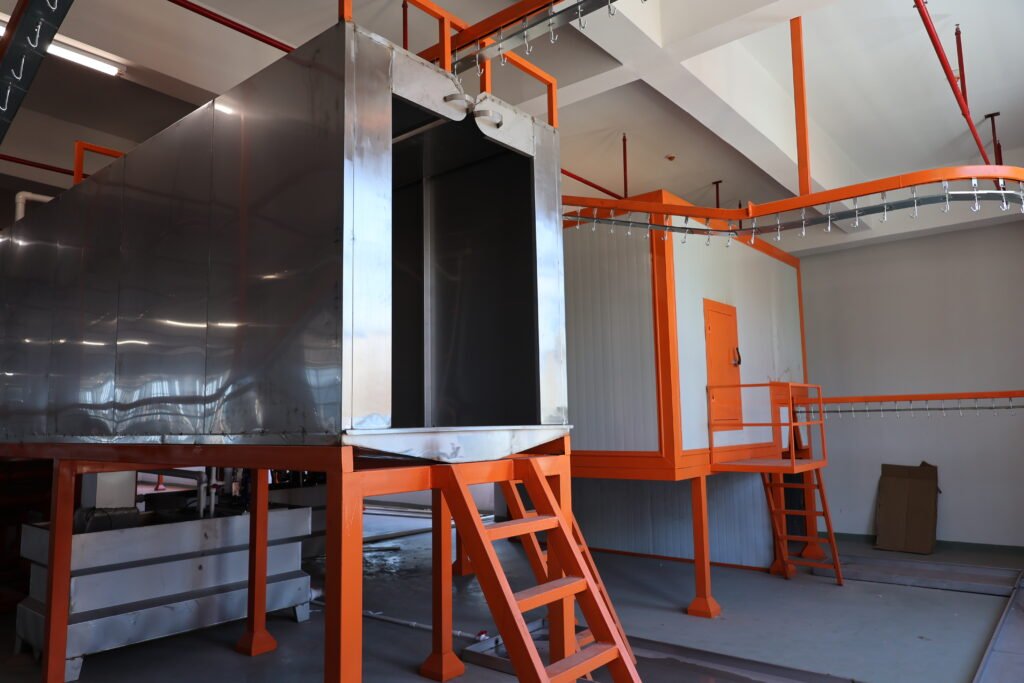
A powder coat line is a connected setup that moves parts through surface preparation, dry-off, powder application, powder recovery, curing, and handling, while controlling time, temperature, airflow, and grounding.
A typical powder coat line includes
- Loading and hanging (racks, jigs, or a conveyor)
- Pretreatment (degrease, rinses, conversion coating like phosphate or zirconium when needed)
- Dry-off oven (remove water before spraying)
- Powder spray booth (manual or automatic) + recovery/filtration
- Curing oven (melt + flow + cure)
- Cooling, unloading, inspection, packaging
| What the line is trying to lock | Process area | What must stay stable | What happens when it drifts |
|---|---|---|---|
| Pretreatment | surface condition consistency | adhesion failures, corrosion risk | |
| Dry-off | no trapped water | pinholes, bubbles | |
| Grounding/racking | stable electrical path | thin edges, poor wrap, rough finish | |
| Booth airflow | stable negative pressure | dust, contamination, powder loss | |
| Cure | part temperature + time | under-cure or over-cure |
This is why a “line” is more than equipment. It is a control system.
What Are Powder Lines?
“Powder lines” is a broad term. It usually means different production system types used to coat parts with powder. The best type depends on how your orders look in real life.
Powder lines are the different line types used for powder coating production, such as batch lines, semi-automatic conveyor lines, and fully automatic lines, and each type balances flexibility, consistency, and unit cost differently.
| Common powder line types | Line type | Best for | The advantage | The common risk |
|---|---|---|---|---|
| Batch line (rack/cart + booth + batch oven) | many SKUs, small lots | flexible and easy inserts | variation if SOP is weak | |
| Semi-automatic line (conveyor + stable flow) | mixed production | steadier takt and cleaner layout | bottleneck at loading/racking | |
| Automatic line (reciprocators/robots) | few SKUs, high volume | best consistency and unit cost at scale | idle time if orders are unstable |
If you coat many colors and do frequent inserts, layout and changeover design often matter more than “more automation.”
What Is a Coating Line?
A coating line is the bigger category. Powder coating is one type of coating line. The concept is the same: prepare the surface, apply the coating, then set it by drying or curing.
A coating line is a production system that prepares a surface, applies a coating material, and then sets it by drying or curing, using controlled movement, utilities, and inspection so results repeat.
Powder coating lines are different from many liquid paint lines because powder is applied as a dry solid and then cured by heat, and many systems can recover overspray to reduce material loss.
What Is a Powder Coat of Paint?
People say “powder coat of paint” because the finished surface looks like paint. But technically it is not liquid paint. It is dry powder that forms a film only after curing.
A powder coat is a dry powder finish that is electrostatically deposited on a part and then heated so it melts, flows, and cures into a continuous protective coating.
| What makes powder coating different from liquid paint | Item | Powder coating | Liquid paint |
|---|---|---|---|
| Material form | dry powder | wet liquid | |
| How it sticks before cure | electrostatic attraction | wetting and solvent/water | |
| How it becomes a film | heat melts and cures | dries by evaporation, then may cure | |
| Common stability driver | grounding + cure window | viscosity + flash/dry control |
In real production, both can work. Powder is often chosen for durability, consistency, and shop control when the process is designed well.
Conclusion
A powder coat paint line is a controlled production system that prepares the surface, sprays powder by electrostatics, and cures it by heat, so factories can deliver consistent quality with less rework and a more predictable unit cost.
 English
  German
  Vietnamese
  French