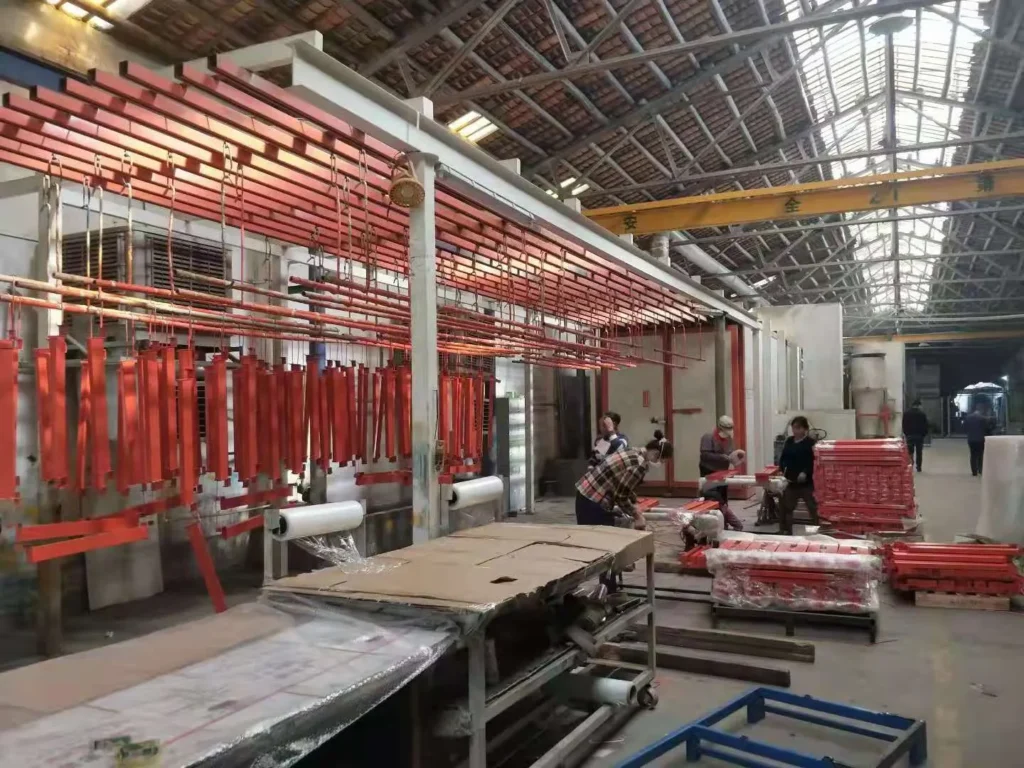
How to Select the Right Configuration for Electrostatic Spray Equipment: Equipment vs. Spray Line
When you're looking to upgrade your coating capabilities, the decision between a standalone spray cabinet and an integrated spray line feels straightforward on the surface. But from years of working with manufacturers in cabinet production, aluminum extrusions, and outdoor furniture, I've learned that this choice is far more nuanced—and the wrong call can cost you significantly in both quality and operating expense.
The real answer isn't "which is better," but rather "which matches your actual production reality." Your daily output, the consistency you need, your factory layout, your long-term growth plans, and your willingness to invest in proper pre-treatment and air supply all determine whether you should be looking at a single spray station or committing to a complete line.
Let me walk you through the decision framework we use with our customers, the critical parameters that actually matter, and the configuration mistakes we see factories repeat over and over.
What is Electrostatic Spray Equipment Configuration and Why Does It Matter for Your Production?
At its core, electrostatic spray equipment configuration means the specific combination of spray cabinets, pre-treatment systems, curing ovens, powder recovery units, and conveyor systems you choose to deploy. It's not just about selecting one spray gun or one oven—it's about ensuring every module works together to achieve your target coating quality consistently, shift after shift.
From our perspective, the configuration you select determines three outcomes: first, whether your coating meets your quality standards; second, whether you can sustain your target production rate without bottlenecks; and third, what your true cost per piece actually is when you factor in powder waste, energy consumption, and labor.
Most factories think about spray equipment in isolation. They ask, "Can this spray gun apply powder?" But the question they should ask is, "Can this gun, combined with my pre-treatment, my curing system, my powder recovery, and my operator skill, consistently produce coatings that won't fail in the field or be rejected by my customer?"
This distinction matters because we've seen factories invest in high-end spray guns only to waste 30% more powder and produce parts with attachment failures because their pre-treatment was inconsistent. We've also seen factories buy expensive curing ovens that run half-empty because their spray rate doesn't match the oven throughput. These are configuration failures, not equipment failures.
![powder coating line in factory]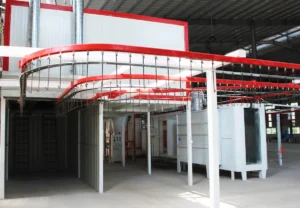
Single Equipment vs. Spray Line: When Should You Choose Each?
Key Differences in Production Capacity, Consistency, and Space Requirements
Here's the practical reality: a standalone spray cabinet is not simply a "smaller" spray line. It's a fundamentally different approach to manufacturing.
A single spray cabinet—what we often call a manual or semi-automated spray station—is designed for flexibility and lower capital investment. You manually move the workpiece in front of the spray gun, apply powder (either by hand or with a simple reciprocating mechanism), then move the part to a separate curing oven. Color changes are fast because you're only rinsing out one spray head. Space requirements are minimal. If you need to spray a different size part tomorrow, you just adjust your handling procedure.
But here's what you're trading: consistency, throughput, and true cost control. When I walk into a factory relying on manual spray cabinets for their primary production, I see wide variation in coating thickness, occasional missed areas where the operator's angle wasn't perfect, and a consistent problem with adhesion on complex-shaped parts because the pre-treatment condition varies between batches. The operator's fatigue by hour 7 of the shift shows in the coating quality.
An integrated spray line—which is what we design for most of our customers—is a choreographed system. Workpieces move on a continuous or indexed conveyor. Pre-treatment, spray, curing, and cooling all happen in sequence at consistent intervals. Spray guns are often automated or semi-automated, ensuring uniform spray patterns. Powder recovery is integrated, not bolted on. The curing oven is sized to match your spray rate, not oversized or undersized.
The investment is higher. The space requirement is longer. But here's what you gain: consistent coating thickness (±25 microns is achievable instead of ±50), virtually zero missed spray areas, 8-10% better powder utilization because overspray is recovered consistently, and operator skill becomes much less critical to your quality outcome.
From our experience, a spray line also handles color changes more thoughtfully. Instead of flushing powder everywhere, modern systems use secondary recovery cabinets that capture 90%+ of the color transition powder, reducing waste and downtime to 20-30 minutes instead of 45-60 minutes.
How to Determine Your Production Volume Threshold for Upgrading to a Line
The break-even point isn't a simple calculation, but here's the framework we use:
If you're running fewer than 300-400 pieces per week of similar products (same material, similar size, similar color families), a high-quality single spray cabinet may be sufficient. You get lower capital cost and operational simplicity.
Once you exceed 500-800 pieces per week, or if you're running the same product family continuously, a spray line becomes economically rational. The powder waste reduction alone typically pays back 15-20% of the line cost annually. Add in the labor efficiency (one operator can supervise a line instead of manning a cabinet all day) and consistency benefits (fewer rejects, fewer touch-ups), and the payback is usually 2-3 years.
But the real decision point isn't just volume—it's consistency requirement and product value. If you're coating high-value aluminum profiles for architectural applications, where surface defects are visible and attachment failures result in warranty claims, you need a line even at 300 pieces/week. If you're coating utility metal boxes where some surface variation is acceptable, you might stay with a cabinet at 600 pieces/week.
I always ask our customers three questions:
First: Can your current process consistently meet your customer's visual and performance specs? If you're already struggling with adhesion issues, color uniformity, or defect rates above 3-5%, the root cause is often configuration-level, not operator error. A spray line fixes this.
Second: What is the cost of quality failures? We once worked with a furniture manufacturer coating outdoor frames. Their manual spray cabinet was producing 8% adhesion failures, which they'd discover during assembly. The scrap cost and rework labor exceeded $0.50 per part. They moved to a spray line, reduced failures to 0.5%, and the line paid for itself in 18 months just from scrap reduction.
Third: What's your growth trajectory? If you're planning to double your production in the next 18-24 months, invest in a line now. The cost per unit on a line scales downward as you increase volume, while a single cabinet's inefficiency becomes more painful.
![metal cabinet powder coating process]
Core Parameters That Determine Spray Quality and How to Interpret Them
Here's where most procurement teams go wrong. They read spec sheets and see numbers like "80 kV" or "20 microns" and assume they're comparing apples to apples. They're not.
Spray Gun Specifications, Voltage, and Powder Feed Rate
A spray gun's capability depends on four interdependent variables: electrostatic voltage (typically 60-90 kV), powder feed rate (measured in grams per second), spray distance (typically 150-300 mm), and gun angle relative to the workpiece.
Voltage controls the electrical field that attracts powder to the workpiece. Too low, and powder won't transfer efficiently—you'll get thin, patchy coatings. Too high, and you risk "overshoot," where powder bounces off the workpiece rather than adhering. We typically see 70-80 kV as the sweet spot for most applications, but complex-shaped parts (think cabinets with recesses) may need 60-65 kV to prevent the "Faraday cage effect"—where internal corners don't receive adequate powder because the field can't penetrate.
Powder feed rate is where I see the most confusion. A gun that feeds 150 grams per second sounds impressive, but if your conveyor speed means the workpiece only passes the gun for 8 seconds, you're applying 1,200 grams of powder per part. If your target dry film thickness is 80 microns (a typical spec for outdoor furniture), and your workpiece is, say, 2 square meters, you might only need 200-300 grams. The extra 900 grams is waste, and it's not going into the part—it's overspray.
What matters is the combination of feed rate and dwell time. We calculate this as powder applied per unit area per unit time, then cross-check against your target film thickness and density. For a metal cabinet, we typically aim for 1.5-2.5 grams per square decimeter to achieve 80-120 microns of cured film.
Spray distance and angle are where most operators cause problems. We recommend 200-250 mm for most industrial parts, but this varies by gun type and powder. Too close (under 150 mm) and you get "orange peel" texture, heavy buildup at the spray point, and poor flow-out. Too far (over 350 mm) and transfer efficiency drops sharply—powder reaches the part with lower velocity and charge, adhesion suffers, and powder utilization drops to 60-70%.
Angle matters because a perpendicular approach covers the surface most efficiently, but complex geometries require 30-45 degree angles to reach recesses. Modern automatic spray systems adjust angle in real-time; manual systems rely on operator discipline.
Temperature Control and Curing System Settings
This is where most quality problems originate, and it's rarely discussed in configuration conversations.
A typical thermoset powder requires a specific cure schedule: a peak metal temperature (PMT) of 170-200°C, held for 10-20 minutes depending on film thickness and powder chemistry. The actual requirement is workpiece temperature, not oven air temperature.
Here's what we see go wrong: A factory installs a 200°C oven, assumes everything at 200°C is "done," and then ships parts with poor adhesion or low hardness. The problem is usually one of these:
First, uneven temperature distribution in the oven. Thick metal parts heat slowly and cool unevenly. A cabinet with 3 mm steel takes 8-10 minutes to reach PMT, while thin aluminum foil reaches temperature in 2 minutes. If your conveyor speed assumes 10 minutes uniform heating, thin parts are over-cured (brittle) and thick parts are under-cured (soft).
Second, poor understanding of the time-temperature curve. Powder doesn't cure linearly. It requires a specific minimum temperature for cross-linking to initiate. Below 160°C, essentially nothing happens. At 180°C, the reaction accelerates. At 220°C, the powder may become over-cured, losing gloss or flexibility. We recommend using thermocouples or thermal imaging to measure actual part temperature, not just air temperature.
Third, conveyor speed mismatch. If your conveyor moves at 2 meters/minute, and your oven is 4 meters long, dwell time is 2 minutes. Most powders need 10-15 minutes. You'd need a 20-30 meter oven, which is impractical. The solution is either a slower line speed (more dwell time per part) or a more compact oven with recirculating air and higher temperature (faster cure).
We always specify the curing system based on your line speed and part thermal mass. An aluminum profile heats and cures faster than a steel cabinet, so we might recommend 180°C and 12 minutes for aluminum, but 200°C and 15 minutes for steel.
Air Supply Quality and Pressure Stability
This is the silent killer of powder coating quality, and I've never seen it listed as a "configuration parameter" in any vendor's proposal.
Compressed air in electrostatic spray systems is used for four things: atomizing the powder (breaking it into fine droplets), creating the electrical field around the spray head, propelling powder through the supply hose, and pulsing the guns during color changes.
If your air is wet, oily, or contains particulates, your coating fails. Wet air causes pinholes and craw-back defects. Oily air causes adhesion failure. Particulates cause surface roughness.
Proper air supply requires three stages: a refrigerated dryer (bringing dew point to –20°C or lower), an oil removal filter, and particle filters (5 microns). Many factories skip the dryer because "the air compressor already dries the air." It doesn't. A standard rotary screw compressor produces saturated air at 35-40°C. Your hose may cool it to ambient (25°C), but that's still near 100% relative humidity. You need active drying.
Second, pressure stability matters. Spray guns require 4-6 bar, and pressure fluctuation of more than ±0.2 bar causes variation in powder feed rate and transfer efficiency. We've seen factories with marginal compressors (undersized for their line) experience pressure drop during color changes, resulting in inconsistent coating thickness between parts.
The configuration decision here is simple: budget for a proper compressed air system as part of your spray line cost. A 30 kW line might require a 15 kW air compressor with a refrigerated dryer. Many factories try to save money by using an existing "shop air" compressor and then wonder why they can't get consistent results.
Matching Equipment Configuration to Your Product Type and Industry
The same spray line configuration that works beautifully for aluminum extrusions will produce mediocre results on cabinet bodies, and vice versa. This is where we see the biggest procurement mistakes.
Configuration Priorities for Cabinet and Metal Box Production
Cabinets and switchgear enclosures have specific demands: consistent attachment across complex geometries, durability in corrosive environments, and zero visible defects (because the cabinet faces are in plain sight).
For this application, pre-treatment is non-negotiable. Switchgear often comes from stamping and welding processes that leave oil residue and iron oxide. A thorough pre-treatment (degreasing + phosphating) is the foundation of long-term adhesion. We typically specify a 3-5 station immersion-style pre-treatment line.
Spray configuration needs to account for internal geometry. Cabinet bodies have recesses, edges, and corners where the Faraday cage effect is worst. We use multiple spray guns with different angles rather than a single automated gun. For a large cabinet line, we might deploy 3-4 guns: one for face coverage, one or two at 45° angles for edges, and one for reverse-side or internal access.
Powder recovery is critical here because cabinets are often painted in single colors (black, gray, white, RAL colors), and color changeovers happen only weekly. High recovery efficiency (90%+) means you recycle premium powder at good quality. We use a two-stage recovery system: a primary large cyclone for immediate recovery, then a secondary fine filter for ultra-fine powder.
Curing ovens for cabinet work should ensure uniform heating to avoid thermal stress. We specify 200-220°C for 12-15 minutes, with attention to air circulation ensuring parts in the center of the conveyor reach the same temperature as parts on the edges.
Configuration Priorities for Aluminum Profile and Extrusion
Aluminum is fundamentally different. No pre-treatment beyond cleaning. Aluminum oxidizes instantly and forms a passive layer; phosphating is unnecessary and can interfere with paint adhesion. We use a simple alkaline cleaner and rinse (3 tanks total).
Transfer efficiency matters more here because aluminum profiles often have large surface areas and complex cross-sections (hollow cores, ribbed surfaces). A single spray gun can't reach internal channels effectively. We use reciprocating guns (guns that move back and forth) rather than fixed guns, allowing the nozzle to reach into recesses.
Temperature control is more critical. Aluminum conducts heat differently than steel—it heats faster but can also experience thermal shock if moved from 180°C directly to ambient. We specify 170-180°C for aluminum cures (lower than steel) and include a gradual cool-down zone before parts exit the oven.
Powder recovery is critical because aluminum profile customers often run multiple colors per shift (window frames in white, brown, and gray, for example). Fast color changes and high recovery minimize changeover time and cost. We often use filter-based secondary recovery rather than cyclones, as filters capture ultra-fine powder better.
One often-missed detail: conveyor loading design. Profiles must be supported to prevent bending under their own weight during the hot cure phase. We design custom profile racks that distribute load across the part length, not just at the ends.
Configuration Priorities for Furniture and Wooden Products
Furniture is the most forgiving and the most demanding simultaneously. Forgiving because surface-level defects are often hidden by assembly or upholstery. Demanding because outdoor furniture experiences harsh environments, and adhesion failure means customer dissatisfaction.
For furniture, we prioritize coating finish appearance over durability, which means curing and flow-out become critical. We specify slightly lower PMT (170-180°C) and longer dwell time (15-20 minutes) to allow the powder to flow and meld into a glossy, smooth surface rather than locking in texture.
Pre-treatment is lighter than cabinet work but still essential. We use two-stage degreasing and rinse, skipping phosphate because wood-based components may be present.
Spray coverage needs to account for complex shapes and joints. A dining chair has spindles, curved backs, and seat-rail joints where powder can pool or miss entirely. We use multiple lower-power guns rather than one high-power gun, allowing better access to detail areas without over-applying powder.
Powder recovery is less critical for furniture lines because customers often accept occasional color blending (residual powder from the previous color mixing with the current color, creating slight color variation). This means we often spec single-stage cyclone recovery rather than two-stage, reducing cost while maintaining 85-90% recovery.
The curing oven design for furniture often includes humidity control. Wood-based components in furniture can absorb moisture from the air, causing dimensional changes that may crack freshly-cured coatings. We add a drying phase (low humidity, 60-70°C for 5-10 minutes) before the main cure to remove ambient moisture.
![aluminum profile surface finishing]
Calculating Your Equipment Needs: From Daily Output to Actual Specifications
This is where configuration becomes concrete. Most procurement teams start with "we need 500 pieces per day" and then shop for equipment. That's backwards.
How to Convert Production Requirements into Machine Specifications
Let's work through an example: You manufacture metal electrical boxes. Specifications are 300 mm × 200 mm × 100 mm (steel), painted black, throughput target 1,000 pieces per day.
Step 1: Establish your actual working hours.
If you run one 8-hour shift, that's 28,800 seconds per shift. 1,000 pieces means one piece every 28.8 seconds.
But you're not spraying continuously. You have:
- Setup time (morning cleaning, air bleed-down, gun checks): 30 minutes
- Color changes (for the next run, not today): assume 30 minutes mid-shift
- Actual spray time: 7 hours = 25,200 seconds
- Actual pieces in 7 hours: 1,000 pieces
Realistic available time per piece: 25.2 seconds.
Step 2: Determine your spray dwell time.
For a 300 × 200 mm box (0.06 m²), aiming for 100 microns film thickness, you need roughly 200-250 grams of powder. At a 2 gram/second feed rate (typical for spray guns), this requires 100-125 seconds of spray time per part.
But wait—that's just spray time. The part also needs cooling transition time before exiting the spray chamber (5-10 seconds) and time to move between stations.
Step 3: Map your total cycle time.
- Spray: 120 seconds
- Cool/transition: 10 seconds
- Total spray chamber dwell: 130 seconds
If your conveyor is continuous, you need a spray chamber that can accommodate 130 seconds of parts at your line speed. If line speed is 1 part per 28.8 seconds, then in 130 seconds you have approximately 4-5 parts simultaneously in the spray chamber.
Step 4: Size your spray guns.
If you need 250 grams per part over 120 seconds, that's 2.08 grams/second. A single spray gun rated for 2.5-3 grams/second is sufficient, with some margin. If your part had internal recesses requiring angled coverage, you might add a second gun at 45°.
Step 5: Size your curing oven.
If one part exits the spray chamber every 28.8 seconds, your oven must cure and cool one part every 28.8 seconds (allowing for buffer capacity). For a 100-micron coating requiring 200°C × 15 minutes, you need either:
- A 200°C oven, 15 meters long, running at 0.67 m/minute (tight but feasible), or
- A 210°C oven, 10 meters long, running at 0.67 m/minute (more conservative), or
- An 180°C oven with recirculating air, 8 meters long, accepting slightly longer cure times.
Step 6: Size your powder recovery system.
If you spray 1,000 pieces daily and experience 20% overspray (typical for manual or semi-automated spray), you're collecting 1,000 × 250g × 0.20 = 50 kg of powder daily. A single-stage cyclone with 90% recovery captures 45 kg, a secondary filter captures an additional 4.5 kg. The remaining 0.5 kg exhausts to the environment—acceptable in most cases.
Your air handling system needs to move air volume equal to your spray chamber exhaust (roughly 100-150 m³/hour for a 300×200×100 mm cabinet sprayed in 120 seconds, accounting for air replacement and fume extraction).
Accounting for Setup Time, Material Loss, and Real-World Efficiency
Here's the hard truth: no spray line runs at 100% theoretical efficiency.
Setup and changeover typically consume 15-20% of available time. Not just color changes—also cleaning, maintenance, minor troubleshooting, and quality checks.
Powder waste is 15-25% in manual spray systems, 8-15% in semi-automated systems, and 5-8% in fully automatic systems. This isn't just overspray; it's also color-change waste and occasional material degradation.
Part defect rates (which then require touch-up or scrap) typically run 2-5% depending on equipment and operator skill. A spray line reduces this to 0.5-1%.
So if your target is 1,000 good parts per day:
- Actual parts that must enter the line: 1,000 ÷ (1 - defect rate) = 1,000 ÷ 0.98 = 1,020 parts
- Powder needed (accounting for 12% waste): 1,020 parts × 250 grams × 1.12 = 286 kg
- Line speed: 1,020 parts in 25,200 seconds = 1 part every 24.7 seconds
When we size equipment, we add 15% capacity margin to your calculated requirement. So instead of a spray gun rated for 2.08 g/second, we spec 2.4 g/second.
| Configuration Element | Calculated Requirement | Actual Specification | Rationale |
|---|---|---|---|
| Spray dwell time per part | 120 seconds | 140 seconds | 15% margin for variation |
| Powder feed rate | 2.08 g/sec | 2.4 g/sec | Margin for efficiency loss |
| Curing PMT | 200°C | 210°C | Ensures margin on cure kinetics |
| Oven length for 15-min cure at 0.67 m/min | 10 meters | 12 meters | Buffer for thermal variation |
| Air handling capacity | 100 m³/hr | 120 m³/hr | Margin for dust buildup |
| Daily powder requirement | 250 kg | 290 kg | Accounts for 15% overspray + waste |
Cost Analysis: Initial Investment vs. Long-Term Operating Expenses
This is where our customers often make the biggest mistakes. They focus on purchase price and ignore lifetime cost.
Hidden Costs Most Buyers Overlook
A spray line's purchase price might be $150,000-$250,000 depending on complexity. But that's only 40-50% of your true first-year cost.
Pre-treatment system costs are often shock-inducing. A proper immersion-style degreaser and rinse system requires custom-built tanks, heating systems, chemical management infrastructure, and wastewater treatment. Budget $30,000-$60,000 if you don't already have one. Many factories think "we can just rinse parts with a brush," then wonder why adhesion fails.
Compressed air infrastructure. A 30 kW spray line typically requires a 15 kW compressor, refrigerated dryer, filters, and piping. Real-world cost: $8,000-$15,000. Skip this, and your coating quality suffers.
Electrical infrastructure. A 30 kW line plus an 8 kW oven requires 50+ kW of capacity. If your factory doesn't have this available, electrical upgrades can cost $10,000-$20,000. Many facilities are constrained here.
Installation and commissioning. Professional installation, equipment setup, calibration, and operator training typically cost 10-15% of equipment cost. That's another $15,000-$35,000. Don't skip this. We've seen factories try to DIY installation and waste months troubleshooting that proper commissioning would have resolved in days.
Operating supplies: powder, compressed air quality maintenance (filter changes, dryer servicing), spare parts.
Environmental compliance: dust collection upgrades, wastewater treatment, emissions permits. Depending on your local regulations, this can be $5,000-$20,000.
Total first-year cost: equipment ($150,000-$250,000) + pre-treatment ($30,000-$60,000) + compressed air ($8,000-$15,000) + electrical ($0-$20,000) + installation ($15,000-$35,000) + permits/compliance ($5,000-$20,000) = $208,000-$400,000.
Many first-time spray line buyers budget only for the equipment itself and are shocked by the total.
Why Continuous 8-Hour Stability Matters More Than Peak Performance Specs
Here's a lesson we learned the hard way: it doesn't matter that your spray gun can apply 3 grams per second if it only does so for the first hour before thermal drift causes output to drop to 2.5 grams/second by hour 6.
Thermal drift is real. Spray guns warm up during operation. As the gun body temperature rises (from 40°C to 60-70°C over several hours), the powder's rheology changes slightly, and feed rate drifts. Curing ovens that haven't reached thermal equilibrium produce under-cured parts early in the shift.
We specify equipment based on sustained performance, not peak specs.
A gun rated for "3 grams/second peak" might deliver:
- Hour 1-2: 3.0 g/sec (ramping up)
- Hour 3-6: 2.7-2.8 g/sec (steady-state drift)
- Hour 7-8: 2.6 g/sec (thermal saturation)
If your process requires 2.8 g/sec, you're under-spec'd by hour 6.
We always run equipment on test lines for 8-10 hours under load before final acceptance, measuring actual output at 1-hour intervals. This reveals drift patterns that spec sheets never mention.
For curing ovens, we verify that thermal distribution across the full length of the chamber remains within ±10°C for the entire shift, accounting for thermostat cycling and part load changes.
The cost of undersizing in this dimension is brutal: inconsistent coating thickness (some parts meet spec, some don't), scrap rates that climb as the shift progresses, and quality complaints that only appear on afternoon production.
Complete Configuration Planning: Pre-treatment, Spray, Curing, and Recovery Integration
You cannot optimize one module in isolation. A spray line is a system, and the bottleneck is usually where you haven't thought carefully.
How These Four Modules Must Work Together to Achieve Your Target Quality
Pre-treatment feeds spray performance. If pre-treatment is inconsistent (part humidity, chemical concentration, water quality vary), spray results will vary proportionally. You can't "spray better" to compensate for a bad pre-treatment.
Spray feeds curing. Film thickness, uniformity, and coverage from the spray stage determine how well the powder can cure. Over-thick films take longer to cure and may not fully cross-link in your oven's time window.
Curing feeds durability. Under-cured parts fail in adhesion tests and field use. Over-cured parts may become brittle. Curing control (temperature and time) is non-negotiable.
Recovery feeds cost. Better recovery means less powder purchased per part, lower waste, and faster color changes. But recovery quality matters: degraded powder or contamination in recovery reduces the quality of recirculated material, forcing you to supplement with fresh powder.
We always map the flow of critical parameters through all four stages:
-
Moisture: Pre-treatment must dry parts to <1% residual moisture (critical for adhesion). If drying is inadequate, you enter spray with wet parts, causing pinholes or poor attachment. Curing helps remove residual moisture, but this competes with cross-linking chemistry.
-
Surface cleanliness: Pre-treatment removes all oils, oxides, and contaminants. Spray applies powder only to clean surfaces. Curing depends on clean, properly prepared surfaces for cross-linking.
-
Powder charge: Spray imparts electrical charge to powder particles. Curing requires adequate charge retention from spray to final cure (if powder degrades in recovery and loses charge properties, transfer efficiency drops).
-
Part temperature during cure: Powder reaches spray at ambient (25°C). Curing oven heats it. Cooling must be gradual to avoid thermal shock.
Here's a concrete example of system mismatch we've diagnosed:
A cabinet manufacturer had a 180°C curing oven sized for 10-minute dwell. Their powder was a standard polyester (cure peak at 200°C, but acceptable at 180°C with extended time). They were experiencing 5-8% attachment failures (parts peeling during assembly handling).
Root cause: oversized spray gun. The spray gun delivered 3.5 grams per second. At their line speed, parts received 300+ grams of powder (30-40% thicker than designed). Thicker films require longer cure time. At 180°C for 10 minutes, the outer surface cured, but the interior of the thick film remained under-cured, leading to poor mechanical interlocking with the substrate.
Solution: downsize the spray gun to 2.2 g/second, reducing film thickness to 110 microns (designed spec). Same oven, same time, same powder, but now parts fully cured. Adhesion failures dropped to 0.3%.
This couldn't have been diagnosed by looking at any single component. Only by mapping the system flow did the mismatch become visible.
Common Integration Mistakes and Why Coordinated System Tuning Requires 2-4 Weeks
When we commission a new spray line, we allocate 2-4 weeks of on-site tuning before the customer accepts the equipment. This isn't bureaucracy; it's because every factory's conditions are different, and the system needs to be optimized to local reality.
Common mistakes we see:
Pre-treatment and spray mismatch. Customer has an old, underpowered pre-treatment line. Parts exit with inconsistent dryness. Spray variability follows. We either upgrade pre-treatment capacity or adjust spray parameters (lower voltage, slower line speed) to accommodate the variation. Takes 3-5 days of diagnostic spraying and scrap generation to identify this.
Air quality issues. Compressed air from the customer's existing plant supply is borderline (slightly oily from the compressor, occasional moisture spikes). In low-production testing, this isn't obvious. But under full 8-hour production load, filter loads increase, air pressure fluctuates, and coating defects appear. We typically need 5-7 days of air quality data collection and filter replacement cycles to reach a stable condition.
Oven calibration. The oven's thermostatic controls work fine, but the air circulation pattern doesn't match the part load density. Parts loaded tightly cook unevenly. Parts loaded sparsely don't benefit from reflected heat. We optimize spacing and air velocity over 5-10 production runs.
Operator skill. Even with semi-automated spray, the operator must understand what "stable" looks like and recognize early signs of drift (spray sound changes, powder coverage appearance, recoil feedback). Training requires 1-2 weeks of supervised operation.
The 2-4 week window accounts for:
- Days 1-3: Equipment mechanical checks, safety validation, initial power-up
- Days 4-7: Pre-treatment and spray parameter tuning (expect 30-50% scrap rate)
- Days 8-14: Curing optimization and adhesion testing (expect 5-10% scrap rate)
- Days 15-21: Recovery system tuning and color-change validation
- Days 22-28: Full production runs with quality data collection and operator independence
If a vendor promises "installation in 3 days," they're either not doing commissioning, or they're setting you up for poor performance. You'll spend the next 6 months troubleshooting problems that proper commissioning would have prevented.
Evaluating Your Specific Configuration Needs: A Decision Framework
By this point, you understand the technical dimensions. But deciding what to actually buy requires connecting this to your reality.
Here's a diagnostic table to help you identify what configuration makes sense:
| Your Situation | Recommended Approach | Key Configuration Focus |
|---|---|---|
| <300 pcs/week, simple geometry, tolerant customers | Single spray cabinet + separate oven | Pre-treatment quality, powder recovery efficiency |
| 300-800 pcs/week, consistent product, quality-focused customers | Semi-automatic spray line (indexed conveyor, manual spray positioning) | Spray parameter stability, curing consistency, color change speed |
| 800-2,000 pcs/week, multiple products, premium requirements | Automatic spray line (continuous conveyor, automated guns) | System integration, thermal stability, real-time quality monitoring |
| >2,000 pcs/week or high-mix production | Modular automatic line with flexibility modules | Adaptive spray scheduling, advanced recovery, integrated ERP |
Now, use these questions to sense-check your choice:
Question 1: Can you commit to pre-treatment excellence?
If no (existing pre-treatment is marginal, or you're unwilling to invest $30k-$50k), stay with a single spray cabinet. A line will expose pre-treatment deficiencies rapidly and painfully.
Question 2: Is your product stable?
If you're spraying the same part design 80%+ of the time, a line scales well. If you're constantly changing sizes, shapes, and colors, a cabinet's flexibility may actually be superior despite lower efficiency.
Question 3: What's your true attachment requirement?
If your customer acceptance is >2% defect, a cabinet with careful operator work is acceptable. If <0.5% defect is required, a line is essential.
Question 4: What's your growth trajectory?
If you're confident in 20% annual growth, size for a line now (upgrade is expensive). If you're uncertain, a cabinet is a lower-risk intermediate step.
Question 5: Can you support the infrastructure?
Pre-treatment, compressed air, electrical, wastewater treatment. If your factory can't accommodate any of these, a line won't succeed.
More Related Questions
Q: How long does a spray line take to pay back?
A: With proper configuration, 2-3 years through powder waste reduction, labor efficiency, and scrap reduction. We've seen paybacks as short as 18 months in high-scrap applications (e.g., adhesion-sensitive products). Payback longer than 4 years usually indicates either very low scrap baseline or misconfigured equipment.
Q: What's the difference between "semi-automatic" and "fully automatic" spray lines?
A: Semi-automatic means the conveyor is continuous or indexed, but operator placement/positioning is still manual. Spray guns may move (reciprocate) but the operator decides when to start. Fully automatic means workpiece positioning, spray timing, and gun motion are all controlled by the system with no operator intervention. Fully automatic is 30-50% more expensive but reduces labor and variation further.
Q: Can I upgrade a single spray cabinet to a line later?
A: Partially. The spray chamber can be reused, but you'd need to add a conveyor system, curing oven, recovery equipment, and controls. Total cost is typically 60-70% of buying new. The spray chamber itself represents only 25-30% of total line cost, so upgrade economics depend on your cabinet's age and condition.
Q: What's the lead time for a custom spray line?
A: Typically 8-12 weeks from order to shipping, plus 2-4 weeks for on-site commissioning. Total project duration is usually 4-5 months from decision to full production. Longer timelines occur if you need electrical upgrades or custom pre-treatment.
Conclusion
The right spray equipment configuration is not a purchase decision—it's a manufacturing strategy decision. It determines your quality ceiling, your unit cost structure, and your growth flexibility for the next 5-10 years.
Single spray cabinets are appropriate for sub-500 pieces/week, simple geometries, and forgiving customer specs. They're capital-light and flexible. But they're labor-dependent and carry higher per-unit operating costs.
Spray lines are appropriate for consistent, higher-volume production where quality and cost per unit matter more than flexibility. They require upfront investment in infrastructure (pre-treatment, compressed air, electrical) and commissioning discipline. But they deliver superior consistency, lower operating costs, and genuine competitive advantage if your customer base values surface quality.
The biggest mistake I see: customers invest in high-spec spray guns but fail to invest in pre-treatment, compressed air, and proper commissioning. The gun then becomes a bottleneck rather than an advantage—you're trying to spray powder onto poorly prepared surfaces with marginal air quality, and blaming the gun.
Start with pre-treatment. That determines your quality ceiling. Then size spray and curing to match your product and rate. Then invest in compressed air and recovery infrastructure. Finally, choose your guns and controls. In that sequence, you'll build a system that actually delivers on its promise.
If you're making this decision for your factory, I'd recommend a few next steps:
First, audit your current pre-treatment and compressed air systems. These are often overlooked, but they're foundational. If they're inadequate, fix them before you even consider new spray equipment.
Second, collect 4-week production data: actual throughput, defect rates, adhesion failures, color-change time, powder consumption. Use this to calculate your true break-even point for a line.
Third, visit working installations. See how similar products are being sprayed, what uptime looks like, what operator demands are. Visiting one of our customer installations in the cabinet or furniture space can be far more informative than a vendor pitch.
Fourth, plan for the full cost of ownership: equipment, infrastructure, commissioning, operator training, and supply chain (pre-treatment chemicals, powder, spare parts).
If you want to explore what a custom configuration might look like for your specific product and volume, I'm happy to walk through a preliminary sizing. The conversation costs nothing, and it often reveals overlooked constraints or opportunities.
Contact us via WhatsApp at +8618064668879 or email ketumachinery@gmail.com to discuss your spray equipment needs. We can help you evaluate whether a single cabinet or an integrated line is right for your situation, and what configuration parameters matter most for your product and production goals.
 English
  German
  Vietnamese
  French