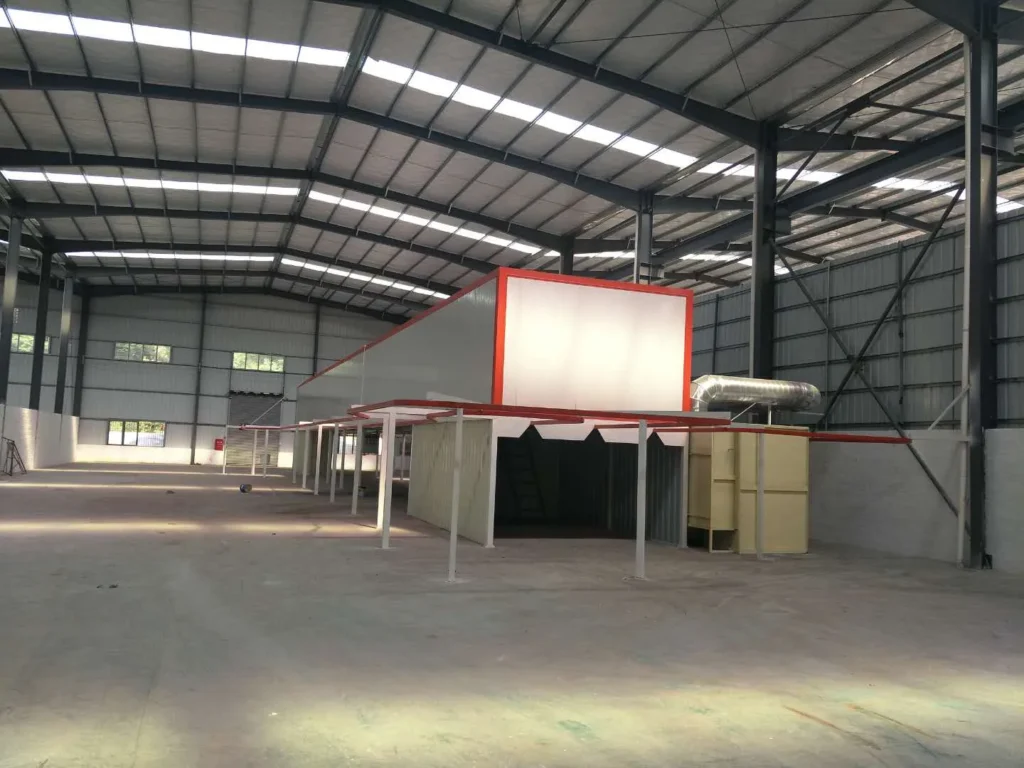
How to Inspect Your Powder Coating Curing Oven Environment: Key Parameters, Testing Methods & Troubleshooting
When you first notice coating defects—whether it's dull finish, incomplete curing, or inconsistent appearance across batches—the instinct is often to adjust the spray gun parameters or change the powder mix. But in my years working with powder coating lines, I've learned that many of these problems actually originate in the curing oven environment, not the equipment itself.
The curing oven environment isn't just about temperature. It's a system involving temperature uniformity, humidity control, air quality, and cleanliness. If any of these factors drift out of specification, your coatings will fail to cure properly—no matter how perfect your pre-treatment or spraying was.
To properly inspect your powder coating curing oven environment, you need to systematically check five critical areas: temperature distribution uniformity across the oven chamber using multiple measuring points, relative humidity levels in the surrounding workspace (ideally 45–60%), air circulation patterns to prevent heat stagnation and ensure consistent flow, cleanliness of both the oven interior and external ventilation system, and compressed air quality entering the equipment. Any deviation in these factors—such as excessive moisture, poor airflow, temperature gradients exceeding ±10°C, or dust contamination—directly impacts coating defects like shrinkage, pinhole formation, or uneven curing. Regular monitoring using calibrated temperature sensors, humidity meters, and visual inspection helps identify environmental issues before they affect coating quality.
This guide walks you through exactly how to diagnose and fix the environmental issues that are silently sabotaging your powder coating results.
What Is a Powder Coating Curing Oven Environment & Why Does It Matter?
The curing oven environment refers to the combined conditions inside and around your oven during the powder coating cure cycle. This includes temperature, humidity, air movement, cleanliness, and air quality.
Many manufacturers think of the curing oven as a simple heating box—you set the temperature, parts go in hot, and come out cured. But that's incomplete. The oven environment determines whether powder particles melt evenly, flow uniformly, undergo proper cross-linking, and develop full adhesion and hardness.
From our experience managing powder coating lines for cabinet manufacturers, furniture makers, and aluminum profile producers, we've found that environment problems are responsible for roughly 30–40% of on-site quality issues. The coating looks defective, but it's not actually a coating formulation problem or a spray gun problem—it's an environmental failure.
Why should you care? Because:
- Poor temperature uniformity creates color variation and uneven gloss
- Excess humidity causes pinholes, blistering, and adhesion loss
- Contaminated air introduces defects that are hard to trace
- Inadequate airflow leads to incomplete curing and soft coatings
- Dust ingress causes surface defects that can't be buffed out
The good news: most environment problems are preventable and correctable with systematic inspection.
Core Environmental Parameters You Need to Monitor
Temperature Distribution & Uniformity
Temperature is the most obvious parameter, but it's also the most misunderstood. Factory operators often watch the digital readout on the control panel and assume the oven is at 200°C throughout. In reality, there can be 15–20°C differences between different zones inside the same oven.
What to measure: The actual temperature experienced by the workpiece, not just the oven air temperature.
We recommend placing temperature probes at five points inside the oven during a normal cycle:
- Upper left zone
- Upper right zone
- Center
- Lower left zone
- Lower right zone
Record readings over at least a 10-minute cycle. For most powder formulations, the specification is ±10°C uniformity. If you're seeing greater variation, your oven's air circulation or heating distribution needs adjustment.
Common causes of poor temperature uniformity:
- Heating elements failing or degrading
- Circulation fan not running at rated speed
- Ductwork partially blocked or misaligned
- Oven door seals compromised
- Racks stacked too densely, blocking airflow
Humidity Levels & Moisture Control
Powder is hygroscopic—it absorbs moisture from the air. When humid air enters the oven with the powder, the absorbed moisture vaporizes during curing, creating tiny gas bubbles that manifest as pinholes or blistering.
Ideal humidity range: 45–60% relative humidity (RH) in the work area and spray room.
How to measure: Use a calibrated digital hygrometer. Take readings:
- In the spray booth before powder reaches the oven
- At the oven entrance
- Inside the oven during operation (if possible with a probe)
- In the room where you store bulk powder
Why this matters: If your spray room sits at 75% RH on a humid day, and you don't have a dehumidifier, the powder in your supply tank is already starting to pick up moisture. By the time it reaches the oven, curing defects are almost inevitable.
Real-world fix: One cabinet manufacturer we work with in Southeast Asia was experiencing chronic pinhole problems. They thought it was a coating issue until we measured humidity—their facility was running at 85% RH during monsoon season. Installing two industrial dehumidifiers solved the problem entirely.
Air Quality & Ventilation Systems
Compressed air used in powder coating—whether for fluidizing the powder, operating pneumatic controls, or drying the oven—must be clean and dry.
Air quality problems create:
- Clogged spray nozzles
- Spitting or unstable spray patterns
- Powder build-up in supply lines
- Oven contamination leading to coating defects
Check these ventilation points:
- Oven exhaust fan: Is it running? Can you hear steady air movement?
- Exhaust ductwork: Any blockages, dents, or loose connections?
- Intake openings: Are they clogged with dust or debris?
- Compressed air dryer: When was it last serviced? Are the filters clean?
- Air compressor: Is there visible moisture or oil in the tank?
What we check on site: We typically use an anemometer to measure air velocity at the oven exit. Inadequate airflow creates dead zones where powder doesn't cure uniformly.
Cleanliness & Contamination Prevention
Dust inside the oven gets baked into the coating surface, creating rough spots and aesthetic defects.
Clean your oven environment by checking:
- Oven interior walls and roof for accumulated powder dust
- Filter cartridges for blockage or damage
- Secondary recovery cabinet for overfilling
- The floor under and around the oven for spilled powder
- Air vents and return ducts for visible dust accumulation
Powder accumulation also insulates the oven walls, reducing heating efficiency and creating hot spots or cold zones.
How to Diagnose Environment-Related Coating Defects
Common Defects Caused by Environmental Issues
Pinholes or cratering: Tiny holes in the coating surface, often in clusters.
Environmental causes: Excess humidity, contaminated compressed air, poor oven air circulation.
How to verify: If pinholes appear consistently regardless of powder batch or spray settings, suspect environment. If they appear only on humid days, it's almost certainly humidity-related.
Orange peel texture: Bumpy, uneven surface resembling an orange skin.
Environmental causes: Oven temperature too high causing over-melting, or poor air circulation causing uneven flow and consolidation.
How to verify: Check if orange peel correlates with oven temperature spikes or humidity fluctuations.
Dull or hazy finish: Loss of gloss, giving the coating a flat appearance.
Environmental causes: Incomplete curing due to cold zones, excess moisture preventing flow, or dust settling on the surface during cure.
How to verify: Compare glossmeter readings across different oven zones. If gloss drops significantly in one area, suspect a temperature dead zone.
Poor adhesion: Coating peels or flakes easily.
Environmental causes: Inadequate drying before oven entry (moisture trapped), incomplete curing due to insufficient temperature exposure, contamination on the part surface.
How to verify: Do adhesion failures cluster in the same oven zone? If so, that zone likely has a temperature or moisture problem.
Distinguishing Between Equipment Failure & Environmental Problems
Here's a quick diagnostic flowchart we use:
Step 1: Did the defect appear suddenly across multiple parts, or gradually?
- Sudden across multiple parts = likely equipment failure or environmental spike
- Gradual, worse on certain days = likely environmental drift (humidity, seasonal changes)
Step 2: Does the defect appear in all oven zones or only in specific areas?
- All zones = equipment or material problem
- Specific zones = environmental (temperature gradient, cold spot, air circulation issue)
Step 3: When did you last calibrate your temperature probes, test humidity, or service your air compressor?
- More than 6 months ago = time for environmental inspection before blaming equipment
Step 4: Have you changed powder suppliers, spray gun type, or pre-treatment chemistry recently?
- Yes = verify new material is compatible with current oven environment
- No = environmental factors likely at fault
Step-by-Step Inspection Checklist for Your Curing Oven Environment
Use this checklist monthly, or whenever coating quality issues arise:
Temperature & Heating System
- [ ] Calibrate oven temperature probes (thermometer or thermal camera)
- [ ] Record readings at 5 points inside oven (all zones)
- [ ] Check uniformity: all readings within ±10°C of setpoint
- [ ] Note any readings trending upward or downward over time
- [ ] Visually inspect heating elements (electric ovens) or burner (gas ovens)
- [ ] Check oven door seals for gaps or damage
Humidity & Moisture Control
- [ ] Measure ambient humidity in spray area with calibrated hygrometer
- [ ] Record humidity inside powder storage area
- [ ] Verify dehumidifier is running (if installed)
- [ ] Check dehumidifier drain line for blockage
- [ ] Inspect silica gel or desiccant in powder storage (if used) for saturation
Air Circulation & Ventilation
- [ ] Verify oven exhaust fan is running
- [ ] Use anemometer to measure airflow velocity at oven exit
- [ ] Inspect intake and exhaust ductwork for blockages
- [ ] Check for visible dust accumulation on filters
- [ ] Listen for abnormal fan noise (bearing wear, vibration)
Compressed Air Quality
- [ ] Check air compressor tank for visible moisture or oil
- [ ] Inspect air dryer cartridge (if installed)
- [ ] Measure pressure at oven inlet (should match specification)
- [ ] Look for leaks in compressed air piping
- [ ] Drain moisture from pressure tanks
Cleanliness & Contamination
- [ ] Visually inspect oven interior walls and roof
- [ ] Check recovery system for excess powder accumulation
- [ ] Sweep floor around oven and spray area
- [ ] Inspect filter cartridges for tears or damage
- [ ] Wipe down exterior vents and ducts
Documentation
- [ ] Record all readings with date and time
- [ ] Note any adjustments made
- [ ] Track defect correlation over time
Essential Testing Tools & Measurement Standards
You don't need expensive lab equipment. Here are the core tools we recommend:
| Tool | Purpose | Typical Cost | Accuracy |
|---|---|---|---|
| Digital Thermometer (Probe) | Measure oven interior temperature at multiple points | $50–150 | ±1°C |
| Infrared Thermal Camera | Non-contact temperature mapping of oven and parts | $300–800 | ±2°C |
| Digital Hygrometer | Measure ambient and oven area humidity | $30–80 | ±3% RH |
| Anemometer | Measure air velocity in ducts and oven exit | $60–200 | ±5% |
| Pressure Gauge | Verify compressed air pressure | $20–50 | ±2% |
| Glossmeter | Measure surface gloss consistency across zones | $200–400 | ±0.5 gloss units |
| Calibration Block | Verify thermometer accuracy | $50–100 | Reference standard |
Measurement standards to follow:
- Temperature uniformity: ±10°C across oven (most powder specs)
- Humidity range: 45–60% RH in work area
- Air pressure: ±0.5 bar of target (typically 5–6 bar for powder systems)
- Gloss deviation: No more than 3 gloss units between zones
- Air quality: Oil content <1 mg/m³, water content <5 ppm
How to Improve Your Curing Oven Environment: Practical Solutions
Temperature Control & Airflow Optimization
If you're seeing cold zones or poor uniformity:
-
Check circulation fan speed. Modern ovens have variable-speed fans. If yours is running at 60% capacity, it won't circulate heat properly. Run it at 80–90% unless your oven manual specifies otherwise.
-
Verify heating element distribution. Older electric ovens sometimes have heating elements concentrated in one area. If available, request a retrofit that distributes elements more evenly.
-
Inspect ductwork alignment. Return air ducts should point downward and inward. Misaligned ducts create stagnant zones. Realign if necessary.
-
Reduce part density. If racks are packed too tightly, airflow can't penetrate. Space parts to allow at least 5–10 cm between pieces and racks.
-
Clean air intake and exhaust. Blockages force the fan to work harder and distribute air unevenly. Clear debris at least monthly.
Expected improvement: Temperature uniformity typically improves from ±15–20°C to ±5–8°C.
Humidity Management & Moisture Removal
If you're experiencing pinholes or blistering:
-
Install or upgrade dehumidification. If your facility is above 65% RH, install an industrial dehumidifier rated for your room size. In high-humidity climates, this is non-negotiable.
-
Add a pre-dry stage before the oven. Many plants use a secondary "warm zone" (80–100°C) where parts dry for 5–10 minutes before entering the main cure oven. This removes surface moisture before high-temperature cure begins.
-
Store powder in sealed containers with desiccant. Even if the powder leaves the supplier dry, it can absorb humidity in a high-humidity facility. Use sealed drums with silica gel packets.
-
Drain compressed air tanks daily. Most pinhole problems we've resolved started with moisture in the air supply. Make draining a daily routine.
-
Service the air dryer. Replace cartridges according to manufacturer spec (typically 6–12 months, or when pressure drop exceeds specification).
Expected improvement: Pinhole defects typically drop by 60–80% within 2–3 weeks.
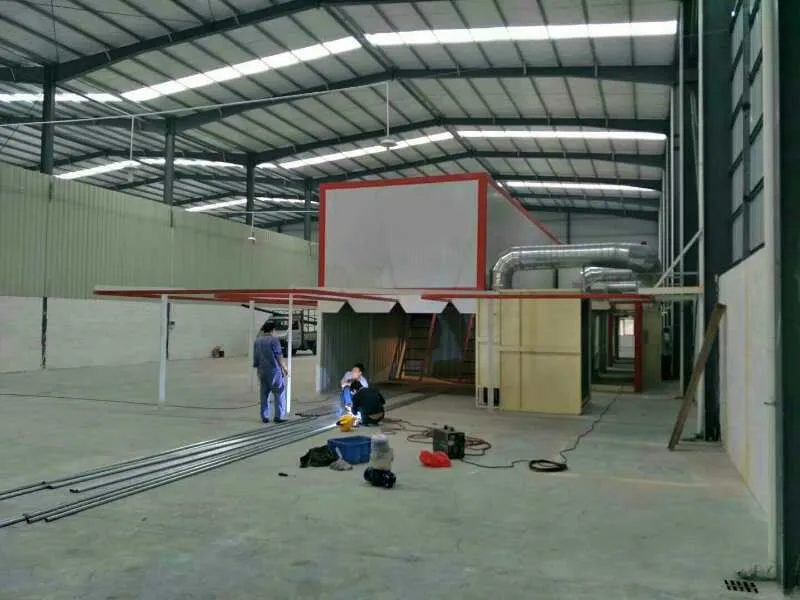 powder coating oven air filtration system" />
Air Filtration & Contamination Control
If you're seeing dust defects or rough surfaces:
-
Upgrade filter cartridges. Standard cartridges capture particles down to 10 microns. High-efficiency cartridges capture down to 1 micron. The upgrade cost is minimal compared to rework.
-
Establish a filter replacement schedule. Don't wait until filters are visibly clogged. Replace based on pressure drop gauges (if available) or on a fixed schedule—typically every 3–6 months for busy lines.
-
Seal gaps around recovery cabinet. Dust can re-enter the system if the recovery cabinet isn't properly sealed. Check door gaskets and connection points regularly.
-
Install intake filters on compressed air supply. If your compressor isn't equipped with pre-filters, add a 5-micron intake filter. This prevents dust from entering the system upstream.
-
Establish a "no open powder" policy in the spray area. Keep powder containers sealed except during loading. Spilled powder is easy to miss and becomes airborne contamination.
Expected improvement: Surface defects from contamination typically drop by 70–90%.
Environment Requirements by Powder Type & Production Volume
Different powder systems and production scales have slightly different environmental demands.
For standard epoxy or polyester powders (most common):
- Temperature: 190–220°C (maintain ±10°C uniformity)
- Humidity: 45–60% RH
- Air pressure: 5–6 bar (dry, clean)
- Cleanliness: No visible dust in oven
For high-end or low-VOC powders (more sensitive):
- Temperature: 180–210°C (maintain ±5°C uniformity)
- Humidity: 40–55% RH (tighter tolerance)
- Air pressure: 5–6 bar (critical: compressed air must be ultra-dry)
- Cleanliness: Filter to 1 micron minimum
For high-volume production (cabinets, furniture, commodity items):
- Focus on temperature uniformity and humidity stability
- Invest in automated dehumidification
- Use redundant air circulation fans (so one failure doesn't halt production)
- Establish preventive maintenance schedules
For low-volume or custom coating (job shop):
- Focus on flexibility and rapid color change
- Monitor environment before each batch, not just daily
- Allow for longer pre-dry times to accommodate variable conditions
For outdoor or seasonal operations:
- Humidity will fluctuate significantly
- Install continuous dehumidification, not seasonal
- Increase filter change frequency in high-pollen seasons
From our work with aluminum profile manufacturers in humid climates, we've learned that investing in permanent humidity and air quality control—even if it's expensive upfront—pays back within 6–12 months through reduced defects and rework.
Real-World Troubleshooting: When to Adjust, When to Replace
Scenario 1: Defects appear only in winter
Likely cause: Oven losing heat due to door seal degradation. Cold outside air enters through leaks during heating cycles.
Fix: Replace door seals. This is usually a $200–500 repair and takes 2–3 hours.
Scenario 2: Defects improve when you run the oven longer or hotter
Likely cause: Temperature is too low or unevenly distributed. Some parts aren't reaching full cure.
Fix: Before raising temperature or time, verify with probes that cold zones are the issue. Raising setpoint wastes energy if the real problem is poor circulation.
Scenario 3: Defects are random and unpredictable across different days
Likely cause: Environmental conditions (humidity, ambient temperature) are drifting. Not a consistent equipment problem.
Fix: Install continuous humidity monitoring and automatic dehumidification. Once humidity stabilizes, defects typically disappear.
Scenario 4: One corner of the oven consistently shows defects, but other areas are fine
Likely cause: Dead zone in airflow, or heating element weak in that area.
Fix: Check fan discharge direction, ductwork alignment, and element continuity. Realign ducts or service heating system.
Conclusion
Your powder coating curing oven environment is the hidden variable that separates consistent, high-quality results from chronic defects. Temperature, humidity, air quality, and cleanliness each play a role, and all must be managed systematically.
The good news is that most environment problems are cheap to diagnose and relatively affordable to fix—especially compared to the cost of rework and customer returns.
Start with these three immediate actions:
-
Measure your oven's temperature uniformity this week using a simple probe thermometer. If you see more than ±10°C variation, prioritize circulation fan inspection or ductwork realignment.
-
Check your facility's humidity level. If it's above 65% and you're experiencing coating defects, install a dehumidifier before making any other changes.
-
Service your compressed air system. Drain tanks, replace dryer cartridges if they're overdue, and verify pressure is stable. This alone resolves 20–30% of defect issues we see in the field.
Environment management is preventive maintenance that pays immediate dividends. If you're managing a powder coating line and experiencing quality inconsistencies, we're happy to discuss your specific situation. You can reach us at WhatsApp: +8618064668879 or ketumachinery@gmail.com. We can help you diagnose environment issues before they become costly production problems.
 English
  German
  Vietnamese
  French