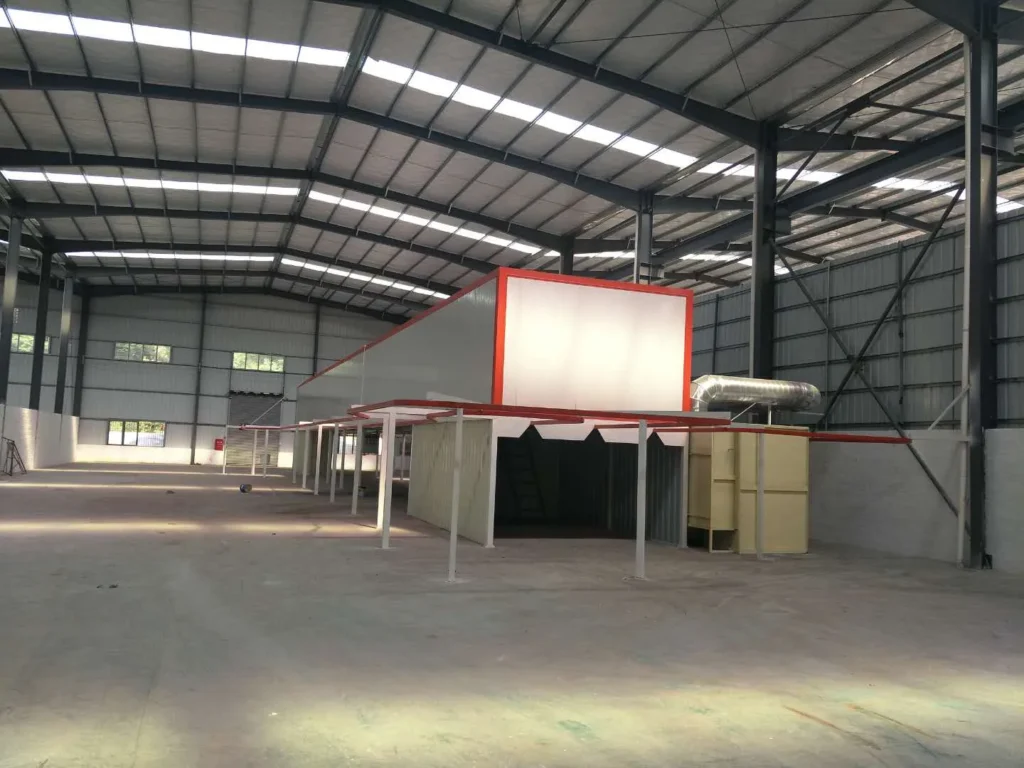
Understanding Powder Coating Lines: What They Are, How They Work, and Why They Matter
Qu'est-ce qu'une ligne de poudrage électrostatique et pourquoi est-elle importante ?
An electrostatic powder coating line is an automated or semi-automated production system that applies dry powder coating to metal workpieces through static electricity, then cures the coating through controlled heat. Unlike traditional liquid paint spraying, which relies on solvents and produces volatile organic compounds (VOCs), powder coating is environmentally friendly, highly efficient, and produces superior surface finishes.
From my perspective working with manufacturing clients across multiple industries, I see powder coating lines as one of the most practical investments a production facility can make. The technology isn't new, but its value has become even more apparent as manufacturers face stricter environmental regulations, rising labor costs, and customer demands for consistent quality.
Why does this matter? Because the coating isn't just about appearance. For cabinet makers, the coating provides essential corrosion protection and durability. For outdoor furniture manufacturers, it ensures resistance to weathering and UV damage. For aluminum profile companies, it guarantees consistent thickness and surface quality across thousands of units. A well-designed powder coating line directly affects your product's market competitiveness, your customer satisfaction, and your bottom line.
The real power of a powder coating line lies in its ability to deliver both quality and consistency at scale. A good line doesn't just coat products—it transforms manufacturing economics by reducing waste, lowering labor dependency, improving finish quality, and enabling faster production cycles.
Table des matières
- Composants principaux et fonctionnement d'une ligne de revêtement en poudre
- Key Advantages Over Traditional Liquid Coating Methods
- Applications Across Industries
- Critical Factors for Successful Line Operation
- Investment Costs, ROI, and Long-Term Operating Expenses
- How to Decide If Your Factory Needs a Powder Coating Line
Composants principaux et fonctionnement d'une ligne de revêtement en poudre
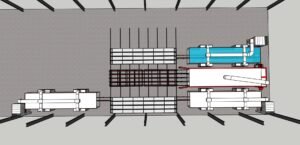
A complete powder coating line isn't a single machine—it's an integrated system where each component depends on the others. Understanding this integration is essential because a breakdown in any stage ripples through the entire process.
Pre-treatment System and Its Critical Role
Before any powder reaches the workpiece, the surface must be meticulously cleaned and prepared. This is where I see the most underestimated step in powder coating.
Pre-treatment typically involves:
Dégraissage – Removes oils, cutting fluids, and fingerprints using alkaline wash or immersion tanks. If this step is inadequate, powder won't adhere properly, no matter how perfect your spray parameters are.
Surface activation – Includes wire brushing, sandblasting, or shot blasting to increase surface roughness and remove rust and oxidation layers. For steel, this is non-negotiable for corrosion resistance.
Phosphatage ou traitement de conversion – Creates a chemical film that dramatically improves paint adhesion and corrosion resistance. This step transforms a simple metal surface into one primed to receive coating. For aluminum, you might use a zirconium or titanium conversion coating instead, which is chrome-free and more environmentally compatible.
Rinsing and drying – Removes residual chemicals and ensures the surface is completely dry. Any remaining moisture will cause pinholes and poor adhesion after curing.
From my experience, when customers experience coating failures—peeling, blistering, poor salt-spray performance—the root cause is almost always inadequate pre-treatment, not problems with the powder or spray settings. I've found that clients who invest in robust pre-treatment systems see return rates drop by 20-40% compared to those who cut corners here.
Electrostatic Spray Application Process
Once the workpiece is prepared, it enters the spray booth where the actual coating deposition happens. This is where electrostatics do the work that would otherwise require extensive manual labor.
How electrostatic deposition works:
The spray gun applies high voltage (typically 60-90 kV) to dry powder particles, giving them a negative charge. The workpiece, properly grounded, becomes positively charged relative to the powder. The electrostatic attraction pulls the charged powder particles toward the workpiece surface with remarkable efficiency—up to 95% of applied powder can deposit on the target.
Critical parameters that affect outcome:
-
cURL Too many subrequests by single Worker invocation. To configure this limit, refer to https://developers.cloudflare.com/workers/wrangler/configuration/#limits – Too close and you get uneven buildup and powder rebound; too far and you waste material and lose transfer efficiency. The sweet spot is usually 150-300mm depending on gun type and powder.
-
Voltage and current – Higher voltage increases transfer efficiency but risks coating defects and operator safety concerns. Current must be balanced to avoid excessive powder accumulation or discharge instability.
-
Débit de poudre – Must match the gun's capacity and the workpiece's surface area. Inconsistent flow creates membrane thickness variation.
-
Grounding quality – This cannot be overstated. Poor grounding causes powder to bounce off, reducing deposition and wasting material. Every contact point—hooks, fixturing, workpiece—must maintain electrical continuity.
One challenge I frequently encounter is the Effet de cage de Faraday—deep recesses, internal angles, and blind holes don't receive powder effectively because the electric field lines struggle to penetrate these areas. Solutions include reducing voltage temporarily, adjusting spray gun angle, or using multiple spray passes from different angles.
Four de cuisson et système de récupération de poudre
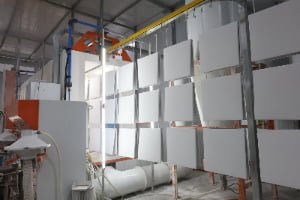
After spraying, the workpiece enters a curing oven where two things happen simultaneously: the powder particles melt and coalesce into a continuous film, and the resin systems undergo chemical cross-linking to form the final, hardened coating.
Curing requirements:
Curing temperature is material-specific—typically 175-220°C for most polyester systems, though some specialty powders require higher or lower temperatures. What matters is the workpiece's actual temperature, not just the oven's air temperature. Thick parts take longer to heat through, so time and temperature must be coordinated with line speed.
Inadequate curing leaves surfaces soft, susceptible to scratching, and vulnerable to poor chemical resistance. Over-curing can cause yellowing, gloss reduction, and even brittleness.
cURL Too many subrequests by single Worker invocation. To configure this limit, refer to https://developers.cloudflare.com/workers/wrangler/configuration/#limits
cURL Too many subrequests by single Worker invocation. To configure this limit, refer to https://developers.cloudflare.com/workers/wrangler/configuration/#limits
-
cURL Too many subrequests by single Worker invocation. To configure this limit, refer to https://developers.cloudflare.com/workers/wrangler/configuration/#limits cURL Too many subrequests by single Worker invocation. To configure this limit, refer to https://developers.cloudflare.com/workers/wrangler/configuration/#limits.
-
cURL Too many subrequests by single Worker invocation. To configure this limit, refer to https://developers.cloudflare.com/workers/wrangler/configuration/#limits cURL Too many subrequests by single Worker invocation. To configure this limit, refer to https://developers.cloudflare.com/workers/wrangler/configuration/#limits.
-
cURL Too many subrequests by single Worker invocation. To configure this limit, refer to https://developers.cloudflare.com/workers/wrangler/configuration/#limits cURL Too many subrequests by single Worker invocation. To configure this limit, refer to https://developers.cloudflare.com/workers/wrangler/configuration/#limits.
cURL Too many subrequests by single Worker invocation. To configure this limit, refer to https://developers.cloudflare.com/workers/wrangler/configuration/#limits.
Key Advantages Over Traditional Liquid Coating Methods
cURL Too many subrequests by single Worker invocation. To configure this limit, refer to https://developers.cloudflare.com/workers/wrangler/configuration/#limits.
| Fonctionnalité | Pulvérisation de peinture liquide | Ligne de poudrage |
|---|---|---|
| Déchets de matériau | cURL Too many subrequests by single Worker invocation. To configure this limit, refer to https://developers.cloudflare.com/workers/wrangler/configuration/#limits | cURL Too many subrequests by single Worker invocation. To configure this limit, refer to https://developers.cloudflare.com/workers/wrangler/configuration/#limits |
| Émissions VOC | cURL Too many subrequests by single Worker invocation. To configure this limit, refer to https://developers.cloudflare.com/workers/wrangler/configuration/#limits | cURL Too many subrequests by single Worker invocation. To configure this limit, refer to https://developers.cloudflare.com/workers/wrangler/configuration/#limits |
| cURL Too many subrequests by single Worker invocation. To configure this limit, refer to https://developers.cloudflare.com/workers/wrangler/configuration/#limits | cURL Too many subrequests by single Worker invocation. To configure this limit, refer to https://developers.cloudflare.com/workers/wrangler/configuration/#limits | cURL Too many subrequests by single Worker invocation. To configure this limit, refer to https://developers.cloudflare.com/workers/wrangler/configuration/#limits |
| cURL Too many subrequests by single Worker invocation. To configure this limit, refer to https://developers.cloudflare.com/workers/wrangler/configuration/#limits | 50-100 microns | cURL Too many subrequests by single Worker invocation. To configure this limit, refer to https://developers.cloudflare.com/workers/wrangler/configuration/#limits |
| Temps de durcissement | cURL Too many subrequests by single Worker invocation. To configure this limit, refer to https://developers.cloudflare.com/workers/wrangler/configuration/#limits | cURL Too many subrequests by single Worker invocation. To configure this limit, refer to https://developers.cloudflare.com/workers/wrangler/configuration/#limits |
| cURL Too many subrequests by single Worker invocation. To configure this limit, refer to https://developers.cloudflare.com/workers/wrangler/configuration/#limits | 6-8 hours | 2-3 heures |
| Color Change Downtime | 30-45 minutes | 10-15 minutes |
| Coating Durability (salt spray) | 500-1000 hours | 2000+ hours |
| Coût de l'équipement | Lower initial | Higher initial |
| Operating Cost/year | High (material + VOC handling) | Lower (powder recovery) |
Conformité environnementale :
Powder coating produces virtually zero VOCs. Liquid paint requires extensive air scrubbing, water disposal systems, and regulatory reporting. In regions with strict environmental standards—EU, California, increasingly Asia—powder coating is becoming not just preferred but necessary.
Quality and consistency:
Powder coating delivers dramatically superior coating uniformity. Because the electrostatic process physically pulls powder to every surface, even complex geometries get even coverage. Liquid paint relies on spray technique and operator skill, making quality variable across batches.
Speed to market:
A 20-minute cure cycle versus 8-24 hours means you can deliver finished products faster. For contract manufacturers or production-to-order businesses, this translates to competitive advantage.
Customer perception:
High-end clients—automotive suppliers, architectural firms, OEMs—increasingly expect powder coating. It signals quality, durability, and environmental responsibility. In many B2B markets, liquid paint is now considered inferior.
Applications Across Industries: Where Powder Coating Lines Are Used
Powder coating isn't a one-size-fits-all solution, but it does work remarkably well across diverse applications. From my experience, the best candidates share common traits: metal substrates, moderate to high volumes, and quality-conscious end-users.
Cabinet and enclosure manufacturing – Electrical cabinets, switchgear housings, server racks, and control boxes represent one of the largest markets. These products demand corrosion resistance, consistent appearance, and quick turnaround. Powder coating meets all three requirements and has become the industry standard.
Outdoor furniture and architectural components – Garden furniture, outdoor dining sets, aluminum railings, and structural components face sun, moisture, and temperature extremes. Powder coating's UV resistance and humidity barrier make it ideal. The finish also looks premium, which supports higher retail pricing.
Aluminum profiles and extrusions – Building materials, window frames, solar panel components, and decorative profiles benefit from powder coating's ability to provide uniform coverage on complex profiles. The speed of powder coating enables aluminum processors to offer custom colors with minimal lead time.
Metal furniture and storage solutions – Shelving, workbenches, tool cabinets, and warehouse racking all use powder coating because it delivers durability, quick turnaround, and maintenance-free surfaces that resist warehouse dust and forklift dings.
Automotive and heavy equipment components – Brackets, housings, wheels, and structural parts use powder coating where corrosion resistance is critical and appearance matters.
Metal hardware and fasteners – Hinges, handles, brackets, and decorative hardware often use powder coating for both protection and aesthetic appeal.
The common thread: these are all situations where product quality directly influences customer satisfaction, where environmental compliance is important, and where batch sizes justify the equipment investment.
Critical Factors for Successful Line Operation and Stability
Buying a powder coating line is one thing. Operating it consistently to deliver quality results is another. I've seen identical equipment produce wildly different results based on operational discipline.
Line Rhythm and Equipment Synchronization
A powder coating line is only as fast as its slowest stage. If pre-treatment takes 5 minutes but spraying takes only 3 minutes, workpieces accumulate and bottleneck. If the oven takes 10 minutes but spraying takes 12, the oven runs empty half the time, wasting energy.
Line rhythm refers to the synchronization of:
- Vitesse du convoyeur – Must coordinate with spray booth residence time and oven dwell time
- cURL Too many subrequests by single Worker invocation. To configure this limit, refer to https://developers.cloudflare.com/workers/wrangler/configuration/#limits cURL Too many subrequests by single Worker invocation. To configure this limit, refer to https://developers.cloudflare.com/workers/wrangler/configuration/#limits
- cURL Too many subrequests by single Worker invocation. To configure this limit, refer to https://developers.cloudflare.com/workers/wrangler/configuration/#limits cURL Too many subrequests by single Worker invocation. To configure this limit, refer to https://developers.cloudflare.com/workers/wrangler/configuration/#limits
- cURL Too many subrequests by single Worker invocation. To configure this limit, refer to https://developers.cloudflare.com/workers/wrangler/configuration/#limits cURL Too many subrequests by single Worker invocation. To configure this limit, refer to https://developers.cloudflare.com/workers/wrangler/configuration/#limits
cURL Too many subrequests by single Worker invocation. To configure this limit, refer to https://developers.cloudflare.com/workers/wrangler/configuration/#limits
- cURL Too many subrequests by single Worker invocation. To configure this limit, refer to https://developers.cloudflare.com/workers/wrangler/configuration/#limits
- cURL Too many subrequests by single Worker invocation. To configure this limit, refer to https://developers.cloudflare.com/workers/wrangler/configuration/#limits
- cURL Too many subrequests by single Worker invocation. To configure this limit, refer to https://developers.cloudflare.com/workers/wrangler/configuration/#limits
- cURL Too many subrequests by single Worker invocation. To configure this limit, refer to https://developers.cloudflare.com/workers/wrangler/configuration/#limits
cURL Too many subrequests by single Worker invocation. To configure this limit, refer to https://developers.cloudflare.com/workers/wrangler/configuration/#limits.
cURL Too many subrequests by single Worker invocation. To configure this limit, refer to https://developers.cloudflare.com/workers/wrangler/configuration/#limits
cURL Too many subrequests by single Worker invocation. To configure this limit, refer to https://developers.cloudflare.com/workers/wrangler/configuration/#limits.
cURL Too many subrequests by single Worker invocation. To configure this limit, refer to https://developers.cloudflare.com/workers/wrangler/configuration/#limits
-
cURL Too many subrequests by single Worker invocation. To configure this limit, refer to https://developers.cloudflare.com/workers/wrangler/configuration/#limits cURL Too many subrequests by single Worker invocation. To configure this limit, refer to https://developers.cloudflare.com/workers/wrangler/configuration/#limits.
-
cURL Too many subrequests by single Worker invocation. To configure this limit, refer to https://developers.cloudflare.com/workers/wrangler/configuration/#limits cURL Too many subrequests by single Worker invocation. To configure this limit, refer to https://developers.cloudflare.com/workers/wrangler/configuration/#limits.
-
cURL Too many subrequests by single Worker invocation. To configure this limit, refer to https://developers.cloudflare.com/workers/wrangler/configuration/#limits cURL Too many subrequests by single Worker invocation. To configure this limit, refer to https://developers.cloudflare.com/workers/wrangler/configuration/#limits.
cURL Too many subrequests by single Worker invocation. To configure this limit, refer to https://developers.cloudflare.com/workers/wrangler/configuration/#limits
- An aftercooler to condense moisture
- A refrigerated dryer to remove condensed water
- Multi-stage filters (5 micron minimum, preferably 1 micron final stage)
- A receiver tank to buffer pressure fluctuations
This infrastructure costs $5,000-15,000 but prevents far more expensive coating rejections. I've seen customers spend months troubleshooting surface defects only to discover that upgrading their air supply system solved everything.
Multi-Color Changeover and Powder Recovery Efficiency
Many manufacturers need to spray multiple colors in a single production run. This creates two challenges: preventing color contamination and maintaining productivity during changeovers.
Color changeover procedure:
- Spray off remaining first color (continue until no powder exits guns)
- Close powder supply to guns
- Backflush supply lines with compressed air
- Clean spray guns and internal passages
- Filter or remove contaminated powder from recovery system
- Install fresh powder and clean guns again
- Resume production
This process typically takes 15-45 minutes depending on system complexity and housekeeping discipline. A poorly organized changeover can lose 2-3 hours per shift if colors rotate frequently.
Minimizing color change losses:
- Use powder recovery systems with separate collection for each color
- Maintain color-specific supply lines and hoses
- Implement automated backflush sequences where possible
- Establish changeover checklists to prevent missed steps
- Consider reserving specific production slots for specific colors to reduce changeovers
Powder recovery efficiency directly affects economics. If recovery systems only achieve 80% efficiency, you lose 20% to waste. Upgrading from single-cyclone to cyclone-plus-secondary-filter systems can improve efficiency to 95%, which on a line spraying 1,000 kg of powder per week saves $100/week in material costs—roughly $5,000 annually.
Investment Costs, ROI, and Long-Term Operating Expenses
The sticker price of a powder coating line can appear daunting. A complete system with pre-treatment, spray booth, curing oven, and recovery components typically ranges from $150,000-500,000+ depending on capacity and automation level. But this is only the first half of the story.
Equipment Cost vs. Total Cost of Ownership
Initial investment breakdown (typical mid-size line for cabinet manufacturing):
| Composant | Cost Range |
|---|---|
| Système de pré-traitement | $30,000-60,000 |
| Spray booth (spray guns, extraction) | $40,000-80,000 |
| Four de cuisson | $50,000-100,000 |
| Système de récupération de poudre | $20,000-40,000 |
| Conveyor/transport | $15,000-30,000 |
| Control systems & electrical | $15,000-25,000 |
| Installation & commissioning | $20,000-40,000 |
| Total | $190,000-375,000 |
This range assumes semi-automated operation with operator involvement. Fully automated lines cost 50-100% more.
But total cost of ownership over 10 years includes:
- Powder cost – At $8-15/kg, a line coating 500 kg/week costs $4,000-7,500/week in material
- Énergie – Curing ovens consume 40-80 kW continuously; add $3,000-6,000/month depending on production schedule
- Main-d'œuvre – 1-3 operators per shift depending on automation level
- Entretien – Filter replacements, gun refurbishment, compressor service
- Conformité environnementale – Air quality testing, waste disposal
cURL Too many subrequests by single Worker invocation. To configure this limit, refer to https://developers.cloudflare.com/workers/wrangler/configuration/#limits
| Article | cURL Too many subrequests by single Worker invocation. To configure this limit, refer to https://developers.cloudflare.com/workers/wrangler/configuration/#limits |
|---|---|
| cURL Too many subrequests by single Worker invocation. To configure this limit, refer to https://developers.cloudflare.com/workers/wrangler/configuration/#limits | $25,000 |
| cURL Too many subrequests by single Worker invocation. To configure this limit, refer to https://developers.cloudflare.com/workers/wrangler/configuration/#limits | $195,000 |
| cURL Too many subrequests by single Worker invocation. To configure this limit, refer to https://developers.cloudflare.com/workers/wrangler/configuration/#limits | $48,000 |
| cURL Too many subrequests by single Worker invocation. To configure this limit, refer to https://developers.cloudflare.com/workers/wrangler/configuration/#limits | $80,000 |
| Entretien | $15,000 |
| cURL Too many subrequests by single Worker invocation. To configure this limit, refer to https://developers.cloudflare.com/workers/wrangler/configuration/#limits | $363,000 |
| cURL Too many subrequests by single Worker invocation. To configure this limit, refer to https://developers.cloudflare.com/workers/wrangler/configuration/#limits | $3,630,000 |
cURL Too many subrequests by single Worker invocation. To configure this limit, refer to https://developers.cloudflare.com/workers/wrangler/configuration/#limits
- cURL Too many subrequests by single Worker invocation. To configure this limit, refer to https://developers.cloudflare.com/workers/wrangler/configuration/#limits
- cURL Too many subrequests by single Worker invocation. To configure this limit, refer to https://developers.cloudflare.com/workers/wrangler/configuration/#limits
cURL Too many subrequests by single Worker invocation. To configure this limit, refer to https://developers.cloudflare.com/workers/wrangler/configuration/#limits
cURL Too many subrequests by single Worker invocation. To configure this limit, refer to https://developers.cloudflare.com/workers/wrangler/configuration/#limits.
cURL Too many subrequests by single Worker invocation. To configure this limit, refer to https://developers.cloudflare.com/workers/wrangler/configuration/#limits
cURL Too many subrequests by single Worker invocation. To configure this limit, refer to https://developers.cloudflare.com/workers/wrangler/configuration/#limits
- cURL Too many subrequests by single Worker invocation. To configure this limit, refer to https://developers.cloudflare.com/workers/wrangler/configuration/#limits
- cURL Too many subrequests by single Worker invocation. To configure this limit, refer to https://developers.cloudflare.com/workers/wrangler/configuration/#limits
- cURL Too many subrequests by single Worker invocation. To configure this limit, refer to https://developers.cloudflare.com/workers/wrangler/configuration/#limits
cURL Too many subrequests by single Worker invocation. To configure this limit, refer to https://developers.cloudflare.com/workers/wrangler/configuration/#limits.
cURL Too many subrequests by single Worker invocation. To configure this limit, refer to https://developers.cloudflare.com/workers/wrangler/configuration/#limits
cURL Too many subrequests by single Worker invocation. To configure this limit, refer to https://developers.cloudflare.com/workers/wrangler/configuration/#limits
- cURL Too many subrequests by single Worker invocation. To configure this limit, refer to https://developers.cloudflare.com/workers/wrangler/configuration/#limits – Well-insulated ovens reduce operating temperature and fuel consumption by 10-15%
- Line velocity matching – Don't run the oven hotter than necessary; instead, adjust conveyor speed to match cure requirements
- Batch scheduling – Run production in consolidated batches rather than scattered shifts to maintain oven temperature
- Excess airflow control – Exhaust extraction systems should be sized correctly; oversized systems waste energy
Proper tuning can reduce oven energy consumption by 20-30%, worth $10,000-18,000 annually on a mid-sized line.
Maintenance planning:
The equipment most commonly requiring attention:
- Spray guns – Clean every shift, rebuild yearly ($500-1,000/gun)
- Filter cartridges – Replace every 3-6 months ($200-600 per cartridge)
- Conveyor chain – Inspect monthly, lubricate, replace every 3-5 years ($5,000-15,000)
- Curing oven elements – Last 5-10 years; replacement costs $10,000-25,000
- Compressor service – Annual inspection, oil/filter change ($500-1,000)
Budgeting $10,000-15,000 annually for maintenance prevents expensive breakdowns and ensures consistent quality.
How to Decide If Your Factory Needs a Powder Coating Line
Not every manufacturer should invest in a powder coating line. The decision depends on several interconnected factors.
Your operation is a good fit if:
✓ You coat 5,000+ units annually – Below this volume, the fixed costs per unit become prohibitive. Above this, the line generates real value.
✓ Your products require consistent, high-quality finishes – If customers inspect and complain about coating quality, outsourcing saves headaches. In-house coating gives you control.
✓ You have pressure to improve coating durability or corrosion resistance – If customers are returning products for rust or coating failure, powder coating directly addresses root cause.
✓ You face environmental compliance pressure – If your jurisdiction restricts VOC emissions or liquid waste disposal, powder coating becomes necessary.
✓ You need fast turnaround and color flexibility – If you manufacture-to-order with short lead times, in-house coating enables 48-hour delivery. Outsourcing means 1-2 week wait.
✓ You have adequate space and utilities – A basic line requires 2,000-3,000 sq ft, 380V 3-phase power, compressed air, and drainage. Without these, retrofitting costs more than the equipment itself.
✓ Your product geometry is compatible – Simple shapes work well. Highly complex assemblies with many recesses may struggle with uniform coverage.
Your operation is NOT a good fit if:
✗ cURL Too many subrequests by single Worker invocation. To configure this limit, refer to https://developers.cloudflare.com/workers/wrangler/configuration/#limits cURL Too many subrequests by single Worker invocation. To configure this limit, refer to https://developers.cloudflare.com/workers/wrangler/configuration/#limits
✗ cURL Too many subrequests by single Worker invocation. To configure this limit, refer to https://developers.cloudflare.com/workers/wrangler/configuration/#limits cURL Too many subrequests by single Worker invocation. To configure this limit, refer to https://developers.cloudflare.com/workers/wrangler/configuration/#limits
✗ cURL Too many subrequests by single Worker invocation. To configure this limit, refer to https://developers.cloudflare.com/workers/wrangler/configuration/#limits cURL Too many subrequests by single Worker invocation. To configure this limit, refer to https://developers.cloudflare.com/workers/wrangler/configuration/#limits
✗ cURL Too many subrequests by single Worker invocation. To configure this limit, refer to https://developers.cloudflare.com/workers/wrangler/configuration/#limits cURL Too many subrequests by single Worker invocation. To configure this limit, refer to https://developers.cloudflare.com/workers/wrangler/configuration/#limits
✗ cURL Too many subrequests by single Worker invocation. To configure this limit, refer to https://developers.cloudflare.com/workers/wrangler/configuration/#limits cURL Too many subrequests by single Worker invocation. To configure this limit, refer to https://developers.cloudflare.com/workers/wrangler/configuration/#limits
cURL Too many subrequests by single Worker invocation. To configure this limit, refer to https://developers.cloudflare.com/workers/wrangler/configuration/#limits
cURL Too many subrequests by single Worker invocation. To configure this limit, refer to https://developers.cloudflare.com/workers/wrangler/configuration/#limits
cURL Too many subrequests by single Worker invocation. To configure this limit, refer to https://developers.cloudflare.com/workers/wrangler/configuration/#limits
cURL Too many subrequests by single Worker invocation. To configure this limit, refer to https://developers.cloudflare.com/workers/wrangler/configuration/#limits
- cURL Too many subrequests by single Worker invocation. To configure this limit, refer to https://developers.cloudflare.com/workers/wrangler/configuration/#limits
- cURL Too many subrequests by single Worker invocation. To configure this limit, refer to https://developers.cloudflare.com/workers/wrangler/configuration/#limits
- cURL Too many subrequests by single Worker invocation. To configure this limit, refer to https://developers.cloudflare.com/workers/wrangler/configuration/#limits
- cURL Too many subrequests by single Worker invocation. To configure this limit, refer to https://developers.cloudflare.com/workers/wrangler/configuration/#limits
- cURL Too many subrequests by single Worker invocation. To configure this limit, refer to https://developers.cloudflare.com/workers/wrangler/configuration/#limits
cURL Too many subrequests by single Worker invocation. To configure this limit, refer to https://developers.cloudflare.com/workers/wrangler/configuration/#limits
- cURL Too many subrequests by single Worker invocation. To configure this limit, refer to https://developers.cloudflare.com/workers/wrangler/configuration/#limits
- cURL Too many subrequests by single Worker invocation. To configure this limit, refer to https://developers.cloudflare.com/workers/wrangler/configuration/#limits
- Revised annual savings: $36,500
- Revised payback period: 6.8 years
Most facilities see payback in 5-8 years when quality benefits are included. After payback, the line generates $30,000-50,000 annually in pure profit.
The decision framework:
- Calculate current coating costs – both what you pay for outsourcing and quality losses
- Model equipment and operating costs – use realistic numbers for your product
- Quantify speed-to-market benefits – faster delivery enables higher prices or customer retention
- Assess space and utility constraints – get quotes for facility upgrades
- Calculate payback period – aim for <8 years
- Visit a reference customer – see similar equipment in operation, ask about surprises
Final Recommendations
Based on my experience working across multiple industries, here's my honest assessment:
A well-designed powder coating line is one of the best capital investments a manufacturing company can make, but only if three conditions are met: sufficient volume, adequate space, and realistic expectations about the ramp-up period.
The lines that fail are those purchased with vague hopes of "improving quality" but without systematic attention to process control—pre-treatment discipline, air quality, line synchronization, and maintenance. The lines that succeed are those where management treats the coating operation as a core manufacturing process, not an afterthought.
If you're considering this investment, my recommendation is:
- Start with a candid assessment of current coating quality and costs – Quantify the real problem you're solving
- Visit 2-3 installations at similar manufacturers – Nothing replaces seeing equipment in actual production
- Request a proposal that includes training and post-commissioning support – The equipment is only 60% of success; the rest is people and process
- Plan for a 3-6 month learning curve – Even experienced operators need time to optimize a new system
- Budget for 10% contingency – Installation always costs more than quoted
For manufacturers in cabinet making, outdoor furniture, aluminum profiles, and similar sectors, powder coating is no longer optional—it's the baseline expectation. The question isn't whether to implement it, but whether to do so in-house or outsource.
In-house coating gives you speed, quality control, and competitive advantage. Outsourcing gives you simplicity and flexibility. Choose based on your business model, not your equipment budget.
Ready to Explore Powder Coating Solutions?
If you're evaluating whether a powder coating line makes sense for your operation, I'm happy to discuss your specific situation. We've worked with manufacturers across cabinet making, outdoor furniture, aluminum profiles, and metalworking industries to design systems that actually work in real production environments—not just on paper.
Get in touch to discuss your coating challenges:
📧 Email : ketumachinery@gmail.com
📞 WhatsApp : +8618064668879
Or contactez-nous directement to request a consultation and facility tour to see our systems in operation.
 French
  English
  German
  Vietnamese