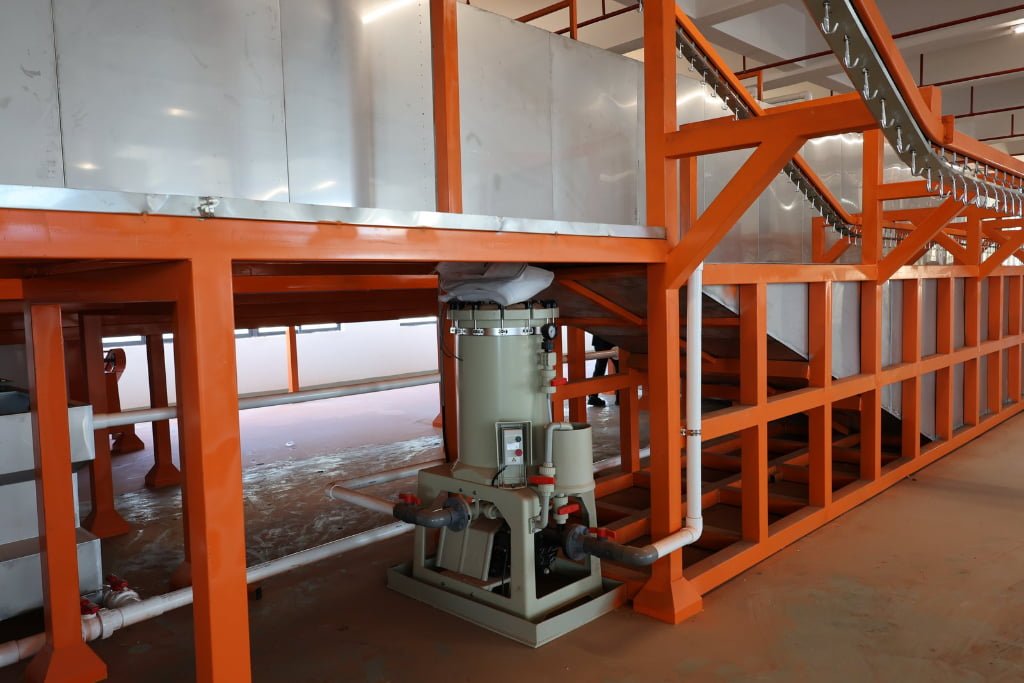
Technical Requirements for Electrostatic Powder Coating: A Complete System Guide
When I first worked with manufacturing clients on thermolaquage électrostatique[^1], I quickly realized that most quality failures weren't caused by spray gun problems or furnace temperature issues—they came from overlooked technical requirements in the early stages of the process. From my experience on production floors across cabinet, furniture, and aluminum profile manufacturing, I've learned that coating success depends on precise control across multiple interconnected systems, not just adjusting one parameter and hoping for the best.
Electrostatic powder coating requires precise control across multiple technical dimensions: pre-treatment (degreasing, corrosion removal, phosphate film formation), air quality (pressure 4–8 kg/cm², fully dry and oil-free), workpiece grounding (contact resistance ≤0.1 Ω for stable powder adhesion), spray parameters (voltage 60–90 kV, gun distance 150–300 mm), curing conditions (temperature typically 170–200°C depending on powder chemistry, with proper temperature profiling to avoid under-cure or over-cure), and coating thickness control (typically 80–150 μm). Environmental factors like humidity, compressed air purity, and equipment maintenance directly impact coating quality. Meeting these requirements ensures uniform coverage, strong adhesion, corrosion resistance, and consistent production efficiency while avoiding common defects such as pinholes, cratering, and poor adhesion.
The reason I'm emphasizing this upfront is that I've seen too many projects fail because people thought they could "dial in" quality issues during spraying. In reality, once a workpiece reaches the spray booth, much of the outcome has already been determined by what happened before.
Why Technical Requirements Matter in Electrostatic Powder Coating
Most manufacturers approach powder coating as a simple sequence: spray powder, cure it, done. But that perspective ignores the reality: electrostatic powder coating is a physics-based process with cumulative tolerance stacks. A defect that appears in the final coating—whether it's poor adhesion, orange peel texture, or inconsistent film thickness—almost always traces back to a violation of technical requirements somewhere upstream.
From my perspective working directly with production lines, I've observed three patterns:
First, small deviations compound. If air pressure fluctuates by 1 kg/cm² and humidity is 5% higher than spec, and the phosphate film is slightly underdeveloped, each factor alone might seem acceptable. Together, they create the conditions for pinholes or weak adhesion that customer inspections reject.
Second, clients often mistake symptoms for root causes. They see uneven film thickness and immediately reach for the spray gun parameters. What they miss is that the workpiece may have poor grounding, the furnace may have an uneven temperature field, or the conveyor speed may be drifting. Adjusting the spray gun alone won't fix it.
Third, and most critically, technical requirements aren't suggestions—they're boundaries. Operate inside them consistently, and your line runs predictably. Step outside and your defect rate climbs, often non-linearly.
Pre-Treatment: The Foundation of Coating Quality
I've investigated hundreds of coating failures on customer sites, and in roughly 70% of cases where adhesion was poor, surface defects appeared, or corrosion protection was inadequate, the root cause was pre-treatment. This is not a peripheral step. This is the foundation.
Pre-treatment serves one core function: create a surface condition on the metal that powder can bond to reliably and that will resist environmental degradation. Without proper pre-treatment, the adhesion of powder to the substrate becomes the weak link—regardless of spray parameters or furnace performance.
Degreasing, Rust Removal, Phosphating, and Passivation Standards
The pre-treatment sequence I typically specify for clients follows this logic:
Dégraissage removes oils, cutting fluids, fingerprints, and particulates that would block adhesion. We use alkaline spray degreasing at temperatures between 50–70°C, typically at pH 10–13, with spray pressure around 2–3 bar. Immersion time matters: usually 3–5 minutes depending on contamination severity. The specification is straightforward: no visible oil residue, no oily film when the workpiece is inspected under lights.
Élimination de la rouille is critical for steel components. I prefer alkaline or chelating rust removers over strong acids because they're gentler on thin sections and more controllable. Spray rate, contact time, and liquid concentration all affect penetration and stripping speed. The standard I enforce: all loose rust, mill scale, and previous coating remnants must be removed to bare metal. No partial stripping.
Phosphatage on steel creates a thin, micro-crystalline conversion film (typically 1–5 micrometers) that acts as both an adhesion anchor and a corrosion barrier. I specify iron phosphate[^2] for most applications, with bath temperature 40–60°C, concentration monitored weekly, and contact time 1–3 minutes. The film should appear as a uniform gray or blue-gray color, with no bare spots. Thickness should fall in the range of 1–3 micrometers (checked via X-ray fluorescence on reference samples).
Passivation or conversion film treatment on aluminum is equally critical. We use zirconium or titanium-based conversions (replacing older chromium-based processes for environmental compliance). Bath temperature 25–50°C, contact time 30–90 seconds. The film should be thin, transparent, and uniform across the workpiece.
Rinçage à l'eau pure is often overlooked but essential. After each process stage, residual chemicals, ions, and particles must be removed. I specify deionized[^3] or reverse-osmosis water at the final rinse stage, with conductivity ≤ 500 µS/cm to confirm cleanliness.
Séchage must reduce moisture to near-zero levels. Typical practice: hot air drying at 60–80°C for 2–5 minutes, or infrared + air combination. The workpiece should be completely dry when it reaches the spray booth. Any residual moisture will cause pinholes and cratering in the powder coating.
Pre-Treatment Verification and Common Failures
I insist on daily verification because pre-treatment is where mistakes hide. Here's what I monitor on every line:
Contact angle test (or water droplet test): A drop of deionized water placed on a pre-treated steel surface should spread and wet the surface (contact angle < 50°). If the droplet beads up, it indicates incomplete degreasing or conversion film failure. I perform this test on at least two workpieces per shift.
Film weight verification: For phosphated steel, I use X-ray fluorescence to confirm conversion film thickness is within spec (1–3 µm). Below 1 µm and adhesion drops. Above 5 µm and coverage uniformity suffers.
Conductivity measurement on final rinse water: Should stay below 500 µS/cm. If it creeps toward 1000 µS/cm, ions are building up in the rinse tanks—a sign that chemistry is degrading or contamination is accumulating.
Common pre-treatment failures I've encountered:
Underdrying: Workpieces enter the spray booth with residual water. Result: pinholes and cratering within 1–2 minutes of curing as trapped moisture vaporizes.
Incomplete degreasingcURL Too many subrequests by single Worker invocation. To configure this limit, refer to https://developers.cloudflare.com/workers/wrangler/configuration/#limits.
cURL Too many subrequests by single Worker invocation. To configure this limit, refer to https://developers.cloudflare.com/workers/wrangler/configuration/#limitscURL Too many subrequests by single Worker invocation. To configure this limit, refer to https://developers.cloudflare.com/workers/wrangler/configuration/#limits.
cURL Too many subrequests by single Worker invocation. To configure this limit, refer to https://developers.cloudflare.com/workers/wrangler/configuration/#limitscURL Too many subrequests by single Worker invocation. To configure this limit, refer to https://developers.cloudflare.com/workers/wrangler/configuration/#limits.
cURL Too many subrequests by single Worker invocation. To configure this limit, refer to https://developers.cloudflare.com/workers/wrangler/configuration/#limits
cURL Too many subrequests by single Worker invocation. To configure this limit, refer to https://developers.cloudflare.com/workers/wrangler/configuration/#limits.
cURL Too many subrequests by single Worker invocation. To configure this limit, refer to https://developers.cloudflare.com/workers/wrangler/configuration/#limits.
cURL Too many subrequests by single Worker invocation. To configure this limit, refer to https://developers.cloudflare.com/workers/wrangler/configuration/#limits
cURL Too many subrequests by single Worker invocation. To configure this limit, refer to https://developers.cloudflare.com/workers/wrangler/configuration/#limitscURL Too many subrequests by single Worker invocation. To configure this limit, refer to https://developers.cloudflare.com/workers/wrangler/configuration/#limits.
cURL Too many subrequests by single Worker invocation. To configure this limit, refer to https://developers.cloudflare.com/workers/wrangler/configuration/#limits.
cURL Too many subrequests by single Worker invocation. To configure this limit, refer to https://developers.cloudflare.com/workers/wrangler/configuration/#limitscURL Too many subrequests by single Worker invocation. To configure this limit, refer to https://developers.cloudflare.com/workers/wrangler/configuration/#limits.
cURL Too many subrequests by single Worker invocation. To configure this limit, refer to https://developers.cloudflare.com/workers/wrangler/configuration/#limits cURL Too many subrequests by single Worker invocation. To configure this limit, refer to https://developers.cloudflare.com/workers/wrangler/configuration/#limits. cURL Too many subrequests by single Worker invocation. To configure this limit, refer to https://developers.cloudflare.com/workers/wrangler/configuration/#limits.
cURL Too many subrequests by single Worker invocation. To configure this limit, refer to https://developers.cloudflare.com/workers/wrangler/configuration/#limits.
Contamination par l'huilecURL Too many subrequests by single Worker invocation. To configure this limit, refer to https://developers.cloudflare.com/workers/wrangler/configuration/#limits cURL Too many subrequests by single Worker invocation. To configure this limit, refer to https://developers.cloudflare.com/workers/wrangler/configuration/#limitscURL Too many subrequests by single Worker invocation. To configure this limit, refer to https://developers.cloudflare.com/workers/wrangler/configuration/#limits.
cURL Too many subrequests by single Worker invocation. To configure this limit, refer to https://developers.cloudflare.com/workers/wrangler/configuration/#limits oil removal filter downstream of the compressor, followed by a coalescer to capture aerosol oil droplets, and finally a dewpoint dryer (refrigerant or desiccant type).
Filtration System Configuration and Maintenance
The configuration I specify for a robust air preparation system:
| Étape | Composant | Fonction | Entretien |
|---|---|---|---|
| 1 | Aftercooler | Cools compressed air to reduce moisture load | Check cooler fins monthly; clean if blocked |
| 2 | Air Separator Tank | Allows oil and condensate to settle and drain | Drain water trap daily; check drain valve |
| 3 | Oil Removal Filter | Removes oil aerosol | Replace element per hours or 6 months |
| 4 | Coalescer | Captures submicron oil droplets | Replace element per hours or quarterly |
| 5 | Dewpoint Dryer | Removes moisture to -40°C | Replace desiccant per hours; monitor pressure drop |
| 6 | Final Particulate Filter | Removes dust and particles | Replace element quarterly or when ΔP > 0.3 bar |
Practical maintenance I enforce: Every morning before production, I open the drain valve on the air separator tank for 10–15 seconds to purge accumulated condensate. If water comes out copiously, I know the dryer is struggling. Weekly, I inspect the differential pressure gauges on each filter stage; if any stage shows pressure drop > 0.3 bar above baseline, I schedule element replacement.
On lines I've personally commissioned, uncontrolled air quality has been the #2 cause of mysterious defects (after pre-treatment failures). The moment we tightened air specs and committed to the maintenance schedule above, defect rates dropped by 60–70%.
 )
)
Electrostatic Spraying Parameters: Voltage, Current, Distance, and Their Relationships
This is where the physics of powder coating becomes visible and controllable. The electrostatic spray gun is the interface between electrical field and powder particles. Adjust one parameter in isolation, and you'll get unpredictable results because voltage, current, spray distance, and powder flow interact with each other.
Parameter Ranges and How They Interact
Voltage (60–90 kV typical range):
Higher voltage increases the charge transferred to powder particles, improving their attraction to the grounded workpiece. In my experience, 70–80 kV is the sweet spot for most applications.
Too low (< 50 kV): Powder particles carry weak charge, transfer efficiency drops, and fine features may not receive adequate coverage. The workpiece "feels" empty to the electrostatic field.
Too high (> 95 kV): Particles become over-charged and can repel each other (Coulomb repulsion). They also have a higher risk of discharge and une ionisation arrière[^5] (the creation of positive ions that form a cloud in front of the workpiece, repelling incoming negatively-charged powder). Orange peel texture and edge accumulation often result.
Current (10–20 µA typical range):
cURL Too many subrequests by single Worker invocation. To configure this limit, refer to https://developers.cloudflare.com/workers/wrangler/configuration/#limits.
cURL Too many subrequests by single Worker invocation. To configure this limit, refer to https://developers.cloudflare.com/workers/wrangler/configuration/#limits.
cURL Too many subrequests by single Worker invocation. To configure this limit, refer to https://developers.cloudflare.com/workers/wrangler/configuration/#limits:
cURL Too many subrequests by single Worker invocation. To configure this limit, refer to https://developers.cloudflare.com/workers/wrangler/configuration/#limits.
cURL Too many subrequests by single Worker invocation. To configure this limit, refer to https://developers.cloudflare.com/workers/wrangler/configuration/#limits.
cURL Too many subrequests by single Worker invocation. To configure this limit, refer to https://developers.cloudflare.com/workers/wrangler/configuration/#limits.
cURL Too many subrequests by single Worker invocation. To configure this limit, refer to https://developers.cloudflare.com/workers/wrangler/configuration/#limits.
cURL Too many subrequests by single Worker invocation. To configure this limit, refer to https://developers.cloudflare.com/workers/wrangler/configuration/#limits.
cURL Too many subrequests by single Worker invocation. To configure this limit, refer to https://developers.cloudflare.com/workers/wrangler/configuration/#limits
cURL Too many subrequests by single Worker invocation. To configure this limit, refer to https://developers.cloudflare.com/workers/wrangler/configuration/#limits cURL Too many subrequests by single Worker invocation. To configure this limit, refer to https://developers.cloudflare.com/workers/wrangler/configuration/#limitscURL Too many subrequests by single Worker invocation. To configure this limit, refer to https://developers.cloudflare.com/workers/wrangler/configuration/#limits.
cURL Too many subrequests by single Worker invocation. To configure this limit, refer to https://developers.cloudflare.com/workers/wrangler/configuration/#limits
cURL Too many subrequests by single Worker invocation. To configure this limit, refer to https://developers.cloudflare.com/workers/wrangler/configuration/#limits cURL Too many subrequests by single Worker invocation. To configure this limit, refer to https://developers.cloudflare.com/workers/wrangler/configuration/#limits.
cURL Too many subrequests by single Worker invocation. To configure this limit, refer to https://developers.cloudflare.com/workers/wrangler/configuration/#limits cURL Too many subrequests by single Worker invocation. To configure this limit, refer to https://developers.cloudflare.com/workers/wrangler/configuration/#limits.
cURL Too many subrequests by single Worker invocation. To configure this limit, refer to https://developers.cloudflare.com/workers/wrangler/configuration/#limits.
 )
)
cURL Too many subrequests by single Worker invocation. To configure this limit, refer to https://developers.cloudflare.com/workers/wrangler/configuration/#limits
cURL Too many subrequests by single Worker invocation. To configure this limit, refer to https://developers.cloudflare.com/workers/wrangler/configuration/#limits.
cURL Too many subrequests by single Worker invocation. To configure this limit, refer to https://developers.cloudflare.com/workers/wrangler/configuration/#limits
cURL Too many subrequests by single Worker invocation. To configure this limit, refer to https://developers.cloudflare.com/workers/wrangler/configuration/#limits earth ground[^6] so that an electrical potential can be maintained between it and the negatively-charged powder in the spray field. Without this potential difference, the electrostatic attraction doesn't exist.
In practice, the workpiece sits on a fixture (hanger, bracket, or conveyor contact point). The fixture must be conductive and maintain continuous contact with a grounding bus or ground rail. Any break in this chain—rust on contact points, insulating coatings, or loose connections—creates a grounding failure.
On lines I commission, I specify:
Fixture material: Conductive steel or aluminum, not coated or painted at contact points.
Contact area: At least 10–20 cm² of bare metal contact between workpiece and fixture. More contact area = more reliable grounding.
Contact pressure: Sufficient spring tension or mechanical clamping to maintain contact even as the conveyor moves.
Ground rail conductivity: Typically a copper or aluminum bus bar sized to carry the process current without excessive voltage drop (< 5 V across the entire rail).
Contact Resistance Standards and Testing
This is where precision matters. The contact resistance between workpiece and ground should be measured and verified.
Target specification: ≤ 0.1 Ω (100 milliohms) contact resistance.
Why such a tight tolerance? At typical spray currents (10–15 µA = 0.000010–0.000015 A), even 0.1 Ω resistance is negligible. But real-world systems can degrade. Corrosion, dust, or thermal cycling can increase resistance toward 1–10 Ω. At that level, voltage potential on the workpiece may drop enough that field strength becomes marginal, and powder transfer efficiency can fall by 20–50%.
Mesure: I use a dedicated contact resistance tester (ohmmeter) at least weekly on representative workpieces. I touch one lead to a clean area of the fixture and the other to a clean area of the workpiece (after cleaning any oxide). Reading should stay below 0.2 Ω for most applications; if it creeps toward 0.5 Ω, I investigate contact points.
Common issues:
- Powdered residue or dust accumulating on contact rails → cleaned biweekly.
- Oxidation of aluminum fixtures exposed to moisture → re-machined or re-coated annually.
- Loose connections at ground clamps → tightened or replaced.
- Workpieces with non-conductive coatings (anodized, plated) at contact points → fixture redesigned to contact bare material underneath coating.
Poor grounding often presents as "uneven coverage" or "low powder uptake"—symptoms that look like spray parameter problems. In reality, the spray parameters are fine; the workpiece isn't properly charged, so powder just doesn't stick to certain areas.
Curing: Temperature Curves, Ramp Rates, and Time Control
Curing is where powder transitions from discrete particles to a continuous, cross-linked coating. Many operators think of curing as just "heating to the right temperature." That's incomplete. What matters is the time-temperature profile—how fast the workpiece heats, how long it holds at peak temperature, and how fast it cools.
Curing Temperature and Duration by Powder Type
Most thermosetting powder systems (epoxy, polyester, polyurethane) cure in the range of 170–200°C. But "curing temperature" is ambiguous: do we mean air temperature, or actual workpiece surface temperature?
From my field experience, the workpiece surface temperature is what matters. Due to conduction time, thick or thermally massive workpieces can lag behind furnace air temperature by 5–15°C.
Typical specifications I use:
- Epoxy powder: 180–200°C workpiece temperature, 10–15 minutes at temperature.
- Poudre polyester: 170–190°C workpiece temperature, 15–25 minutes at temperature.
- Poudre de polyuréthane: 150–170°C workpiece temperature, 20–30 minutes at temperature.
The exact spec depends on powder supplier data, so I always reference the technical sheet for the specific powder in use.
Time at temperature is critical. cURL Too many subrequests by single Worker invocation. To configure this limit, refer to https://developers.cloudflare.com/workers/wrangler/configuration/#limits, cURL Too many subrequests by single Worker invocation. To configure this limit, refer to https://developers.cloudflare.com/workers/wrangler/configuration/#limitscURL Too many subrequests by single Worker invocation. To configure this limit, refer to https://developers.cloudflare.com/workers/wrangler/configuration/#limits.
cURL Too many subrequests by single Worker invocation. To configure this limit, refer to https://developers.cloudflare.com/workers/wrangler/configuration/#limits
Le cURL Too many subrequests by single Worker invocation. To configure this limit, refer to https://developers.cloudflare.com/workers/wrangler/configuration/#limitscURL Too many subrequests by single Worker invocation. To configure this limit, refer to https://developers.cloudflare.com/workers/wrangler/configuration/#limits.
cURL Too many subrequests by single Worker invocation. To configure this limit, refer to https://developers.cloudflare.com/workers/wrangler/configuration/#limitscURL Too many subrequests by single Worker invocation. To configure this limit, refer to https://developers.cloudflare.com/workers/wrangler/configuration/#limits.
cURL Too many subrequests by single Worker invocation. To configure this limit, refer to https://developers.cloudflare.com/workers/wrangler/configuration/#limits:
cURL Too many subrequests by single Worker invocation. To configure this limit, refer to https://developers.cloudflare.com/workers/wrangler/configuration/#limits.
cURL Too many subrequests by single Worker invocation. To configure this limit, refer to https://developers.cloudflare.com/workers/wrangler/configuration/#limits:
cURL Too many subrequests by single Worker invocation. To configure this limit, refer to https://developers.cloudflare.com/workers/wrangler/configuration/#limits.
cURL Too many subrequests by single Worker invocation. To configure this limit, refer to https://developers.cloudflare.com/workers/wrangler/configuration/#limits.
Sous-cuisson cURL Too many subrequests by single Worker invocation. To configure this limit, refer to https://developers.cloudflare.com/workers/wrangler/configuration/#limits cURL Too many subrequests by single Worker invocation. To configure this limit, refer to https://developers.cloudflare.com/workers/wrangler/configuration/#limitscURL Too many subrequests by single Worker invocation. To configure this limit, refer to https://developers.cloudflare.com/workers/wrangler/configuration/#limits.
Surréaction de cuisson cURL Too many subrequests by single Worker invocation. To configure this limit, refer to https://developers.cloudflare.com/workers/wrangler/configuration/#limits.
cURL Too many subrequests by single Worker invocation. To configure this limit, refer to https://developers.cloudflare.com/workers/wrangler/configuration/#limits
cURL Too many subrequests by single Worker invocation. To configure this limit, refer to https://developers.cloudflare.com/workers/wrangler/configuration/#limits.
cURL Too many subrequests by single Worker invocation. To configure this limit, refer to https://developers.cloudflare.com/workers/wrangler/configuration/#limits
cURL Too many subrequests by single Worker invocation. To configure this limit, refer to https://developers.cloudflare.com/workers/wrangler/configuration/#limitscURL Too many subrequests by single Worker invocation. To configure this limit, refer to https://developers.cloudflare.com/workers/wrangler/configuration/#limits.
Below 80 µm: Insufficient corrosion protection, especially in salt-fog or outdoor environments.
Above 150 µm: Excessive cost, risk of overspray and edge accumulation, potential adhesion issues at extreme thickness.
Mesure: I use a non-destructive coating thickness gauge (electromagnetic gauge for steel, eddy-current for aluminum/non-ferrous metals). I measure at least 3 locations per workpiece: flat section, edge, and recessed area. Average should fall within spec, and no single point should be > 20 µm outside the tolerance band.
Weekly, I conduct spot checks on 5–10 parts per batch and document the data. If trend shows thickness creeping upward, I reduce conveyor speed or powder flow. If trending downward, I investigate grounding, spray distance, or air pressure stability.
Common Defects (Pinholes, Sags, Orange Peel, Powder Loss) and Root Causes
| Défaut | Typical Appearance | Root Causes | Diagnostic Steps |
|---|---|---|---|
| Trou de piqûres | Tiny voids (0.5–2 mm dia.), regularly distributed | Moisture in pre-treated surface, contaminated air, rapid curing | Check: dewpoint of air, final rinse water cleanliness, heating ramp rate |
| Sags/Runs | Coating flows downward, creating thick lower edge | Excessive film thickness, insufficient flow-on time, elevated furnace temperature | Check: powder flow rate, conveyor speed, furnace temperature consistency |
| Peau d’orange | Surface texture similar to orange skin | Fast heating rate, excessive voltage, poor powder quality, inadequate flow time | Check: heating ramp (target 5–8°C/min), spray voltage (lower to 65–75 kV), curing hold time |
| Powder Loss (Adhesion) | Coating flakes or peels after impact or in salt-spray | Poor pre-treatment, inadequate grounding, under-curing, incompatible substrate | Check: phosphate film thickness, contact resistance, curing time/temp curve, surface prep |
| Mottling/Color Variation | Uneven color or gloss across surface | Inconsistent film thickness, powder batch inconsistency, grounding issues | Check: conveyor speed stability, measure DFT at multiple points, verify powder lot |
| Cracks/Crazing | Fine cracks or crazing pattern in cured coating | Over-curing, excessive thickness, poor adhesion to substrate | Check: curing temperature (reduce if > 200°C), confirm thickness within range |
Quick Troubleshooting Checklist for On-Site Problem Solving
When a defect appears on a production line, the order of investigation matters. Chasing spray parameters first often wastes time. Here's the sequence I follow:
-
Pre-treatment integrity: Open a workpiece and inspect. Rinse a sample with water and look for hydrophobic areas (oil residue). Measure phosphate film thickness on steel samples.
-
Qualité de l'air comprimé: Connect a dewpoint meter to the spray booth air line. Measure within 5 minutes of noting the defect. Check filter differential pressures.
-
Workpiece grounding: Measure contact resistance with a dedicated tester. Visually inspect contact rails for corrosion or powder accumulation.
-
Spray parameterscURL Too many subrequests by single Worker invocation. To configure this limit, refer to https://developers.cloudflare.com/workers/wrangler/configuration/#limits.
-
cURL Too many subrequests by single Worker invocation. To configure this limit, refer to https://developers.cloudflare.com/workers/wrangler/configuration/#limitscURL Too many subrequests by single Worker invocation. To configure this limit, refer to https://developers.cloudflare.com/workers/wrangler/configuration/#limits.
-
cURL Too many subrequests by single Worker invocation. To configure this limit, refer to https://developers.cloudflare.com/workers/wrangler/configuration/#limitscURL Too many subrequests by single Worker invocation. To configure this limit, refer to https://developers.cloudflare.com/workers/wrangler/configuration/#limits.
cURL Too many subrequests by single Worker invocation. To configure this limit, refer to https://developers.cloudflare.com/workers/wrangler/configuration/#limits.
cURL Too many subrequests by single Worker invocation. To configure this limit, refer to https://developers.cloudflare.com/workers/wrangler/configuration/#limits
cURL Too many subrequests by single Worker invocation. To configure this limit, refer to https://developers.cloudflare.com/workers/wrangler/configuration/#limits.
cURL Too many subrequests by single Worker invocation. To configure this limit, refer to https://developers.cloudflare.com/workers/wrangler/configuration/#limits
TempératurecURL Too many subrequests by single Worker invocation. To configure this limit, refer to https://developers.cloudflare.com/workers/wrangler/configuration/#limits.
cURL Too many subrequests by single Worker invocation. To configure this limit, refer to https://developers.cloudflare.com/workers/wrangler/configuration/#limitscURL Too many subrequests by single Worker invocation. To configure this limit, refer to https://developers.cloudflare.com/workers/wrangler/configuration/#limits.
cURL Too many subrequests by single Worker invocation. To configure this limit, refer to https://developers.cloudflare.com/workers/wrangler/configuration/#limitscURL Too many subrequests by single Worker invocation. To configure this limit, refer to https://developers.cloudflare.com/workers/wrangler/configuration/#limits.
cURL Too many subrequests by single Worker invocation. To configure this limit, refer to https://developers.cloudflare.com/workers/wrangler/configuration/#limitscURL Too many subrequests by single Worker invocation. To configure this limit, refer to https://developers.cloudflare.com/workers/wrangler/configuration/#limits.
cURL Too many subrequests by single Worker invocation. To configure this limit, refer to https://developers.cloudflare.com/workers/wrangler/configuration/#limitscURL Too many subrequests by single Worker invocation. To configure this limit, refer to https://developers.cloudflare.com/workers/wrangler/configuration/#limits.
cURL Too many subrequests by single Worker invocation. To configure this limit, refer to https://developers.cloudflare.com/workers/wrangler/configuration/#limitscURL Too many subrequests by single Worker invocation. To configure this limit, refer to https://developers.cloudflare.com/workers/wrangler/configuration/#limits.
cURL Too many subrequests by single Worker invocation. To configure this limit, refer to https://developers.cloudflare.com/workers/wrangler/configuration/#limits
cURL Too many subrequests by single Worker invocation. To configure this limit, refer to https://developers.cloudflare.com/workers/wrangler/configuration/#limits.
Takt time (cycle time): This is the time available per workpiece. If I'm targeting 20 units/hour, each workpiece has 3 minutes total. This must be divided among: convey time, pre-treatment, flash-off (evaporation of volatile components), spray time, conveyor transport through furnace, cooling, and unload.
If I compress any stage too much, quality suffers. For example, if I reduce spray time from 60 seconds to 40 seconds to meet takt, powder transfer efficiency may drop and film thickness becomes inconsistent.
Gun trajectory: On automated lines with reciprocating (back-and-forth) spray guns, the trajectory pattern determines coverage uniformity. I program gun position to follow the workpiece contour, with consistent distance and angle throughout the stroke. Misalignment—where the gun is too close at one end of the traverse or too far at the other—creates thickness variation.
Speed stability: The conveyor speed must be rock-solid. Even ±5% variation in line speed changes the time powder spends in the electrostatic field, affecting film thickness. I use variable frequency drives (VFDs) with tachometer feedback to maintain speed within ±2%.
Temperature profiles on automated lines: The conveyor residence time in the furnace is typically set during line commissioning. If I later want to adjust heating rate, I can't simply change furnace temperature—I'd also need to adjust conveyor speed. Faster speed = less residence time = lower workpiece temperature. Slower speed = more time = higher temperature.
From experience, the most common issue on automated lines is that someone adjusts line speed to meet production targets without recalculating curing time. The line runs faster, but workpieces exit the furnace under-cured, and defects emerge weeks later in the field.
Interconnected Systems: Why Each Parameter Matters to the Others
I want to emphasize something that often gets lost in technical specifications: these parameters are not independent. They form an interconnected system.
For example: If I discover poor grounding (contact resistance 0.5 Ω instead of 0.1 Ω), I cannot simply increase spray voltage to compensate. Higher voltage without better grounding will cause back-ionization and edge effects, creating new problems.
Or: If furnace heating rate is too slow due to low burner output, I cannot just increase conveyor speed to meet takt time. The workpiece won't reach cure temperature, and the line will produce defects.
These aren't isolated dials. They're coupled control variables. Changing one typically requires reassessing one or more others.
This is why on every line I commission, I run a systematic startup procedure:
- Confirm all pre-treatment stages are correct.
- Verify air quality and pressure.
- Test grounding on multiple workpieces.
- Run test sprays at nominal parameters.
- Measure film thickness and visual quality.
- Run test workpieces through the furnace and measure actual cure temperature profile.
- Only after all above confirm do I lock in the process parameters.
Once locked, I monitor them weekly and adjust only when trends indicate a real change (e.g., grounding degradation, furnace performance drift).
Summary: Practical Next Steps
If you're tasked with setting up a new coating line, evaluating an existing one, or troubleshooting quality issues, here's what I recommend:
Immediate priorities:
- Audit your pre-treatment system. Measure phosphate film thickness on steel and conversion film on aluminum.
- Test your compressed air. Measure dewpoint, check for oil, verify pressure stability.
- Check grounding on 10 random workpieces. Contact resistance should be ≤ 0.1 Ω.
- Confirm furnace heating rate with temperature labels. Target 5–10°C per minute from entry to peak.
Weekly discipline:
- Measure film thickness on 5–10 samples. Log the data.
- Visually inspect for defects. Photograph any anomalies.
- Verify air dewpoint, furnace setpoint, and line speed.
Monthly verification:
- Conduct adhesion testing (cross-hatch) on representative samples.
- Inspect pre-treatment tanks for chemistry balance; adjust or replace as needed.
- Replace air filter elements if differential pressure approaches 0.3 bar.
- cURL Too many subrequests by single Worker invocation. To configure this limit, refer to https://developers.cloudflare.com/workers/wrangler/configuration/#limits.
cURL Too many subrequests by single Worker invocation. To configure this limit, refer to https://developers.cloudflare.com/workers/wrangler/configuration/#limits.
cURL Too many subrequests by single Worker invocation. To configure this limit, refer to https://developers.cloudflare.com/workers/wrangler/configuration/#limits +8618064668879 ou par email ketumachinery@gmail.com cURL Too many subrequests by single Worker invocation. To configure this limit, refer to https://developers.cloudflare.com/workers/wrangler/configuration/#limits.
cURL Too many subrequests by single Worker invocation. To configure this limit, refer to https://developers.cloudflare.com/workers/wrangler/configuration/#limits.
cURL Too many subrequests by single Worker invocation. To configure this limit, refer to https://developers.cloudflare.com/workers/wrangler/configuration/#limits.
cURL Too many subrequests by single Worker invocation. To configure this limit, refer to https://developers.cloudflare.com/workers/wrangler/configuration/#limits.
cURL Too many subrequests by single Worker invocation. To configure this limit, refer to https://developers.cloudflare.com/workers/wrangler/configuration/#limits.
cURL Too many subrequests by single Worker invocation. To configure this limit, refer to https://developers.cloudflare.com/workers/wrangler/configuration/#limits.
cURL Too many subrequests by single Worker invocation. To configure this limit, refer to https://developers.cloudflare.com/workers/wrangler/configuration/#limits.
cURL Too many subrequests by single Worker invocation. To configure this limit, refer to https://developers.cloudflare.com/workers/wrangler/configuration/#limits.
cURL Too many subrequests by single Worker invocation. To configure this limit, refer to https://developers.cloudflare.com/workers/wrangler/configuration/#limits.
 French
  English
  German
  Vietnamese